




Radiator/trans cooler ?
Thread Starter
Racer


Joined: Oct 2013
Posts: 251
Likes: 0
From: SAN ANTONIO TX
 Radiator/trans cooler ?
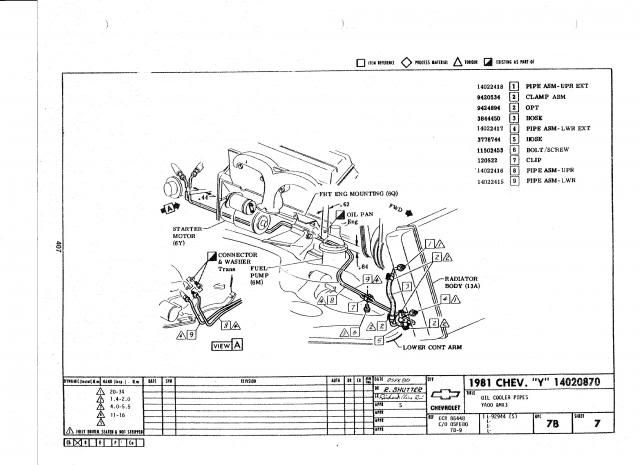
I was told on this 81 I have that the trans cooler lines mount directly to the radiator. Cannot find any inlets for hard lines. There appears to be two bolts in the bottom tray where I have seen some coolers mounted. Is mine missing? OR, are there inlets I cannot find. Does someone have a pic or something to show how these cooler lines run?
Thx
Thx
Thread Starter
Racer
Joined: Oct 2013
Posts: 251
Likes: 0
From: SAN ANTONIO TX
Is there a trans cooler in the front of the radiator? I didnt take this car apart so I dont know. sry. I've seen the coolers in pics mounted in front of the radiator but read an article where the lines connect directly to radiator. Is that true? If not, then I have to buy a cooler. If I have to buy one, any suggestions?
THx
THx

Le Mans Master


Joined: Dec 2007
Posts: 6,422
Likes: 591
From: McHenry Illinois
The lines hook up to the right side radiator tank with short hard lines, then hose to the long hard lines to the trans.
http://www.zip-corvette.com/ProductD...GR-SR&CTitle=&
http://www.zip-corvette.com/ProductD...GR-SR&CTitle=&
Le Mans Master
Joined: Mar 2008
Posts: 5,948
Likes: 72
From: Oxford MA-----You just lost the game!!!!
If you're going to run an external cooler, the best way to do it is to route the transmission fluid through the internal cooler in the radiator, then to the external cooler in front of the radiator, and finally, back to the transmission.
Scott
Scott

Team Owner


Joined: Jun 2000
Posts: 38,923
Likes: 1,482
From: Southbound
Cruise-In II Veteran
None of us know what Bubba may have left you.
In one of your earlier posts, I believe you mentioned ordering the AIM. Has it arrived?


Race Director

Joined: Apr 2009
Posts: 19,294
Likes: 2,754
From: Charlotte NC
I do not know if you want to look into this method of routing the line further...but...I have been told by a reputable transmission manufacturer ( along with others ) that IF an external cooler it to be installed. The lines go from the transmission into the external cooler first...then into the cooler in the radiator...then back to the transmission. AND that the cooler used needs to be one that looks like a mini radiator...and not the type that has the line in the cooler going back and forth in a "S" pattern several times.
I am doing a conversion on a 1974 with a 700R4...and "BOWTIE OVERDRIVES" clearly states the routing pattern of the cooler lines...and also installing a temp gauge.
Everybody has "their way" of doing things...but I often follow what the supplier states so I do not run into an issue which can effect a warranty claim....or a issues in the transmissions performance.
DUB
Corvette Stories
The Best of Corvette for Corvette Enthusiasts

Top 10 Most Expensive Corvettes Ever Sold on Bring A Trailer
Brett Foote
10 Things Every Corvette Owner Needs (2026 Edition)
Michael S. Palmer
8 Most "Only Corvette Owners Understand" Quirks and Problems
Pouria Savadkouei
10 Reasons the C6 Z06 is Still A Performance Benchmark After 20 Years
Joe Kucinski
How Much Horsepower Every Corvette Engine "LOST" in 1972
Joe Kucinski
Top 10 DOs and DON'Ts for Protecting Your Convertible Top!
Michael S. Palmer
Top 10 Most Explosive Corvettes Ever Made: Power-to-Weight Ratio Ranked!
Joe Kucinski
150 hp to 1,250 hp: Every Corvette Generation Compared by the Specs That Matter
Joe Kucinski
8 Coolest Corvette Pace Cars (and Replicas) of All Time
Verdad Gallardo
Le Mans Master
Joined: Oct 2007
Posts: 7,453
Likes: 976
From: RI, Now Franklin/Nashville TN
NOT MY OPINION: This comes from the source.
I do not know if you want to look into this method of routing the line further...but...I have been told by a reputable transmission manufacturer ( along with others ) that IF an external cooler it to be installed. The lines go from the transmission into the external cooler first...then into the cooler in the radiator...then back to the transmission. AND that the cooler used needs to be one that looks like a mini radiator...and not the type that has the line in the cooler going back and forth in a "S" pattern several times.
I am doing a conversion on a 1974 with a 700R4...and "BOWTIE OVERDRIVES" clearly states the routing pattern of the cooler lines...and also installing a temp gauge.
Everybody has "their way" of doing things...but I often follow what the supplier states so I do not run into an issue which can effect a warranty claim....or a issues in the transmissions performance.
DUB
I do not know if you want to look into this method of routing the line further...but...I have been told by a reputable transmission manufacturer ( along with others ) that IF an external cooler it to be installed. The lines go from the transmission into the external cooler first...then into the cooler in the radiator...then back to the transmission. AND that the cooler used needs to be one that looks like a mini radiator...and not the type that has the line in the cooler going back and forth in a "S" pattern several times.
I am doing a conversion on a 1974 with a 700R4...and "BOWTIE OVERDRIVES" clearly states the routing pattern of the cooler lines...and also installing a temp gauge.
Everybody has "their way" of doing things...but I often follow what the supplier states so I do not run into an issue which can effect a warranty claim....or a issues in the transmissions performance.
DUB
http://inet.derale.com/clientdocs/1_213.pdf
A little physics here and some basic longevity rules for transmissions:
The number 1 enemy of any transmission is HEAT. By running the trans fluid into the cooler first and THEN through the factory trans radiator cooler, you are defeating the purpose of the external trans cooler by lower the transmission fluid temp and then raising the fluid in the radiator before it returns to the transmission. The radiator transmission cooler can NEVER be less than the coolant temp in the radiator. If the coolant temp is say 180 degrees, then the trans fluid will never be less than 180 degrees, regardless of what the external cooler lowers the trans fluid temp BEFORE it enters the radiator. The preferred method of the external cooler manufacturers is to have the trans fluid go through the radiator FIRST and then leave the radiator and enter the external cooler for optimum results.
With that said, I prefer to have the trans fluid 100% cooled by the external cooler (S) outside of the radiator cooler ( I totally by pass the radiator for reasons stated above) as detailed in the link above, as an alternative method. Why? I don't want the starting point fluid temp for the external cooler to be so high-looking for maximum cooling although air to air coolers are not the most efficient way to cool fluid.
Real world experience:
I have been using exclusively air cooled trans fluid by external coolers since 1978. This method is ideal for cars like the C3 with mechanical fans always pulling air over the coolers. Examples:
1. 1973 Nova SS with Turbo 350 using 2 tube and fin coolers (no double stack coolers back then) installed in 1978. Beat the crap out of that tranny and drove it 100% all year round in very hot weather and freezing temps down to 0 degrees. No issues. Trans running perfectly when I sold the car in 1990 with 168,000 miles on the tranny.
2. 2001 Pontiac GP driven today as DD with 150,000 miles on the crap 4T65E FWD tranny with 2 Long Double Stack 18,000 GVW coolers cooled outside of the radiator driven year round in the weather described above with ELECTRIC fans that rarely run in cold temps. 100,000 miles with the coolers installed. Perfect. Average trans fluid temp-120-125 degrees
3. 1994 Mustang GT Convertible with 2 Long coolers (24,000 GVW and 18,000 GVW coolers) with ELECTRIC fans. Driven in 3 seasons, NOT the winter. Transgo shift kit installed by me in the crap AODE auto. Perfect.
Average trans fluid temp-135-150 degrees.
4. 2008 Chrysler 300. About to install a Long 28,000 GVW cooler. This car is interesting! Chrysler aka Mercedes does NOT use the radiator for trans fluid cooling but instead cools the trans fluid from the factory by using the lower portion of the AC condenser as an air to air external cooler like I have been doing for 35 years!! This car also has ELECTRIC fans that rarely operate in cool weather. Validates my method above.
The only downside to running external coolers outside of the radiator in VERY cold weather is that the fluid takes longer to heat up than if the radiator was used in conjunction with the external coolers. I don't expect any issues with the Chrysler since this method is NOT used by the factory BUT in the GP, when the temp is below 20 degrees, it takes about 3 miles of driving before the trans will shift into overdrive when the temp is below 20 degrees (GM programs these transmissions to not operate in 4th gear-overdrive-until the trans fluid is 88 degrees). I am willing to live with that trade off for maximum trans fluid reduction with the external coolers.
Hope this helps!
Last edited by jb78L-82; Oct 28, 2013 at 07:32 AM.
Melting Slicks

Joined: Dec 2009
Posts: 3,233
Likes: 657
From: Thunder Bay
I have seen a number of vehicles that have had replacement transmissions installed by 'professional' shops where they have bypassed the trans cooler lines in the radiator in favor of an externally mounted cooler. Their logic is that when a transmission fails it can leave debris in the lines that can compromise the new transmission. Obviously the right way to do it is to flush the lines when installing the new trans, but this may be why the OP's lines aren't connected.

2026 Loser of the Year


Joined: Sep 2013
Posts: 36,597
Likes: 7,046
From: New Or-leens Loo-z-anna
J & P Cycles (motorcyoe parts) sells a thermostatic bypass valve that goes in-line before the fluid goes into the external cooler.
The bypass valve allows the fluid to be diverted BEFORE entering the cooling tubes....then, back to the transmission....until the fluid reaches operating temperature.....once operating temp is reached, the bypass valve allows the fluid to go thru the external cooler.
The bypass valve also diverts the fluid back to the transmission befor it goes into the cooling tubes in very cold weather....then when the fluid warms up.....it is allows the fluid to go thru the cooling tubes again....then back to the transmission.
If I lived in an area that had cold winters, I would allow the fluid to go thru the radiator transmission-fluid tank and the external cooler to keep the fluid at operating temperature...but in Louisiana, cold is not a problem, so we bypass the radiator transmission-fluid tank completely (and cap off the fittings to the radiator tank).
The bypass valve allows the fluid to be diverted BEFORE entering the cooling tubes....then, back to the transmission....until the fluid reaches operating temperature.....once operating temp is reached, the bypass valve allows the fluid to go thru the external cooler.
The bypass valve also diverts the fluid back to the transmission befor it goes into the cooling tubes in very cold weather....then when the fluid warms up.....it is allows the fluid to go thru the cooling tubes again....then back to the transmission.
If I lived in an area that had cold winters, I would allow the fluid to go thru the radiator transmission-fluid tank and the external cooler to keep the fluid at operating temperature...but in Louisiana, cold is not a problem, so we bypass the radiator transmission-fluid tank completely (and cap off the fittings to the radiator tank).
Le Mans Master
Joined: Oct 2007
Posts: 7,453
Likes: 976
From: RI, Now Franklin/Nashville TN
J & P Cycles (motorcyoe parts) sells a thermostatic bypass valve that goes in-line before the fluid goes into the external cooler.
The bypass valve allows the fluid to be diverted BEFORE entering the cooling tubes....then, back to the transmission....until the fluid reaches operating temperature.....once operating temp is reached, the bypass valve allows the fluid to go thru the external cooler.
The bypass valve also diverts the fluid back to the transmission befor it goes into the cooling tubes in very cold weather....then when the fluid warms up.....it is allows the fluid to go thru the cooling tubes again....then back to the transmission.
If I lived in an area that had cold winters, I would allow the fluid to go thru the radiator transmission-fluid tank and the external cooler to keep the fluid at operating temperature...but in Louisiana, cold is not a problem, so we bypass the radiator transmission-fluid tank completely (and cap off the fittings to the radiator tank).
The bypass valve allows the fluid to be diverted BEFORE entering the cooling tubes....then, back to the transmission....until the fluid reaches operating temperature.....once operating temp is reached, the bypass valve allows the fluid to go thru the external cooler.
The bypass valve also diverts the fluid back to the transmission befor it goes into the cooling tubes in very cold weather....then when the fluid warms up.....it is allows the fluid to go thru the cooling tubes again....then back to the transmission.
If I lived in an area that had cold winters, I would allow the fluid to go thru the radiator transmission-fluid tank and the external cooler to keep the fluid at operating temperature...but in Louisiana, cold is not a problem, so we bypass the radiator transmission-fluid tank completely (and cap off the fittings to the radiator tank).
"When automatic transmission fluid (ATF) is cold it is viscous. The unique Tru -Cool design allows the colder, thicker ATF to flow more efficiently through two open by pass channels positioned at the top of the cooler. As operating temperatures increase, the ATF becomes hotter and thinner. It is then directed through the core where it is cooled"
Another words the Long coolers I use are self regulating according to the temperature of the fluid which is one of the reasons I have no issues using their coolers year round, even in VERY cold temperatures.
Hope that helps!
Le Mans Master
Joined: Mar 2008
Posts: 5,948
Likes: 72
From: Oxford MA-----You just lost the game!!!!
Can't say much about your source BUT running the trans fluid into the radiator cooler AFETR the external trans cooler is NOT the preferred method by the 2 most respected manufacturers of OEM factory installed transmission coolers-Derale and Long (aka Dana Corporation who incidentally is the OEM supplier for 9 out of 10 car manufacturers that install factory external coolers in cars). See below:
http://inet.derale.com/clientdocs/1_213.pdf
A little physics here and some basic longevity rules for transmissions:
The number 1 enemy of any transmission is HEAT. By running the trans fluid into the cooler first and THEN through the factory trans radiator cooler, you are defeating the purpose of the external trans cooler by lower the transmission fluid temp and then raising the fluid in the radiator before it returns to the transmission. The radiator transmission cooler can NEVER be less than the coolant temp in the radiator. If the coolant temp is say 180 degrees, then the trans fluid will never be less than 180 degrees, regardless of what the external cooler lowers the trans fluid temp BEFORE it enters the radiator. The preferred method of the external cooler manufacturers is to have the trans fluid go through the radiator FIRST and then leave the radiator and enter the external cooler for optimum results.
With that said, I prefer to have the trans fluid 100% cooled by the external cooler (S) outside of the radiator cooler ( I totally by pass the radiator for reasons stated above) as detailed in the link above, as an alternative method. Why? I don't want the starting point fluid temp for the external cooler to be so high-looking for maximum cooling although air to air coolers are not the most efficient way to cool fluid.
Real world experience:
I have been using exclusively air cooled trans fluid by external coolers since 1978. This method is ideal for cars like the C3 with mechanical fans always pulling air over the coolers. Examples:
1. 1973 Nova SS with Turbo 350 using 2 tube and fin coolers (no double stack coolers back then) installed in 1978. Beat the crap out of that tranny and drove it 100% all year round in very hot weather and freezing temps down to 0 degrees. No issues. Trans running perfectly when I sold the car in 1990 with 168,000 miles on the tranny.
2. 2001 Pontiac GP driven today as DD with 150,000 miles on the crap 4T65E FWD tranny with 2 Long Double Stack 18,000 GVW coolers cooled outside of the radiator driven year round in the weather described above with ELECTRIC fans that rarely run in cold temps. 100,000 miles with the coolers installed. Perfect. Average trans fluid temp-120-125 degrees
3. 1994 Mustang GT Convertible with 2 Long coolers (24,000 GVW and 18,000 GVW coolers) with ELECTRIC fans. Driven in 3 seasons, NOT the winter. Transgo shift kit installed by me in the crap AODE auto. Perfect.
Average trans fluid temp-135-150 degrees.
4. 2008 Chrysler 300. About to install a Long 28,000 GVW cooler. This car is interesting! Chrysler aka Mercedes does NOT use the radiator for trans fluid cooling but instead cools the trans fluid from the factory by using the lower portion of the AC condenser as an air to air external cooler like I have been doing for 35 years!! This car also has ELECTRIC fans that rarely operate in cool weather. Validates my method above.
The only downside to running external coolers outside of the radiator in VERY cold weather is that the fluid takes longer to heat up than if the radiator was used in conjunction with the external coolers. I don't expect any issues with the Chrysler since this method is NOT used by the factory BUT in the GP, when the temp is below 20 degrees, it takes about 3 miles of driving before the trans will shift into overdrive when the temp is below 20 degrees (GM programs these transmissions to not operate in 4th gear-overdrive-until the trans fluid is 88 degrees). I am willing to live with that trade off for maximum trans fluid reduction with the external coolers.
Hope this helps!
http://inet.derale.com/clientdocs/1_213.pdf
A little physics here and some basic longevity rules for transmissions:
The number 1 enemy of any transmission is HEAT. By running the trans fluid into the cooler first and THEN through the factory trans radiator cooler, you are defeating the purpose of the external trans cooler by lower the transmission fluid temp and then raising the fluid in the radiator before it returns to the transmission. The radiator transmission cooler can NEVER be less than the coolant temp in the radiator. If the coolant temp is say 180 degrees, then the trans fluid will never be less than 180 degrees, regardless of what the external cooler lowers the trans fluid temp BEFORE it enters the radiator. The preferred method of the external cooler manufacturers is to have the trans fluid go through the radiator FIRST and then leave the radiator and enter the external cooler for optimum results.
With that said, I prefer to have the trans fluid 100% cooled by the external cooler (S) outside of the radiator cooler ( I totally by pass the radiator for reasons stated above) as detailed in the link above, as an alternative method. Why? I don't want the starting point fluid temp for the external cooler to be so high-looking for maximum cooling although air to air coolers are not the most efficient way to cool fluid.
Real world experience:
I have been using exclusively air cooled trans fluid by external coolers since 1978. This method is ideal for cars like the C3 with mechanical fans always pulling air over the coolers. Examples:
1. 1973 Nova SS with Turbo 350 using 2 tube and fin coolers (no double stack coolers back then) installed in 1978. Beat the crap out of that tranny and drove it 100% all year round in very hot weather and freezing temps down to 0 degrees. No issues. Trans running perfectly when I sold the car in 1990 with 168,000 miles on the tranny.
2. 2001 Pontiac GP driven today as DD with 150,000 miles on the crap 4T65E FWD tranny with 2 Long Double Stack 18,000 GVW coolers cooled outside of the radiator driven year round in the weather described above with ELECTRIC fans that rarely run in cold temps. 100,000 miles with the coolers installed. Perfect. Average trans fluid temp-120-125 degrees
3. 1994 Mustang GT Convertible with 2 Long coolers (24,000 GVW and 18,000 GVW coolers) with ELECTRIC fans. Driven in 3 seasons, NOT the winter. Transgo shift kit installed by me in the crap AODE auto. Perfect.
Average trans fluid temp-135-150 degrees.
4. 2008 Chrysler 300. About to install a Long 28,000 GVW cooler. This car is interesting! Chrysler aka Mercedes does NOT use the radiator for trans fluid cooling but instead cools the trans fluid from the factory by using the lower portion of the AC condenser as an air to air external cooler like I have been doing for 35 years!! This car also has ELECTRIC fans that rarely operate in cool weather. Validates my method above.
The only downside to running external coolers outside of the radiator in VERY cold weather is that the fluid takes longer to heat up than if the radiator was used in conjunction with the external coolers. I don't expect any issues with the Chrysler since this method is NOT used by the factory BUT in the GP, when the temp is below 20 degrees, it takes about 3 miles of driving before the trans will shift into overdrive when the temp is below 20 degrees (GM programs these transmissions to not operate in 4th gear-overdrive-until the trans fluid is 88 degrees). I am willing to live with that trade off for maximum trans fluid reduction with the external coolers.
Hope this helps!
Scott
Le Mans Master
Joined: Oct 2007
Posts: 7,453
Likes: 976
From: RI, Now Franklin/Nashville TN
The coolant on the side of the radiator that contains the transmission cooler has been pumped through the radiator and cooled somewhat. The transmission cooler does not see normal operating temperature engine coolant. Just a little something that may seem obvious, but many people don't consider.
Scott
Scott
That is true but on engines that run abnormally high coolant temps in VERY hot weather, the radiator trans cooler often cannot bring the ATF fluid temp down low enough-less than 200 degrees, which is still very marginal-to really keep the ATF temp in a safe operating temperature.

Team Owner
Joined: Oct 2004
Posts: 81,241
Likes: 3,063
From: altered state
St. Jude Donor '05
Used to run a loose 2800 stall in another GM car I had, ran it through the rad. first then the cooler
When Id go up inclines or hard on it the coolant would start heating from the converter slipping and making heat.
Bypassed the radiator ran it through the cooler only problem solved.
When Id go up inclines or hard on it the coolant would start heating from the converter slipping and making heat.
Bypassed the radiator ran it through the cooler only problem solved.
Le Mans Master
Joined: Apr 2011
Posts: 6,284
Likes: 1,171
From: Hermosa
Used to run a loose 2800 stall in another GM car I had, ran it through the rad. first then the cooler
When Id go up inclines or hard on it the coolant would start heating from the converter slipping and making heat.
Bypassed the radiator ran it through the cooler only problem solved.
Today 10:11 AM
When Id go up inclines or hard on it the coolant would start heating from the converter slipping and making heat.
Bypassed the radiator ran it through the cooler only problem solved.
Today 10:11 AM
If a guy has a stellar radiator/fan set up and a cool running engine maybe that would keep trans fluid cooler than just air to fluid trans cooler alone?
Le Mans Master
Joined: Oct 2007
Posts: 7,453
Likes: 976
From: RI, Now Franklin/Nashville TN
Used to run a loose 2800 stall in another GM car I had, ran it through the rad. first then the cooler
When Id go up inclines or hard on it the coolant would start heating from the converter slipping and making heat.
Bypassed the radiator ran it through the cooler only problem solved.
When Id go up inclines or hard on it the coolant would start heating from the converter slipping and making heat.
Bypassed the radiator ran it through the cooler only problem solved.
Race Director
Joined: Apr 2009
Posts: 19,294
Likes: 2,754
From: Charlotte NC
WELL, WELL, WELL,
I MUST make a sincere APOLOGY.
AFTER making a call...I WAS WRONG and misunderstood the CORRECT flow routing when an external cooler is being installed.
SO...To all of those individuals that may have taken my post to heart. I am here to SINCERELY APOLOGIZE. And I STAND CORRECTED.
I do not like the taste of "CROW"...but I can admit when I am WRONG and once again...I apologize.
And for what it is worth. The routing of lines and external cooler did not seem to make sense when I heard it the first time...so I am glad I commented incorrectly..BECAUSE if I did not double check and absorb the above posts that were written...I could have made a BIG MISTAKE...and IF I allowed my EGO to get in the way...I would not have gained KNOWLEDGE.
SIMPLY HUMBLING!!!!
DUB
I MUST make a sincere APOLOGY.
AFTER making a call...I WAS WRONG and misunderstood the CORRECT flow routing when an external cooler is being installed.
SO...To all of those individuals that may have taken my post to heart. I am here to SINCERELY APOLOGIZE. And I STAND CORRECTED.
I do not like the taste of "CROW"...but I can admit when I am WRONG and once again...I apologize.
And for what it is worth. The routing of lines and external cooler did not seem to make sense when I heard it the first time...so I am glad I commented incorrectly..BECAUSE if I did not double check and absorb the above posts that were written...I could have made a BIG MISTAKE...and IF I allowed my EGO to get in the way...I would not have gained KNOWLEDGE.
SIMPLY HUMBLING!!!!
DUB
Le Mans Master
Joined: Oct 2007
Posts: 7,453
Likes: 976
From: RI, Now Franklin/Nashville TN
WELL, WELL, WELL,
I MUST make a sincere APOLOGY.
AFTER making a call...I WAS WRONG and misunderstood the CORRECT flow routing when an external cooler is being installed.
SO...To all of those individuals that may have taken my post to heart. I am here to SINCERELY APOLOGIZE. And I STAND CORRECTED.
I do not like the taste of "CROW"...but I can admit when I am WRONG and once again...I apologize.
And for what it is worth. The routing of lines and external cooler did not seem to make sense when I heard it the first time...so I am glad I commented incorrectly..BECAUSE if I did not double check and absorb the above posts that were written...I could have made a BIG MISTAKE...and IF I allowed my EGO to get in the way...I would not have gained KNOWLEDGE.
SIMPLY HUMBLING!!!!
DUB
I MUST make a sincere APOLOGY.
AFTER making a call...I WAS WRONG and misunderstood the CORRECT flow routing when an external cooler is being installed.
SO...To all of those individuals that may have taken my post to heart. I am here to SINCERELY APOLOGIZE. And I STAND CORRECTED.
I do not like the taste of "CROW"...but I can admit when I am WRONG and once again...I apologize.
And for what it is worth. The routing of lines and external cooler did not seem to make sense when I heard it the first time...so I am glad I commented incorrectly..BECAUSE if I did not double check and absorb the above posts that were written...I could have made a BIG MISTAKE...and IF I allowed my EGO to get in the way...I would not have gained KNOWLEDGE.
SIMPLY HUMBLING!!!!
DUB
No worries!!! That is what the forum is for-sharing information. We all have made mistakes and you are right, it is simply a humbling experience. Believe me I have made a few as well. All the best