





intake valve closing angle question

Thread Starter
Racer


Joined: Jan 2009
Posts: 261
Likes: 1
From: frederick maryland
 intake valve closing angle question
hey everyone, im trying to get a beginners understanding of cam selection, DCR etc.
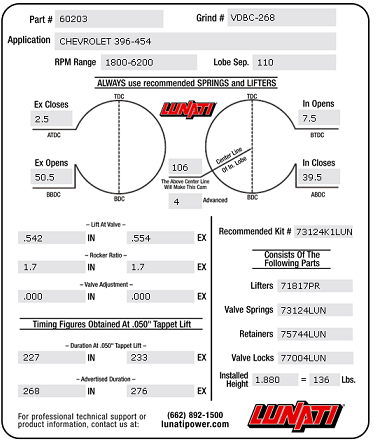
my hangup is the intake valve closing angle. if i use the Lunati 60203 as an example, the card shows 39.5 deg.
if i use the formula here:
http://forums.corvetteforum.com/c3-t...lculation.html
(268/2)+110-4-180=60
i come up w 60deg. the various DCR calculators ive used also figure the closing point or this cam at 60 deg ABDC.
what am i missing? is the cam card spec something else entirely?
thx!
lear
my hangup is the intake valve closing angle. if i use the Lunati 60203 as an example, the card shows 39.5 deg.
if i use the formula here:
http://forums.corvetteforum.com/c3-t...lculation.html
(268/2)+110-4-180=60
i come up w 60deg. the various DCR calculators ive used also figure the closing point or this cam at 60 deg ABDC.
what am i missing? is the cam card spec something else entirely?

thx!
lear
Thread Starter
Racer
Joined: Jan 2009
Posts: 261
Likes: 1
From: frederick maryland
To figure this you take the advertised intake duration and divide by 2. 268/2=134
Then you add the LSA to this number. 110=134=244
Then you subtract out the ground in advance. 244-4=240
Then you subtract 180 240-180= 60
i never entered any .050 figures in the formula...227I/233E
please elaborate
thx!
Then you add the LSA to this number. 110=134=244
Then you subtract out the ground in advance. 244-4=240
Then you subtract 180 240-180= 60
i never entered any .050 figures in the formula...227I/233E
please elaborate
thx!
Thread Starter
Racer
Joined: Jan 2009
Posts: 261
Likes: 1
From: frederick maryland
dang, thx guys...i thought i saw somewhere 'not' to use the numbers at .050
but the math sure adds up now
nother question then if i may...
so the intake valve actually opens and closes at the .050 numbers? if so why the larger 'advertised duration'?
thx again!
but the math sure adds up now
nother question then if i may...
so the intake valve actually opens and closes at the .050 numbers? if so why the larger 'advertised duration'?
thx again!
Race Director


Joined: Sep 1999
Posts: 11,361
Likes: 383
From: Plano TX
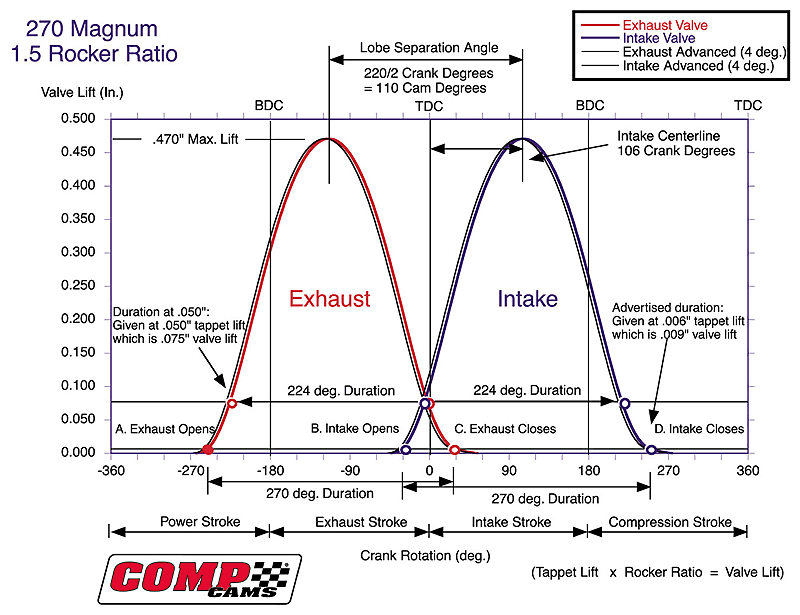
At 39.5 dgr ABDC the valve is closing, but still 0.050" tappet (or 0.075" at the valve w/ 1.5:1 rockers) off the seat. So not completely closed yet.
The valves close slowly, otherwise they would bounce off the seats and damage them. It gets very fuzzy to determine the exact point the valve is really closed, so all cam companies pick a point right before that as the "advertised duration". Problem was some cams were rated at 0.004" lift, some used 0.006". Hard to compare... so a long time ago all the cam companies agreed on the "duration at 0.050" lift" as the standard way to compare cams.
The idea was that the amount of air a valve flows between the point it is open 0.050" and fully closed is so small as not being terribly important.
The valves close slowly, otherwise they would bounce off the seats and damage them. It gets very fuzzy to determine the exact point the valve is really closed, so all cam companies pick a point right before that as the "advertised duration". Problem was some cams were rated at 0.004" lift, some used 0.006". Hard to compare... so a long time ago all the cam companies agreed on the "duration at 0.050" lift" as the standard way to compare cams.
The idea was that the amount of air a valve flows between the point it is open 0.050" and fully closed is so small as not being terribly important.
Last edited by zwede; Jan 1, 2014 at 01:12 PM.

Race Director


Joined: May 2005
Posts: 10,674
Likes: 122
From: Millington Illinois
St. Jude Donor '08-'09
http://forums.corvetteforum.com/c3-t...lculation.html
The .050 duration numbers have no bearing on DCR calculation. Your looking for the actual intake closing point in degrees. The formula I posted assumes a symmetrical lobe design. Most are, some aren't, difference is minor but I always err to 7.7 DCR with Iron heads and 8.2 with aluminum. This gets you a safety margin and might let you run midgrade or even regular with additional tuning. I am reposting my thread for those who are planning their winter builds.

Race Director
Joined: Sep 1999
Posts: 11,361
Likes: 383
From: Plano TX
I always found this diagram to be very helpful. It shows how the intake and exhaust valves move in relation to the crank turning. Notice how the curve flattens right at zero lift. This is what's called the "ramp" and ensures the valves move very slowly when opening and closing.
Corvette Stories
The Best of Corvette for Corvette Enthusiasts

Top 10 Most Expensive Corvettes Ever Sold on Bring A Trailer
Brett Foote
10 Things Every Corvette Owner Needs (2026 Edition)
Michael S. Palmer
8 Most "Only Corvette Owners Understand" Quirks and Problems
Pouria Savadkouei
10 Reasons the C6 Z06 is Still A Performance Benchmark After 20 Years
Joe Kucinski
How Much Horsepower Every Corvette Engine "LOST" in 1972
Joe Kucinski
Top 10 DOs and DON'Ts for Protecting Your Convertible Top!
Michael S. Palmer
Top 10 Most Explosive Corvettes Ever Made: Power-to-Weight Ratio Ranked!
Joe Kucinski
150 hp to 1,250 hp: Every Corvette Generation Compared by the Specs That Matter
Joe Kucinski
8 Coolest Corvette Pace Cars (and Replicas) of All Time
Verdad Gallardo
Le Mans Master

Joined: Oct 2002
Posts: 7,098
Likes: 378
From: Las Vegas - Just stop perpetuating myths please.
Yes as zwede mentioned the industry went to the 0.050" lift for comparisons as the stock cams - like GM - have tremendously long ramps when compared to the aftermarket cams will higher "intensity" ramps. Long ramps means long vlv train/cam life. A lot of GM cams have huge full duration numbers while the actual duration at 0.050" - which the industry considers giving the cam its actual character/performance - is more like a small cam. This allows easier comparisons when shopping for a cam.
But for DCR calcs the full duration is used as the charge volume is actually moving in a significant amount to call a vlv open (or closed) which sets the point where flow actually stops and the charge is trapped for compression/fuel detonation calculations.
There are still some issues with the full duration numbers as different cam companies use different lift numbers for full duration - just for ex 0.006", 0.005", 0.008", 0.010", 0.002."
Also any engines volumetric efficiency will have an effect on the amount of charge that enters the cyl and become more or less prone to detonation. And my guess is some engine lab somewhere has empirical data to use for this but i wont lose sleep over it and hope no else does either.
Myself i have never used a DCR calc as just from my reading of D. Vizard an engines DCR - for street driven cars - becomes important more for cams of fairly large duration - greater than 280 degrees full duration.
Less than that duration good old thumb rules can be used:
- for iron headed engines, keep static compression below 9.5 (9.5 with good quench)
- for aluminum headed engines, keep s.c.r. below 10.5 (10.5 with good quench)
This is more realistic as most of us on moderate eng budgets have a limited choice on pistons and cyl heads for c.r. choices.
But yes if someone is building a hi comp performance eng with large duration (wants to make big hp) then DCR calc are definitely needed.
learje, for your planned 9.5 c.r. build (i read your other post) that lunati cam is a good choice (and so are plenty of other on the shelf cams) - but you will need good cyl quench. But u are right on the edge of the s.c.r. limit and the shorter the duration the more so. If you do go s.c.r. >9.5 you will need a DCR calc. Myself while the eng is out of car i would get a calibrated cyl (ml) and piece of plexiglass and measure my above the piston volume at TDC. Then measure head chamber vol also nearly same way. That way u can nail your s.c.r. to make accurate cam choices.
Hope this helps more than it hurts,
cardo0
But for DCR calcs the full duration is used as the charge volume is actually moving in a significant amount to call a vlv open (or closed) which sets the point where flow actually stops and the charge is trapped for compression/fuel detonation calculations.
There are still some issues with the full duration numbers as different cam companies use different lift numbers for full duration - just for ex 0.006", 0.005", 0.008", 0.010", 0.002."
Also any engines volumetric efficiency will have an effect on the amount of charge that enters the cyl and become more or less prone to detonation. And my guess is some engine lab somewhere has empirical data to use for this but i wont lose sleep over it and hope no else does either.
Myself i have never used a DCR calc as just from my reading of D. Vizard an engines DCR - for street driven cars - becomes important more for cams of fairly large duration - greater than 280 degrees full duration.
Less than that duration good old thumb rules can be used:
- for iron headed engines, keep static compression below 9.5 (9.5 with good quench)
- for aluminum headed engines, keep s.c.r. below 10.5 (10.5 with good quench)
This is more realistic as most of us on moderate eng budgets have a limited choice on pistons and cyl heads for c.r. choices.
But yes if someone is building a hi comp performance eng with large duration (wants to make big hp) then DCR calc are definitely needed.
learje, for your planned 9.5 c.r. build (i read your other post) that lunati cam is a good choice (and so are plenty of other on the shelf cams) - but you will need good cyl quench. But u are right on the edge of the s.c.r. limit and the shorter the duration the more so. If you do go s.c.r. >9.5 you will need a DCR calc. Myself while the eng is out of car i would get a calibrated cyl (ml) and piece of plexiglass and measure my above the piston volume at TDC. Then measure head chamber vol also nearly same way. That way u can nail your s.c.r. to make accurate cam choices.
Hope this helps more than it hurts,
cardo0
Race Director
Joined: May 2005
Posts: 10,674
Likes: 122
From: Millington Illinois
St. Jude Donor '08-'09
hey everyone, im trying to get a beginners understanding of cam selection, DCR etc.
my hangup is the intake valve closing angle. if i use the Lunati 60203 as an example, the card shows 39.5 deg.
if i use the formula here:
http://forums.corvetteforum.com/c3-t...lculation.html
(268/2)+110-4-180=60
i come up w 60deg. the various DCR calculators ive used also figure the closing point or this cam at 60 deg ABDC.
what am i missing? is the cam card spec something else entirely?
thx!
lear
my hangup is the intake valve closing angle. if i use the Lunati 60203 as an example, the card shows 39.5 deg.
if i use the formula here:
http://forums.corvetteforum.com/c3-t...lculation.html
(268/2)+110-4-180=60
i come up w 60deg. the various DCR calculators ive used also figure the closing point or this cam at 60 deg ABDC.
what am i missing? is the cam card spec something else entirely?
thx!
lear
Thread Starter
Racer
Joined: Jan 2009
Posts: 261
Likes: 1
From: frederick maryland
wow great stuff thx everyone!
i need to save this page as a pix so i can figure out that diagram etc...im headed out of the country for a couple days w no net access
full advertised duration for DCR, thats what i thought, didnt make sense any other way..7.7 DCR w iron heads, ill have to run my planned build again. was hopin ud chime in mako, thx..
what i 'know' atm is:
bore 4.155
stroke 3.76
deck height: the pistons vary from .009 to .015 in the hole, measured w a dial indicator and averaging piston rock, checked at both 6 and 12 o'clock w the indicator at the outer edge of the piston. measurements checked w feeler gauges and a straight edge.
gasket thickness/volume: planning a .039 felpro, 4.370 bore, 9.7cc gasket
what im assuming( and will measure, thx cardo)
head cc: 100 is my target, depends on the final set of heads i pick out and how much decking they need to clean up
piston dome: 13.8 (from my machinist's book)
my static cr on the lowest (.015 down) is 9.42 / .054 quench
highest .009 9.54 / .048
i could close the quench up a bit w a cometic gasket, but the finish on the block isnt near as nice as they recommend. no plans to pull this 402 down any further, so decking the block isnt really an option. if i need to get into the bottom end ill just slap my current heads back on and save my pennies for a 454
thx again everyone!
i need to save this page as a pix so i can figure out that diagram etc...im headed out of the country for a couple days w no net access
full advertised duration for DCR, thats what i thought, didnt make sense any other way..7.7 DCR w iron heads, ill have to run my planned build again. was hopin ud chime in mako, thx..
what i 'know' atm is:
bore 4.155
stroke 3.76
deck height: the pistons vary from .009 to .015 in the hole, measured w a dial indicator and averaging piston rock, checked at both 6 and 12 o'clock w the indicator at the outer edge of the piston. measurements checked w feeler gauges and a straight edge.
gasket thickness/volume: planning a .039 felpro, 4.370 bore, 9.7cc gasket
what im assuming( and will measure, thx cardo)
head cc: 100 is my target, depends on the final set of heads i pick out and how much decking they need to clean up
piston dome: 13.8 (from my machinist's book)
my static cr on the lowest (.015 down) is 9.42 / .054 quench
highest .009 9.54 / .048
i could close the quench up a bit w a cometic gasket, but the finish on the block isnt near as nice as they recommend. no plans to pull this 402 down any further, so decking the block isnt really an option. if i need to get into the bottom end ill just slap my current heads back on and save my pennies for a 454
thx again everyone!
Le Mans Master
Joined: Oct 2002
Posts: 7,098
Likes: 378
From: Las Vegas - Just stop perpetuating myths please.
I cant tell if your pistons stick above the deck on your block (pix in your other thread look like they do). If they do it will be difficult to measure using the liquid method. Those are good ole TRW forged pistons and good for performance. Had some in my '70 GTO and worked great - had some little piston slap while cold but quite once warmed up. But if u have the correct piston part numbers and dome numbers U will need them to crunch a s.c.r. from those mfr numbers - recognize that at 9.4 SCR u are on the edge of SCR for iron heads. With those pistons nothing wrong with running a larger cam so in that case the DCR calc may get u a cam to match your higher SCR. And the higher SCR would help your larger cam at the low end of RPM too.
I think u will find stock head volumes are conservatively larger than advertized and recommend u measure them yourself - it may save u headaches and some $$$ for different heads to. Also if your interested u can polish up the chambers and remeasure thier vol to look for another 1cc or 2cc in volume.
I had to add that you should see some quench even from the 0.054" quench. Quench starts at 0.060" and the more cubic inches means the more air volume seeing that squish 0.054" gap to help the mixture combust. U are pushing 408ci now. What im saying is save your $$$ from expensive custom head gaskets.
cardo0
I think u will find stock head volumes are conservatively larger than advertized and recommend u measure them yourself - it may save u headaches and some $$$ for different heads to. Also if your interested u can polish up the chambers and remeasure thier vol to look for another 1cc or 2cc in volume.
I had to add that you should see some quench even from the 0.054" quench. Quench starts at 0.060" and the more cubic inches means the more air volume seeing that squish 0.054" gap to help the mixture combust. U are pushing 408ci now. What im saying is save your $$$ from expensive custom head gaskets.
cardo0
Race Director
Joined: May 2005
Posts: 10,674
Likes: 122
From: Millington Illinois
St. Jude Donor '08-'09
L79, L46 and LT1 were all 11 to 1 compression with iron heads. I have seen all these run fine on pump gas. How? Big advertised duration numbers on the factory cams with slow ramps and late intake closing point. Modern cams profiles close much faster. Factory vortec L31 is 9.4 to 1 compression and only has a 191/196 duration @ .050 cam. Runs on regular fuel. How? The chamber design is very efficient and burns faster, this allows less timing and the A/f Ratio is computer controlled as is timing using knock sensors to dial it back when needed. If your @ 7.7 to 1 DCR your fine and with tight quench and conservative timing might be ok with midgrade or even regular fuel. 

1st Gear
Joined: Apr 2019
Posts: 1
Likes: 0
How would i adjust the equation to calculate for IVC at .053'' ? The Hammer calculator asks for that, and i only know how to find .05'' IVC. What do I need to change to find this? Cant anyone help? (yes ive already used the GoFastMath calculator successfully, but the Hammer can help me plug in for an efficiency graph to figure out if im gonna detonate at higher rpm on pump gas, and by how much I would have to retard the timing, if at all. Its a 12:1 static, 7.53:1 dynamic (massive cam - track queen - high rev launches) that used to run on 93 pump gas before the last machining job.That chart, I dont need help with, ironically enough. Its finding my event timing for .053'' IVC rather than .050''. Im either blind or this cam slip doesnt show it.
Also "ground in advance", I've heard that before and never understood what it ment. Timing advance?
Also "ground in advance", I've heard that before and never understood what it ment. Timing advance?