



New Wiring Engine & Chassis
Race Director


Joined: Apr 2007
Posts: 11,150
Likes: 890
From: South Western Ontario

I did similar to Gary on my Impala. I used an American Autowire 22 fuse panel and re-purposed some of the fuses for the EFI system. My dash wiring was easy. I used Dakota Digital so I wired the module under the dash and then it's just a cat5 plugged into the instrument panel.

Thread Starter
Instructor

Joined: Oct 2013
Posts: 222
Likes: 4
From: Cameron Park California
I did similar to Gary on my Impala. I used an American Autowire 22 fuse panel and re-purposed some of the fuses for the EFI system. My dash wiring was easy. I used Dakota Digital so I wired the module under the dash and then it's just a cat5 plugged into the instrument panel.
With the aftermarket wiring from what I have read the wires are all labeled so for example it's not guesswork when wiring the transmission safety switch, backup lights, etc.? Sounds like there is some potential to have to reuse some of the OEM wire connectors but other than that?
Thanks!
Le Mans Master


Joined: May 2003
Posts: 8,876
Likes: 3,556
From: Fernandina Beach FL
2023 Restomod of the Year finalist
2020 C3 of the Year Winner - Modified
Since I was adding electric fans, stereo, Vintage Air, electric wiper door, etc to my LSx swap, I went with an aftermarket generic fuse panel with a lot more circuits mounted behind the passenger dash panel. If you have the whole dash out, might as well rewire. My old harness was rough, hacked up, and brittle. Easy choice.
You can also make it modular for the console and dash pad.Molex connectors under the dash, weatherpack under the hood.
Btw, I was able to wire in the original ammeter by trying different resistors.
Pic of fuse panel and relays. I cleaned it up quite a bit from this pic.

You can also make it modular for the console and dash pad.Molex connectors under the dash, weatherpack under the hood.
Btw, I was able to wire in the original ammeter by trying different resistors.
Pic of fuse panel and relays. I cleaned it up quite a bit from this pic.

NICE---Now that's how it should LOOK!!!!
I've been looking for a modular/stackable-flexible-relatively inexpensive piece to use for add on circuits. I have seen a lot of fuse blocks but most have limitations unless you want to spend several hundred dollars.
Here's what I found- however only suppliers I found were in the UK
It stackable- totally flexible-looks OEM. You can wire the fuses before or after the relay or both -any combination. AND w/ shipping socket including terminals- I'm getting them for about $6 each!!! Just add wire- relays and fuses.
Richard


Melting Slicks


Joined: Sep 2004
Posts: 2,655
Likes: 19
Also check out these guys. They've got some unique pieces and great prices.
http://www.haywireinc.com/
http://www.haywireinc.com/
Race Director
Joined: Apr 2007
Posts: 11,150
Likes: 890
From: South Western Ontario
I was wondering about what is involved with wiring the Dakota Digital box vs. just wiring some Auotmeter gauges?
With the aftermarket wiring from what I have read the wires are all labeled so for example it's not guesswork when wiring the transmission safety switch, backup lights, etc.? Sounds like there is some potential to have to reuse some of the OEM wire connectors but other than that?
Thanks!
With the aftermarket wiring from what I have read the wires are all labeled so for example it's not guesswork when wiring the transmission safety switch, backup lights, etc.? Sounds like there is some potential to have to reuse some of the OEM wire connectors but other than that?
Thanks!
I did a mix of re-using the OEM connectors and replacing with new. The harness is missing some wires like the reverse lights and no interior light harness, just enough wire to tie into the existing stuff. Mine is a ragtop so I bought the AAW under dash light kit and new door pin switches too. It had enough extra fuses to power the EFI and such directly. You can't use as many fuses as stock though, for example all my injectors are on a single fuse instead of 2 like the factory uses. My O2 heaters and transmission are all on another fuse instead of 3 separate ones.
Here is a site detailing the OEM connectors with some sources.
http://www.rowand.net/shop/Tech/Auto...Connectors.htm
Here are cool indicator strips for other types of gauge panels.
http://www.newvintageusa.com/panels.html
Even NAPA can get the different Packard terminals but you might not like the min quantities.
Last edited by lionelhutz; Jan 22, 2014 at 06:05 PM.
Burning Brakes

Joined: Oct 2008
Posts: 1,037
Likes: 14
From: Mobile Alabama
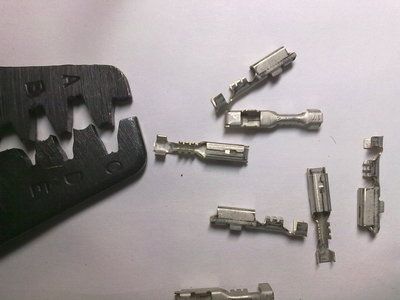
Well most of the time I like to make it hard, and do as much as possible myself. I use factory fuse-boxes (salvage yard), empty them, and use new terminals. You can terminate your existing wire, use some of the wire that came with the box, or use new wire. I just don't like too many splices. For a sub panel, I like the semi-weatherproof GM under hood truck boxes with a cover. You can even printout and laminate a fuse diagram and glue it in the cover. For the main panel a later model with the firewall connector.
I can do a box for ~$25.00, and it is the way I like it.
Here is one place I used for terminals.
http://stores.ebay.com/pcsconnectors/

I can do a box for ~$25.00, and it is the way I like it.
Here is one place I used for terminals.
http://stores.ebay.com/pcsconnectors/
Last edited by 74modified; Jan 22, 2014 at 08:32 PM.
Thread Starter
Instructor
Joined: Oct 2013
Posts: 222
Likes: 4
From: Cameron Park California
As always you guys are great with information and ideas! I am going to call Ron Francis Wiring again tomorrow and ask about a custom Express or 7x24 series harness. Some things on my list are:
- Accommodate new gauges - Dakota Digital sounds better and better
- wiring for headlight motors
- wiring for headlight relay for brighter lights
- wiring to handle LED running / backup lights / turn signals
- Voltmeter vs. Ammeter
- 6 gauge alternator to starter /firewall junction
- I will ask about interior lights
- see what advice / recommendations they have
Thread Starter
Instructor
Joined: Oct 2013
Posts: 222
Likes: 4
From: Cameron Park California
Harness Removed.
I spent a couple of hours removing the steering column, brake booster, and wiring harness. Also found some broken duct work. Not certain what to do there?
My biggest concern is having the Heating/AC controls working when all the new wires are installed. What did you guys do in this area?
My biggest concern is having the Heating/AC controls working when all the new wires are installed. What did you guys do in this area?
Corvette Stories
The Best of Corvette for Corvette Enthusiasts

10 Reasons the C6 Z06 is Still A Performance Benchmark After 20 Years
Joe Kucinski
How Much Horsepower Every Corvette Engine "LOST" in 1972
Joe Kucinski
Top 10 DOs and DON'Ts for Protecting Your Convertible Top!
Michael S. Palmer
Top 10 Most Explosive Corvettes Ever Made: Power-to-Weight Ratio Ranked!
Joe Kucinski
150 hp to 1,250 hp: Every Corvette Generation Compared by the Specs That Matter
Joe Kucinski
8 Coolest Corvette Pace Cars (and Replicas) of All Time
Verdad Gallardo
Top 10 Corvette Engines RANKED by Peak Torque (70+ Years of Muscle!)
Joe Kucinski
Corvette ZR1X Will Be Pacing the Indy 500, And Could Probably Race, Too!
Verdad Gallardo
Top 10 Corvettes Coming to Mecum Indy 2026!
Brett Foote
Melting Slicks
Joined: Sep 2004
Posts: 2,655
Likes: 19
Some circuits are vehicle specific. HVAC controls are one of those. With my vette, I went to a Vintage Air system. If you're keeping your original vette ac system, I would first suggest updating. Classic Auto air has a lot of info/parts for that.
As for the wiring, get the schematics and understand how it works. On these old cars, they control 1) fan speed by the switch and resistor pack, high through a relay 2) air doors by vacuum, may also be an electric actuator on later years 3) ac request by a 12 volt signal that goes through a thermostat to the compressor. So it's not that complicated. You can dissect out that part of the harness if it's in good condition.
As for the wiring, get the schematics and understand how it works. On these old cars, they control 1) fan speed by the switch and resistor pack, high through a relay 2) air doors by vacuum, may also be an electric actuator on later years 3) ac request by a 12 volt signal that goes through a thermostat to the compressor. So it's not that complicated. You can dissect out that part of the harness if it's in good condition.
Last edited by Garys 68; Jan 25, 2014 at 08:44 AM.
Race Director
Joined: Apr 2007
Posts: 11,150
Likes: 890
From: South Western Ontario
The replacement harnesses typically supply the power for the HVAC. You have to keep the rest of the original harness or get new wires and re-make it yourself. As Gary posted, you really need to know and understand every wiring connection needed if you're going to build a harness.
Thread Starter
Instructor
Joined: Oct 2013
Posts: 222
Likes: 4
From: Cameron Park California
The replacement harnesses typically supply the power for the HVAC. You have to keep the rest of the original harness or get new wires and re-make it yourself. As Gary posted, you really need to know and understand every wiring connection needed if you're going to build a harness.
While researching VintageAir I found OldAir and Classic Air. I have to admit I am intrigued by OldAir as it looks like a more compact unit?
BTW - do they still sell the insulation that was between the AC/Heater ducts and the firewall?
Melting Slicks
Joined: Sep 2004
Posts: 2,655
Likes: 19
My comments on Vintage Vs Classic Auto air below.
http://forums.corvetteforum.com/c3-t...arket-a-c.html
http://forums.corvetteforum.com/c3-t...arket-a-c.html
Thread Starter
Instructor
Joined: Oct 2013
Posts: 222
Likes: 4
From: Cameron Park California
My comments on Vintage Vs Classic Auto air below.
http://forums.corvetteforum.com/c3-t...arket-a-c.html
http://forums.corvetteforum.com/c3-t...arket-a-c.html
Melting Slicks
Joined: Sep 2004
Posts: 2,655
Likes: 19
Both Classic and Vintage use the modified console controls. Looks like Oldair uses separate standalone controls. Check out VA and CAA installation instruction online. Before you order, PM me, there are some substitutions that you'll want for the LS swap.
Thread Starter
Instructor
Joined: Oct 2013
Posts: 222
Likes: 4
From: Cameron Park California
As always your advice is much appreciated! I ordered my wiring today from Ron Francis and went with an XP-771 as recommended by Chris. I opted for the longer wires as he gave me some food for thought which is to consider the mounting location of the panel. One option could be to place it behind the seats or in one of the storage compartments behind the seats? I would like it to be accessible and not in the traditional area as that is such a tight spot to get to. Gutting the interior it reminded me of the not so pleasant job of removing the brake booster and just getting to wiring behind the dashboard. I am going to attempt to mock up a custom aluminum panel as when I removed the center console and two dash panels, all had broken pieces.
I was able to pick up a steering column from an 82 to replace my stock non-tilt/telescoping wheel. I am looking forward to having the brights off the floor and with an LS1 I can wire the cruise control to the column as well.

Le Mans Master

Joined: Dec 2003
Posts: 5,727
Likes: 38
From: Fremont CA
That would be a good simple solution. You might want to look into running a late model " mega fuse " you can get them in 150-175 amp ratings, match alternator output. Available at your local FLAPS.