




Cutting coils=rocket science?

2026 Loser of the Year


Joined: Sep 2013
Posts: 36,600
Likes: 7,046
From: New Or-leens Loo-z-anna

Here are the remaining steps in the coil spring cut/modification.....(the nice and rusty frame will be redone this winter)........
I installed the new bushings in the upper and lower control arms/re-installed the upper & lower arms/cut the spring to match the other modified spring and began the installation.......
The modified spring is placed in the upper and lower pockets loosely---Notice that the lower ball joint is not installed yet to allow the lower control arm to drop down enough to re-install the modified coil spring.....
NOTICE!!!! I installed the spring the wrong way in the picture below....the "tighter(closer spaced) coils should have been in the UPPER pocket!!!!!!

The lower end of the spring is set in place in the lower control arm....

The temporary 3/8 diameter by 1&1/4" long bolt is held with mechanic's fingers so it can be placed in the pre-drilled guide hole in the upper pocket when the lower control arm is being jacked to a level position......

The upper end of the spring is forced into place with a pickle fork and the retaining bolt is inserted thru the pre-drilled hole to keep the top of the spring from jumping out of the depression and from dislocating itself from the "stop" that is built into the upper pocket when the lower control arm is being jacked into position........

As the lower control arm is being jacked to a level position, the spring begins to arch itself----this is usually where the top of the spring jumps out of the depression in the upper pocket and ***** itself to one side---(which is not a good thing)----but the temporary 3/8" retaining bolt holds the upper part of the spring in place......

The wheel assembly is slid back into place where the lower ball joint can be stabbed while the lower control arm is being lowered slightly to engage the tapered end on the ball joint---the hardware is installed on the ball joint and the car is lowered to the concrete (not shown in the pics).....

*The end-caps on the upper and lower control arms are tightened and torqued (the control arms have to be at ride-height before the caps are tightened because they exert force on the control arm shafts/bushings and the arms, themselves)*
The temporary 3/8" by 1 & 1/4" long spring retaining is removed.
The car is driven thru the neighborhood/entering and exiting curbed driveways to help the suspension settle-----which it does---right where I hoped it would---2" above the top of the tire from the fender lip......
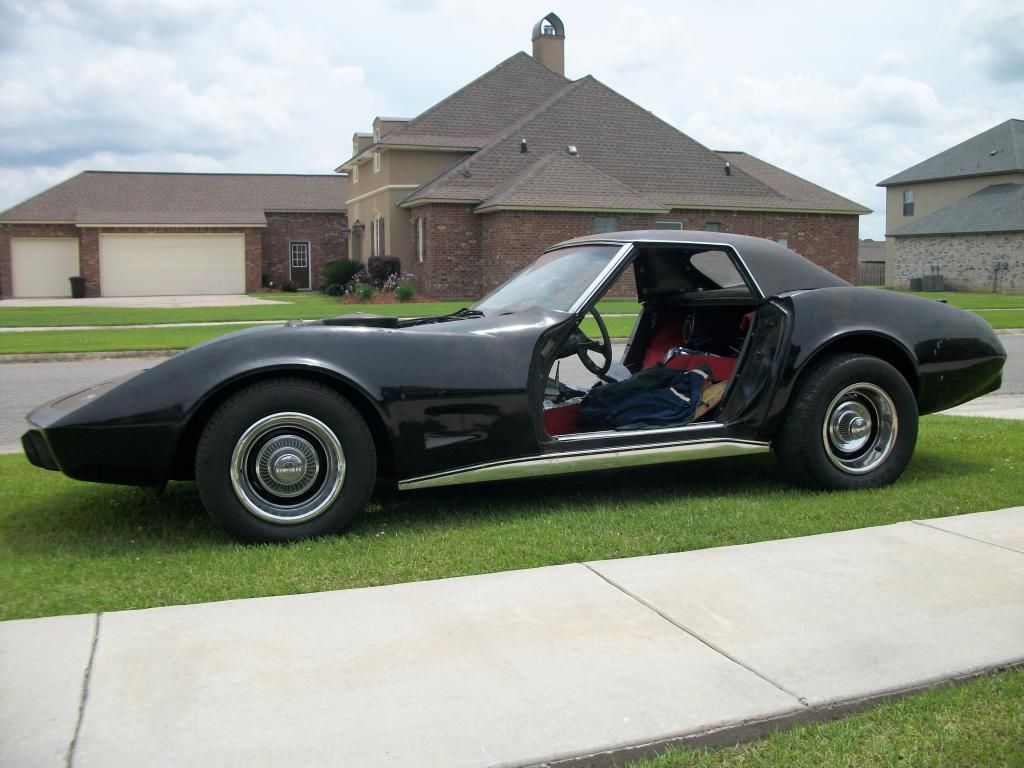
Once the car is back in the garage, the camber is checked---which is about 1/2" out of adjustment......

The Toe is also checked, and is about 1/8" out of adjustment.....

I will align the passenger's wheel tomorrow.
There is more good news for those members who want a smoother/softer (but not mushy) ride........
My car came with approx 340 in.lb. coil springs because it originally had a 327 cu.in. engine (350 cu.in. now).
I "bounced each side of the front suspension" with my body weight(180 lbs.) and the springs compressed slightly over 1" (NO shocks are installed on the front suspension yet in order for me to check "before and after rebound"). The car also did not bottom out when entering/exiting curbed driveways .
.
I am thinking that with new Monroe SensaTrac shocks or equivalent shocks (I have SensaTracs on my '34 street truck), the car will have a smooth ride (no more 100mph curves though).
If I forgot any important facts, please post them so I can edit the thread.....Thanks to all the Expert members who supplied the "tricks/short-cuts" in previous threads!
I installed the new bushings in the upper and lower control arms/re-installed the upper & lower arms/cut the spring to match the other modified spring and began the installation.......
The modified spring is placed in the upper and lower pockets loosely---Notice that the lower ball joint is not installed yet to allow the lower control arm to drop down enough to re-install the modified coil spring.....
NOTICE!!!! I installed the spring the wrong way in the picture below....the "tighter(closer spaced) coils should have been in the UPPER pocket!!!!!!
The lower end of the spring is set in place in the lower control arm....
The temporary 3/8 diameter by 1&1/4" long bolt is held with mechanic's fingers so it can be placed in the pre-drilled guide hole in the upper pocket when the lower control arm is being jacked to a level position......
The upper end of the spring is forced into place with a pickle fork and the retaining bolt is inserted thru the pre-drilled hole to keep the top of the spring from jumping out of the depression and from dislocating itself from the "stop" that is built into the upper pocket when the lower control arm is being jacked into position........
As the lower control arm is being jacked to a level position, the spring begins to arch itself----this is usually where the top of the spring jumps out of the depression in the upper pocket and ***** itself to one side---(which is not a good thing)----but the temporary 3/8" retaining bolt holds the upper part of the spring in place......
The wheel assembly is slid back into place where the lower ball joint can be stabbed while the lower control arm is being lowered slightly to engage the tapered end on the ball joint---the hardware is installed on the ball joint and the car is lowered to the concrete (not shown in the pics).....
*The end-caps on the upper and lower control arms are tightened and torqued (the control arms have to be at ride-height before the caps are tightened because they exert force on the control arm shafts/bushings and the arms, themselves)*
The temporary 3/8" by 1 & 1/4" long spring retaining is removed.
The car is driven thru the neighborhood/entering and exiting curbed driveways to help the suspension settle-----which it does---right where I hoped it would---2" above the top of the tire from the fender lip......
Once the car is back in the garage, the camber is checked---which is about 1/2" out of adjustment......
The Toe is also checked, and is about 1/8" out of adjustment.....
I will align the passenger's wheel tomorrow.
There is more good news for those members who want a smoother/softer (but not mushy) ride........
My car came with approx 340 in.lb. coil springs because it originally had a 327 cu.in. engine (350 cu.in. now).
I "bounced each side of the front suspension" with my body weight(180 lbs.) and the springs compressed slightly over 1" (NO shocks are installed on the front suspension yet in order for me to check "before and after rebound"). The car also did not bottom out when entering/exiting curbed driveways
.I am thinking that with new Monroe SensaTrac shocks or equivalent shocks (I have SensaTracs on my '34 street truck), the car will have a smooth ride (no more 100mph curves though).
If I forgot any important facts, please post them so I can edit the thread.....Thanks to all the Expert members who supplied the "tricks/short-cuts" in previous threads!
Last edited by doorgunner; May 28, 2014 at 02:53 PM.

Thread Starter
Racer


Joined: Apr 2014
Posts: 406
Likes: 22
From: Lyons Colorado
Here are the remaining steps in the coil spring cut/modification.....(the nice and rusty frame will be redone this winter)........
I installed the new bushings in the upper and lower control arms/re-installed the upper & lower arms/cut the spring to match the other modified spring and began the installation.......
The modified spring is placed in the upper and lower pockets loosely---Notice that the lower ball joint is not installed yet to allow the lower control arm to drop down enough to re-install the modified coil spring....
The lower end of the spring is set in place in the lower control arm....
The temporary 3/8 diameter by 1&1/4" long bolt is held with mechanic's fingers so it can be placed in the pre-drilled guide hole in the upper pocket when the lower control arm is being jacked to a level position......
The upper end of the spring is forced into place with a pickle fork and the retaining bolt is inserted thru the pre-drilled hole to keep the top of the spring from jumping out of the depression and from dislocating itself from the "stop" that is built into the upper pocket when the lower control arm is being jacked into position........
As the lower control arm is being jacked to a level position, the spring begins to arch itself----this is usually where the top of the spring jumps out of the depression in the upper pocket and ***** itself to one side---(which is not a good thing)----but the temporary 3/8" retaining bolt holds the upper part of the spring in place......
The wheel assembly is slid back into place where the lower ball joint can be stabbed while the lower control arm is being lowered slightly to engage the tapered end on the ball joint---the hardware is installed on the ball joint and the car is lowered to the concrete (not shown in the pics).....
*The end-caps on the upper and lower control arms are tightened and torqued (the control arms have to be at ride-height before the caps are tightened because they exert force on the control arm shafts/bushings and the arms, themselves)*
The temporary 3/8" by 1 & 1/4" long spring retaining is removed.
The car is driven thru the neighborhood/entering and exiting curbed driveways to help the suspension settle-----which it does---right where I hoped it would---2" above the top of the tire from the fender lip......
Once the car is back in the garage, the camber is checked---which is about 1/2" out of adjustment......
The Toe is also checked, and is about 1/8" out of adjustment.....
I will align the passenger's wheel tomorrow.
There is more good news for those members who want a smoother/softer (but not mushy) ride........
My car came with approx 340 in.lb. coil springs because it originally had a 327 cu.in. engine (350 cu.in. now).
I "bounced each side of the front suspension" with my body weight(180 lbs.) and the springs compressed slightly over 1" (NO shocks are installed on the front suspension yet in order for me to check "before and after rebound"). The car also did not bottom out when entering/exiting curbed driveways .
I am thinking that with new Monroe SensaTrac shocks or equivalent shocks (I have SensaTracs on my '34 street truck), the car will have a smooth ride (no more 100mph curves though).
If I forgot any important facts, please post them so I can edit the thread.....Thanks to all the Expert members who supplied the "tricks/short-cuts" in previous threads!
I installed the new bushings in the upper and lower control arms/re-installed the upper & lower arms/cut the spring to match the other modified spring and began the installation.......
The modified spring is placed in the upper and lower pockets loosely---Notice that the lower ball joint is not installed yet to allow the lower control arm to drop down enough to re-install the modified coil spring....
The lower end of the spring is set in place in the lower control arm....
The temporary 3/8 diameter by 1&1/4" long bolt is held with mechanic's fingers so it can be placed in the pre-drilled guide hole in the upper pocket when the lower control arm is being jacked to a level position......
The upper end of the spring is forced into place with a pickle fork and the retaining bolt is inserted thru the pre-drilled hole to keep the top of the spring from jumping out of the depression and from dislocating itself from the "stop" that is built into the upper pocket when the lower control arm is being jacked into position........
As the lower control arm is being jacked to a level position, the spring begins to arch itself----this is usually where the top of the spring jumps out of the depression in the upper pocket and ***** itself to one side---(which is not a good thing)----but the temporary 3/8" retaining bolt holds the upper part of the spring in place......
The wheel assembly is slid back into place where the lower ball joint can be stabbed while the lower control arm is being lowered slightly to engage the tapered end on the ball joint---the hardware is installed on the ball joint and the car is lowered to the concrete (not shown in the pics).....
*The end-caps on the upper and lower control arms are tightened and torqued (the control arms have to be at ride-height before the caps are tightened because they exert force on the control arm shafts/bushings and the arms, themselves)*
The temporary 3/8" by 1 & 1/4" long spring retaining is removed.
The car is driven thru the neighborhood/entering and exiting curbed driveways to help the suspension settle-----which it does---right where I hoped it would---2" above the top of the tire from the fender lip......
Once the car is back in the garage, the camber is checked---which is about 1/2" out of adjustment......
The Toe is also checked, and is about 1/8" out of adjustment.....
I will align the passenger's wheel tomorrow.
There is more good news for those members who want a smoother/softer (but not mushy) ride........
My car came with approx 340 in.lb. coil springs because it originally had a 327 cu.in. engine (350 cu.in. now).
I "bounced each side of the front suspension" with my body weight(180 lbs.) and the springs compressed slightly over 1" (NO shocks are installed on the front suspension yet in order for me to check "before and after rebound"). The car also did not bottom out when entering/exiting curbed driveways
.I am thinking that with new Monroe SensaTrac shocks or equivalent shocks (I have SensaTracs on my '34 street truck), the car will have a smooth ride (no more 100mph curves though).
If I forgot any important facts, please post them so I can edit the thread.....Thanks to all the Expert members who supplied the "tricks/short-cuts" in previous threads!
2026 Loser of the Year
Joined: Sep 2013
Posts: 36,600
Likes: 7,046
From: New Or-leens Loo-z-anna
Nice work and documentation! I'm now thinking that I'll do as you did and cut 1 off the top and see how it looks. Hopefully one will do it because the second drops it more than the first if your car is any example. I'm afraid to go too low, for fear of the oil pain being too low. Also, when I've done coil spring replacements on other cars I've removed the lower control arm shaft bolts and put a couple longer ones in and then lowered from there. It was easier for me than doing it the other way, maybe a vette would be different. So maybe tomorrow or Thursday I'll have something to report!
And yes.....the second cut made much more difference than the first wrap/coil that I removed.
That's the kind of comparisons that we need in this thread.
(And yes....I accidentally installed the 2nd spring upside down---even though I was determined to install it "tight end up" per the A.I.M.)
Those ___________________ing V.A. meds!
Last edited by doorgunner; May 27, 2014 at 10:17 PM.
Thread Starter
Racer
Joined: Apr 2014
Posts: 406
Likes: 22
From: Lyons Colorado
And here's the passenger side coil spring, the wide coil end was installed at the top:
[IMG] [/IMG]
The drivers side has the coil installed with the wide coils on the bottom, so Bubba has obviously been into the right side. Incidentally the right side sat 1/4 of an inch higher than the driver side, probably due to the spring being installed upside down.
Looking at the spring it's now obvious that to cut one coil from the wide end would do little because it's flattened out at that end. On the narrow end cutting one coil will be much more effective, resulting in an uncompressed 3/4 inch shorter spring. I'll also gain a little by installing it right side up I'm guessing. I can also see why Doorgunner gained an inch and a half on the second cut due to the wider spacing on the spring on the second coil.
The hardest part so far has been breaking the lower ball joint loose, I usually just hit one side of the lower spindle with a small sledge with a bar dolly on the other side and they break loose without too much trouble but not this one, I had to break out the pickle fork.
I'll now go out and cut the spring and reinstall it.
[IMG]
 [/IMG]
The drivers side has the coil installed with the wide coils on the bottom, so Bubba has obviously been into the right side. Incidentally the right side sat 1/4 of an inch higher than the driver side, probably due to the spring being installed upside down.
Looking at the spring it's now obvious that to cut one coil from the wide end would do little because it's flattened out at that end. On the narrow end cutting one coil will be much more effective, resulting in an uncompressed 3/4 inch shorter spring. I'll also gain a little by installing it right side up I'm guessing. I can also see why Doorgunner gained an inch and a half on the second cut due to the wider spacing on the spring on the second coil.
The hardest part so far has been breaking the lower ball joint loose, I usually just hit one side of the lower spindle with a small sledge with a bar dolly on the other side and they break loose without too much trouble but not this one, I had to break out the pickle fork.
I'll now go out and cut the spring and reinstall it.
Thread Starter
Racer
Joined: Apr 2014
Posts: 406
Likes: 22
From: Lyons Colorado
Here are the remaining steps in the coil spring cut/modification.....(the nice and rusty frame will be redone this winter)........
I installed the new bushings in the upper and lower control arms/re-installed the upper & lower arms/cut the spring to match the other modified spring and began the installation.......
The modified spring is placed in the upper and lower pockets loosely---Notice that the lower ball joint is not installed yet to allow the lower control arm to drop down enough to re-install the modified coil spring.....
The lower end of the spring is set in place in the lower control arm....
The temporary 3/8 diameter by 1&1/4" long bolt is held with mechanic's fingers so it can be placed in the pre-drilled guide hole in the upper pocket when the lower control arm is being jacked to a level position......
The upper end of the spring is forced into place with a pickle fork and the retaining bolt is inserted thru the pre-drilled hole to keep the top of the spring from jumping out of the depression and from dislocating itself from the "stop" that is built into the upper pocket when the lower control arm is being jacked into position........
As the lower control arm is being jacked to a level position, the spring begins to arch itself----this is usually where the top of the spring jumps out of the depression in the upper pocket and ***** itself to one side---(which is not a good thing)----but the temporary 3/8" retaining bolt holds the upper part of the spring in place......
The wheel assembly is slid back into place where the lower ball joint can be stabbed while the lower control arm is being lowered slightly to engage the tapered end on the ball joint---the hardware is installed on the ball joint and the car is lowered to the concrete (not shown in the pics).....
*The end-caps on the upper and lower control arms are tightened and torqued (the control arms have to be at ride-height before the caps are tightened because they exert force on the control arm shafts/bushings and the arms, themselves)*
The temporary 3/8" by 1 & 1/4" long spring retaining is removed.
The car is driven thru the neighborhood/entering and exiting curbed driveways to help the suspension settle-----which it does---right where I hoped it would---2" above the top of the tire from the fender lip......
Once the car is back in the garage, the camber is checked---which is about 1/2" out of adjustment......
The Toe is also checked, and is about 1/8" out of adjustment.....
I will align the passenger's wheel tomorrow.
There is more good news for those members who want a smoother/softer (but not mushy) ride........
My car came with approx 340 in.lb. coil springs because it originally had a 327 cu.in. engine (350 cu.in. now).
I "bounced each side of the front suspension" with my body weight(180 lbs.) and the springs compressed slightly over 1" (NO shocks are installed on the front suspension yet in order for me to check "before and after rebound"). The car also did not bottom out when entering/exiting curbed driveways .
I am thinking that with new Monroe SensaTrac shocks or equivalent shocks (I have SensaTracs on my '34 street truck), the car will have a smooth ride (no more 100mph curves though).
If I forgot any important facts, please post them so I can edit the thread.....Thanks to all the Expert members who supplied the "tricks/short-cuts" in previous threads!
I installed the new bushings in the upper and lower control arms/re-installed the upper & lower arms/cut the spring to match the other modified spring and began the installation.......
The modified spring is placed in the upper and lower pockets loosely---Notice that the lower ball joint is not installed yet to allow the lower control arm to drop down enough to re-install the modified coil spring.....
The lower end of the spring is set in place in the lower control arm....
The temporary 3/8 diameter by 1&1/4" long bolt is held with mechanic's fingers so it can be placed in the pre-drilled guide hole in the upper pocket when the lower control arm is being jacked to a level position......
The upper end of the spring is forced into place with a pickle fork and the retaining bolt is inserted thru the pre-drilled hole to keep the top of the spring from jumping out of the depression and from dislocating itself from the "stop" that is built into the upper pocket when the lower control arm is being jacked into position........
As the lower control arm is being jacked to a level position, the spring begins to arch itself----this is usually where the top of the spring jumps out of the depression in the upper pocket and ***** itself to one side---(which is not a good thing)----but the temporary 3/8" retaining bolt holds the upper part of the spring in place......
The wheel assembly is slid back into place where the lower ball joint can be stabbed while the lower control arm is being lowered slightly to engage the tapered end on the ball joint---the hardware is installed on the ball joint and the car is lowered to the concrete (not shown in the pics).....
*The end-caps on the upper and lower control arms are tightened and torqued (the control arms have to be at ride-height before the caps are tightened because they exert force on the control arm shafts/bushings and the arms, themselves)*
The temporary 3/8" by 1 & 1/4" long spring retaining is removed.
The car is driven thru the neighborhood/entering and exiting curbed driveways to help the suspension settle-----which it does---right where I hoped it would---2" above the top of the tire from the fender lip......
Once the car is back in the garage, the camber is checked---which is about 1/2" out of adjustment......
The Toe is also checked, and is about 1/8" out of adjustment.....
I will align the passenger's wheel tomorrow.
There is more good news for those members who want a smoother/softer (but not mushy) ride........
My car came with approx 340 in.lb. coil springs because it originally had a 327 cu.in. engine (350 cu.in. now).
I "bounced each side of the front suspension" with my body weight(180 lbs.) and the springs compressed slightly over 1" (NO shocks are installed on the front suspension yet in order for me to check "before and after rebound"). The car also did not bottom out when entering/exiting curbed driveways
.I am thinking that with new Monroe SensaTrac shocks or equivalent shocks (I have SensaTracs on my '34 street truck), the car will have a smooth ride (no more 100mph curves though).
If I forgot any important facts, please post them so I can edit the thread.....Thanks to all the Expert members who supplied the "tricks/short-cuts" in previous threads!
[IMG]
 [/IMG]
Looking at the diagram it appears that the narrow end should go on top. Also, while reading the manual I see that they use a special tool to raise and lower the lower control arm from the shaft end, which does seem a better way to locate the spring. I don't have that special tool, but I do have long bolts and I've used them before to do it on cars that have two bolts on each end of the shaft. Obviously the Vette only has one on the rear of the shaft, but it may be something I can do anyway. So can anyone chime in and tell us which end of the spring should go up? My car had them going in opposite directions so it's not a good example.

Le Mans Master


Joined: Oct 2007
Posts: 7,455
Likes: 977
From: RI, Now Franklin/Nashville TN
I have been watching this thread closely since I just installed my "new" L-82 with AFR aluminum heads this past weekend and noticed and new that the aluminum heads were going to raise the front ride height-they did. Car can't move yet but unsettled I am at 29 inches from the top of the 255/45/17's to the fender well lip. I am definitely NOT tackling the coil spring cutting this year after the fight with the engine/trans so far this year but will probably have to cut a coil off the 550 front springs.
BTW-Softer springs will definitely make the car squeak more than stiffer springs as the frame will flex more as the car oscillates up and down from the softer springs. All C3 owners need to do the car a big service and install a $100 spreader bar in the front between the front shock towers. I have a 100% factory mechanical fan and shroud on my SBC and the speed direct bar fits perfectly AND my car is very solid for a 37 year old car. No squeaks at all from the front end. Probably the cheapest upgrade one can make to improve the handling and the ride.
BTW-Softer springs will definitely make the car squeak more than stiffer springs as the frame will flex more as the car oscillates up and down from the softer springs. All C3 owners need to do the car a big service and install a $100 spreader bar in the front between the front shock towers. I have a 100% factory mechanical fan and shroud on my SBC and the speed direct bar fits perfectly AND my car is very solid for a 37 year old car. No squeaks at all from the front end. Probably the cheapest upgrade one can make to improve the handling and the ride.
Last edited by jb78L-82; May 28, 2014 at 02:11 PM.
Corvette Stories
The Best of Corvette for Corvette Enthusiasts

Top 10 Most Expensive Corvettes Ever Sold on Bring A Trailer
Brett Foote
10 Things Every Corvette Owner Needs (2026 Edition)
Michael S. Palmer
8 Most "Only Corvette Owners Understand" Quirks and Problems
Pouria Savadkouei
10 Reasons the C6 Z06 is Still A Performance Benchmark After 20 Years
Joe Kucinski
How Much Horsepower Every Corvette Engine "LOST" in 1972
Joe Kucinski
Top 10 DOs and DON'Ts for Protecting Your Convertible Top!
Michael S. Palmer
Top 10 Most Explosive Corvettes Ever Made: Power-to-Weight Ratio Ranked!
Joe Kucinski
150 hp to 1,250 hp: Every Corvette Generation Compared by the Specs That Matter
Joe Kucinski
8 Coolest Corvette Pace Cars (and Replicas) of All Time
Verdad Gallardo
Thread Starter
Racer
Joined: Apr 2014
Posts: 406
Likes: 22
From: Lyons Colorado
So I cut one coil from the narrow side and reinstalled it. I put the lower control arm back into the lower ball joint, put the spring into the pockets, turned the spring until it ran into the stop on the lower control arm, and lifted on the shaft end of the lower control arm. It was really easy! There's a big leverage advantage to lifting on that end, so it's really easy to locate the shaft to the bolt holes and I only had to use one longer bolt to cinch it up into the front. Now to do the other side.
Last edited by Illegal Vette; May 28, 2014 at 02:42 PM. Reason: More info
2026 Loser of the Year
Joined: Sep 2013
Posts: 36,600
Likes: 7,046
From: New Or-leens Loo-z-anna
The spring was upside-down........I installed the "tighter" (closer) coiled-end into the lower control arm by mistake....R A T S !!!!!!!!!
I told you guys to keep an eye on me!!!!!!
(I need to put a red notation above the appropriate pic so others don't make the same mistake-RATS!!!!
Last edited by doorgunner; May 28, 2014 at 02:56 PM.
2026 Loser of the Year
Joined: Sep 2013
Posts: 36,600
Likes: 7,046
From: New Or-leens Loo-z-anna
So I cut one coil from the narrow side and reinstalled it. I put the lower control arm back into the lower ball joint, put the spring into the pockets, turned the spring until it ran into the stop on the lower control arm, and lifted on the shaft end of the lower control arm. It was really easy! There's a big leverage advantage to lifting on that end, so it's really easy to locate the shaft to the bolt holes and I only had to use one longer bolt to cinch it up into the front. Now to do the other side.
LOL....I should have posted a pic of each step...then waited for you guys to make sure I did it correctly before I proceeded to the next step! But I don't mind flipping the spring--I'm pretty fast at it now....
 !!!!
!!!!

Le Mans Master
Joined: Feb 2011
Posts: 5,943
Likes: 61
From: Southern NH
when I pulled my springs out to do my suspension rebuild they were in upside down. not sure how long they were in like that or if it made a difference with anything. if it did, i didn't notice.
2026 Loser of the Year
Joined: Sep 2013
Posts: 36,600
Likes: 7,046
From: New Or-leens Loo-z-anna
Illegal Vette and others noticed my mistake....now I understand why the passenger's side fender sits one inch closer to the top of the tire (the driver's side spring is installed correctly and has 2 inches of clearance from fender lip to the top of the tire........I accidentally
 installed the passenger spring upside down ("tight" coils down/widely spaced coils up).
Thread Starter
Racer
Joined: Apr 2014
Posts: 406
Likes: 22
From: Lyons Colorado
By saying "narrow side".....you are referring to the widely space wraps (coils) ? I just want to make sure that I understand the term correctly.
LOL....I should have posted a pic of each step...then waited for you guys to make sure I did it correctly before I proceeded to the next step! But I don't mind flipping the spring--I'm pretty fast at it now.... !!!!
LOL....I should have posted a pic of each step...then waited for you guys to make sure I did it correctly before I proceeded to the next step! But I don't mind flipping the spring--I'm pretty fast at it now....
!!!!
2026 Loser of the Year
Joined: Sep 2013
Posts: 36,600
Likes: 7,046
From: New Or-leens Loo-z-anna
Thread Starter
Racer
Joined: Apr 2014
Posts: 406
Likes: 22
From: Lyons Colorado
Well I can't say how much it's dropped because the lower ball joint I bought for the drivers side was short the grease boot. I suspect I'll have to cut some more, but we'll see. If I do have to cut some more I now feel comfortable cutting just a section if I need to, the way it fits into the upper spring pocket looks like it doesn't need to be against a stop as with the lower pocket.
Thread Starter
Racer
Joined: Apr 2014
Posts: 406
Likes: 22
From: Lyons Colorado
Believe it or not---Like Other members have said--It DOES make a difference if the springs are installed upside down.
Illegal Vette and others noticed my mistake....now I understand why the passenger's side fender sits one inch closer to the top of the tire (the driver's side spring is installed correctly and has 2 inches of clearance from fender lip to the top of the tire........I accidentally installed the passenger spring upside down ("tight" coils down/widely spaced coils up).
Illegal Vette and others noticed my mistake....now I understand why the passenger's side fender sits one inch closer to the top of the tire (the driver's side spring is installed correctly and has 2 inches of clearance from fender lip to the top of the tire........I accidentally
installed the passenger spring upside down ("tight" coils down/widely spaced coils up).
2026 Loser of the Year
Joined: Sep 2013
Posts: 36,600
Likes: 7,046
From: New Or-leens Loo-z-anna
I started with close to 5" of gap-----1st cut dropped fender 3/4"----2nd cut dropped fender 1 & 3/4" MORE!
Keep us updated.
Last edited by doorgunner; May 29, 2014 at 05:02 PM.