





Oversteer!

Thread Starter
Drifting


Joined: Apr 2014
Posts: 1,396
Likes: 129
From: Plainfield IN
 Oversteer!
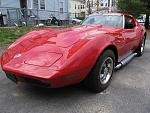
My '78 seems to oversteer more than I'm use too. Is this a characteristic with these cars or should I be looking for something in the suspension? As a side note I've had the car for almost 2 months, and haven't driven a car of this age in 30 years.

Melting Slicks


Joined: Oct 2012
Posts: 2,156
Likes: 273
From: Dunedin NZ.
All else being equal, you tend to feel an over steering condition more quickly in a vette because you are sitting so close to the back axle compared to a sedan for instance. So even though the two vehicles are over steering the same amount you will feel what is happening more quickly in the vette JMHO.

Advanced

Joined: Jul 2013
Posts: 51
Likes: 0
From: ontario


Le Mans Master


Joined: Oct 2007
Posts: 7,453
Likes: 976
From: RI, Now Franklin/Nashville TN

Team Owner


Joined: Jul 1999
Posts: 65,492
Likes: 230
From: Orange Park Florida
As a stock machine with stock size wheels/tires/equivalent you will experience that.....
NOW if you give up on antiquated wheels/tires and go with suspension mods, THAT changes everything.....
otherwise, it is not up to modern performance standards.....


NOW if you give up on antiquated wheels/tires and go with suspension mods, THAT changes everything.....
otherwise, it is not up to modern performance standards.....
Thread Starter
Drifting
Joined: Apr 2014
Posts: 1,396
Likes: 129
From: Plainfield IN
I thought that was the case - plus my 1st vette was a C5 soooooo.
Corvette Stories
The Best of Corvette for Corvette Enthusiasts

Top 10 Most Expensive Corvettes Ever Sold on Bring A Trailer
Brett Foote
10 Things Every Corvette Owner Needs (2026 Edition)
Michael S. Palmer
8 Most "Only Corvette Owners Understand" Quirks and Problems
Pouria Savadkouei
10 Reasons the C6 Z06 is Still A Performance Benchmark After 20 Years
Joe Kucinski
How Much Horsepower Every Corvette Engine "LOST" in 1972
Joe Kucinski
Top 10 DOs and DON'Ts for Protecting Your Convertible Top!
Michael S. Palmer
Top 10 Most Explosive Corvettes Ever Made: Power-to-Weight Ratio Ranked!
Joe Kucinski
150 hp to 1,250 hp: Every Corvette Generation Compared by the Specs That Matter
Joe Kucinski
8 Coolest Corvette Pace Cars (and Replicas) of All Time
Verdad Gallardo

Thread Starter
Drifting
Joined: Apr 2014
Posts: 1,396
Likes: 129
From: Plainfield IN

Safety Car


Joined: Aug 2000
Posts: 3,711
Likes: 43
From: San Antonio TX
All factory road cars bias to understeer. It's not a new car/old car thing. It has always been this way. It is inherently safer for the front end to push when grip is exceeded. The reason it is safer is the car can generally be brought back in line by lifting off the throttle or applying some brake. If the car oversteers, the rear end will start coming around and can be hard to bring back into line with reduced throttle or braking. It frequently gets worse on throttle lift/braking depending upon the car's attitude and velocity. Oversteer also makes the car very nervous and a bit scary to drive, particularly on wet roads. You can make your car oversteer by applying power quickly to start spinning the rear tires in a corner but that's kind of boneheaded unless you are in a drifting competition.
It's most important to get the alignment checked by a competent shop. Next, do not over-inflate the tires, particularly in the rear. This is more of an issue with Corvettes in the pre-radial tire era, not on your year. Bias ply tires ran a couple more psi than radials and using the factory-recommended pressure for a bias tire on a radial can make a real difference.
It's most important to get the alignment checked by a competent shop. Next, do not over-inflate the tires, particularly in the rear. This is more of an issue with Corvettes in the pre-radial tire era, not on your year. Bias ply tires ran a couple more psi than radials and using the factory-recommended pressure for a bias tire on a radial can make a real difference.
Thread Starter
Drifting
Joined: Apr 2014
Posts: 1,396
Likes: 129
From: Plainfield IN
All factory road cars bias to understeer. It's not a new car/old car thing. It has always been this way. It is inherently safer for the front end to push when grip is exceeded. The reason it is safer is the car can generally be brought back in line by lifting off the throttle or applying some brake. If the car oversteers, the rear end will start coming around and can be hard to bring back into line with reduced throttle or braking. It frequently gets worse on throttle lift/braking depending upon the car's attitude and velocity. Oversteer also makes the car very nervous and a bit scary to drive, particularly on wet roads. You can make your car oversteer by applying power quickly to start spinning the rear tires in a corner but that's kind of boneheaded unless you are in a drifting competition.
It's most important to get the alignment checked by a competent shop. Next, do not over-inflate the tires, particularly in the rear. This is more of an issue with Corvettes in the pre-radial tire era, not on your year. Bias ply tires ran a couple more psi than radials and using the factory-recommended pressure for a bias tire on a radial can make a real difference.
It's most important to get the alignment checked by a competent shop. Next, do not over-inflate the tires, particularly in the rear. This is more of an issue with Corvettes in the pre-radial tire era, not on your year. Bias ply tires ran a couple more psi than radials and using the factory-recommended pressure for a bias tire on a radial can make a real difference.
Safety Car
Joined: Aug 2000
Posts: 3,711
Likes: 43
From: San Antonio TX
Considered for what? The rear track width is about 3/4" wider on the rear for all C3s. It seems this way for most cars I've ever seen specifications on. I know of none with a wider front track -not that they don't exist. There are probably some with the same front and rear.