



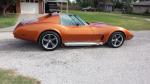

ride height with a 360 rear spring

Le Mans Master


Joined: Oct 2010
Posts: 6,938
Likes: 848
From: melbourne florida
2023 C3 of the Year Finalist - Modified

front of a big block is nowhere near the centerline. I've talked to many racers who said there wasn't any noticeable difference in handling. aluminum heads would effect weight too.
Racer

Joined: May 2011
Posts: 484
Likes: 10
From: Newcastle NSW

If the big block sat that forward, there would be no way you could fit a spreader bar on a big block car. And you definitely can!

Le Mans Master


Joined: Oct 2007
Posts: 7,455
Likes: 977
From: RI, Now Franklin/Nashville TN
My understanding is that the OEM BB engined cars are slightly longer-2-3 inches (the actual engine dimensions)-than the SB cars and the frame cross member has a slight indentation for the balancer of the BB cars versus the small block cars. The BB engines weigh about 200 pounds (iron heads of course) more than the SB engines and are significantly higher (taller) in the engine bay than a SB engine adversely effecting weight distribution and higher center of gravity. The BB cars have a weight distribution biased to the front with the SB cars achieving a more ideal 50:50 weight distribution-many of the SB car years are actually 48%F:52% rear which is much more ideal for racing/handling. Duntov preferred the SB C3's for racing with their better handling dynamics. BB cars rule for power, while SB C3's rock for handling with much of the power in some years of the BB C3's. I love the BB C3's but the SB vettes are actually the better overall package, if your interest leans more heavily to handling and road racing.
Last edited by jb78L-82; Nov 1, 2014 at 12:56 PM.
Racer
Joined: May 2011
Posts: 484
Likes: 10
From: Newcastle NSW
The BB engines weigh about 200 pounds (iron heads of course) more than the SB engines and are significantly higher (taller) in the engine bay than a SB engine adversely effecting weight distribution and higher center of gravity. The BB cars have a weight distribution biased to the front with the SB cars achieving a more ideal 50:50 weight distribution-many of the SB car years are actually 48%F:52% rear which is much more ideal for racing/handling. Duntov preferred the SB C3's for racing with their better handling dynamics. BB cars rule for power, while SB C3's rock for handling with much of the power in some years of the BB C3's. I love the BB C3's but the SB vettes are actually the better overall package, if your interest leans more heavily to handling and road racing.
Ultimately most of the successful vintage C3 road course cars were big blocks, albeit in the end they were running ZL1 or Can Am blocks. I agree that the small block is the more balanced package, but you have to remember that this isn't a Camaro. The big block Corvettes are still very well balanced, unlike other cars with the big engine sitting right over the axle centreline.
Last edited by Bad Bird; Nov 1, 2014 at 04:16 PM.
Le Mans Master
Joined: Oct 2007
Posts: 7,455
Likes: 977
From: RI, Now Franklin/Nashville TN
Ok let's try this one more time: You make some good points but the differences are not small.
There are lots of different numbers on the BB/SB engine weights and weight distribution for various engines and years of the C3. Two facts though are undisputed. The BB engines weigh "considerable" more than the SB engines and yes the BB cars are nose heavy RELATIVE to the small block cars.
The engine weight numbers that I could find for BB cars-depending on the years, options, etc are:
BB Engine-675-700 lbs
SB Engine-550-575 lbs
The biggest difference between the figures is 150 lbs with the smallest difference being 100 Lbs-So yes it is not 200 lbs but it is very significant. Call it 125 lbs
The weight distribution numbers for BB cars depending on the year, options etc varies from:
Front 51-52% Rear: 48-49%
SB engined C3's weight distribution varies from 50:50 to Front 48% Rear 52%
Either way the BB cars are considerable heavier in the engine department and also have a nose heavy bias versus the SB cars-There is a big difference between F 52% R 48% ON A BB car versus a SB car that is F48% 52% rear.
There are lots of different numbers on the BB/SB engine weights and weight distribution for various engines and years of the C3. Two facts though are undisputed. The BB engines weigh "considerable" more than the SB engines and yes the BB cars are nose heavy RELATIVE to the small block cars.
The engine weight numbers that I could find for BB cars-depending on the years, options, etc are:
BB Engine-675-700 lbs
SB Engine-550-575 lbs
The biggest difference between the figures is 150 lbs with the smallest difference being 100 Lbs-So yes it is not 200 lbs but it is very significant. Call it 125 lbs
The weight distribution numbers for BB cars depending on the year, options etc varies from:
Front 51-52% Rear: 48-49%
SB engined C3's weight distribution varies from 50:50 to Front 48% Rear 52%
Either way the BB cars are considerable heavier in the engine department and also have a nose heavy bias versus the SB cars-There is a big difference between F 52% R 48% ON A BB car versus a SB car that is F48% 52% rear.
Corvette Stories
The Best of Corvette for Corvette Enthusiasts

Top 10 Most Expensive Corvettes Ever Sold on Bring A Trailer
Brett Foote
10 Things Every Corvette Owner Needs (2026 Edition)
Michael S. Palmer
8 Most "Only Corvette Owners Understand" Quirks and Problems
Pouria Savadkouei
10 Reasons the C6 Z06 is Still A Performance Benchmark After 20 Years
Joe Kucinski
How Much Horsepower Every Corvette Engine "LOST" in 1972
Joe Kucinski
Top 10 DOs and DON'Ts for Protecting Your Convertible Top!
Michael S. Palmer
Top 10 Most Explosive Corvettes Ever Made: Power-to-Weight Ratio Ranked!
Joe Kucinski
150 hp to 1,250 hp: Every Corvette Generation Compared by the Specs That Matter
Joe Kucinski
8 Coolest Corvette Pace Cars (and Replicas) of All Time
Verdad Gallardo
Racer
Joined: May 2011
Posts: 484
Likes: 10
From: Newcastle NSW
Ok let's try this one more time: You make some good points but the differences are not small.
There are lots of different numbers on the BB/SB engine weights and weight distribution for various engines and years of the C3. Two facts though are undisputed. The BB engines weigh "considerable" more than the SB engines and yes the BB cars are nose heavy RELATIVE to the small block cars.
There are lots of different numbers on the BB/SB engine weights and weight distribution for various engines and years of the C3. Two facts though are undisputed. The BB engines weigh "considerable" more than the SB engines and yes the BB cars are nose heavy RELATIVE to the small block cars.
 The only thing I want to do is ensure that that people don't read this thread and think that the big block cars are nose-heavy pigs. They are a well balanced car, but for sure are not quite as balanced as the small blocks.
The engine weight numbers that I could find for BB cars-depending on the years, options, etc are:
BB Engine-675-700 lbs
SB Engine-550-575 lbs
The biggest difference between the figures is 150 lbs with the smallest difference being 100 Lbs-So yes it is not 200 lbs but it is very significant. Call it 125 lbs
The weight distribution numbers for BB cars depending on the year, options etc varies from:
Front 51-52% Rear: 48-49%
SB engined C3's weight distribution varies from 50:50 to Front 48% Rear 52%
Either way the BB cars are considerable heavier in the engine department and also have a nose heavy bias versus the SB cars-There is a big difference between F 52% R 48% ON A BB car versus a SB car that is F48% 52% rear.
BB Engine-675-700 lbs
SB Engine-550-575 lbs
The biggest difference between the figures is 150 lbs with the smallest difference being 100 Lbs-So yes it is not 200 lbs but it is very significant. Call it 125 lbs
The weight distribution numbers for BB cars depending on the year, options etc varies from:
Front 51-52% Rear: 48-49%
SB engined C3's weight distribution varies from 50:50 to Front 48% Rear 52%
Either way the BB cars are considerable heavier in the engine department and also have a nose heavy bias versus the SB cars-There is a big difference between F 52% R 48% ON A BB car versus a SB car that is F48% 52% rear.
I went out to the shed and measured the distance from the engine CG to to axle centrelines front and rear. I got about 420 mm to the front and 2000 mm to the rear.
Let's do the best-case scenario. 48:52 weight distribution small block (no AC, no PS), weighing in at 3200 lbs. This comes out to a corner-weighted distribution of 1536 lbs (f), 1664 lbs (r). Using the algebraic sum of moments, and taking a big block weight of 125 lbs, we get:
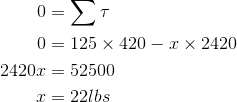
So, 22 lbs rear and hence 103 lbs front. Adding these values to our above 1536:1664 for the small block, we get 1639:1686 for the big block, which is a weight distribution of 49:51.
Let's do a less-ideal scenario. 50:50 weight distribution small block and a 150 lb BBC. Again doing the calculation, we get 1600 (f), 1600 (r) for the small block. 150 lbs for the big block yields an additional 124 lbs (f) , 26 lbs (r). This comes out to 1724 lbs (f), 1626 lbs (r) for the big block; a weight distribution of 51:49.
As a sanity-check, if we say that the ZL1 block and aluminum heads save about 100 lbs over the iron small block, we get a weight distribution of about 47:53, which agrees with contemporary sources about the weight distribution of this particular car.
The conclusion here is that yes, relative to the small blocks, the big blocks are slightly more front heavy. However, the engine set back radically reduces the effect of the heavy engine. Since the engine is almost entirely behind the front axle centreline (balancer and some pulleys are inline), you don't get the large moment about the front axle line, which is why say a Camaro has a horrible weight distribution with a big block. What happens in this scenario is that the motor actually causes an effective reduction in weight over the rear axle, and so the front axle must actually provide an effective upward force of greater than the weight of the engine!
Whereas for a C3, depending on options, a big block is more like 51:49 to 49:51 weight distribution. Also, you can't compare loaded (AC, PB, PS) big blocks (51:49) to low option (48:52) small blocks and claim that as a "big difference". It is a small difference at best.
Last edited by Bad Bird; Nov 1, 2014 at 07:44 PM.
Le Mans Master
Joined: Oct 2007
Posts: 7,455
Likes: 977
From: RI, Now Franklin/Nashville TN
We are getting closer to agreeing. I am with you that the BB cars are NOT nose heavy pigs and they do handle decently well just not as well as well as the SB cars. I appreciate and understand perfectly the mathematical equation above BUT I did not find 1 credible source that lists the weight distribution for the BB cars at 50:50 much less F 49%:R51%. Every single source like Car and Driver, Road and Track, various Corvette Fact sites list the big block having a front nose bias of 51 or 52%, not 49%. In fact, I have owned my 78 for 30+ years and was a corvette fan before I owned my C3 and never once did I see a reference that BB cars were 50:50 weight distribution or rear biased like the SBC cars. The facts do not support this claim from credible sources from the period and Duntov's remarks about the BB C3's.
Last edited by jb78L-82; Nov 1, 2014 at 10:37 PM.
Racer
Joined: May 2011
Posts: 484
Likes: 10
From: Newcastle NSW
I'm good with the 51:49 figure for the all-iron big blocks being out there (maybe 52:48 for a high-option car). When I get the opportunity to corner-weight my car I'll put my findings in this thread.
Le Mans Master
Joined: Oct 2007
Posts: 7,455
Likes: 977
From: RI, Now Franklin/Nashville TN
The rest is academic, but I'm good with this. Less, ah, fanatical Corvette owners should get the right idea out of this thread now.
I'm good with the 51:49 figure for the all-iron big blocks being out there (maybe 52:48 for a high-option car). When I get the opportunity to corner-weight my car I'll put my findings in this thread.
I'm good with the 51:49 figure for the all-iron big blocks being out there (maybe 52:48 for a high-option car). When I get the opportunity to corner-weight my car I'll put my findings in this thread.


Melting Slicks


Joined: Oct 2011
Posts: 2,748
Likes: 90
From: Sacramento California
C2 of Year Finalist (performance mods) 2019
2018 C2 of Year Finalist
JBL...I cut half a coil off a 550 spring for my AFR headed 78....it was too much. If you do a search for my. 78 pics you will see what I mean. 550 as installed or 1/4 coil cut at most. I had 255/60/15 tires too. Spoiler was so low I couldn't drive it on my race ramps without an approach board.
Le Mans Master
Joined: Oct 2010
Posts: 6,938
Likes: 848
From: melbourne florida
2023 C3 of the Year Finalist - Modified
i had an old spring man in Virginia years ago tell me a rule of thumb , no hard fast always works thing, but a rule of thumb if you want to drop an inch you remove an inch of the total height of the spring. i wanted about 2 1/2 inches i cut 2 1/2 inches which came out to be about 3/4 of a coil.
Burning Brakes

Joined: Oct 2010
Posts: 1,192
Likes: 7
From: Wentzville MO
Shorter rear main spring options?
Lowered the front of my 78 yesterday using VBP 550 coil springs. They lower the car about 1-1 /2". Now moving to the rear, Had to cut the stock bolts out and looks like the rear spring is going to hit the inside of my 9 1/2 wheels. Don't want to add wheel spacers so anyone use a shortened rear leaf. I found a shortened composite from Van Steel. Is this my only option?


Le Mans Master
Joined: Oct 2010
Posts: 6,938
Likes: 848
From: melbourne florida
2023 C3 of the Year Finalist - Modified
VBP suggested the bilstien or QA1 shocks as they felt the valving is too light in the KYB shocks. i think most people like the bilstien sport in the rear. i like the QA1 units i have. much improved ride over stock which surprised me. but handling is Vastly better.