






fuel return line????
Thread Starter
Racer

Joined: Jan 2013
Posts: 302
Likes: 2
From: Sayville New york
 fuel return line????
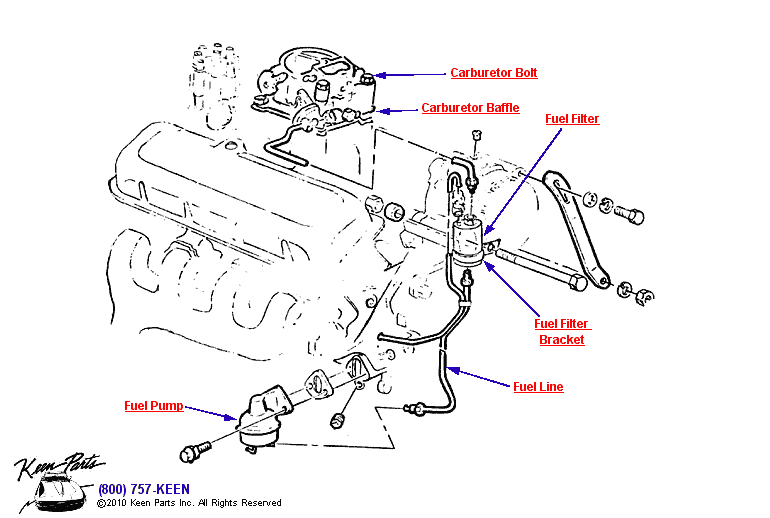
removed 350 out of my 71 and installed 408" now i am plumbing new fuel line to carb.i use AN fitted SS braided hose to Holley 110 gph fuel pump then AN-6 fitted braided hose to fuel filter and same out to dual feed of holley 750 cfm carb. what do i do with fuel return line on frame .the old 350" 270hp had a duel outlet fuel filter with one line going to carb and one line returning to OEM. return line on frame.do i need it??? holley fuel pump is 6 to 8 psi.


Burning Brakes

Joined: Oct 2008
Posts: 1,037
Likes: 14
From: Mobile Alabama
You may be able to get by without one, but if you truly want to set up a robust fuel system, you need a return.
Check this: https://www.corvetteforum.com/forums...d-by-lars.html
Check this: https://www.corvetteforum.com/forums...d-by-lars.html

Had a 1976 L-82, 4-sp


Joined: Mar 2011
Posts: 5,338
Likes: 1,213
From: Some days your the dog and some days your the hydrant.
Royal Canadian Navy
I just plugged the fuel return hose on the frame. I have used the original quadrajet, Holley 4011 and now a Holley 650 DP. It hasn't been an issue for me but I don't see above 90F very often. I would just plug it and see how it runs.

Race Director


Joined: Apr 2009
Posts: 19,294
Likes: 2,753
From: Charlotte NC
You may be able to get by without one, but if you truly want to set up a robust fuel system, you need a return.
Check this: https://www.corvetteforum.com/forums...d-by-lars.html
Check this: https://www.corvetteforum.com/forums...d-by-lars.html
 and..... EXCELLENT EXAMPLES of 'taking it' to the NEXT LEVEL.
AND...I understand that the dynamics of fuel return has changed somewhat.....because on the C5/C6 Corvettes...the fuel return is way back by the fuel tank and made into the fuel filter...and only one fuel line makes it way to the engine.
DUB

Pro


Joined: Oct 2009
Posts: 664
Likes: 89
From: Marysville Ohio
My experience - Ohio summer gets hot enough with a modified egine to warrant a fule return fron the carb to the tank.
2 years ago was running a Holley 4150 with my 383 - if it was high 80s/90s I would get fuel boiling after driving, and occasionally while driving it would boil over and flood out. If the temps were cooler, it never happened, only when outside temps were hot.
I was running the stock return from the pump, but not the carb.
Talked to Lars and installed a return similar to some of the ones in the link above - The return went from the carb through an orifice restriction I fabbed up, to the tank - the problem was immediately solved.
I wont go without one on a carbureted car now. My belief is that modern fuels just boil easily - they are formulated for fuel-injected cars vs our naturally aspirated cars.
2 years ago was running a Holley 4150 with my 383 - if it was high 80s/90s I would get fuel boiling after driving, and occasionally while driving it would boil over and flood out. If the temps were cooler, it never happened, only when outside temps were hot.
I was running the stock return from the pump, but not the carb.
Talked to Lars and installed a return similar to some of the ones in the link above - The return went from the carb through an orifice restriction I fabbed up, to the tank - the problem was immediately solved.
I wont go without one on a carbureted car now. My belief is that modern fuels just boil easily - they are formulated for fuel-injected cars vs our naturally aspirated cars.
Burning Brakes
Joined: Oct 2008
Posts: 1,037
Likes: 14
From: Mobile Alabama
and..... EXCELLENT EXAMPLES of 'taking it' to the NEXT LEVEL.AND...I understand that the dynamics of fuel return has changed somewhat.....because on the C5/C6 Corvettes...the fuel return is way back by the fuel tank and made into the fuel filter...and only one fuel line makes it way to the engine.
DUB
Corvette Stories
The Best of Corvette for Corvette Enthusiasts

8 Coolest Corvette Pace Cars (and Replicas) of All Time
Verdad Gallardo
Top 10 Corvette Engines RANKED by Peak Torque (70+ Years of Muscle!)
Joe Kucinski
Corvette ZR1X Will Be Pacing the Indy 500, And Could Probably Race, Too!
Verdad Gallardo
Top 10 Corvettes Coming to Mecum Indy 2026!
Brett Foote
Top 10 C9 Corvette MUST-HAVES to Fix These C8 Generation Flaws!
Michael S. Palmer
10 Revolutionary 'Corvette Firsts' Most People Don't Know
Joe Kucinski
5 Reasons to Upgrade to an LS6-Powered Corvette; 5 Reasons to Stay LT2
Michael S. Palmer
2027 Corvette vs The World: Every C8 vs Its Closest Competitor
Joe Kucinski
10 Most Common Corvette Problems of the Last 20 Years!
Joe Kucinski
Melting Slicks

Joined: Feb 2006
Posts: 3,105
Likes: 96
From: Sunrise FL
So...does the stock return line AT THE PUMP do essentially the same thing? Or is it just less effective being further away from the carb inlet??
My problem in FL on multiple vettes has been fuel boiling over/flooding at the carb itself. Mainly on the secondary bowl...which is not getting a steady refill of cool fuel. Seen on Holleys. Tried insulators, blocked heat crossovers, etc.
My problem in FL on multiple vettes has been fuel boiling over/flooding at the carb itself. Mainly on the secondary bowl...which is not getting a steady refill of cool fuel. Seen on Holleys. Tried insulators, blocked heat crossovers, etc.
Burning Brakes
Joined: Oct 2008
Posts: 1,037
Likes: 14
From: Mobile Alabama
The return on the pump works, but doesn't work as well as one near the carb. You have static/slow moving fuel in the line to the carb without the return at the carb. This could allow the fuel to gain more heat. Fuel bowl also may need a heat shield.
Thread Starter
Racer
Joined: Jan 2013
Posts: 302
Likes: 2
From: Sayville New york
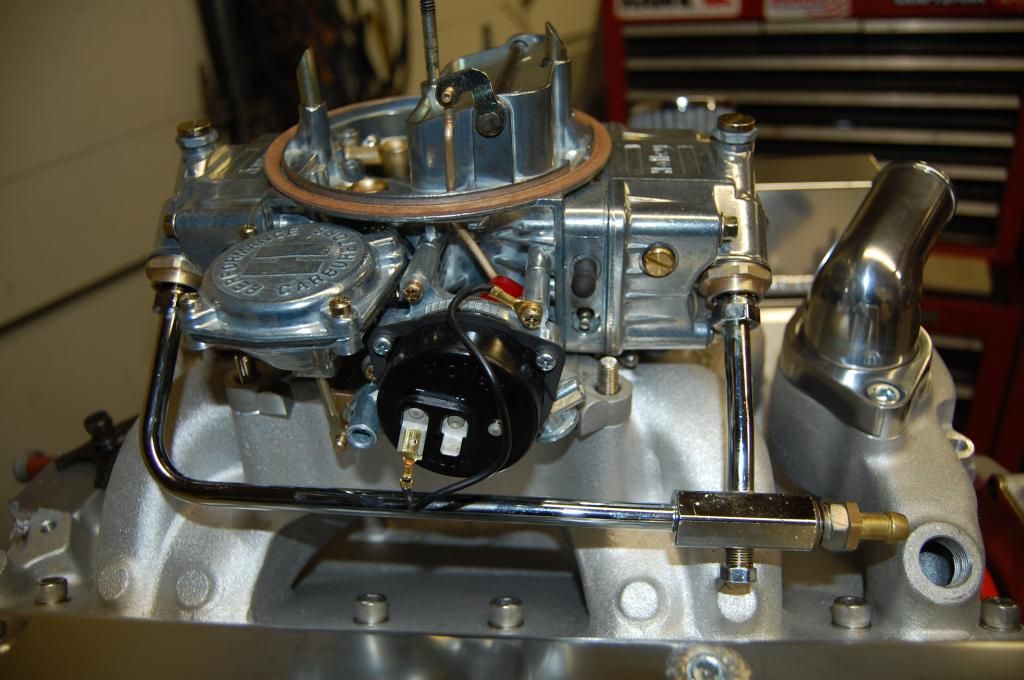
i have seen all the post up to date on fuel return lines.i have chrome dual feed to holley carb and would like to retain it.can i utilize that 1/8npt plug on the dual feed pipe and come out with tee one side a fuel pressure gauge and other neck down to a .060 orifice that will be piped back to the 5/16" OEM. return line on upper frame to tank.i know Lars had the line coming out extreme end after carb inlet but i think this would work and most of all keep what i already own.

Burning Brakes
Joined: Oct 2008
Posts: 1,037
Likes: 14
From: Mobile Alabama
[QUOTE=Captain bob;1588846977]i have seen all the post up to date on fuel return lines.i have chrome dual feed to holley carb and would like to retain it.can i utilize that 1/8npt plug on the dual feed pipe and come out with tee one side a fuel pressure gauge and other neck down to a .060 orifice that will be piped back to the 5/16" OEM. return line on upper frame to tank.i know Lars had the line coming out extreme end after carb inlet but i think this would work and most of all keep what i already own.
I think that would work. Much better than no return. Good Luck
I think that would work. Much better than no return. Good Luck
Pro
Joined: Oct 2009
Posts: 664
Likes: 89
From: Marysville Ohio
i have seen all the post up to date on fuel return lines.i have chrome dual feed to holley carb and would like to retain it.can i utilize that 1/8npt plug on the dual feed pipe and come out with tee one side a fuel pressure gauge and other neck down to a .060 orifice that will be piped back to the 5/16" OEM. return line on upper frame to tank.i know Lars had the line coming out extreme end after carb inlet but i think this would work and most of all keep what i already own.
Thread Starter
Racer
Joined: Jan 2013
Posts: 302
Likes: 2
From: Sayville New york
i would some day love to remove the myths on this forum namely AFR heads with angle plugs are way better way to remove spark plugs with long tube headers with side pipes then straight plug. i illustrated photo with headers on stand because somebody mention problems with angle plug ,so i doubted myself and put it together on stand ------that was stupid, plugs angle AWAY from pipes not into them like straight plug heads.##2 i play golf with the guy in charge of the 400 block assembly line now retired.1970 to nov of 1972 400"" thick block" made both in 4 bolt and two bolt identical web casting the two bolt is not stronger 73 to 75 they use lighter casting then 1975 thru 80 shaved about 18 pounds that is were the 2 bolt is stronger then the 4 bolt because webbing under outside bolts have reduced material to the point that 2 bolt with studs are stronger.however if you find 1970 to 1972 they can go .060 over and 4 bolt is stronger but not if you used splayed cap and drill 4 bolt.
Drifting


Joined: Jul 2009
Posts: 1,532
Likes: 14
From: Dallas-Fort Worth TX
Captain Bob, Nice Ride you got there. Here are a few pics of my return fuel line. I updated the carb since that original thread which was linked above. I would recommend a heat shield also. Since Lars steered me to this upgrade, it hot starts and idles great, even in the hot Texas summers.
Any issues with the AFR heads with raised exh ports and the side pipe headers fitament?
A fellow CF member and friend of mine are about to install a new crate engine with AFR heads and his hooker header and side pipes. He had iron heads with OEM exh port locations before.


Any issues with the AFR heads with raised exh ports and the side pipe headers fitament?
A fellow CF member and friend of mine are about to install a new crate engine with AFR heads and his hooker header and side pipes. He had iron heads with OEM exh port locations before.


Race Director
Joined: Apr 2009
Posts: 19,294
Likes: 2,753
From: Charlotte NC
Captain bob,
In your photo...as I have encountered so many times and end up making my own dual line set-ups....is that the fuel line gets REALLY close to if not touches your heater hose fitting coming out of the intake manifold. I have had some dual line set-ups that you can buy run right into the fitting and NOT work at all.
Hopefully yours gives you the clearance you like...because I prefer to keep the fuel line away from heat sources.
DUB
In your photo...as I have encountered so many times and end up making my own dual line set-ups....is that the fuel line gets REALLY close to if not touches your heater hose fitting coming out of the intake manifold. I have had some dual line set-ups that you can buy run right into the fitting and NOT work at all.
Hopefully yours gives you the clearance you like...because I prefer to keep the fuel line away from heat sources.
DUB
Thread Starter
Racer
Joined: Jan 2013
Posts: 302
Likes: 2
From: Sayville New york
DUB you are absolutely on the ball both with your observation on c-5/c-6 fuel routing and the heater hose on top ,front of intake of intake manifold, to close for comfort.i am using a air gap rpm manifold and there are two takeoffs on the rear water ports of the manifold so i will go with a 3/8 npt. by 3/4" barb fitting and utilize the drivers side 3/8 NPT opening and plug normal SBC take off on front of manifold. Incidentally as you can observe in first photo number 2 cylinder primary exhaust turns sharply away from fuel pump giving a foot of clearance from fuel pump,fuel lines in addition plenty of air movement with dual electric fans and ample room between rad. and block.
be advised if using AFR heads they cut a recess around spark plug diameter you must use one of those cheap K-mart spark plug sockets with super thin wall to fully contact six sided surface of spark plug.regular Snap-on,Matco are to thick and mar plugs.check headers on engine stand you may have to elongate header bolt holes.
be advised if using AFR heads they cut a recess around spark plug diameter you must use one
of those cheap K-mart spark plug sockets with super thin wall to fully contact six sided surface of spark plug.regular Snap-on,Matco are to thick and mar plugs.check headers on engine stand you may have to elongate header bolt holes.
Race Director
Joined: Apr 2009
Posts: 19,294
Likes: 2,753
From: Charlotte NC
Captain bob,
NOT PREACHING...but down here in the south...I get Corvettes similar to what you have with a bad ARS motor in them in my shop...and I have found that when using electric fans(which is fine). Many times the fans are not on ( being sensor controlled)..and when the Corvette is just sitting there...in traffic...their is NO air movement due to not having a clutch fan....and the radiant heat from the headers or exhaust slowly builds up over time....and that is when a problem shows up. I often times have to fabricate up heat shields and use protecting wraps on fuel lines and other parts.
Hopefully you do not have any 'heat soak' issues when driven for any extended length of time. You might actually be surprised on how hot the frame rail actually gets with headers...and thus your fuel line soaks in that heat...which is why I have to make shields to reflect this heat away.
DUB
NOT PREACHING...but down here in the south...I get Corvettes similar to what you have with a bad ARS motor in them in my shop...and I have found that when using electric fans(which is fine). Many times the fans are not on ( being sensor controlled)..and when the Corvette is just sitting there...in traffic...their is NO air movement due to not having a clutch fan....and the radiant heat from the headers or exhaust slowly builds up over time....and that is when a problem shows up. I often times have to fabricate up heat shields and use protecting wraps on fuel lines and other parts.
Hopefully you do not have any 'heat soak' issues when driven for any extended length of time. You might actually be surprised on how hot the frame rail actually gets with headers...and thus your fuel line soaks in that heat...which is why I have to make shields to reflect this heat away.
DUB
Thread Starter
Racer
Joined: Jan 2013
Posts: 302
Likes: 2
From: Sayville New york
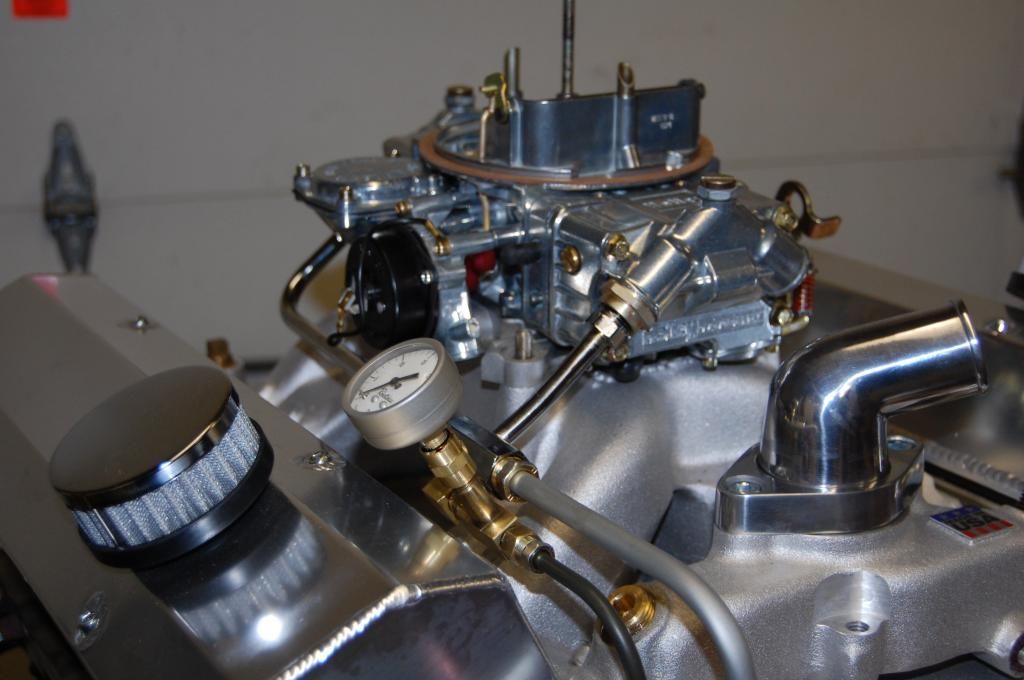
dub i used two fans with totally independent circuitry however the engine stays to cool i have one fan switch in cylinder head in area next to plugs 3/8" npt. opening and the other in top of intake manifold 3/8npt. take off well with old LT-1 fan goes on at 160 degrees in manifold sender after warm up and stays on all the time secondary sender and fan in head never goes on.engine thermostat is 180 degree and engine stay just under because 4 row radiator overwhelms with one fan running perhaps the 408" will require me to change one sensor to 195 degrees and use as a "just in case".here is the completed fuel system with transition piece after tee filled with braze and drilled to .062.not as good as Lars but will do the job i hope.extremely rare if ever to get caught in 80+ degrees traffic situation.

Last edited by Captain bob; Feb 3, 2015 at 02:58 PM. Reason: spelling
Race Director
Joined: Apr 2009
Posts: 19,294
Likes: 2,753
From: Charlotte NC
captain bob,
LOOK GOOD...but I have just one thought/observation...because I was not there and can not see the entire plumbing....BUT...the fitting you installed in the chrome fuel line set-up that is looking like a brass fitting where your pressure gauge is installed.....I am concerned that IN TIME the possibility that this fitting can fail...due to the two steel lines are not joined together by some nice solid billet clamps. Thus... the supply and return steel lines are independent and each can move differently...and where they join can fail....due to the fitting is small and not so stout.....and as like I wrote...I was not there and just commenting on what I see.. Excuse me if I am incorrect.
DUB
LOOK GOOD...but I have just one thought/observation...because I was not there and can not see the entire plumbing....BUT...the fitting you installed in the chrome fuel line set-up that is looking like a brass fitting where your pressure gauge is installed.....I am concerned that IN TIME the possibility that this fitting can fail...due to the two steel lines are not joined together by some nice solid billet clamps. Thus... the supply and return steel lines are independent and each can move differently...and where they join can fail....due to the fitting is small and not so stout.....and as like I wrote...I was not there and just commenting on what I see.. Excuse me if I am incorrect.
DUB