




Emissions???
Thread Starter
Drifting


Joined: Sep 2007
Posts: 1,572
Likes: 51
From: Wichita Kansas
 Emissions???
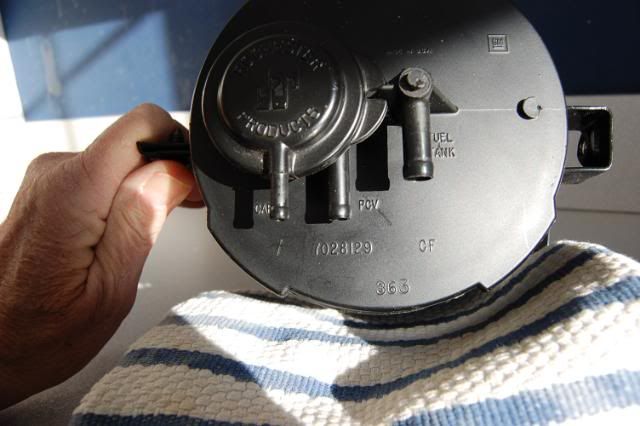
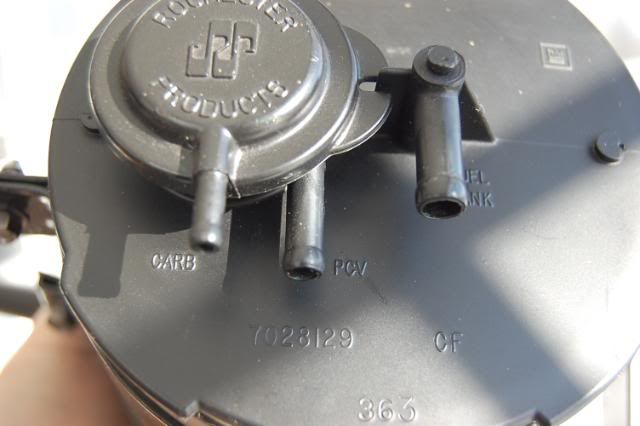
With the install of my 383 i have removed the vapor canistor. I have concern with fire when those canisters fill with gas over the years and i dont think it cool to leave the tubue open for raw vapor to excape.
My question is what to do about the left over vent tube running from the engine bay to the tank? I was think about disconnecting it at the fuel tank and letting it just vent. Any thought on this? If left connected to the fuel tank what is the safe approach to the open tube in the engine bay?
I guess I need to think about the return line from the pump to the tank also.
My question is what to do about the left over vent tube running from the engine bay to the tank? I was think about disconnecting it at the fuel tank and letting it just vent. Any thought on this? If left connected to the fuel tank what is the safe approach to the open tube in the engine bay?
I guess I need to think about the return line from the pump to the tank also.
Last edited by Aggitated Monkey; May 13, 2015 at 04:01 PM.

Team Owner


Joined: Sep 2006
Posts: 31,274
Likes: 4,366
From: Westminster Maryland
Hi AM,
I didn't realize the vapor canister filled with gasoline over the years.
I thought the vapor separator mounted on the side of the tank prevented anything but fumes from being drawn into the line and then forward into the canister.
Regards,
Alan
I didn't realize the vapor canister filled with gasoline over the years.
I thought the vapor separator mounted on the side of the tank prevented anything but fumes from being drawn into the line and then forward into the canister.
Regards,
Alan

Pro


Joined: Jan 2001
Posts: 511
Likes: 66
From: Timnath, CO
I agree with Alan that you should not get liquid in that line. However I think I've read that some people have had problems with malfunctioning V/L separators. I personally like the canister as it helps reduce fumes in my garage, which could also prove dangerous. I don't think you should vent to the atmosphere - I would cap the vent if you don't use the canister.
As an aside, it seems the carbon loses it's ability to desorb the gasoline over time. When I changed my carbon out, the gas smell was very strong. I put a match to a small sample of it, and this is what happened:

As an aside, it seems the carbon loses it's ability to desorb the gasoline over time. When I changed my carbon out, the gas smell was very strong. I put a match to a small sample of it, and this is what happened:

Le Mans Master


Joined: Oct 2002
Posts: 7,098
Likes: 378
From: Las Vegas - Just stop perpetuating myths please.
As it is now u have an intake manifold leak and need to plug the flex hose to carb base. Next u need to find a method of venting the tank as the line from tank to charcoal canister is what vented the tank. As that remains open now u have gasoline vapors that flow past the little float check valve near the tank to the removed CC. So raw gas vapor is exiting near your exh manifolds. But if u plug it then the only way the tank relieves pressure is through the gas cap. Yes a gas cap will fart to relieve pressure. Also a gas cap will vent the other way when tank vacuum is greated when fuel is used up. But using the gas cap is not the way to control tank pressure as it is a safety valve not a regulator and will be problematic giving u gost problems with fuel supply.
Option is use a early years "vented" vap that is only a gas cap w/o a gasket and let your garage fill up with fumes. Or u can restore your CC and just replace the charcoal filter at normal intervals as in your owners manual. Yes Fram still makes and sells these filters.
Any questions?
Option is use a early years "vented" vap that is only a gas cap w/o a gasket and let your garage fill up with fumes. Or u can restore your CC and just replace the charcoal filter at normal intervals as in your owners manual. Yes Fram still makes and sells these filters.
Any questions?
Thread Starter
Drifting
Joined: Sep 2007
Posts: 1,572
Likes: 51
From: Wichita Kansas
Ok thanks for the input. I think I will put the canister back in and let it do its job. I'm in the clean a paint portion of the build. Once I re assemble the under carrage and install the new engine and trans I will re connect the can. The original connection was to the A Jet. I'm running a Quick Fuel SS 750 CFM on top of the 383 stroker. Am I correct to think I can source any vacuums port for the vapor canister?
Le Mans Master
Joined: Oct 2002
Posts: 7,098
Likes: 378
From: Las Vegas - Just stop perpetuating myths please.
No! The carb vacuum connection used/needed is what they call a ported vacuum that is connected to the venturi above the throttle plates. The reason is if the intake vacuum - which is highest at idle - takes in the stored vapor at start-up or even idle it may well stall from an over rich condition. I think this was discovered during the canisters development or what/when ever. But u need a port above the throttle plates.
What i use to identify ports is a thin solid wire to probe through the connection nipple and see where it enters the carb/venturi.
Good luck.
What i use to identify ports is a thin solid wire to probe through the connection nipple and see where it enters the carb/venturi.
Good luck.
Corvette Stories
The Best of Corvette for Corvette Enthusiasts

Top 10 Most Expensive Corvettes Ever Sold on Bring A Trailer
Brett Foote
10 Things Every Corvette Owner Needs (2026 Edition)
Michael S. Palmer
8 Most "Only Corvette Owners Understand" Quirks and Problems
Pouria Savadkouei
10 Reasons the C6 Z06 is Still A Performance Benchmark After 20 Years
Joe Kucinski
How Much Horsepower Every Corvette Engine "LOST" in 1972
Joe Kucinski
Top 10 DOs and DON'Ts for Protecting Your Convertible Top!
Michael S. Palmer
Top 10 Most Explosive Corvettes Ever Made: Power-to-Weight Ratio Ranked!
Joe Kucinski
150 hp to 1,250 hp: Every Corvette Generation Compared by the Specs That Matter
Joe Kucinski
8 Coolest Corvette Pace Cars (and Replicas) of All Time
Verdad Gallardo
Le Mans Master
Joined: Mar 2001
Posts: 5,738
Likes: 644
From: Lincoln, CA
The carbon acts as sponge. It has a high absorption rate. So after parking it will absorb the fumes and when the car is running get sucked back in.
Changing the media will help as it does break down over time and have less service area.
I'm big into Reef tanks. Same concept but we have to throw it out once it's exhausted and no longer absorbing. You don't want it leaching back into the water.
Changing the media will help as it does break down over time and have less service area.
I'm big into Reef tanks. Same concept but we have to throw it out once it's exhausted and no longer absorbing. You don't want it leaching back into the water.