When you click on links to various merchants on this site and make a purchase, this can result in this site earning a commission. Affiliate programs and affiliations include, but are not limited to, the eBay Partner Network.
Picture taken after I lowered fan start setpoint to the 180° range and let the fan cool the engine down.
This picture is to show that the gauge will track downward and is fairly close at 175-180 mark on the gauge.....with digital indication reading 179°
Just FYI.
It took quite the number of turns adjusting the resistor to get it to read in the 175-180 (compared to where it was for use with the stock 1/2" sender). Not that it matters I reckon....must just place that parallel resistor in the appropriate operating range to allow the SU109 to work in that gauge range. I have NO idea what the resistance value is.
SU109 temp sensor, with installed adjustable Willcox resistor, UPDATE:
Reporting from cold engine start.
It appears that this temp sensor lags (reads colder than real engine temp) behind real temp until it gets to 175°-180° (my Normal Operating Temperature -NOT) ..... which is at about the mark between 100° and 210°..... pretty much matches up there and from previous testing I know it tracks pretty well up to 210°.
I'll leave it hooked up for a while just to check on it. Later I will swap back to my 1/2" sensor which tracks from down at 100° and up...... but that SU109, dialed in with the Willcox resistor,
SUMMARY: sure does seem to work adequately well from the ~175° Normal Operating Temperature and on up to at least 210°.
Last edited by carriljc; Aug 18, 2025 at 07:23 PM.
where to start.
I have a 1971 LS 5 $%$. engine was rebuilt. Old temp sensor was reinstaled. Prior to rebuild it always read at the half way so about 180 degrees.
After the rebuild, the temperature gauge barely moves off of 100 degrees.
replace the sender with the Zip Corvette "correct sender" and no it only reads slightly above the 100 mark, maybe 120 degrees
i have now purchased the Corvette Central unit, with the resistor. Can I expect better results?
Or am i chasing my tail. I read a Duralast TU 5 maybe correct, but its not the same connector. Mine uses a small barrel type .
peyc2
What is it that you purchased from Corvette Central? It is not very clear to me in your statement?
My old sender started acting up similarly to the way you describe yours. It just read low...... it's worth trying the TU5 since it's only like 17 bucks. I suspect that it will read low as your original did but it's worth a shot. If you still have the original (hopefully) you can try to find the willcox adjustable resistor .....with it dialed-in it my original sender work like a dream.
Originally Posted by peyc2
Hello,
where to start.
I have a 1971 LS 5 $%$. engine was rebuilt. Old temp sensor was reinstaled. Prior to rebuild it always read at the half way so about 180 degrees.
After the rebuild, the temperature gauge barely moves off of 100 degrees.
replace the sender with the Zip Corvette "correct sender" and no it only reads slightly above the 100 mark, maybe 120 degrees
i have now purchased the Corvette Central unit, with the resistor. Can I expect better results?
Or am i chasing my tail. I read a Duralast TU 5 maybe correct, but its not the same connector. Mine uses a small barrel type .
thank you,
Last edited by carriljc; Aug 18, 2025 at 06:59 PM.
If you search for a thread we had years back with Dub, Ernie from Willcox we discussed temp senders and the resistor adjustment.
I tested a number of senders and found one that was close to spec but still needed the resistor. Some of the ones touted as correct were hopelessly out. In end used a wt203
I suspect that the corvette central adjustable resistor may only give you an accurate reading at one value from what I've read.
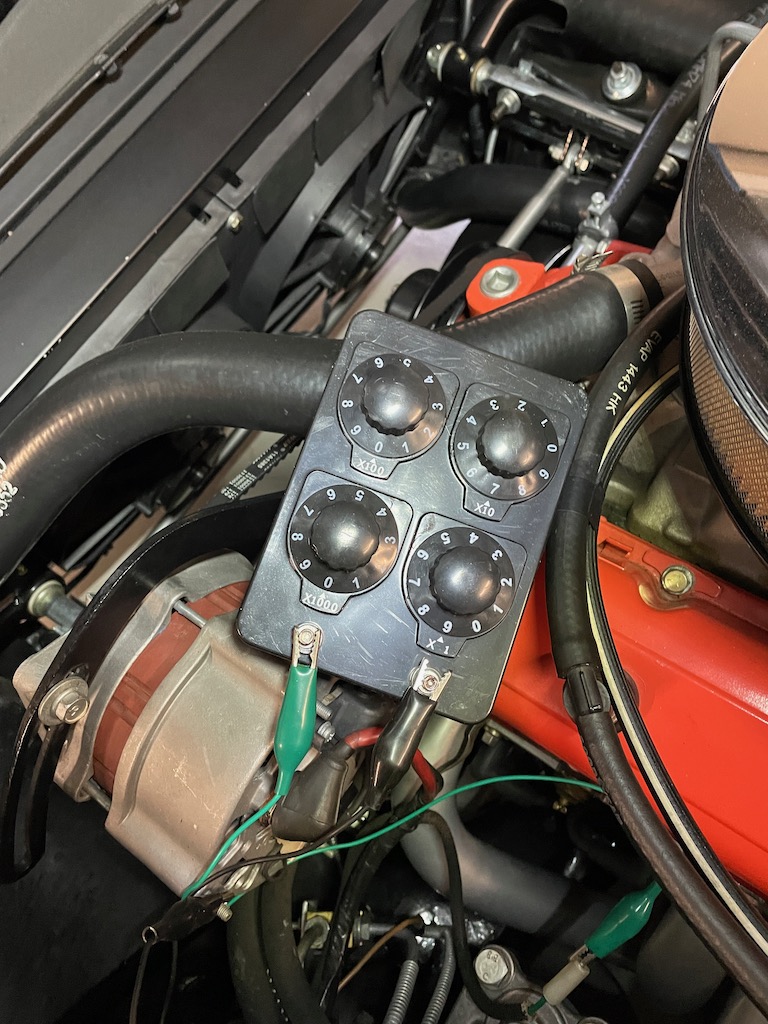
SEE PICTURE BELOW: The adjustable resistor that Willcox used to sell was placed in the back of the gauge between the 2 terminals and replaced the old resistor with the variable unit....see image below:
Last edited by carriljc; Aug 19, 2025 at 11:49 PM.
The factory item is just a fixed wound resistor. The adjustable version is normally a combo of a fixed resistor and a variable resistor. If set at the same resistance as the factory one (can’t recall but I think 90 or 100 ohms) it should act the same.
What causes gauges to be out at so many points is the curve of resistance that the sender delivers.
In the link below I show how to test the gauge at what should be the sender resistance at multiple points. If that is all correct then it’s about what the sender gives as well.
There are so many variables and from my testing many of the newer senders are only correct in a versus small range.
If in the end you try and get a setup that reads ok in the area that matters.
I will also note that when I built the thermo fan controller for my setup we had to stabilise the voltage used in the temp sender circuit (lock it at a specific level like 12.1 volts) so we would get a consistent repeatable temp sender signal as the car voltage varied.
More an issue in more precise control as luckily the factory gauge is heavily buffered from minor fluctuations.
I suspect that the corvette central adjustable resistor may only give you an accurate reading at one value from what I've read.
SEE PICTURE BELOW: The adjustable resistor that Willcox used to sell was placed in the back of the gauge between the 2 terminals and replaced the old resistor with the variable unit....see image below:
So i just attach the Corvette Central variable between the 2 terminals?. That board that is under I do not have? does that matter?