

differences between SB & BB 68 radiator ?

Thread Starter
Melting Slicks


Joined: Feb 2001
Posts: 3,330
Likes: 13
From: Europe , Luxembourg
 differences between SB & BB 68 radiator ?
Hello
I am still a bit lost on what exactly is different between the rads .
I know about the shroud being different . Is there a size difference of the actual radiator for manual non AC ?
What exactly is different on the radiator support ?
Pics showing the differences would be great .
Thanks & rgds . Günther
I am still a bit lost on what exactly is different between the rads .
I know about the shroud being different . Is there a size difference of the actual radiator for manual non AC ?
What exactly is different on the radiator support ?
Pics showing the differences would be great .
Thanks & rgds . Günther

Team Owner


Joined: Sep 2006
Posts: 31,335
Likes: 4,449
From: Westminster Maryland
Hi Gunther,
I believe you'll find that for the 68 model year the radiator for:
SB cars WITHOUT automatic transmissions and/or air conditioning were made from aluminum, had no side tanks, and were supported in the core support by 2 'pegs' on the bottom of the radiator.
BB cars, (except 430 hp,) WITHOUT automatic transmissions and/or air conditioning were made from copper, had end tanks and sat in 'U' shaped brackets welded to the bottom of the core support.
There was a different core support for the two types of radiators because of the difference in the size of the central area of the core support that remained open, and how the 2 types of radiators were mounted.
Expansion tanks of different material, shape, and location were used with some radiators.
Regards,
Alan
I only have 71 sb photos which show a similar application. Hopefully someone will be along with some bb photos.
71 sb aluminum radiator and steel shroud.


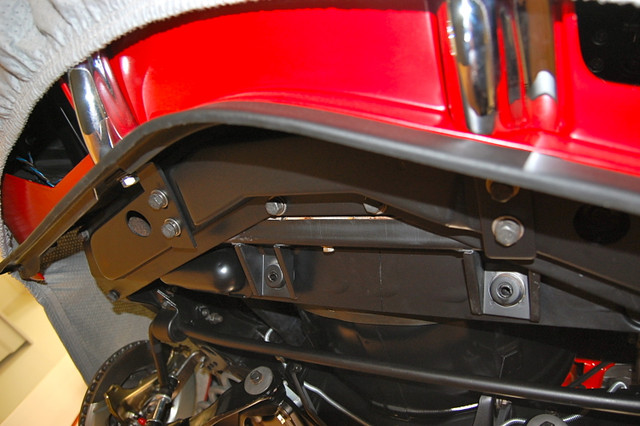
From below showing the 2 brackets on the core support for the radiator's pegs.
I believe you'll find that for the 68 model year the radiator for:
SB cars WITHOUT automatic transmissions and/or air conditioning were made from aluminum, had no side tanks, and were supported in the core support by 2 'pegs' on the bottom of the radiator.
BB cars, (except 430 hp,) WITHOUT automatic transmissions and/or air conditioning were made from copper, had end tanks and sat in 'U' shaped brackets welded to the bottom of the core support.
There was a different core support for the two types of radiators because of the difference in the size of the central area of the core support that remained open, and how the 2 types of radiators were mounted.
Expansion tanks of different material, shape, and location were used with some radiators.
Regards,
Alan
I only have 71 sb photos which show a similar application. Hopefully someone will be along with some bb photos.
71 sb aluminum radiator and steel shroud.
From below showing the 2 brackets on the core support for the radiator's pegs.
Last edited by Alan 71; Dec 22, 2016 at 12:22 PM.

Safety Car


Joined: Sep 2011
Posts: 4,121
Likes: 1,231
From: Madeira Beach, FL
2024 C8 of the Year Finalist - Unmodified
2024 C2 of the Year Finalist - Unmodified
2023 C2 of the Year Finalist - Unmodified
2020 C3 of the Year Finalist - Unmodified
Alan is correct on both.
My big block is copper and no over flow tank on AC equipped cars. Shroud is fiberglass too.
Marshal.
My big block is copper and no over flow tank on AC equipped cars. Shroud is fiberglass too.
Marshal.
Safety Car


Joined: Oct 2007
Posts: 3,729
Likes: 267
From: Austin Texas
Corvette of the Year Winner 2017
2016 C3 of Year Finalist
each radiator requires, a different radiator support.
so if your swapping radiator size, .. you will also need to swap the radiator support.
basically the BB support allows more sqft. of cooling area. (larger cutout for the Air to flow thru)
so if your swapping radiator size, .. you will also need to swap the radiator support.
basically the BB support allows more sqft. of cooling area. (larger cutout for the Air to flow thru)
Last edited by 69Vett; Dec 22, 2016 at 05:26 PM.
Thread Starter
Melting Slicks
Joined: Feb 2001
Posts: 3,330
Likes: 13
From: Europe , Luxembourg
Hi
What do you mean with support. The complete support surround or just the rad supports?
I believe that the radiator support surround framing size is the same for SB and BB , except may be for the mounting pegs ( supports ? ) of the rad and the top mount for the shroud.
This is why I ask for detail pics.
It is not the radiator itself I am worried about, but the support etc.
Example, does the BB also have the strengthening cross steel bars in front of the rad ?
brgds Günther
What do you mean with support. The complete support surround or just the rad supports?
I believe that the radiator support surround framing size is the same for SB and BB , except may be for the mounting pegs ( supports ? ) of the rad and the top mount for the shroud.
This is why I ask for detail pics.
It is not the radiator itself I am worried about, but the support etc.
Example, does the BB also have the strengthening cross steel bars in front of the rad ?
brgds Günther

Burning Brakes

Joined: Jul 2016
Posts: 767
Likes: 74
From: Blaine MN
Hi
What do you mean with support. The complete support surround or just the rad supports?
I believe that the radiator support surround framing size is the same for SB and BB , except may be for the mounting pegs ( supports ? ) of the rad and the top mount for the shroud.
This is why I ask for detail pics.
It is not the radiator itself I am worried about, but the support etc.
Example, does the BB also have the strengthening cross steel bars in front of the rad ?
brgds Günther
What do you mean with support. The complete support surround or just the rad supports?
I believe that the radiator support surround framing size is the same for SB and BB , except may be for the mounting pegs ( supports ? ) of the rad and the top mount for the shroud.
This is why I ask for detail pics.
It is not the radiator itself I am worried about, but the support etc.
Example, does the BB also have the strengthening cross steel bars in front of the rad ?
brgds Günther
Corvette Stories
The Best of Corvette for Corvette Enthusiasts

5 Best & 5 Worst Corvette Daily Drivers
Joe Kucinski
The Headlights of Every Corvette Generation Explained
Joe Kucinski
5 Best & 5 Most Overrated Corvette Track Packages of All Time!
Joe Kucinski
Every 2027 Corvette Engine Explained
Joe Kucinski
Designer Imagines A Corvette That Looks More Like a Corvette Than the Corvette
Verdad Gallardo
10 Ugly Corvettes That We Still Kinda Love
Joe Kucinski
Top 10 Most Expensive Corvettes Ever Sold on Bring A Trailer
Brett Foote
10 Things Every Corvette Owner Needs (2026 Edition)
Michael S. Palmer
8 Most "Only Corvette Owners Understand" Quirks and Problems
Pouria Savadkouei
Drifting

Joined: Jan 2014
Posts: 1,866
Likes: 140
From: Sadieville Kentucky
Hi
What do you mean with support. The complete support surround or just the rad supports?
I believe that the radiator support surround framing size is the same for SB and BB , except may be for the mounting pegs ( supports ? ) of the rad and the top mount for the shroud.
This is why I ask for detail pics.
It is not the radiator itself I am worried about, but the support etc.
Example, does the BB also have the strengthening cross steel bars in front of the rad ?
brgds Günther
What do you mean with support. The complete support surround or just the rad supports?
I believe that the radiator support surround framing size is the same for SB and BB , except may be for the mounting pegs ( supports ? ) of the rad and the top mount for the shroud.
This is why I ask for detail pics.
It is not the radiator itself I am worried about, but the support etc.
Example, does the BB also have the strengthening cross steel bars in front of the rad ?
brgds Günther
Wes
Team Owner
Joined: Sep 2006
Posts: 31,335
Likes: 4,449
From: Westminster Maryland
Hi Gunther,
Here's a photo of a 71 core-support for a small block aluminum radiator.
Perhaps it'll help be of help to you.
Regards,
Alan
You can see the plates added to close down the opening to the size of the radiator core and the 2 brackets to support the mounts (pegs) on the bottom of the radiator.


Here's a photo of a 71 core-support for a small block aluminum radiator.
Perhaps it'll help be of help to you.
Regards,
Alan
You can see the plates added to close down the opening to the size of the radiator core and the 2 brackets to support the mounts (pegs) on the bottom of the radiator.
Thread Starter
Melting Slicks
Joined: Feb 2001
Posts: 3,330
Likes: 13
From: Europe , Luxembourg
Hi
Thanks so much.
So , the mount pegs shown are for SB , correct ?
I was wondering about my car. It's a BB, had a BB rad, but a steel shroud. It doesn't have this mounting pegs, but bolt on pegs that grip the rad water tank weldings.
Guess all I need a fiberglass BB shroud then ?
Rgds Günther
Thanks so much.
So , the mount pegs shown are for SB , correct ?
I was wondering about my car. It's a BB, had a BB rad, but a steel shroud. It doesn't have this mounting pegs, but bolt on pegs that grip the rad water tank weldings.
Guess all I need a fiberglass BB shroud then ?
Rgds Günther

Racer


Joined: Nov 2014
Posts: 463
Likes: 129
Günther
Very early 68 big blocks car used a steel shroud on the radiator fan. Due to over heating problems the steel shroud was quickly replaced in production with a fiberglass one to help address it.
If you car is has a vin sequence number of before 2469 it originally had a steel shroud.
The big block steel shroud looked just like the small block shroud but was a little shorter in length.
Because so few big block car were were built with a steel shroud, and most that had them were replaced under warranty, it is very difficult to find one today.
John
Very early 68 big blocks car used a steel shroud on the radiator fan. Due to over heating problems the steel shroud was quickly replaced in production with a fiberglass one to help address it.
If you car is has a vin sequence number of before 2469 it originally had a steel shroud.
The big block steel shroud looked just like the small block shroud but was a little shorter in length.
Because so few big block car were were built with a steel shroud, and most that had them were replaced under warranty, it is very difficult to find one today.
John
Last edited by JC68; Dec 24, 2016 at 07:38 PM.
Drifting
Joined: Jan 2014
Posts: 1,866
Likes: 140
From: Sadieville Kentucky
Hello
I am still a bit lost on what exactly is different between the rads .
I know about the shroud being different . Is there a size difference of the actual radiator for manual non AC ?
What exactly is different on the radiator support ?
Pics showing the differences would be great .
Thanks & rgds . Günther
I am still a bit lost on what exactly is different between the rads .
I know about the shroud being different . Is there a size difference of the actual radiator for manual non AC ?
What exactly is different on the radiator support ?
Pics showing the differences would be great .
Thanks & rgds . Günther
Gunther
Here is a picture of a big block cradle mount using a 28" radiator
If you need pictures of the radiator and shroud let me know
Wes


Safety Car


Joined: May 2001
Posts: 4,761
Likes: 1,648
From: Fairfax Virginia
Steel shroud on early 1968 C3
Günther
Very early 68 big blocks car used a steel shroud on the radiator fan. Due to over heating problems the steel shroud was quickly replaced in production with a fiberglass one to help address it.
If you car is has a vin sequence number of before 2469 it originally had a steel shroud.
The big block steel shroud looked just like the small block shroud but was a little shorter in length.
Because so few big block car were were built with a steel shroud, and most that were had them were replaced under warranty, it is very difficult to find one today.
John
Very early 68 big blocks car used a steel shroud on the radiator fan. Due to over heating problems the steel shroud was quickly replaced in production with a fiberglass one to help address it.
If you car is has a vin sequence number of before 2469 it originally had a steel shroud.
The big block steel shroud looked just like the small block shroud but was a little shorter in length.
Because so few big block car were were built with a steel shroud, and most that were had them were replaced under warranty, it is very difficult to find one today.
John
Hello John!
I have a 1968 C3 BB Convertible Corvette with 4 speed and mine has the steel shroud with cross bars. Andrew at "Tony's Corvettes" in Maryland was amazed at the parts on the radiator support as they were the same as the 1967 BB radiator support with the steel shroud. My car's V.I.N. ends with #2595 and was made in October of 1967.
The early overheating issue was also fixed with a pulley change that spun the water pump a bit faster along with the shroud change.

Racer
Joined: Nov 2014
Posts: 463
Likes: 129
Hello John!
I have a 1968 C3 BB Convertible Corvette with 4 speed and mine has the steel shroud with cross bars. Andrew at "Tony's Corvettes" in Maryland was amazed at the parts on the radiator support as they were the same as the 1967 BB radiator support with the steel shroud. My car's V.I.N. ends with #2595 and was made in October of 1967.
The early overheating issue was also fixed with a pulley change that spun the water pump a bit faster along with the shroud change.
I have a 1968 C3 BB Convertible Corvette with 4 speed and mine has the steel shroud with cross bars. Andrew at "Tony's Corvettes" in Maryland was amazed at the parts on the radiator support as they were the same as the 1967 BB radiator support with the steel shroud. My car's V.I.N. ends with #2595 and was made in October of 1967.
The early overheating issue was also fixed with a pulley change that spun the water pump a bit faster along with the shroud change.
John
Thread Starter
Melting Slicks
Joined: Feb 2001
Posts: 3,330
Likes: 13
From: Europe , Luxembourg
Hello
Vin of my 05 Oct 67 build car is 1391, hence steel shroud is fine.
Good, am I happy to have asked this question as I was on the way to toss the shroud in order to repl it by a fiberglass one.
I own this car nor since 2000 , and find this out only now !!
68th are so fun.
This forum is so great.
Wishing all of you a Merry Christmas and happy new year.
Günther
If you car is has a vin sequence number of before 2469 it originally had a steel shroud.
Good, am I happy to have asked this question as I was on the way to toss the shroud in order to repl it by a fiberglass one.
I own this car nor since 2000 , and find this out only now !!
68th are so fun.
This forum is so great.
Wishing all of you a Merry Christmas and happy new year.
Günther
Thread Starter
Melting Slicks
Joined: Feb 2001
Posts: 3,330
Likes: 13
From: Europe , Luxembourg
Hi John
If you have this serv. bulletin, could I pls have a copy of it ( scan ) to meeko@vo.lu , pls ?
Would be a great Christmas present.
Thanks & rgds Günther
I got the 2469 number from a Chevrolet Technical Service bulletin
Would be a great Christmas present.
Thanks & rgds Günther
Safety Car
Joined: May 2001
Posts: 4,761
Likes: 1,648
From: Fairfax Virginia
1968 Corvettes are Unique in many good ways!
Merry Christmas to you as well my Friend in Luxembourg!!
A Merry Christmas to all you Corvette Forum people!
You are right Gunther, the 1968 Corvette is a very cool car to have. You are a very lucky man!
I bought my 1968 Corvette on July 19, 2001 and have had it ever since. It was in a barn down south in Virginia when I heard about it. I bought it and then found out that many Corvette Purists believe the 1968's are a piece of junk. They don't appreciate all the unique parts to it.
I have told people that the 1968 Corvette is the "Rodney Dangerfield" of Corvettes. It never gets any respect around Corvette gatherings.
I have the factory 427 built up like a L-88. I was fortunate enough to find a real L-88 Hood assembly at Carlisle Corvettes. The seller gave me a awesome deal on Sunday afternoon right before the show ended. Two weeks later I got a box from the seller with the entire air-filtration system referred to as a "Wedding cake" assembly. He also sent a few other L-88 parts like the carburetor from his original L-88 he had purchased to race. At Carlisle he showed me pictures of his car and the purchase paperwork to prove that the hood was real.
So began the long process of making it "act" like one. A former Porsche Race car mechanic and I rebuilt the engine. We installed very high Compression (12.25 to 1) pistons that stick out the top of the block by ~24 mm. My heads were chosen from a limited group so I wouldn't have any detonation problems with this cheap gas we have. I found in my reading that the older style "Closed Chamber" heads did not have the problems like the newer style "Open Chamber" heads have. In the early 1990's aluminum heads were very expensive so I chose a 1965 396 Iron Head used in Corvettes. I spent about $1000 having the ports polished and the bowls cleaned up then I bolted it all together.
It runs elevens in the quarter mile and should hit the tens with good tires. I even beat an early Viper and a bunch of NICE original corvettes including an original L-89 and 2 ZR-1's
I had a real problem at the track, my car gets no traction until I pass the halfway mark. I am afraid to use any kind of drag slicks for fear of breaking parts, I blew a half-shaft U-Joint to pieces playing in traffic one day. It is fast and it is a Corvette....
I used to go to Carlisle Corvettes every August. One year the folks from "SpeedVision" saw my car. They spent about 20 minutes filming the car from about twenty angles. They were sure that some crazy guy had driven a "real" L-88 up from Virginia. I heard the announcer describing my car and the features that made it a "Real L-88". He was so surprised when I showed him the few places where it was obvious that it was not a L-88. No "Snowflakes" on my cylinder heads should have been the most obvious indicator.
I love my 1968 Corvette, it is unique and that makes it more special. Not being able to find certain parts is becoming a bigger problem now that they are getting older. I have both tops for my car and it came with power steering, now it has a "Steeroids" rack and pinion and a "Marche" Serpentine belt conversion. It is a fairly well loaded car without air conditioning.
If you ever need help finding things or a particular part for your 1968 let me know and maybe I can help you out. I have lots of connections for the parts and the availability is probably better this side of the Atlantic.
Good Luck and represent us well over there with your beautiful car!
Best Regards,
Chris
A Merry Christmas to all you Corvette Forum people!
You are right Gunther, the 1968 Corvette is a very cool car to have. You are a very lucky man!
I bought my 1968 Corvette on July 19, 2001 and have had it ever since. It was in a barn down south in Virginia when I heard about it. I bought it and then found out that many Corvette Purists believe the 1968's are a piece of junk. They don't appreciate all the unique parts to it.
I have told people that the 1968 Corvette is the "Rodney Dangerfield" of Corvettes. It never gets any respect around Corvette gatherings.
I have the factory 427 built up like a L-88. I was fortunate enough to find a real L-88 Hood assembly at Carlisle Corvettes. The seller gave me a awesome deal on Sunday afternoon right before the show ended. Two weeks later I got a box from the seller with the entire air-filtration system referred to as a "Wedding cake" assembly. He also sent a few other L-88 parts like the carburetor from his original L-88 he had purchased to race. At Carlisle he showed me pictures of his car and the purchase paperwork to prove that the hood was real.
So began the long process of making it "act" like one. A former Porsche Race car mechanic and I rebuilt the engine. We installed very high Compression (12.25 to 1) pistons that stick out the top of the block by ~24 mm. My heads were chosen from a limited group so I wouldn't have any detonation problems with this cheap gas we have. I found in my reading that the older style "Closed Chamber" heads did not have the problems like the newer style "Open Chamber" heads have. In the early 1990's aluminum heads were very expensive so I chose a 1965 396 Iron Head used in Corvettes. I spent about $1000 having the ports polished and the bowls cleaned up then I bolted it all together.
It runs elevens in the quarter mile and should hit the tens with good tires. I even beat an early Viper and a bunch of NICE original corvettes including an original L-89 and 2 ZR-1's
I had a real problem at the track, my car gets no traction until I pass the halfway mark. I am afraid to use any kind of drag slicks for fear of breaking parts, I blew a half-shaft U-Joint to pieces playing in traffic one day. It is fast and it is a Corvette....
I used to go to Carlisle Corvettes every August. One year the folks from "SpeedVision" saw my car. They spent about 20 minutes filming the car from about twenty angles. They were sure that some crazy guy had driven a "real" L-88 up from Virginia. I heard the announcer describing my car and the features that made it a "Real L-88". He was so surprised when I showed him the few places where it was obvious that it was not a L-88. No "Snowflakes" on my cylinder heads should have been the most obvious indicator.
I love my 1968 Corvette, it is unique and that makes it more special. Not being able to find certain parts is becoming a bigger problem now that they are getting older. I have both tops for my car and it came with power steering, now it has a "Steeroids" rack and pinion and a "Marche" Serpentine belt conversion. It is a fairly well loaded car without air conditioning.
If you ever need help finding things or a particular part for your 1968 let me know and maybe I can help you out. I have lots of connections for the parts and the availability is probably better this side of the Atlantic.
Good Luck and represent us well over there with your beautiful car!
Best Regards,
Chris
Racer
Joined: Nov 2014
Posts: 463
Likes: 129
I sent the info directly to Günther as he requested, but will post it here as well for others.
Attached are the scanned pages of the TSB that discusses 427 over heating and the changes that were made to deal with them. Sorry about the quality. It is a scan of a scan.
These were taken from the NCRS Judging Guide. If you don't have one it is a good resource for information.
John
Attached are the scanned pages of the TSB that discusses 427 over heating and the changes that were made to deal with them. Sorry about the quality. It is a scan of a scan.
These were taken from the NCRS Judging Guide. If you don't have one it is a good resource for information.
John
Last edited by JC68; Dec 26, 2016 at 10:22 PM.