








VIN missing on '78 pace car engine block
Thread Starter
Heel & Toe

Joined: Feb 2017
Posts: 17
Likes: 0
From: Saskatoon Saskatchewan
 VIN missing on '78 pace car engine block
I have just purchased a '78 pace car. The car is in mint condition inside and out, it has 15000 original miles, I think. The engine compartment is mint, every thing looks new and original as far as I can tell. It doesn't look like any nut or clamp has ever seen a wrench! HOWEVER, the VIN on the engine block is missing? faint blue paint still on it though. No number next to oil filter either. engine casting number is correct for 1978. Can it still be original, or perhaps the block was replaced at the factory?
Last edited by Bigchucker; Feb 18, 2017 at 02:54 PM.

Race Director


Joined: Oct 2000
Posts: 12,710
Likes: 3,161
From: Shamong, NJ
You never want to take sandpaper, or anything abrasive, to an original stamp pad. Thinner or paint stripper is the way to go, if you want to preserve the broach marks.

Team Owner


Joined: Jan 2006
Posts: 37,637
Likes: 3,118
From: Crossville TN
Rebuilding the engine with only 15K miles on it????
Engine was either replaced or rebuilt..but car likely has more miles on it, if that is the case. What documentation proves 15K miles? (other than the odometer)
Engine was either replaced or rebuilt..but car likely has more miles on it, if that is the case. What documentation proves 15K miles? (other than the odometer)
Le Mans Master


Joined: Sep 2002
Posts: 5,236
Likes: 898
From: Myrtle Beach SC
This link is to a write-up I did on my 78 and shows the block stamp. The original would have had paint on it...but not much!
Matching Numbers
Corvette Stories
The Best of Corvette for Corvette Enthusiasts

Corvette & Porsche 911: How Two Icons Conquered the Last 25 Years
Joe Kucinski
2027 Chevrolet Silverado 1500 First Look: Everything You NEED to Know!
Michael S. Palmer
5 Best & 5 Worst Corvette Daily Drivers
Joe Kucinski
The Headlights of Every Corvette Generation Explained
Joe Kucinski
5 Best & 5 Most Overrated Corvette Track Packages of All Time!
Joe Kucinski
Every 2027 Corvette Engine Explained
Joe Kucinski
Designer Imagines A Corvette That Looks More Like a Corvette Than the Corvette
Verdad Gallardo
10 Ugly Corvettes That We Still Kinda Love
Joe Kucinski
Top 10 Most Expensive Corvettes Ever Sold on Bring A Trailer
Brett Foote
Team Owner

Joined: Sep 2006
Posts: 31,336
Likes: 4,452
From: Westminster Maryland
Hi Bc,
"or perhaps the block was replaced at the factory?"
Engines that failed while at the factory were known to be repaired or replaced, but the engine would still have had the engine assembly information, (that was done at the Flint engine plant), and vehicle identification information, (done in St.Louis), stamped on the pad.
Regards,
Alan
"or perhaps the block was replaced at the factory?"
Engines that failed while at the factory were known to be repaired or replaced, but the engine would still have had the engine assembly information, (that was done at the Flint engine plant), and vehicle identification information, (done in St.Louis), stamped on the pad.
Regards,
Alan
Last edited by Alan 71; Feb 19, 2017 at 07:59 AM.


Melting Slicks

Joined: Dec 2009
Posts: 3,235
Likes: 658
From: Thunder Bay
Definitely looks like a blank stamp pad. Also looks like the block has never been decked. Notice the straight scratches on the stamp pad. This is indicative of a factory finish. If the numbers had been milled off when the engine was rebuilt, there would be a circular pattern from the machine work in decking the block. Not sure how to explain this as there should be two stampings on the pad. One to identify the engine, and another with the serial number of the car. The engine number is stamped when the engine is built. The serial number is added when the engine is installed in the car. Unlikely they would forget to stamp both. Possible the engine was rebuilt by the dealer using a factory replacement block?

Le Mans Master


Joined: Oct 2010
Posts: 6,952
Likes: 858
From: melbourne florida
2023 C3 of the Year Finalist - Modified
thousand grit or finer paper would take alot of work to erase broach marks. You could clean the pad well and wipe some white out over it the. Wipe the pad.

Drifting

Joined: Aug 2008
Posts: 1,528
Likes: 24
From: Calgary Alberta
A '78 with a '71 block? I wonder what the casting number is? Very strange but like they say truth is always stranger than fiction. It wouldn't be the first time GM did something odd at the factory while assembling their cars.........
Team Owner
Joined: Jan 2006
Posts: 37,637
Likes: 3,118
From: Crossville TN
Blown engine; replaced with something that was 'available'. The replacement may have been properly machined and rebuilt...which is why the pad was clear (after the block was decked).
Last edited by 7T1vette; Feb 19, 2017 at 11:08 AM.
Team Owner
Joined: Sep 2006
Posts: 31,336
Likes: 4,452
From: Westminster Maryland
Hi Bc,
It looks to me like there is more to the casting date that's hidden in your photo.
Regards,
Alan
An engine block with a stamp pad in that shape wasn't being cast in 1971.
The mold didn't exist.
It looks to me like there is more to the casting date that's hidden in your photo.
Regards,
Alan
An engine block with a stamp pad in that shape wasn't being cast in 1971.
The mold didn't exist.
Team Owner
Joined: Sep 2006
Posts: 31,336
Likes: 4,452
From: Westminster Maryland
Hi Bc,
It looks to me like there is more to the casting date that's hidden in your photo.
Regards,
Alan
An engine block with a stamp pad in that shape wasn't being cast in 1971.
The mold didn't exist.
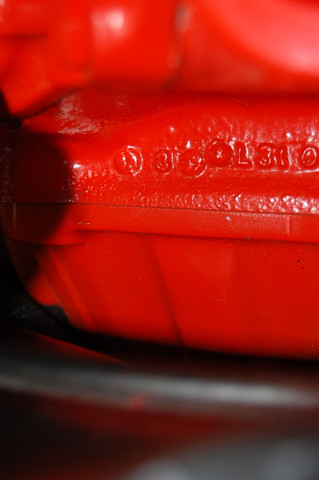
Here a typical sb casting date from the early 70s.
L31 0
January 31st, 1970.
It looks to me like there is more to the casting date that's hidden in your photo.
Regards,
Alan
An engine block with a stamp pad in that shape wasn't being cast in 1971.
The mold didn't exist.
Here a typical sb casting date from the early 70s.
L31 0
January 31st, 1970.
Thread Starter
Heel & Toe
Joined: Feb 2017
Posts: 17
Likes: 0
From: Saskatoon Saskatchewan
Casting number is 14016379, which I've read is 1979 and later. However, I emailed GM Heritage Centre and they said that code could also be correct for 1978. They also said "odd" things happened at factory where markings are missing or in different spots. Everything is still unclear. Any other way to prove that is the correct block?