When you click on links to various merchants on this site and make a purchase, this can result in this site earning a commission. Affiliate programs and affiliations include, but are not limited to, the eBay Partner Network.
I've found a couple of discussions through Google (vette427-sbc here was most useful: https://www.corvetteforum.com/forums...n-my-69-a.html) but I was wondering if anyone else has tackled this job? My brakes got a bit hot last weekend...:
the problem you will have is ducting air to the center of the rotor which is one reason the fast vintage guys remount their calipers to the rear of the spindle, proper pad material and hi-temp brake fluid is also a big deal.
You can weld a 3" or even a 2-1/2" piece of exhaust pipe to the back of the shield behind the front disk. Attach the ducting to this pipe. The issue is how to route this to the front of the car to get air flow to and thru it. Have to be a bit creative. Another thing you can try is to put titanium plates behind the brake pads. This idea is to prevent heat from migrating thru the pistons to the fluid. The old J56 brakes had insulated pistons. Vette Brake has some insulated pistons. Are they to the caliber as the older versions - probably not but for some short track time they might be worth a try. As recvetracr said, proper brake pads and proper brake fluid are critical.
While the stock brake calipers work OK. I have found that the newer Wilwood D8 calipers work better for this application. They are made from aluminum, which dissipates heat faster. The pistons are stainless steel which inhibits heat transfer. The O ring seal is much superior design.
From: I tend to be leery of any guy who doesn't own a chainsaw or a handgun.
As gg521 mentioned, putting some insulating material between the pad and the pistons helps reduce the heat transfer. I use 304 stainless steel material cut into the shape of the pad. The thermal impedance of 304 SS is nearly identical to titanium (some charts show that 304 is better than titanium), and stainless material is less expensive and easily available in different thicknesses. As the pad material wears down I just swap in thicker SS shims.
I just use my plasma cutter to cut out the shims, and then some touch-up with a bench grinder gets me all the shims I need.
I used 3 inch ducting and 600 degree fluid in preparation for the first weekend of SCCA racing at our local track years ago. I had also installed hoosier R1 road racing slicks 295/17 fronts and 335/17 rears.
I had a 7500 rpm 383 solid roller motor at the time with a tko 600 5 speed 4.11 rear end 11.5 pound flywheel.
Local track is 4.3 miles around with a long main straight where I could get up to nearly 150 mph. In my first practice session I went out and ran a couple of easy tire warm up laps to scrub the tires in, then a couple of 90% laps to get the feel of these wide slicks. Then I did a full on lap and my brakes had a complete failure from boiling over. without brakes I just yanked the wheel causing my vette to do a series of 360 loops to scrub off some speed before flying off into the gravel traps. It scared me so bad that I packed up everything and went back to the drawing board.
I ended up buying big willwoods with the mounting kits. For the front I use GT aluminum hat 13.06 X 1.25 rotors . The big piston area and the thermlock option made them heat proof.
I can't say enough good things about never having to worry about brake failure. I now use the BP30 pad compound. Unless you are bound by some rule book you might as well get the best. They have been on my Vette now for more that 12 years and I won the region in VP1 scca class one of the following years with a 427 ci SBC
the problem you will have is ducting air to the center of the rotor which is one reason the fast vintage guys remount their calipers to the rear of the spindle, proper pad material and hi-temp brake fluid is also a big deal.
I would like to know more about moving the calipers to the rear.
Is it just swapping the calipers and brackets to the other side?
Do the brackets need trimming to clear the steering arms?
Does the hose length change?
Will the J56 braces still work?
Any advice from someone who has done this would be appreciated.
the problem you will have is ducting air to the center of the rotor which is one reason the fast vintage guys remount their calipers to the rear of the spindle, proper pad material and hi-temp brake fluid is also a big deal.
Thanks! Better pads and brake fluid have been ordered. I got pad fade after just a few laps, and foolishly didn't slow to let them recover, boiling the fluid in just a couple more laps and sending the pedal to the floor...
Originally Posted by gg521
You can weld a 3" or even a 2-1/2" piece of exhaust pipe to the back of the shield behind the front disk. Attach the ducting to this pipe. The issue is how to route this to the front of the car to get air flow to and thru it. Have to be a bit creative. Another thing you can try is to put titanium plates behind the brake pads. This idea is to prevent heat from migrating thru the pistons to the fluid. The old J56 brakes had insulated pistons. Vette Brake has some insulated pistons. Are they to the caliber as the older versions - probably not but for some short track time they might be worth a try. As recvetracr said, proper brake pads and proper brake fluid are critical.
While the stock brake calipers work OK. I have found that the newer Wilwood D8 calipers work better for this application. They are made from aluminum, which dissipates heat faster. The pistons are stainless steel which inhibits heat transfer. The O ring seal is much superior design.
Yeh, that was my plan with the ducting. I'll look into the insulated pistons and backing plates, thanks! I'd love the Wilwood calipers even just from a weight perspective, but am having trouble justifying the cost to benefit, and may just go for bigger brakes while I'm at it if I'm laying out the money for the calipers.
Originally Posted by 69427
As gg521 mentioned, putting some insulating material between the pad and the pistons helps reduce the heat transfer. I use 304 stainless steel material cut into the shape of the pad. The thermal impedance of 304 SS is nearly identical to titanium (some charts show that 304 is better than titanium), and stainless material is less expensive and easily available in different thicknesses. As the pad material wears down I just swap in thicker SS shims.
I just use my plasma cutter to cut out the shims, and then some touch-up with a bench grinder gets me all the shims I need.
Great to know! Are you running ducts at all? What pads and other changes do you use on your car?
Originally Posted by gkull
I used 3 inch ducting and 600 degree fluid in preparation for the first weekend of SCCA racing at our local track years ago. I had also installed hoosier R1 road racing slicks 295/17 fronts and 335/17 rears.
I had a 7500 rpm 383 solid roller motor at the time with a tko 600 5 speed 4.11 rear end 11.5 pound flywheel.
Local track is 4.3 miles around with a long main straight where I could get up to nearly 150 mph. In my first practice session I went out and ran a couple of easy tire warm up laps to scrub the tires in, then a couple of 90% laps to get the feel of these wide slicks. Then I did a full on lap and my brakes had a complete failure from boiling over. without brakes I just yanked the wheel causing my vette to do a series of 360 loops to scrub off some speed before flying off into the gravel traps. It scared me so bad that I packed up everything and went back to the drawing board.
I ended up buying big willwoods with the mounting kits. For the front I use GT aluminum hat 13.06 X 1.25 rotors . The big piston area and the thermlock option made them heat proof.
I can't say enough good things about never having to worry about brake failure. I now use the BP30 pad compound. Unless you are bound by some rule book you might as well get the best. They have been on my Vette now for more that 12 years and I won the region in VP1 scca class one of the following years with a 427 ci SBC
Thanks gkull. This was my first time on a larger circuit, my brakes have been fine on the shorter and/or lower speed events I've been doing up until now. It was also my first on proper semi slicks. This track has me doing similar speeds to what you describe, and my car isn't a lot different either. I'm hopeful I can get acceptable performance from what I have without going down the big brake $ path, but time will tell. Probably didn't help that the weather was about 97F also...
Last edited by Metalhead140; Dec 22, 2017 at 08:22 PM.
The room is limited for a street car, so I use 2" duct instead of the preferred 3" duct but I was to get it routed to the front of the car without any major modifications. I welded some exhaust pipe onto the factory dust shield to feed the air to the center of the rotor.
The room is limited for a street car, so I use 2" duct instead of the preferred 3" duct but I was to get it routed to the front of the car without any major modifications. I welded some exhaust pipe onto the factory dust shield to feed the air to the center of the rotor.
Excellent, thanks! I had been considering whether 2" duct might be sufficient, and more easily routed. Does your duct not get squashed passing the swaybar there? My tyre rubs the front swaybar when approaching full lock.
Excellent, thanks! I had been considering whether 2" duct might be sufficient, and more easily routed. Does your duct not get squashed passing the swaybar there? My tyre rubs the front swaybar when approaching full lock.
I'm running 245/17's up front and haven't had any issues rubbing. It's a little hard to tell in the photo, but the hose is really close to the a-arm. It's actually strapped to the lower a-arm to keep it out of the way. After that photo, I also added some more of the black plastic tubing to prevent rubbing & damage to the orange brake duct. The black tubing is just Shop-Vac tubing, nice and pliable but pretty tough material .
Also the ducts I used were small enough they tucked up behind the grills without affecting head light operation. Most people never realize they are even in there, which is what I was going for. I haven't warped a rotor since I installed the ducts. Not the best, but for a dual purpose street / HPDE car I'm happy with how they turned out.
Excellent! I'm aiming for something very similar, I prefer people underestimate my old street car. Do you block them at all for street use? I had thought that if I'm going to a more aggressive pad (that may not work as well when cold) that I may not want the brakes being cooled when I'm not at the track.
Last edited by Metalhead140; Dec 23, 2017 at 01:41 AM.
My 6t8 with the original calipers had continuous brake failure problems during HPD events. Upgraded to Wilwood calipers, 12" rotors and 600* fluid. A lot of the brake problems went away, but after a tight corner the next corner I had very low to no pedal. Read an article in Hot Rod mag. about the F-bodied Mustangs having brake pad knock back causing the same problem as I had. If you note mine is a 68 which is the last year of the small spindle vettes [65 to 68]. Got some spindles and hubs from a 75 and during assembly the dust shields were not put on to allow more air to the rotor. Brake problems are gone and I can trust them now. Temp readings back in the pits are mid to high 300s depending on ambient temperature and have not cracked or warped a rotor since. T
My 6t8 with the original calipers had continuous brake failure problems during HPD events. Upgraded to Wilwood calipers, 12" rotors and 600* fluid. A lot of the brake problems went away, but after a tight corner the next corner I had very low to no pedal. Read an article in Hot Rod mag. about the F-bodied Mustangs having brake pad knock back causing the same problem as I had. If you note mine is a 68 which is the last year of the small spindle vettes [65 to 68]. Got some spindles and hubs from a 75 and during assembly the dust shields were not put on to allow more air to the rotor. Brake problems are gone and I can trust them now. Temp readings back in the pits are mid to high 300s depending on ambient temperature and have not cracked or warped a rotor since. T
I have a 68 too and have changed to the larger front spindles. I also have the J56 caliper stiffeners. However, depending upon the track and the corner type, I still experience some piston knock back from time to time. I have modified my driving style to tap the brake pedal with my left foot long before a corner.
Excellent! I'm aiming for something very similar, I prefer people underestimate my old street car. Do you block them at all for street use? I had thought that if I'm going to a more aggressive pad (that may not work as well when cold) that I may not want the brakes being cooled when I'm not at the track.
I do not think it is necessary to block them off when on the street. The correct pad selection is the thing.
I have a 68 too and have changed to the larger front spindles. I also have the J56 caliper stiffeners. However, depending upon the track and the corner type, I still experience some piston knock back from time to time. I have modified my driving style to tap the brake pedal with my left foot long before a corner.
I still find myself doing the same thing, by the way what gave you the idea of the knock back being the problem and bigger spindles ? It's strange that other drivers haven't had the same problem with knock back. When on the track I'm running 18x9.5 front wheels with slicks and sometimes the pedal is lower than it should be [depending on how tight the corner is] and a quick tap on the pedal and it's up again. T
Excellent! I'm aiming for something very similar, I prefer people underestimate my old street car. Do you block them at all for street use? I had thought that if I'm going to a more aggressive pad (that may not work as well when cold) that I may not want the brakes being cooled when I'm not at the track.
I have never blocked them off, but I don't drive it anymore in cold weather either plus I'm not using racing compound pads. I currently use Hawk HP Plus pads with good results. They are a decent street/HPDE pad (can achieve repeatable over 1g braking with no fade).
Last edited by Jason Staley; Dec 25, 2017 at 06:59 AM.
Thanks all. Interesting discussion on pad knock back - I'll pay attention to see if I can notice it next time out, it may have been the cause of the variable pedal height I experienced before the brakes overheated. I have ordered some ducting and will post up what I end up with when it arrives.
From: I tend to be leery of any guy who doesn't own a chainsaw or a handgun.
Originally Posted by Metalhead140
...........
Great to know! Are you running ducts at all? What pads and other changes do you use on your car?
...
Room near the spindles is really tight in my case. I'm running a '96 C4 suspension up front (but with 11.75" rotors so my stock C3 wheels can still fit), and I have yet to figure out how to get a duct hose snaked into there. So the setup I'm using is some aluminum and plastic sheet attached to the lower A-arm, formed in the shape of a spoiler/ramp, to divert undercar air towards the center of the brake rotor. In addition to that I'm running SS shims between the pads and pistons (with Wilwood calipers) to impede heat flow to the caliper, and hi-temp brake fluid. The Pace car front spoiler also helps to pull air from the wheels/rotors due to the side shape of the spoiler, which directs frontal air sideways, causing a low pressure area at the outer sides of the front wheels.
I'm using Wilwood pads (B compound) that work very well, although they are a bit rough on the rotors.
I've been digging through my old photos of my actual duct work. I have been using Photobucket for ever and you can't copy all your pictures off their site. It saves them as an unusable format.
But anyway, on the front I had NACA screened scoops from I think speedway motors, three inch hoses, I ovalled a three inch pipe directing air to the center of the rotor. three inch is twice the air of a 2 inch setup and I had very little in the way of bends, it was kind of rounded curve from the front.
These pictures I had it all apart to regrease the bearings. You have to use high temp bearing grease because so much heat gets transferred to the spindle that the grease melt and comes out







 Brake ducts





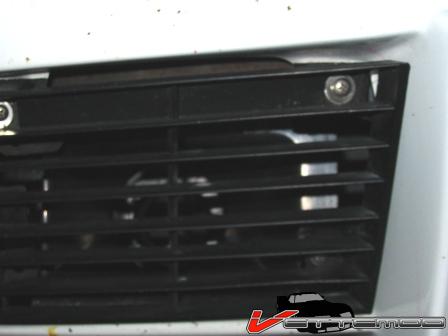
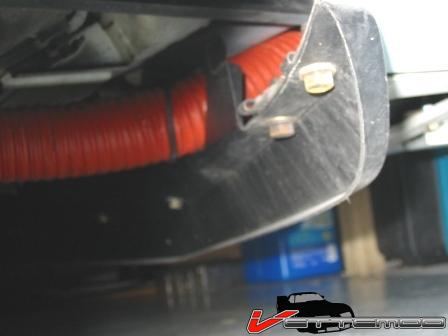
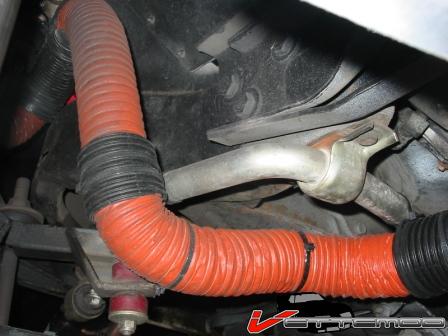
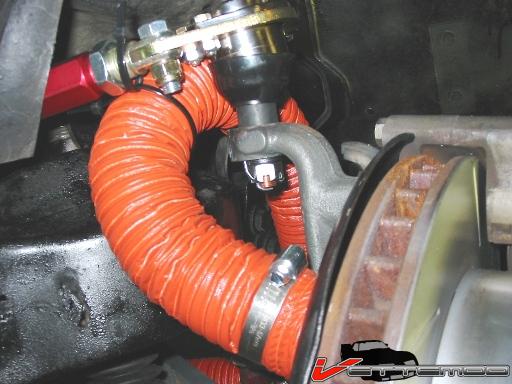









 .
. Do you block them at all for street use? I had thought that if I'm going to a more aggressive pad (that may not work as well when cold) that I may not want the brakes being cooled when I'm not at the track.


