When you click on links to various merchants on this site and make a purchase, this can result in this site earning a commission. Affiliate programs and affiliations include, but are not limited to, the eBay Partner Network.
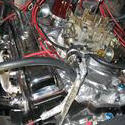
I installed my cheap ebay catch can on my PCV system. I first put a Mopar style breather with nipple on the valve cover. The breather is baffled and has filter material in it that will catch a lot of the oil and vapors before they reach the PCV valve. I installed the PCV valve on the nipple and then ran a hose from the PCV valve to the catch can. From the catch can it goes to the back of the carb's vacuum port.
I modified the catch can a little because the way it was, both the inlet and exit had tubes that ended at the same height. I shortened the exit tube and lengthened the inlet tube so whatever mist comes in is below the exit.
This system should keep most of the garbage out of my intake and off my valves.
Mike
Last edited by v2racing; Jan 17, 2018 at 01:04 AM.
Does your return line have a restrictor? Have you drained the catch to see what is going in or is it to cold up your way to test right now?
Snow, ice, salt, and cold. Not running quite yet anyway. The return line on the fuel pressure regulator does have a restrictor in it. I'm starting with a .050" orifice and we'll see how that works. I have more 3/8" brass plugs to make jets if I need.
Snow, ice, salt, and cold. Not running quite yet anyway. The return line on the fuel pressure regulator does have a restrictor in it. I'm starting with a .050" orifice and we'll see how that works. I have more 3/8" brass plugs to make jets if I need.
Mike
On adding a return to a Camaro I used holley jets. Years ago I bought the jet box that had like 4 of every number from 40 to 108. It seems to me that to maintain 7 psi that it took one of the smallest jets feeding into a 1/4 inch stainless line that we added to feed back to the bottom of the gas tank.
It's 60 at my house and dry. I was out cruising around on errands in my vette the other day. They don't salt here. They really haven't even had black ice yet this year. Very little snow even in the mountains.
On adding a return to a Camaro I used holley jets. Years ago I bought the jet box that had like 4 of every number from 40 to 108. It seems to me that to maintain 7 psi that it took one of the smallest jets feeding into a 1/4 inch stainless line that we added to feed back to the bottom of the gas tank.
It's 60 at my house and dry. I was out cruising around on errands in my vette the other day. They don't salt here. They really haven't even had black ice yet this year. Very little snow even in the mountains.
My Mallory 140 GPH pump sends 12 psi up to the regulator. It's enough pump for around 700 horsepower, so it I think I should be good with the .050" bypass. I have .130" needle and seats, so I think I can run down around 6 psi from the regulator and feed my engine at WOT. I haven't dynoed it but figure it at around 600 HP, maybe a little over.
You're lucky with the weather and no salt. I think you could measure the amount of salt they put down here in inches like snow. It's just crazy.
That blue vinyl line will get very soft when it gets hot under the hood. Then it’ll collapse under vacuum.
I use PCV or fuel line to keep this from happening.
That blue vinyl line will get very soft when it gets hot under the hood. Then it’ll collapse under vacuum.
I use PCV or fuel line to keep this from happening.
I've used it before without issue, but I will keep an eye on it. Thanks.
My Mallory 140 GPH pump sends 12 psi up to the regulator. It's enough pump for around 700 horsepower, so it I think I should be good with the .050" bypass. I have .130" needle and seats, so I think I can run down around 6 psi from the regulator and feed my engine at WOT. I haven't dynoed it but figure it at around 600 HP, maybe a little over.
You're lucky with the weather and no salt. I think you could measure the amount of salt they put down here in inches like snow. It's just crazy.
Mike
the 6 or less psi will work great with larger needle and seat. the reason I went so small on the line and the restrictor was to keep from sending large quantities of high velocity fuel back into the gas tank. I didn't want to be vaporizing the gas and just having it evaporate away through the tank vent.
If you have a 3/8th line with little restriction and 6 psi at the fuel log. that can be a bunch of gallons per hour going back to the tank. It was always a balancing act back when I was working on alki Hilborn mechanical fuel injections with low speed and high speed bypasses. Instead of routing it all back into the fuel cell it was also plumbed back into the input to the fuel pump
the 6 or less psi will work great with larger needle and seat. the reason I went so small on the line and the restrictor was to keep from sending large quantities of high velocity fuel back into the gas tank. I didn't want to be vaporizing the gas and just having it evaporate away through the tank vent.
If you have a 3/8th line with little restriction and 6 psi at the fuel log. that can be a bunch of gallons per hour going back to the tank. It was always a balancing act back when I was working on alki Hilborn mechanical fuel injections with low speed and high speed bypasses. Instead of routing it all back into the fuel cell it was also plumbed back into the input to the fuel pump
Being that it's a .050" orifice going into a -6 3/8" line, it will be running pretty slowly back into the tank. Should cause any aeration of the fuel.
I used to run the returns on the mechanical systems on the nitromethane burning Top Fuel bikes back to the tank. Never had any issues with aeration or fuel starvation. The fuel systems now have gotten much bigger and a lot of fuel is returned to the tank, more than we used to return. I was just talking to a friend of mine who has the fastest Top Fuel bike in the world, Larry "Spiderman" McBride, about his fuel system. He has a -20 AN line, frickin huge, from the tank to the pump. He returns all the fuel directly into that large supply line to insure against aeration. Any loss of fuel supply on that blown engine would be instant disaster.
it might be ok on 3/8" line, but I use 1/2" and the engine vacuum collapses the hose at that size
The 3/8" line has a thicker wall than the 1/2". The 3/16" line hasn't ever been a problem either. The line for the breather nipple and the PCV valve is 3/4" and is thinner walled. It has no place to collapse the way I have it, but if it were to expand, I could get a leak. I'll just have to watch it close.
Mike
Last edited by v2racing; Jan 30, 2018 at 06:45 PM.
From: Las Vegas - Just stop perpetuating myths please.
Originally Posted by v2racing
I installed my cheap ebay catch can on my PCV system. I first put a Mopar style breather with nipple on the valve cover. The breather is baffled and has filter material in it that will catch a lot of the oil and vapors before they reach the PCV valve. I installed the PCV valve on the nipple and then ran a hose from the PCV valve to the catch can. From the catch can it goes to the back of the carb's vacuum port.
I modified the catch can a little because the way it was, both the inlet and exit had tubes that ended at the same height. I shortened the exit tube and lengthened the inlet tube so whatever mist comes in is below the exit.
This system should keep most of the garbage out of my intake and off my valves.
Mike
Instead of a vacuum port on the carb you could install a drain to the oil pan. It doesn't hurt to take suction off the oil pan and I'm sure it's better than contaminating the intake charge through the carb with oil. Oil contamination greatly lowers the octane of the fuel.
Oil contamination greatly lowers the octane of the fuel.
That's partly what this system is for. There were near zero oil or vapors that will reach the intake. The breather will take a great deal of the oil and vapors out before the PCV. The catch can should take out most of the rest.
I run a catch can on my CTS coupe. It had far more oil getting into the intake than this 406 ever did when all I had was the PCV in the valve cover and going straight to the carb. The intake is staying nice and clean now with the catch can. I ran the 406 on 93 pump gas without detonation even with the 11.8 to 1 compression, so that was not an issue either.
I want the benefits of a PCV system. It pull vapors from combustion out of the crankcase and fresh air in. This keeps the oil much cleaner and in turn, the engine cleaner too. Besides, I cannot stand the smell of crankcase fumes. I have a very touchy nose.
Mike
Last edited by v2racing; Jan 21, 2018 at 03:14 PM.
Nice setup. I am using the Jegs Aluminum catch can and the M/E Wagner adjustable PCV valve. I end up with about a tablespoon of oil per a tank of gas in the catch can at most (usually less).













 PVC system catch can