When you click on links to various merchants on this site and make a purchase, this can result in this site earning a commission. Affiliate programs and affiliations include, but are not limited to, the eBay Partner Network.
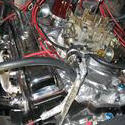
Updated with picture of FIRST intake after getting it ceramic thermal barrier coated:
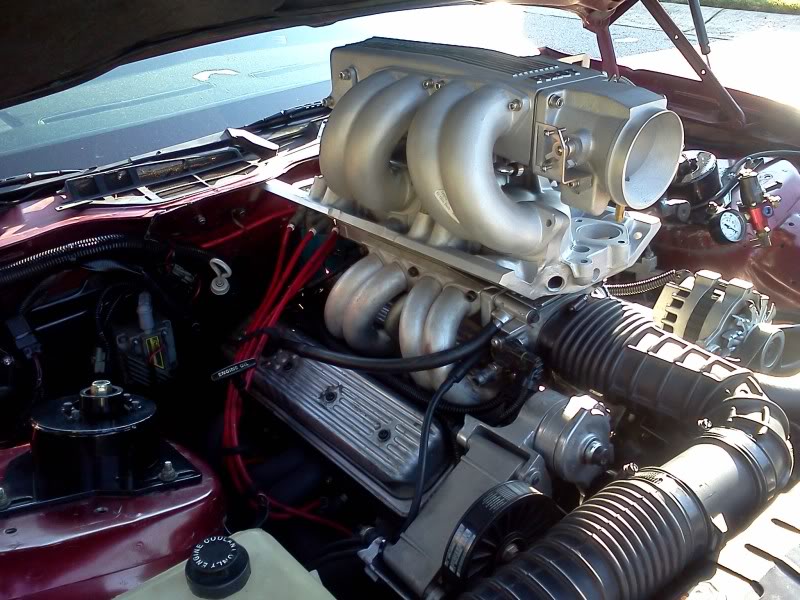
My FIRST intake finally arrived all ported and blended nicely by Ken. This thing is an absolute BEAST. It's definitely not a weight-saving intake; lol!
F.I.R.S.T. Fuel Injection Intake mocked up on heads:
FIRST on heads top-down:
Monsterous scale aside, I've got a few questions about the passenger's side ports and gasket.
Question #1: There's an odd port in the middle of the head that's covered by the gasket; my guess would be an exhaust gas cross-over except the port doesn't go over to the other side of the intake at all; the other side has no such hole. -What is this hole and any ideas on why it would be covered like this?
Question #2: At the back of the intake on both the driver's side and the passenger's side there's no holes for coolant flow; my Profiler heads have coolant ports there that will now just run into a wall. --What should I make of this? Assuming this is normal but I don't understand how coolant is supposed to flow in these engines, nor what the impact is...
Thanks,
Adam So... Shiny!<br/>Note: Disassembling the throttle body is strongly discouraged by Ken@ FIRST as it's difficult to re-assemble correctly and it's got the heavy duty locktite installed on the throttle body blade screws and the shaft screws on the side. I managed it by taking immaculately detailed photos and with a little bit of luck, I think.
Last edited by NewbVetteGuy; Feb 26, 2018 at 02:38 PM.
I’ll throw a Hail Mary up on the rear coolant ports. Because heads are not side specific if you were to flip them left to right the rear ports become front ports. Without them heads would be left right specific and therefore manufacturers would need 2 castings.
Most aftermarket intakes do not have the rear coolant cross over. Some drill/tap the intake and run lines front to back.
Runners are 1.75" inside diameter and can be opened to 1.85" ID. (The stock TPI runners are 1.475 to 1.480" ish...)
Also shorter runners vs. TPI (14.25" intake+5" profiler head intake tract= 19.25" plenum-to-valve vs 22.25" (I'm doing this from memory for GM TPI).
More plenum area, too and a bigger 850 CFM throttle body.
Ken@ FIRST fuel injection opened up the ports to a Felpro 1206 to match them perfectly to my Profiler 195s.
WAY more airflow (296 CFM on the crappy runner and over 300 CFM on the others).
You can checkout 1989GTATransAm's build on ThirdGen.org for what's possible; he got 420 RWHP @ 6,350 RPM and 417 ft lbs RWTQ in a 368 with 11:1CR and AFR Comp 195s and a 228/228 deg @ 0.050" roller cam; he went nuts with his build and went with custom siamesed runners, though, which is why his torque is down. I have no intentions to trade torque for HP. I want the torque. [Adam Edit] Updated cam to be accurate (used to say "288/288 deg @0.050") lol!)
Adam
Last edited by NewbVetteGuy; Jan 22, 2018 at 04:42 PM.
lower rad hose->Water pump->front of block->around cylinders towards rear of block->through head gasket at rear of block->into rear of heads->forwards inside heads to front coolant port of heads->intake->thermostat->upper rad hose
Left & right heads are the same casting so you get coolant ports in the rear although they don't do anything.
lower rad hose->Water pump->front of block->around cylinders towards rear of block->through head gasket at rear of block->into rear of heads->forwards inside heads to front coolant port of heads->intake->thermostat->upper rad hose
Left & right heads are the same casting so you get coolant ports in the rear although they don't do anything.
Thanks Zwede that provides perfect clarity. Great reply; appreciate it!
I took apart the intake today to get it ready to go to get a thermal barrier coating applied all the way around the outside.
I want a polished metal look but the # of hours to polish this honestly pretty rough casting down to the shine I like is just astronomical AND then every 18 months or so it would need to be polished again. The coating should help with air intake temps a little bit and also make it maintenance free.
I'm taking it to the place that coats Stan's Headers for them. I'm hoping that the brass-looking vacuum tubes that are installed can stay because I'm gonna be really freaked out if they can't.
Do you have a picture of the top of the intake base without the plenum and runners in place? That's the exhaust crossover - my best guess is for EGR. I am having trouble finding photos of a FIRST base manifold and the runners obfuscate any view I could get of it.
The stock TPI setups took exhaust from the rear of the manifold via tubing from a pad on the manifold to the passenger side exhaust pipe (at least on the L98 'vettes).
Perhaps the gigantic runners on the first made this a no go?
You can tell from this photo that the port goes somewhere, but I can't see where:
Note that each one of the intake manifold runner ports comes out in a siamesed pair, but there's 3 on the side with the exhaust port, with the one by the port not quite sitting on the same plane as the two going to the intake port.
I'm very curious to see what's hiding under the plenum!
I also found a picture of the FIRST intake base, it's the manifold on the lower left:
Looks like that's a pipe fitting (near center of the intake lengthwise, slightly to left from our perspective) that connects to an EGR valve on the plenum. Now to find a picture of the plenum and figure out how the EGR works.... or maybe you can share that too?
I also found a picture of the FIRST intake base, it's the manifold on the lower left:
Looks like that's a pipe fitting (near center of the intake lengthwise, slightly to left from our perspective) that connects to an EGR valve on the plenum. Now to find a picture of the plenum and figure out how the EGR works.... or maybe you can share that too?
Great sleuthing. You're correct. The EGR port on the manifold base came to me from Ken with a black aluminum fitting in it and a high temperature gaskets that's got high temp silicone on it already. I've seen one or two FIRST intakes using EGR and if I'm interpreting correctly what I've seen most people use the side-mount throttle body blockoff plate for EGR in. (You can front or side mount the throttle body; the side mount comes with an aluminum plate on it that says "TPI" on it- I've seen a few people with what loos like the EGR tube off of their exhaust manifold / headers going into this plate and silversoldered into the "TPI" plate. (Looked like they just drilled a hole in the removeable plate, inserted the EGR tube and soldered it in.)
Does the head have a matching passageway coming from the exhaust port?
I suspect not which means you don't need to worry about the passage on the intake. But, if the heads do have the passage then I'd use a metal block off plate in the intake gasket unless you actually want to use EGR.
It doesn't appear the intake can mount a typical GM EGR valve when looking at that plug.
Does the head have a matching passageway coming from the exhaust port?
I suspect not which means you don't need to worry about the passage on the intake. But, if the heads do have the passage then I'd use a metal block off plate in the intake gasket unless you actually want to use EGR.
It doesn't appear the intake can mount a typical GM EGR valve when looking at that plug.
The heads don't have a matching exhaust port and I wouldn't use it even if it did. I just wanted to understand what everything on the intake did and that bit was a mystery to me.
I kinda wish I would've bought headers that had EGR ports on them, but I did not so no EGR for me. -I base that comment on wanting to maximize fuel economy, but I've been told on SpeedTalk that configuring my EFI with Lean Cruise will get me nearly identical fuel economy to EGR on the highway(although obviously with far more smog emissions; I don't have to pass smog emissions so a good trade-off as far as I'm concerned.).
On the fuel economy front, I've got:
Long runners with plenty of cruise RPM torque, sequential multiport injection (with Bosch 4s), a highly accurate ignition system (58x hall effect crank trigger wheel & LS truck coil-near-plug), 272/280 Advertised (0.006") cam, 10.2:1 CR, 8.38 DCR, 355 rear gears, & a 4L60e with a low OD gear and a lockup torque converter and the ability to control the shift points and lockup strategy in the computer (I've mounted a toggle switch on the console to switch between eco and performance shifting strategy, too.), 200 lbs weight reduction, a lowered ride height, and I'll be tuning for lean cruise mode with a knock sensor so I can safely tune for maximum MPG @ Cruise.
Where I think I went wrong for my build: Headers; I wish I would've gone with a set of Stan's 4:2:1/ Tri-Ys with EGR ports welded in instead of my $274 Flowtech "coated" headers that started rusting after 3 trips.
I also refuse to and can't compromise on the tires; I'm going to need wide, soft & sticky tires to not throw the thing into the ditch with all the torque, so I'll have to take the fuel economy "hit" there.
Adam
Last edited by NewbVetteGuy; Jan 22, 2018 at 05:03 PM.
I'd much rather have the cooler intake without the port if I could get away with it.
I'm not sure how much real value the EGR adds in terms of fuel efficiency. If you have any overlap with your cam, you'll get a little bit of natural EGR anyway. They moved away from EGR in the LS motors in the early 2000s and it had pretty much disappeared from GM gasoline V8s by 2006/7.
It really comes back to the byproducts of combustion. CO and HC are minimized around stoichiometric. Richer mixtures decrease NOx but increase CO. So they lower NOx by cooling down the combustion temp via inert gas injection (EGR).
Another thing benefiting the LS motor is more efficient head design, tighter quench and significantly better fueling control - all things that will summarily reduce NOx.
You should be having fun when it's all done. Those FIRST intakes are going to be very torque happy. Invest in a tire company...
I'm not sure how much real value the EGR adds in terms of fuel efficiency. If you have any overlap with your cam, you'll get a little bit of natural EGR anyway. They moved away from EGR in the LS motors in the early 2000s and it had pretty much disappeared from GM gasoline V8s by 2006/7.
Good point!
I'm not sure I did the calculation correctly, but I tried to calculate my overlap based upon my 272/280 advertised durations and I ended up with 56 degrees of overlap with a 110LSA, so maybe I've got a good bit of "natural EGR" anyway (although overlap is probably an EGR that DECREASES fuel economy vs increasing it...).
(272+280)/4=138
138-110=28
28x2=56 degrees
When I first calculated my overlap is when I first started thinking that I should've gone with a Tri-Y exhaust given my goals. (As the Tri-Ys naturally resist reversion and will help keep the bottom-end torque and fuel economy at my low cruise RPMs up.)
Adam
Last edited by NewbVetteGuy; Jan 22, 2018 at 08:13 PM.
From: Las Vegas - Just stop perpetuating myths please.
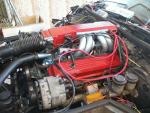
Awesome looking piece. Now you need a see through hood to show it off.
Yes you have 56* of overlap and that's on the large side for a street driven car. You have a lot of money in the car now and cams are one of the cheaper parts comparatively. Not to late to switch to a cam on a 112 LSA but you may be to far along to think about it.
Awesome looking piece. Now you need a see through hood to show it off.
Yes you have 56* of overlap and that's on the large side for a street dog riven car. You have a lot of money in the car now and cams are one of the cheaper parts comparatively. Not to late to switch to a cam on a 112 LSA but you may be to far along to think about it.
Nice build.
I tend to agree about the 110lsa vs 112 given my goals but I filled out a super detailed cam spec sheet with Mike Jones; this is a custom hydraulic roller from him and he’s been involved in a number of other long runner builds like this and he thought this was the way to go because I’m using the Holley EFI vs a stock ecu; he said if I was using the stock ECU he’d cut it on a 112 LSA but because I was using the Holley EFI he recommended the 110 LSA.Adam
Last edited by NewbVetteGuy; Jan 23, 2018 at 11:09 AM.
I'm not sure I did the calculation correctly, but I tried to calculate my overlap based upon my 272/280 advertised durations and I ended up with 56 degrees of overlap with a 110LSA, so maybe I've got a good bit of "natural EGR" anyway (although overlap is probably an EGR that DECREASES fuel economy vs increasing it...).
(272+280)/4=138
138-110=28
28x2=56 degrees
When I first calculated my overlap is when I first started thinking that I should've gone with a Tri-Y exhaust given my goals. (As the Tri-Ys naturally resist reversion and will help keep the bottom-end torque and fuel economy at my low cruise RPMs up.)
Adam
I went from 1 5/8 tri Y headers to ARH 1 7/8 full long tubes and GAINED tons of low end torque, as well as power across all rpm. As far as I’m concerned, tri Y headers are more a gimmick.
I went from 1 5/8 tri Y headers to ARH 1 7/8 full long tubes and GAINED tons of low end torque, as well as power across all rpm. As far as I’m concerned, tri Y headers are more a gimmick.
How much HP and how many Cubic inches? Which Tri-Ys? Single diameter 1 7/8" headers or stepped? Cam duration @ 0.050"? Size of exhaust ports & exhaust valves?
Too many variables; not enough constants to determine WHY. (Coorelation != Causation and all that).
Anti-reversion to support the low-end with lots of overlap is good; there are different ways to provide some anti-reversion capability but appropriately sized and length tri-Ys are a good affordable way (or just put a big stall TC in and only use the RPMs that haz the torquez).
Adam
Last edited by NewbVetteGuy; Jan 23, 2018 at 04:57 PM.










 FIRST Intake Arrived; Looking It Over

















 Now you need a see through hood to show it off.