When you click on links to various merchants on this site and make a purchase, this can result in this site earning a commission. Affiliate programs and affiliations include, but are not limited to, the eBay Partner Network.
Was the wheel hot when you checked it out? Partially-applied pads will generate a LOT of heat pretty fast. If the wheel was hot, I'd bet on a deteriorated flex hose. If so, change them all.
I did use my IR gun and found that the affected wheel was at least 100 degrees hotter than the rear.
Again, it could be a collapsed brake hose but in my personal experience in working on cars for 40 years now since a teenager, often a dragging brake is more often than not a result of a frozen brake caliper from age, wear, poor maintenance (changing old brake fluid) or mileage. The statement that the former owner was 80 years old and can't recall maintenance details tells me that the brake fluid could be very old and often will freeze a caliper from the moisture retention within the system. Also, if the car was stored outdoors, I will double down on a frozen caliper guess from weather corrosion.
Within the last 2 years, I have dealt with a a frozen rear caliper on my Chrysler 300 (sits out doors) and a friend;s Ford Expedition with a frozen caliper. Also, about to replace the front calipers on my daughter's 01 Grand Prix (210,000 miles and sits outdoors) that is partially frozen.
I would inspect the caliper carefully, change the brake fluid completely,and replace all rubber lines with SS braided hoses which I have had on my 78 C3 since the early 90's. I have SS braided lines on my Chrysler 300....gives a much firmer linear brake pedal than the ruibber hoses....
Thanks. I have no clue on the age of the brake fluid and will see what I can figure out, The car was never been stored outside, and to my eye, the caliper looks to be fairly new.
Picked up replacement hoses for front and rear. Are they supposed to come with any type of washer or clip? Mine came with neither. DOT 3 brake fluid is fine, correct?
Yes DOT 3 only. Its available in 55 gal drums for C3s.
The better, nicer businesses would include one mounting clip and one copper washer for the front hose only. So, its back to the store for two copper washers and two clips. You can not / should not re-use the washers.
Make sure the copper washers are for brakelines (crush) and not thicker units for something else.
Last edited by HeadsU.P.; Jul 14, 2018 at 03:56 PM.
Yes DOT 3 only. Its available in 55 gal drums for C3s.
Originally Posted by HeadsU.P.
The better, nicer businesses would include one mounting clip and one copper washer for the front hose only. So, its back to the store for two copper washers and two clips. You can not / should not re-use the washers.
Make sure the copper washers are for brakelines (crush) and not thicker units for something else.
I purchased the front set of hoses at NAPA today, and the rears at Advanced Auto. The sales person at NAPA didn't know anything about a crush washer when I asked. Does anyone happen to know which crush washer and clip I would need from either location? I called NAPA and gave them the GM part numbers from the AIM for each, but they didn't pop up in their system. They said they had crush washers in a "few sizes", and a clip that "should work."
If anyone happens to know a NAPA or Advance Auto part number for the clip and washer, I'd appreciate it. Autozone is close by, too. Thanks--
If you are not in a hurry for parts you could go through a Vette vendor for the proper copper washers and clips. Maybe Muskegon Brake, Zip or Keen Corvette or Corvette Central.
I too bought a brake hose from NAPA and the washer was not in the box. They said it should have been so found another. No part number though.
Try NAPA-On-Line for numbers.
Last edited by HeadsU.P.; Jul 14, 2018 at 07:36 PM.
https://www.summitracing.com/search/...8%2B4294947783
These are the clips that hold the one rubber hose end to the frame bracket. You should be able to reuse the original clips if they are still in good shape. Use pliers to pull the retaining clip out, but break loose the end of the metal line first. Use a fitting wrench not just an open end so the fitting doesn't round off it's corners. This is a Dorman product number and the parts person should be able to cross reference it (I would hope). https://www.dormanproducts.com/gsear...+Copper+Gasket
Dorman also the crush washers but don't give applications. The inside and outside diameter of the washer needs to be measured to get the correct dorman part number. Honestly, I didn't think this would be so difficult to just find the hydraulic brake hose washers. I am spoiled because I have an drawer with an assortment of them at work. Most parts stores have a Help line that usually has crush washers. Take the new hose and try to match up the correct washer.
Corvette America - http://www.corvetteamerica.com/part-info?partno=27302.
Willcox - https://willcoxcorvette.com/corvette...iece-set-53-82.
Vendors don't list the dorman part number so you don't just take that number to Napa.
How were you able to tell that the ports had been blocked? Because I've never worked on Corvette brakes before, I'm trying to picture how I would know that after removing the hose. Is it because no fluid came out of the bleeder?
I replaced the hose and did a trial bleed on the caliper. No fluid came out and I knew it was flowing ok thru the brake hose so there was a blockage somewhere in the caliper itself.. I pulled the caliper off and disassembled it. There were bits of hose in the piston chambers. Blew out the ports with compressed air to get rid of the trapped debris. Rebuilt the caliper and now everything is ok. A second option if you don't want to rebuild the caliper would be to just put the halves back together and trade it in at an Autozone or O'Reiley's, etc for a new rebuilt with all new pistons and hardware, etc. I already had a seal kit and the caliper was stainless steel sleeved and still like new inside so I opted to just rebuild it.
The copper crush washers are a generic brake part. All parts stores should have them in various sizes. You just have to match it up to your hose's thread diameter same as you would match up a flat washer to a bolt. Take the hose with you. The one that fits over the hose threads with a minimum of slop is the right one. Buy two or three in case you have to take the caliper back off for any reason. They are not a very expensive item.
If your calipers have been sleeved, don't trade them in at a local auto store. You may get back a unsleeved calipers made off shore. If you have Delco Moraine calipers, keep them. Rebuild kits are available and not difficult to install. I like to clean the caliper passageways with denatured alcohol and large pipe cleaners or gun cleaning brushes. I finish up with clean, dry compressed air. Don't forget to put the O-ring in between the two halfs. You should be able to get the copper washers at NAPA, just bring in the hose and they will be able to match it up with generic washers in stock. Lastly, you can use Dot 3 or Dot 4 brake fluid. Dot 4 has a higher boiling point then Dot 3. You can mix the two. Jerry
I finally got everything I need for the job and started by getting the entire car off the ground.
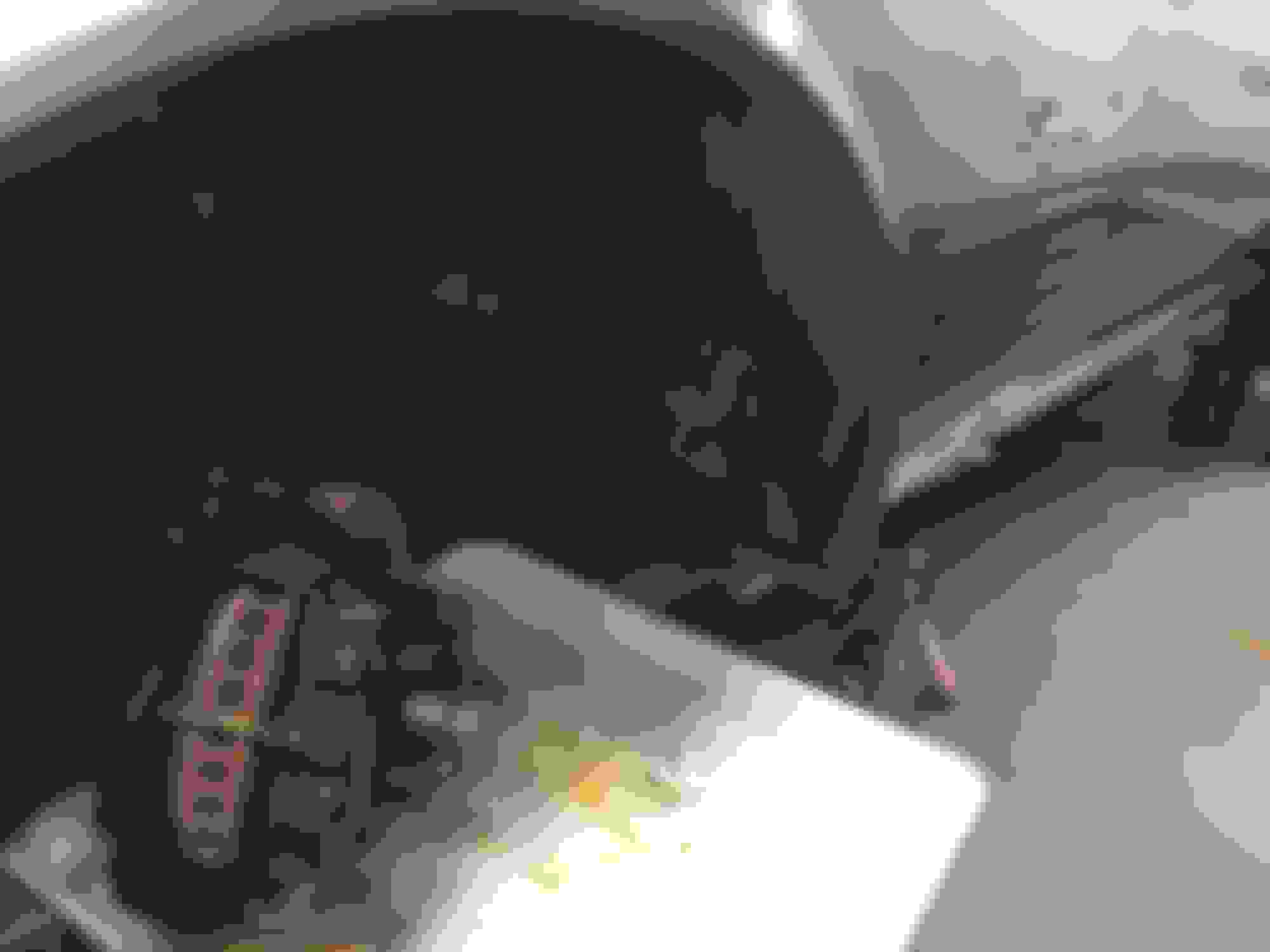
Hit the brake line connections with some penetrating oil, opened the Master Cylinder, sucked some old fluid out with a turkey baster, put some new fluid in, closed it back up then proceeded to try to crack the brake line fitting where it meets the brake hose on the driver's side. My 3/8 inch line wrench had a lot of play on the fitting. Thinking it might be my cheap Harbor Freight wrench, I grabbed a 3/8 inch Craftsman open end wrench, just to check the fit, and it had about the same amount of play. Looking closer at the fitting, it doesn't look so hot. Maybe someone grabbed it with vise grips at some point?? Here's a shot of the fitting:
Without replacing that brake line, I'm dead in the water, correct? Unless I too, take a pair of vise grips to it? The line itself looks easy to replace as it's a very short section of line. Also, where the other end attaches to the Switch Assembly, that fitting looks like it hasn't been touched since it came off the factory floor.
What's involved in replacing that line? Does that portion of the Master Cylinder have to be drained? If so, what does that entail, exactly? Do I have to do anything special with the Switch Assembly? Will the brake light come on? Any pitfalls to watch out for? Sorry for all the questions, but I'm a novice at this stuff.
When I encounter that, I put a fitting wrench on, then I put tight vice grips on over the fitting wrench, to pinch it to the fitting nut. Usually that gets things loose without doing any further damage.
If you have a good quality flaring tool, You could cut the flare off as close as possible to the flare, pull the damaged nut off and slide a new coupling nut on and make a new flare. Although looking at the picture again, it's so close to a bend, that might not be possible.
Last edited by C6_Racer_X; Jul 20, 2018 at 03:45 PM.
Just replace the line. You can get a set or individual lines from any of the major vendors on the forum. Soak the fittings with Liquid Wrench or BP Blaster. The mashed fitting will have to taken off with vice grips. For the other fittings, buy a set of flair wrenches. They are made for the brake fittings and will not round off the fittings. If I remember correctly, the line with the problem is a crossover line which goes under the engine on the frame and is easy to replace. I would also buy an AIM or Assembly Instruction Manual. It will give you diagrams of the major and minor components of your car. When finished, have a trusted mechanic review your work. Jerry
Just replace the line. You can get a set or individual lines from any of the major vendors on the forum. Soak the fittings with Liquid Wrench or BP Blaster. The mashed fitting will have to taken off with vice grips. For the other fittings, buy a set of flair wrenches. They are made for the brake fittings and will not round off the fittings. If I remember correctly, the line with the problem is a crossover line which goes under the engine on the frame and is easy to replace. I would also buy an AIM or Assembly Instruction Manual. It will give you diagrams of the major and minor components of your car. When finished, have a trusted mechanic review your work. Jerry
Thanks Jerry. When I bought the car, I bought the AIM and the other service manuals. I have flair wrenches that I purchased from Harbor Freight. The line to replace is very short and goes right from that Switching Assembly brass "block" mechanism (in my 3rd picture) to the brake hose (driver's side line). Getting it out looks like a piece of cake (famous last words). The part I really have questions about now are what I need to do to that brass block or the MC once the line is removed (or before the line is removed). Thanks.
With this type of project, get the EXACT FIT replacement lines. Not some that are just fairly close. You could Google Corvette brake-lines and compare the vendors photos and prices. Whoever you chose, double check that the armor spring shield is in place on the new units. Try Corvette Central or Corvette America or Willcox.
I don't see any way of not draining the MC when replacing the lines. But a good flush should be done anyway.
The warning light will only come on if you apply the pedal. Use other means to bleed the system: vacuum, pressure, gravity.
Last edited by HeadsU.P.; Jul 20, 2018 at 05:56 PM.
That line was last removed/installed using channel locks or vice grips.
It's gotta come of no matter what so you have nothing to lose by removing it the same way.
It'll likely go right back on via the same tool and just look ugly until you can purchase a replacement.
With this type of project, get the EXACT FIT replacement lines. Not some that are just fairly close. You could Google Corvette brake-lines and compare the vendors photos and prices. Whoever you chose, double check that the armor spring shield is in place on the new units. Try Corvette Central or Corvette America or Willcox.
I don't see any way of not draining the MC when replacing the lines. But a good flush should be done anyway.
The warning light will only come on if you apply the pedal. Use other means to bleed the system: vacuum, pressure, gravity.
Thanks. I just purchased a line from one of the forum's supporting vendors. It is an exact fit piece and has a spring around it.
When you say you think the MC will need to be drained, can I just suck the rest of the fluid out with the turkey baster, or do I need to do something more thorough? Both reservoirs?
I don't know any other way to bleed the brakes, other than the pedal method, although I've seen reference to the gravity method in other threads. Does it make a difference if the pedal is not pushed all the way to the floor during the process? Lastly, has anyone ever written up a step-by-step explanation of how to gravity bleed the brakes? For some reason I thought gravity bleeding was done as a supplement to regular bleeding. Sorry, but this is new to me. I sure do appreciate the help.
Gravity method just means leave the cap off the reservoir and open the bleeders one at a time. The fluid will flow (slowly) with the force of gravity. Useful when you've only opened the caliper end of things.
The "pump the pedal" method with two people, one opening the bleeder, then the other pushing the pedal ⅓ to ½ way to the floor, then the first closing the bleeder, then the pedal pusher releasing the pedal, also works well. The danger with that method with an old master cylinder is that you never want to push the pedal further than a very hard push with a firm pedal. There's often corrosion and "trash" in the master cylinder that will cut the seals (o-rings) in the master cylinder if you push it all the way down. It's like pushing old rubber seals across sandpaper, and it destroys the seals.
The "Pedal Method" has not offered much luck with most C3 owners. The reason for that is the fidgety Proportioning Valve w/ switch. Consider that like a GFCI in your house. The Prop Valve detects a leak, shuts off current (fluid) to part of the system, then notifies you there is a problem via the dash brake light. If you wish to continue using the pedal method to bleed , there is a tool for about $15 to keep the Prop Valve piston centered and the switch in neutral. (Click on my profile and look for my brake photo album)
You would be light years ahead by purchasing a little vacuum pump tool now. That tool will also help you with vac leaks on C3s. You can find them on EBay for $20 or so. A even better tool but more money is the Motive Pressure bleeder. Those can also be found "used" on EBay. But you will have to fabricate a fixture that fits over the MC in place of the lid to use it.
Several members swear by gravity method. Its cheap, no fancy tools required, but on the slow side. Some people manage to bleed all six bleeder fittings at one time.
Also, once the MC is drained dry, technically you have to remove it and bench bleed it in a vice or additional issues will haunt you later. You may be able to install a bench bleeding hose kit fitting quickly as you remove the damaged brake line. Those kits come with plastic hose that is routed into the MC That way the MC can not drain. Do not stick a bolt in the port as a plug. You may damage the flare inside.
Last edited by HeadsU.P.; Jul 20, 2018 at 06:43 PM.