



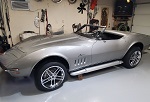

Gas cap

Safety Car


Joined: Apr 2006
Posts: 4,057
Likes: 421
From: BC

If it's not a vented tank you need a vented cap. Not sure what was stock on your 69 Chevelle but 69 Corvette is not a vented tank and requires the vented cap.
Last edited by CanadaGrant; Sep 10, 2018 at 12:19 PM.

Team Owner


Joined: Jan 2006
Posts: 37,637
Likes: 3,118
From: Crossville TN
EVERY system has to be vented in one way or another. Otherwise, the tank would create a vacuum as the fluid was being used. If only the tank was involved, IT would be vented. But, once the vapor recovery systems were added, venting the system at the tank became a liability. In the C3 era, venting 'duties' were assigned to the vapor canister. The tank was connected to the vapor canister with a hose so that fumes could be collected in the charcoal pack. And that charcoal pack was vented to atmosphere after it absorbed those fumes. That was the vent.
Regardless of whether your system has the vapor catch hardware still on it or not, it MUST have a vent somewhere. If you want to capture the fuel vapors, you need a 'catch' system and THAT should be vented. If not, either the tank or the cap could have a vent. But you must have one...somewhere...or your fuel system will not work properly.
Regardless of whether your system has the vapor catch hardware still on it or not, it MUST have a vent somewhere. If you want to capture the fuel vapors, you need a 'catch' system and THAT should be vented. If not, either the tank or the cap could have a vent. But you must have one...somewhere...or your fuel system will not work properly.
Last edited by 7T1vette; Sep 10, 2018 at 10:28 PM.

Racer

Joined: May 2018
Posts: 297
Likes: 43
later models use non vented caps because of the charcoal canister Is supposed to trap fuel instead of venting to air, with your year its most probable that u need a vented cap, if you cannot know for certain if the tank or system ahs ever been repolaced I would just go with a vented cap, better to have it then to need it and not have it, all kinds of nasty problems arise from non vented caps installed where vented is needed, everything from engine dying to crushed tanks and fuel lines
Team Owner
Joined: Jan 2006
Posts: 37,637
Likes: 3,118
From: Crossville TN
If you have a vapor collection system which is operational, that will serve as the vent. If you add a vented cap to that kind of system, your tank will be vented (twice), but the vapor system will be defeated. That C3 vapor collection tank is OPEN at the bottom allowing it to serve as the vent. Exhaust 'air' must pass through the activated charcoal first so that fuel vapors will be captured and held for later disposal.
Racer
Joined: May 2018
Posts: 297
Likes: 43
If you have a vapor collection system which is operational, that will serve as the vent. If you add a vented cap to that kind of system, your tank will be vented (twice), but the vapor system will be defeated. That C3 vapor collection tank is OPEN at the bottom allowing it to serve as the vent. Exhaust 'air' must pass through the activated charcoal first so that fuel vapors will be captured and held for later disposal.

Race Director


Joined: Oct 2000
Posts: 12,679
Likes: 3,130
From: Shamong, NJ
the biggest reason the canister was adopted was not for emissions but because the garage would get a gassy smell from the tanks venting inside a closed garage, not saying the emissions wasn't a factor but it had more to do with pleasing the consumers then from saving the environment.
GM wasn't going to go to the expense of redesigning their gas tanks, designing all of the related plumbing, and installing the charcoal canisters, just because someone's garage might smell like gasoline. GM didn't put an extra penny in a car, unless it absolutely had to.
Last edited by gbvette62; Sep 11, 2018 at 04:40 PM.
Corvette Stories
The Best of Corvette for Corvette Enthusiasts

Top 10 Most Expensive Corvettes Ever Sold on Bring A Trailer
Brett Foote
10 Things Every Corvette Owner Needs (2026 Edition)
Michael S. Palmer
8 Most "Only Corvette Owners Understand" Quirks and Problems
Pouria Savadkouei
10 Reasons the C6 Z06 is Still A Performance Benchmark After 20 Years
Joe Kucinski
How Much Horsepower Every Corvette Engine "LOST" in 1972
Joe Kucinski
Top 10 DOs and DON'Ts for Protecting Your Convertible Top!
Michael S. Palmer
Top 10 Most Explosive Corvettes Ever Made: Power-to-Weight Ratio Ranked!
Joe Kucinski
150 hp to 1,250 hp: Every Corvette Generation Compared by the Specs That Matter
Joe Kucinski
8 Coolest Corvette Pace Cars (and Replicas) of All Time
Verdad Gallardo
Racer
Joined: May 2018
Posts: 297
Likes: 43
Starting in late 69, Federal emission regs made it illegal to vent gasoline fumes directly to the atmosphere. I believe it was written into the EPA's 1970 Clean Air Act.
GM wasn't going to go to the expense of redesigning their gas tanks, designing all of the related plumbing, and installing the charcoal canisters, just because someone's garage might smell like gasoline. GM didn't put an extra penny in a car, unless it absolutely had to.
GM wasn't going to go to the expense of redesigning their gas tanks, designing all of the related plumbing, and installing the charcoal canisters, just because someone's garage might smell like gasoline. GM didn't put an extra penny in a car, unless it absolutely had to.
Team Owner
Joined: Jan 2006
Posts: 37,637
Likes: 3,118
From: Crossville TN
Those local TV ads just mimed the spin from GM to create a better attitude about the EPA-required stuff. OBD-I began in 1981 for Corvettes; vapor canisters were in GM cars in the mid/late '60's.
Race Director

Joined: May 2006
Posts: 18,729
Likes: 2,581
vapor canisters on the Corvette started in 1971, below is the GM Heritage Center document on the 1971, page 147 covers emissions and they have the canister listed.
https://www.gmheritagecenter.com/doc...t-Corvette.pdf
below is the same document for 1970 page 139 covers emissions, no canister.
https://www.gmheritagecenter.com/doc...t-Corvette.pdf
https://www.gmheritagecenter.com/doc...t-Corvette.pdf
below is the same document for 1970 page 139 covers emissions, no canister.
https://www.gmheritagecenter.com/doc...t-Corvette.pdf
Safety Car
Joined: Apr 2006
Posts: 4,057
Likes: 421
From: BC
vapor canisters on the Corvette started in 1971, below is the GM Heritage Center document on the 1971, page 147 covers emissions and they have the canister listed.
https://www.gmheritagecenter.com/doc...t-Corvette.pdf
below is the same document for 1970 page 139 covers emissions, no canister.
https://www.gmheritagecenter.com/doc...t-Corvette.pdf
https://www.gmheritagecenter.com/doc...t-Corvette.pdf
below is the same document for 1970 page 139 covers emissions, no canister.
https://www.gmheritagecenter.com/doc...t-Corvette.pdf
Last edited by CanadaGrant; Sep 12, 2018 at 10:16 PM.
Racer
Joined: May 2018
Posts: 297
Likes: 43
thanks all for the correction, I like learning new things, not so much like learning what I knew was not correct, regs for the obii in 95 state the vapor cannisters were required but California and few other states mandated them in '70 so at least I wasn't totally incorrect, just mostly lol!

Race Director

Joined: Mar 2016
Posts: 14,399
Likes: 8,204
From: Napa Valley California
I've owned many cars, motorcycles and boats with vented caps and never had gas fumes in my garage.
Many times those who have fumes in their garage find it is caused in a problem with their canister, fuel separator or leaking fuel/vapor lines.
Go to the C1 and C2 forums and ask how many have had fuel fumes in their garages and the problem turned out to be solely because they have a vented fuel cap.
Many times it could be a faulty, ill fitting, damaged cap or a cheap Chinese manufactured locking cap that does not seal properly on the tank lip.
Many times those who have fumes in their garage find it is caused in a problem with their canister, fuel separator or leaking fuel/vapor lines.
Go to the C1 and C2 forums and ask how many have had fuel fumes in their garages and the problem turned out to be solely because they have a vented fuel cap.
Many times it could be a faulty, ill fitting, damaged cap or a cheap Chinese manufactured locking cap that does not seal properly on the tank lip.