







750cfm Q-Jet question

Thread Starter
Racer


Joined: Aug 2011
Posts: 429
Likes: 24
From: Charlotte NC
 750cfm Q-Jet question
I'm thinking about dialing back to a 750cfm for street. I'd like to have a Holley but they don't seem to come in spread-bore that size. What's all the fuss about a Q-Jet 750, everyone sort of sneers at that suggestion? Thx

Popular Reply
Jan 9, 2019, 06:10 PM

Tech Contributor


Joined: Aug 1999
Posts: 14,380
Likes: 6,391
From: At my Bar drinking and wrenching in Lafayette Colorado
The Q-Jet will run great. Those who dispute that are unfamiliar with the Q-Jet and Q-Jet tuning. Here is an article I wrote after doing back-to-back testing of a 750 Holley and a 750 Q-Jet. The data and numbers are real and they are accurate. If your engine is a mild street build, the Q-Jet will handle it just fine in near-stock trim. Set the carb up per the "Quickie Performance Setup" section of my Q-Jet paper, and you'll have a carb that will outperfrom the Holley across the rpm range for your street engine.
To prove that point, I did a dyno test of a mildly-built 400, and the results follow…
The engine was a stock-block 400 with stock factory cast iron heads. I got compression ratio up to 10.08:1 with flat-top pistons and the stock deck height. The bottom-end was kept stock with some good rod bolts, and the heads were given a good 3-angle valve job. The restrictive EGR intake was scrapped and an Edelbrock “Performer” intake was used to keep overall engine height near-stock so that there would be no hood interference problems. The owner wanted a very mild cam to maintain engine vacuum and power brakes, so a mild hydraulic roller was used. No other trick parts – the engine was pretty much a modest compression 400 with a mild roller in it.
The real purpose of the dyno run was to get good numbers for the owner and to get a good tune on the engine, but we also wanted to get a back-to-back comparison of a well-tuned Q-Jet to a properly set up Holley of similar size. Those results came in as expected…
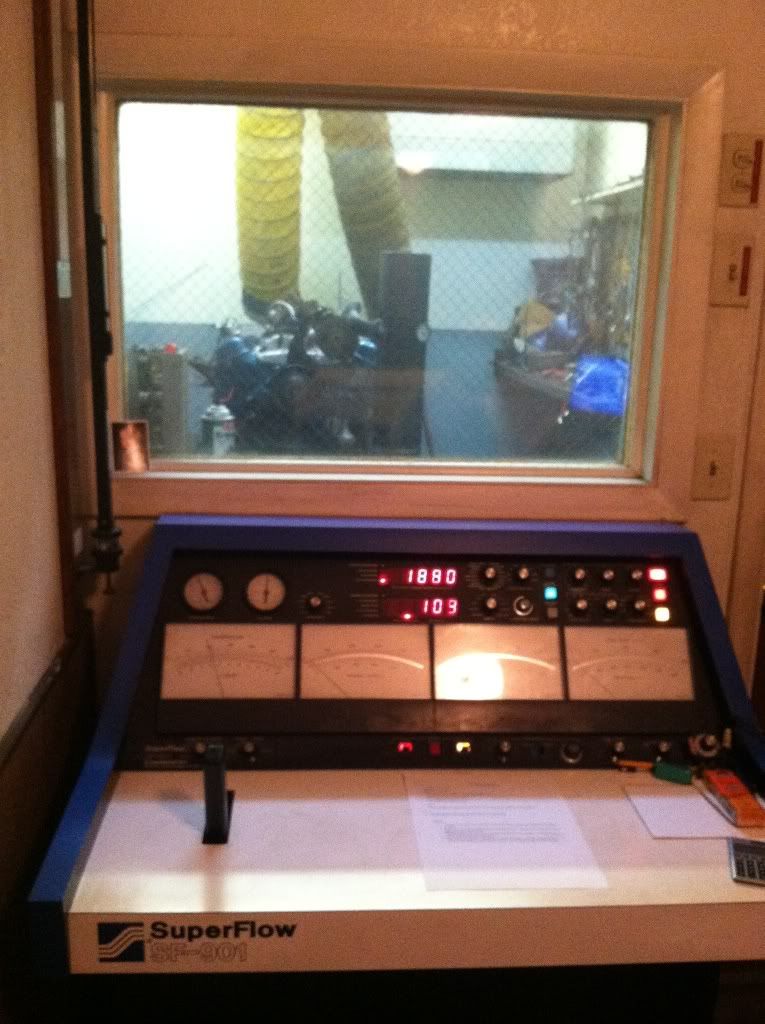
For the first “out-of-the-box” dyno pull, the Q-Jet was used (17056263). This carb is factory jetted at 70/42/DB, which is awfully lean. I re-jetted the carb to 76/42/DB with a 3/8” float level and .640 secondary rod height. Other carb tuning and parameters were set up exactly as outlined in my Q-Jet Tuning Paper under the “Quickie Performance Setup” section.
After getting the timing optimized (the inefficient chambers in the iron heads took 41 degrees total timing for best power and torque without detonation – an increase from my initial setting of 37). We were using 91-octane pump gas with 10% ethanol – right out of the gas station down the street. Total timing was coming in before 2000 rpm – a very quick curve.
Curve showing effect of 37 vesus 41 degrees of timing. Red line is 41 degrees timing:
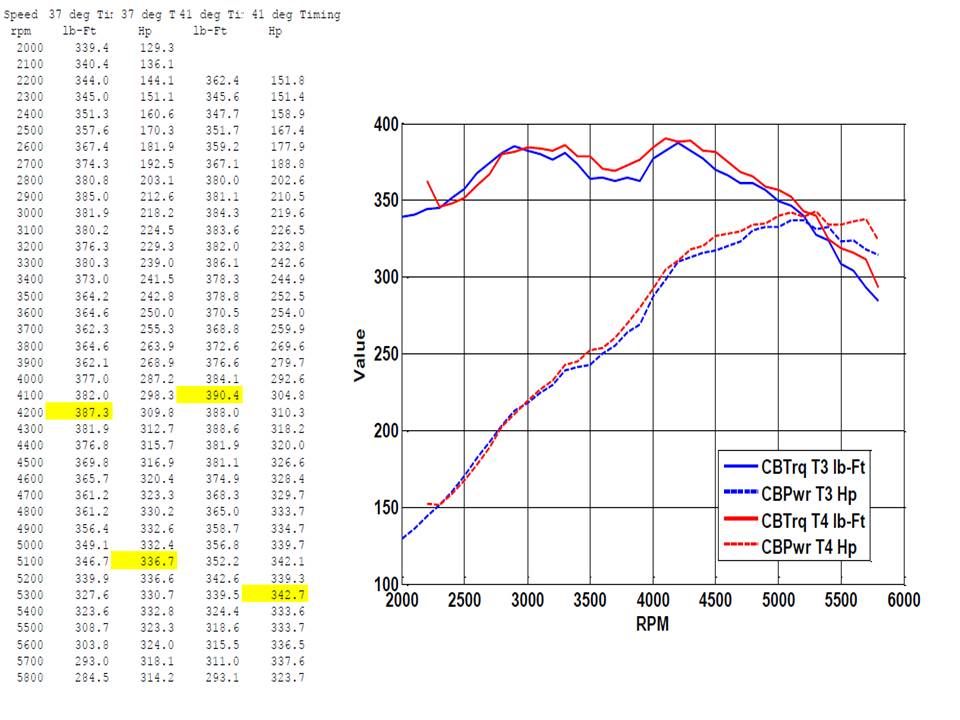
The 4 initial pulls we did on the engine showed a “dip” in the torque curve (with resulting “sag” in the power curve) between 3500 and 4000. This is right where the Q-Jet secondary airvalve is starting to open up, and the air/fuel numbers were showing a lean condition right at the tip-in of the secondaries. The stock “DB” secondary rods in the carb have the “short” power tips, which delay fuel enrichment. We installed a pair of Edelbrock “CL” rods which have about the same diameter (just a small tad richer), but they have the “long” power tips. Richening up the secondary tip-in point really flattened out the torque curve and made the power curve a near straight-line shot towards the top.
Curve showing effect of "tweaking" the Q-Jet secondary rods:
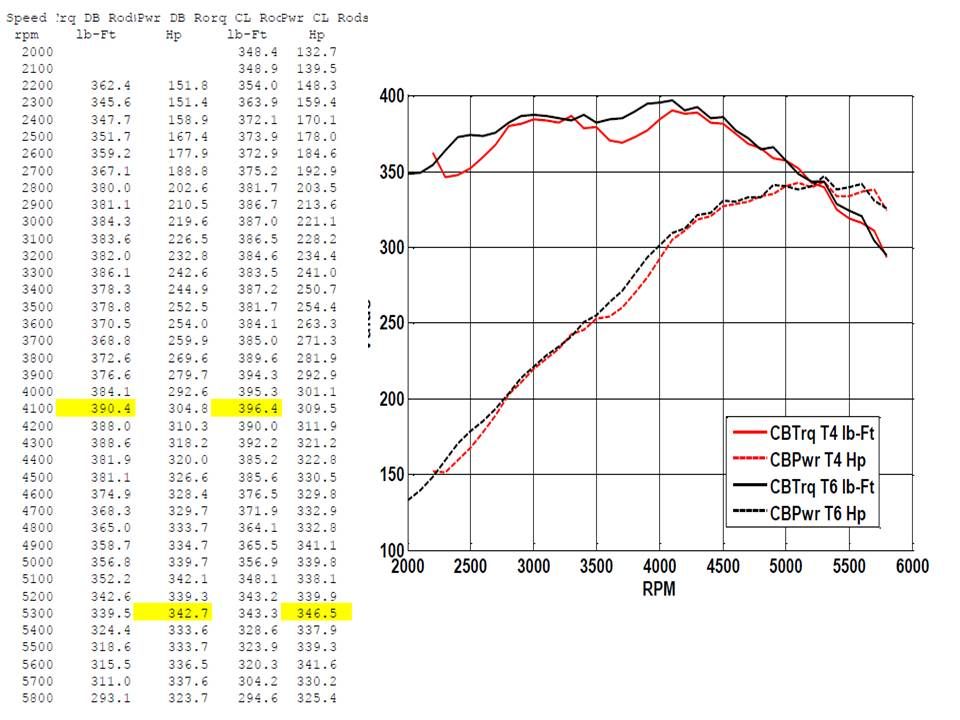
Once this had been sorted out and the Q-Jet was correctly tuned, I wanted to do the final run just to prove one of my pet-peeve points: Q-Jets are garbage, and any Holley will outperform a Q-Jet… blah, blah, blah… As I state in all my seminars and papers, a properly tuned Q-Jet will perform almost identical to a properly tuned Holley, except that the Q-Jet tends to produce better torque and throttle response in the low and mid range in a street driven vehicle than the Holley. Now that we had our Q-Jet pretty well dialed in, it was time for a switch to the Holley.
The Holley I selected was a 3310-1, which is a 750 vacuum secondary with the secondary metering block (not the cheap plate). The carb was set up and tuned to spec with 72 primary jets, 80 secondary, and the “tall yellow” secondary spring was selected to assure that the secondaries would actually open. Choke system was removed to give it all the airflow advantage it could get. Float levels, shooters, and all tuning parameters were all set up correctly and verified and “blessed” by noted NASCAR engine builder Steve Yacki (who was also our dyno operator this day). The Holley was given 2 pulls on the dyno, and we verified that the air/fuel ratio on the Holley was virtually identical to the Q-Jet: The A/F numbers matched exactly at many data points, and were never different by more than 0.5:1 at any time through the entire rpm range – the 2 carbs were metering air and fuel at exactly the same ratio, so there was no “fudging” any numbers on these pulls.
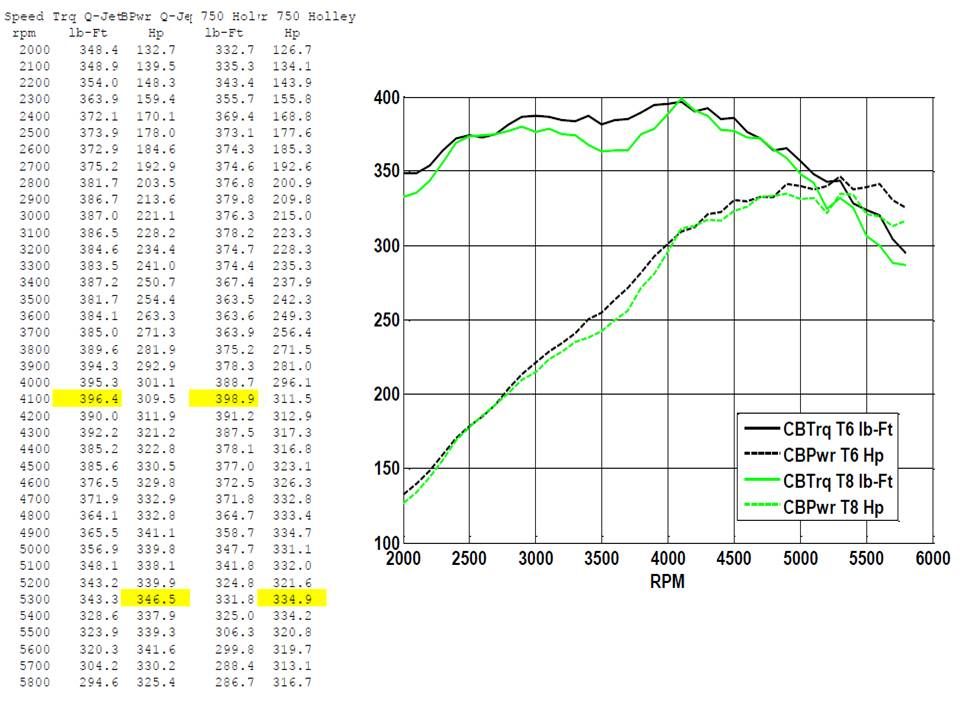
The Q-Jet bettered the Holley by 15 ft/lbs of torque on the bottom end, and pulled more than 20 ft/lbs at many data points, with a 10 to 20 horsepower gain over the Holley at many points through the range. The Holley produced a couple of peak numbers at limited points, but not enough to give it any advantage over the Q-Jet. The mass airflow numbers through the Holley were also lower than the airflow numbers through the Q-Jet at high rpm, and this can be seen by the drop-off in the Holley performance at the top of the curve. We even did one Holley run with me forcing the secondaries fully open for the top ½ of the rpm range, but this killed all the top-end numbers completely: The carb liked the “tall yellow” spring.
The numbers between the two carbs are fairly close, but if these 2 engines had been installed in 2 identical street cars, the Q-Jet car would have come across the finish line ahead of the Holley car by a significant margin.
This is not to say that either carb is “better.” But the fact is, that if you set these carbs up correctly, and know how to tune them, they can be made to run very well. There is no point in replacing a badly-tuned Q-Jet with a badly-tuned Holley or vice versa. A well-tuned Holley will run better than a badly-tuned Q-Jet, and this is what is usually the case in the “Holley is better than that crap Q-Jet” argument. If you have a good Q-Jet and know how to set it up, run it on your street car. If you don’t have a carb, or don’t know how to tune a Q-Jet, a Holley will run fine, but you better be able to tune it, too. Black lines are Q-Jet, green lines are Holley:
Lars
To prove that point, I did a dyno test of a mildly-built 400, and the results follow…
The engine was a stock-block 400 with stock factory cast iron heads. I got compression ratio up to 10.08:1 with flat-top pistons and the stock deck height. The bottom-end was kept stock with some good rod bolts, and the heads were given a good 3-angle valve job. The restrictive EGR intake was scrapped and an Edelbrock “Performer” intake was used to keep overall engine height near-stock so that there would be no hood interference problems. The owner wanted a very mild cam to maintain engine vacuum and power brakes, so a mild hydraulic roller was used. No other trick parts – the engine was pretty much a modest compression 400 with a mild roller in it.
The real purpose of the dyno run was to get good numbers for the owner and to get a good tune on the engine, but we also wanted to get a back-to-back comparison of a well-tuned Q-Jet to a properly set up Holley of similar size. Those results came in as expected…
For the first “out-of-the-box” dyno pull, the Q-Jet was used (17056263). This carb is factory jetted at 70/42/DB, which is awfully lean. I re-jetted the carb to 76/42/DB with a 3/8” float level and .640 secondary rod height. Other carb tuning and parameters were set up exactly as outlined in my Q-Jet Tuning Paper under the “Quickie Performance Setup” section.
After getting the timing optimized (the inefficient chambers in the iron heads took 41 degrees total timing for best power and torque without detonation – an increase from my initial setting of 37). We were using 91-octane pump gas with 10% ethanol – right out of the gas station down the street. Total timing was coming in before 2000 rpm – a very quick curve.
Curve showing effect of 37 vesus 41 degrees of timing. Red line is 41 degrees timing:
The 4 initial pulls we did on the engine showed a “dip” in the torque curve (with resulting “sag” in the power curve) between 3500 and 4000. This is right where the Q-Jet secondary airvalve is starting to open up, and the air/fuel numbers were showing a lean condition right at the tip-in of the secondaries. The stock “DB” secondary rods in the carb have the “short” power tips, which delay fuel enrichment. We installed a pair of Edelbrock “CL” rods which have about the same diameter (just a small tad richer), but they have the “long” power tips. Richening up the secondary tip-in point really flattened out the torque curve and made the power curve a near straight-line shot towards the top.
Curve showing effect of "tweaking" the Q-Jet secondary rods:
Once this had been sorted out and the Q-Jet was correctly tuned, I wanted to do the final run just to prove one of my pet-peeve points: Q-Jets are garbage, and any Holley will outperform a Q-Jet… blah, blah, blah… As I state in all my seminars and papers, a properly tuned Q-Jet will perform almost identical to a properly tuned Holley, except that the Q-Jet tends to produce better torque and throttle response in the low and mid range in a street driven vehicle than the Holley. Now that we had our Q-Jet pretty well dialed in, it was time for a switch to the Holley.
The Holley I selected was a 3310-1, which is a 750 vacuum secondary with the secondary metering block (not the cheap plate). The carb was set up and tuned to spec with 72 primary jets, 80 secondary, and the “tall yellow” secondary spring was selected to assure that the secondaries would actually open. Choke system was removed to give it all the airflow advantage it could get. Float levels, shooters, and all tuning parameters were all set up correctly and verified and “blessed” by noted NASCAR engine builder Steve Yacki (who was also our dyno operator this day). The Holley was given 2 pulls on the dyno, and we verified that the air/fuel ratio on the Holley was virtually identical to the Q-Jet: The A/F numbers matched exactly at many data points, and were never different by more than 0.5:1 at any time through the entire rpm range – the 2 carbs were metering air and fuel at exactly the same ratio, so there was no “fudging” any numbers on these pulls.
The Q-Jet bettered the Holley by 15 ft/lbs of torque on the bottom end, and pulled more than 20 ft/lbs at many data points, with a 10 to 20 horsepower gain over the Holley at many points through the range. The Holley produced a couple of peak numbers at limited points, but not enough to give it any advantage over the Q-Jet. The mass airflow numbers through the Holley were also lower than the airflow numbers through the Q-Jet at high rpm, and this can be seen by the drop-off in the Holley performance at the top of the curve. We even did one Holley run with me forcing the secondaries fully open for the top ½ of the rpm range, but this killed all the top-end numbers completely: The carb liked the “tall yellow” spring.
The numbers between the two carbs are fairly close, but if these 2 engines had been installed in 2 identical street cars, the Q-Jet car would have come across the finish line ahead of the Holley car by a significant margin.
This is not to say that either carb is “better.” But the fact is, that if you set these carbs up correctly, and know how to tune them, they can be made to run very well. There is no point in replacing a badly-tuned Q-Jet with a badly-tuned Holley or vice versa. A well-tuned Holley will run better than a badly-tuned Q-Jet, and this is what is usually the case in the “Holley is better than that crap Q-Jet” argument. If you have a good Q-Jet and know how to set it up, run it on your street car. If you don’t have a carb, or don’t know how to tune a Q-Jet, a Holley will run fine, but you better be able to tune it, too. Black lines are Q-Jet, green lines are Holley:
Lars
Tech Contributor
Joined: Aug 1999
Posts: 14,380
Likes: 6,391
From: At my Bar drinking and wrenching in Lafayette Colorado
The Q-Jet will run great. Those who dispute that are unfamiliar with the Q-Jet and Q-Jet tuning. Here is an article I wrote after doing back-to-back testing of a 750 Holley and a 750 Q-Jet. The data and numbers are real and they are accurate. If your engine is a mild street build, the Q-Jet will handle it just fine in near-stock trim. Set the carb up per the "Quickie Performance Setup" section of my Q-Jet paper, and you'll have a carb that will outperfrom the Holley across the rpm range for your street engine.
To prove that point, I did a dyno test of a mildly-built 400, and the results follow…
The engine was a stock-block 400 with stock factory cast iron heads. I got compression ratio up to 10.08:1 with flat-top pistons and the stock deck height. The bottom-end was kept stock with some good rod bolts, and the heads were given a good 3-angle valve job. The restrictive EGR intake was scrapped and an Edelbrock “Performer” intake was used to keep overall engine height near-stock so that there would be no hood interference problems. The owner wanted a very mild cam to maintain engine vacuum and power brakes, so a mild hydraulic roller was used. No other trick parts – the engine was pretty much a modest compression 400 with a mild roller in it.
The real purpose of the dyno run was to get good numbers for the owner and to get a good tune on the engine, but we also wanted to get a back-to-back comparison of a well-tuned Q-Jet to a properly set up Holley of similar size. Those results came in as expected…
For the first “out-of-the-box” dyno pull, the Q-Jet was used (17056263). This carb is factory jetted at 70/42/DB, which is awfully lean. I re-jetted the carb to 76/42/DB with a 3/8” float level and .640 secondary rod height. Other carb tuning and parameters were set up exactly as outlined in my Q-Jet Tuning Paper under the “Quickie Performance Setup” section.
After getting the timing optimized (the inefficient chambers in the iron heads took 41 degrees total timing for best power and torque without detonation – an increase from my initial setting of 37). We were using 91-octane pump gas with 10% ethanol – right out of the gas station down the street. Total timing was coming in before 2000 rpm – a very quick curve.
Curve showing effect of 37 vesus 41 degrees of timing. Red line is 41 degrees timing:
The 4 initial pulls we did on the engine showed a “dip” in the torque curve (with resulting “sag” in the power curve) between 3500 and 4000. This is right where the Q-Jet secondary airvalve is starting to open up, and the air/fuel numbers were showing a lean condition right at the tip-in of the secondaries. The stock “DB” secondary rods in the carb have the “short” power tips, which delay fuel enrichment. We installed a pair of Edelbrock “CL” rods which have about the same diameter (just a small tad richer), but they have the “long” power tips. Richening up the secondary tip-in point really flattened out the torque curve and made the power curve a near straight-line shot towards the top.
Curve showing effect of "tweaking" the Q-Jet secondary rods:
Once this had been sorted out and the Q-Jet was correctly tuned, I wanted to do the final run just to prove one of my pet-peeve points: Q-Jets are garbage, and any Holley will outperform a Q-Jet… blah, blah, blah… As I state in all my seminars and papers, a properly tuned Q-Jet will perform almost identical to a properly tuned Holley, except that the Q-Jet tends to produce better torque and throttle response in the low and mid range in a street driven vehicle than the Holley. Now that we had our Q-Jet pretty well dialed in, it was time for a switch to the Holley.
The Holley I selected was a 3310-1, which is a 750 vacuum secondary with the secondary metering block (not the cheap plate). The carb was set up and tuned to spec with 72 primary jets, 80 secondary, and the “tall yellow” secondary spring was selected to assure that the secondaries would actually open. Choke system was removed to give it all the airflow advantage it could get. Float levels, shooters, and all tuning parameters were all set up correctly and verified and “blessed” by noted NASCAR engine builder Steve Yacki (who was also our dyno operator this day). The Holley was given 2 pulls on the dyno, and we verified that the air/fuel ratio on the Holley was virtually identical to the Q-Jet: The A/F numbers matched exactly at many data points, and were never different by more than 0.5:1 at any time through the entire rpm range – the 2 carbs were metering air and fuel at exactly the same ratio, so there was no “fudging” any numbers on these pulls.
The Q-Jet bettered the Holley by 15 ft/lbs of torque on the bottom end, and pulled more than 20 ft/lbs at many data points, with a 10 to 20 horsepower gain over the Holley at many points through the range. The Holley produced a couple of peak numbers at limited points, but not enough to give it any advantage over the Q-Jet. The mass airflow numbers through the Holley were also lower than the airflow numbers through the Q-Jet at high rpm, and this can be seen by the drop-off in the Holley performance at the top of the curve. We even did one Holley run with me forcing the secondaries fully open for the top ½ of the rpm range, but this killed all the top-end numbers completely: The carb liked the “tall yellow” spring.
The numbers between the two carbs are fairly close, but if these 2 engines had been installed in 2 identical street cars, the Q-Jet car would have come across the finish line ahead of the Holley car by a significant margin.
This is not to say that either carb is “better.” But the fact is, that if you set these carbs up correctly, and know how to tune them, they can be made to run very well. There is no point in replacing a badly-tuned Q-Jet with a badly-tuned Holley or vice versa. A well-tuned Holley will run better than a badly-tuned Q-Jet, and this is what is usually the case in the “Holley is better than that crap Q-Jet” argument. If you have a good Q-Jet and know how to set it up, run it on your street car. If you don’t have a carb, or don’t know how to tune a Q-Jet, a Holley will run fine, but you better be able to tune it, too. Black lines are Q-Jet, green lines are Holley:
Lars
To prove that point, I did a dyno test of a mildly-built 400, and the results follow…
The engine was a stock-block 400 with stock factory cast iron heads. I got compression ratio up to 10.08:1 with flat-top pistons and the stock deck height. The bottom-end was kept stock with some good rod bolts, and the heads were given a good 3-angle valve job. The restrictive EGR intake was scrapped and an Edelbrock “Performer” intake was used to keep overall engine height near-stock so that there would be no hood interference problems. The owner wanted a very mild cam to maintain engine vacuum and power brakes, so a mild hydraulic roller was used. No other trick parts – the engine was pretty much a modest compression 400 with a mild roller in it.
The real purpose of the dyno run was to get good numbers for the owner and to get a good tune on the engine, but we also wanted to get a back-to-back comparison of a well-tuned Q-Jet to a properly set up Holley of similar size. Those results came in as expected…
For the first “out-of-the-box” dyno pull, the Q-Jet was used (17056263). This carb is factory jetted at 70/42/DB, which is awfully lean. I re-jetted the carb to 76/42/DB with a 3/8” float level and .640 secondary rod height. Other carb tuning and parameters were set up exactly as outlined in my Q-Jet Tuning Paper under the “Quickie Performance Setup” section.
After getting the timing optimized (the inefficient chambers in the iron heads took 41 degrees total timing for best power and torque without detonation – an increase from my initial setting of 37). We were using 91-octane pump gas with 10% ethanol – right out of the gas station down the street. Total timing was coming in before 2000 rpm – a very quick curve.
Curve showing effect of 37 vesus 41 degrees of timing. Red line is 41 degrees timing:
The 4 initial pulls we did on the engine showed a “dip” in the torque curve (with resulting “sag” in the power curve) between 3500 and 4000. This is right where the Q-Jet secondary airvalve is starting to open up, and the air/fuel numbers were showing a lean condition right at the tip-in of the secondaries. The stock “DB” secondary rods in the carb have the “short” power tips, which delay fuel enrichment. We installed a pair of Edelbrock “CL” rods which have about the same diameter (just a small tad richer), but they have the “long” power tips. Richening up the secondary tip-in point really flattened out the torque curve and made the power curve a near straight-line shot towards the top.
Curve showing effect of "tweaking" the Q-Jet secondary rods:
Once this had been sorted out and the Q-Jet was correctly tuned, I wanted to do the final run just to prove one of my pet-peeve points: Q-Jets are garbage, and any Holley will outperform a Q-Jet… blah, blah, blah… As I state in all my seminars and papers, a properly tuned Q-Jet will perform almost identical to a properly tuned Holley, except that the Q-Jet tends to produce better torque and throttle response in the low and mid range in a street driven vehicle than the Holley. Now that we had our Q-Jet pretty well dialed in, it was time for a switch to the Holley.
The Holley I selected was a 3310-1, which is a 750 vacuum secondary with the secondary metering block (not the cheap plate). The carb was set up and tuned to spec with 72 primary jets, 80 secondary, and the “tall yellow” secondary spring was selected to assure that the secondaries would actually open. Choke system was removed to give it all the airflow advantage it could get. Float levels, shooters, and all tuning parameters were all set up correctly and verified and “blessed” by noted NASCAR engine builder Steve Yacki (who was also our dyno operator this day). The Holley was given 2 pulls on the dyno, and we verified that the air/fuel ratio on the Holley was virtually identical to the Q-Jet: The A/F numbers matched exactly at many data points, and were never different by more than 0.5:1 at any time through the entire rpm range – the 2 carbs were metering air and fuel at exactly the same ratio, so there was no “fudging” any numbers on these pulls.
The Q-Jet bettered the Holley by 15 ft/lbs of torque on the bottom end, and pulled more than 20 ft/lbs at many data points, with a 10 to 20 horsepower gain over the Holley at many points through the range. The Holley produced a couple of peak numbers at limited points, but not enough to give it any advantage over the Q-Jet. The mass airflow numbers through the Holley were also lower than the airflow numbers through the Q-Jet at high rpm, and this can be seen by the drop-off in the Holley performance at the top of the curve. We even did one Holley run with me forcing the secondaries fully open for the top ½ of the rpm range, but this killed all the top-end numbers completely: The carb liked the “tall yellow” spring.
The numbers between the two carbs are fairly close, but if these 2 engines had been installed in 2 identical street cars, the Q-Jet car would have come across the finish line ahead of the Holley car by a significant margin.
This is not to say that either carb is “better.” But the fact is, that if you set these carbs up correctly, and know how to tune them, they can be made to run very well. There is no point in replacing a badly-tuned Q-Jet with a badly-tuned Holley or vice versa. A well-tuned Holley will run better than a badly-tuned Q-Jet, and this is what is usually the case in the “Holley is better than that crap Q-Jet” argument. If you have a good Q-Jet and know how to set it up, run it on your street car. If you don’t have a carb, or don’t know how to tune a Q-Jet, a Holley will run fine, but you better be able to tune it, too. Black lines are Q-Jet, green lines are Holley:
Lars
Last edited by lars; Jan 9, 2019 at 06:11 PM.
Thread Starter
Racer
Joined: Aug 2011
Posts: 429
Likes: 24
From: Charlotte NC
Thx Lars, it's good to know it can match up performance wise almost identical. Still wondering about the reliability comparison. I ran one for about a year and half with no probs but a mechanic swapped it for a 3310 by his preference. I wish I still had it to try again.
Tech Contributor
Joined: Aug 1999
Posts: 14,380
Likes: 6,391
From: At my Bar drinking and wrenching in Lafayette Colorado
What is there to wonder about regarding reliability..? Both Q-Jets and Holley were used as factory installed carbs, and they will both run for years or decades with no issues. Most reliability problems are caused by people screwing with them... Several people on this Forum are running Q-Jets that I built for them in the late '90s and early 2000's without ever have touched them since. 
Lars
Lars
Tech Contributor
Joined: Aug 1999
Posts: 14,380
Likes: 6,391
From: At my Bar drinking and wrenching in Lafayette Colorado
There are no "new out of the box" Q-Jets. The re-man stuff is pure junk. You have to find a good, original, used Q-Jet and build it and set it up right. That's the disadvantage of the Q-Jet. You can buy a new Holley. No new Q-Jets. Drop me a note for my paper about the Commercially built re-man units.
Lars
V8FastCars@msn.com
Lars
V8FastCars@msn.com

Le Mans Master


Joined: Oct 2007
Posts: 7,455
Likes: 977
From: RI, Now Franklin/Nashville TN
Hi Lars!
Thank you for the comparison and the detailed explanation.
I do have a couple of questions.
It appears that you custom tuned the Qjet based on your vast experience with Qjets? Was the Holley 750 custom tuned as well or just set up to spec as you indicated above? I am wondering if the Holley had been specifically custom tuned to the applied engine, do you think that it would have been the same results?
Lastly, the big dip at 3,500 RPM for the Holley 750 appears to my untrained eye that the Holley could have used a different secondary spring for the vacuum secondaries to avoid the dip?
Thoughts are greatly appreciated. Trying to keep learning here. Nothing more. Thanks
BTW- I do respect the Qjet for what it was at the time it was made but do think that the Holley due to its simplicity is just easier to tune for the novice. I also like to keep original components for these cars as much as possible as long as they are reasonably close to an aftermarket part and your comparison clearly shows that the 2 carbs are equivalent,
Thank you for the comparison and the detailed explanation.
I do have a couple of questions.
It appears that you custom tuned the Qjet based on your vast experience with Qjets? Was the Holley 750 custom tuned as well or just set up to spec as you indicated above? I am wondering if the Holley had been specifically custom tuned to the applied engine, do you think that it would have been the same results?
Lastly, the big dip at 3,500 RPM for the Holley 750 appears to my untrained eye that the Holley could have used a different secondary spring for the vacuum secondaries to avoid the dip?
Thoughts are greatly appreciated. Trying to keep learning here. Nothing more. Thanks
BTW- I do respect the Qjet for what it was at the time it was made but do think that the Holley due to its simplicity is just easier to tune for the novice. I also like to keep original components for these cars as much as possible as long as they are reasonably close to an aftermarket part and your comparison clearly shows that the 2 carbs are equivalent,
Last edited by jb78L-82; Jan 10, 2019 at 07:46 PM.
Corvette Stories
The Best of Corvette for Corvette Enthusiasts

Top 10 Most Expensive Corvettes Ever Sold on Bring A Trailer
Brett Foote
10 Things Every Corvette Owner Needs (2026 Edition)
Michael S. Palmer
8 Most "Only Corvette Owners Understand" Quirks and Problems
Pouria Savadkouei
10 Reasons the C6 Z06 is Still A Performance Benchmark After 20 Years
Joe Kucinski
How Much Horsepower Every Corvette Engine "LOST" in 1972
Joe Kucinski
Top 10 DOs and DON'Ts for Protecting Your Convertible Top!
Michael S. Palmer
Top 10 Most Explosive Corvettes Ever Made: Power-to-Weight Ratio Ranked!
Joe Kucinski
150 hp to 1,250 hp: Every Corvette Generation Compared by the Specs That Matter
Joe Kucinski
8 Coolest Corvette Pace Cars (and Replicas) of All Time
Verdad Gallardo
Race Director


Joined: Apr 2003
Posts: 19,352
Likes: 654
From: Tampa, Florida
BTW- I do respect the Qjet for what it was at the time it was made but do think that the Holley due to its simplicity is just easier to tune for the novice. I also like to keep original components for these cars as much as possible as long as they are reasonably close to an aftermarket part and your comparison clearly shows that the 2 carbs are equivalent,
Last edited by jim2527; Jan 11, 2019 at 07:38 AM.
Tech Contributor
Joined: Aug 1999
Posts: 14,380
Likes: 6,391
From: At my Bar drinking and wrenching in Lafayette Colorado
It appears that you custom tuned the Qjet based on your vast experience with Qjets? Was the Holley 750 custom tuned as well or just set up to spec as you indicated above?
Lastly, the big dip at 3,500 RPM for the Holley 750 appears to my untrained eye that the Holley could have used a different secondary spring for the vacuum secondaries to avoid the dip
Lastly, the big dip at 3,500 RPM for the Holley 750 appears to my untrained eye that the Holley could have used a different secondary spring for the vacuum secondaries to avoid the dip
Lars
Le Mans Master
Joined: Oct 2007
Posts: 7,455
Likes: 977
From: RI, Now Franklin/Nashville TN
The Holley was a carb I have used as a "standard test carb" for many previous dyno runs on various customer engines, so it had been tweaked and tuned for a near-perfect setup. As noted, the air/fuel mixtures on the two carbs ran identical throughout the entire rpm and power range, so the two carbs were both properly tuned and matched to each other. No fudging there. The Holley secondary spring had been optimized for best possible secondary response, and the secondaries were working as they should. As you can see on the curve, the slight dip did not affect other areas of the curve, so the comparison is pretty valid. For practical purposes, the carbs run the same.
Lars
Lars
Thanks for the explanation Lars......appreciate it!
Tech Contributor
Joined: Aug 1999
Posts: 14,380
Likes: 6,391
From: At my Bar drinking and wrenching in Lafayette Colorado
A few days back I was in the local speed shop asking about custom fuel lines and this very topic came up. I said to the guy, "Oddly enough I understand how Quadrajet's work but I don't understand how Holley's work." He said, "Qjets are old tech" and all I could think was have Holley's really changed much in 40 years? Its the same basic form/function, isn't it? IDK. I like my Qjet.
Lars
Last edited by lars; Jan 11, 2019 at 03:32 PM.
Le Mans Master
Joined: Aug 2017
Posts: 8,336
Likes: 2,810
From: Cool Northern Michigan
A Holley diaphragm that tears or punctures is not the fault of Holley or Holley parts. It is the fault of the tuner that did not follow the dozens of instruction videos about how to set the clearance of the accelerator arm at WOT. The videos point out that without a adequate gap of .012-.015 you will destroy that diaphragm.
I have never had one leak in two decades of tuning Holleys.
Last edited by HeadsU.P.; Jan 11, 2019 at 08:17 PM.

Le Mans Master
Joined: Dec 2006
Posts: 8,837
Likes: 1,028
Sorry Big2Bird, you are blaming the wrong thing here.
A Holley diaphragm that tears or punctures is not the fault of Holley or Holley parts. It is the fault of the tuner that did not follow the dozens of instruction videos about how to set the clearance of the accelerator arm at WOT. The videos point out that without a adequate gap of .012-.015 you will destroy that diaphragm.
I have never had one leak in two decades of tuning Holleys.
A Holley diaphragm that tears or punctures is not the fault of Holley or Holley parts. It is the fault of the tuner that did not follow the dozens of instruction videos about how to set the clearance of the accelerator arm at WOT. The videos point out that without a adequate gap of .012-.015 you will destroy that diaphragm.
I have never had one leak in two decades of tuning Holleys.
Le Mans Master
Joined: Aug 2017
Posts: 8,336
Likes: 2,810
From: Cool Northern Michigan
Ok, I will explain. Holley diaphragms tear because the clearance between the accelerator pump arm and the linkage is too tight. It ruptures. No fault of Holley. Fault of the tuner.
Le Mans Master
Joined: Dec 2006
Posts: 8,837
Likes: 1,028
And the alcohol eats the old ones, hence the blue ones, causing a leak.
I am merely pointing out I see the pumps on the bottom of a fuel bowl is not the brightest thing.
Holley has been around way longer than people realise. (OEM supplier for Model T Fords).They make fine stuff. I just think its not so smart.
I am merely pointing out I see the pumps on the bottom of a fuel bowl is not the brightest thing.
Holley has been around way longer than people realise. (OEM supplier for Model T Fords).They make fine stuff. I just think its not so smart.