




W - driveline angle

Team Owner


Joined: Apr 1999
Posts: 21,953
Likes: 1,445
From: Reno Nevada
2024 C3 of the Year Finalist- Modified

I made my own and bigger before I saw them online. keeps the differential from ripping the bolts out of the cross member when you solid mount the ends
https://www.racevette.com/store/p9/C...s_1963-79.html
https://www.racevette.com/store/p9/C...s_1963-79.html
Le Mans Master


Joined: May 2003
Posts: 8,875
Likes: 3,554
From: Fernandina Beach FL
2023 Restomod of the Year finalist
2020 C3 of the Year Winner - Modified
I'm referring to those pics from super motors, now I do notice that the back has been modified some as well but I just think that's a lot of work to try to get everything to line up. I spent a lot of time juggling stuff around with mine, granted it's not a regular Corvette transmission and it's a tr6060 with a flat plate on the back but it just seemed to me that with all the movement you had to make with the differential the W configuration was the most straightforward.
The build- https://www.digitalcorvettes.com/for...d.php?t=148376
And the post on the diff /driveline work- https://www.digitalcorvettes.com/forums/showpost.php?p=2232426&postcount=280
Last edited by Richard454; Jan 25, 2019 at 06:41 PM.

Thread Starter
Burning Brakes


Joined: Apr 2008
Posts: 825
Likes: 40
From: Glasgow, Scotland
Had another go at this stuff today, i tryed bolting the diff tail to chassis, metal to metal no bush, ends up at about just above zero degrees, so to get it up at 2 degrees up would mean having to re fab the diff tail bracket and then to go up that much, you would be so close to hitting propshaft of the trans tunnel near diff with prop
so with the poly bush in and bolted up tight, squeezing a little, i end up with a 2 degrees downward angle on diff and trans/engine is going down 2 degrees, so i end up with the perfect W configuration
Iam thinking the ploy bush will reduce movement alot compared to rubber bush, therefore less chance of stuff breaking hopefully
so just going to try this and see how it goes
so with the poly bush in and bolted up tight, squeezing a little, i end up with a 2 degrees downward angle on diff and trans/engine is going down 2 degrees, so i end up with the perfect W configuration
Iam thinking the ploy bush will reduce movement alot compared to rubber bush, therefore less chance of stuff breaking hopefully
so just going to try this and see how it goes

Safety Car


Joined: May 2004
Posts: 4,350
Likes: 1,578
From: los altos hills california
https://www.corvetteforum.com/forums...e-bracket.html
Also note Willcox's comment. Best to do your own research, but this I remembered.
Thread Starter
Burning Brakes
Joined: Apr 2008
Posts: 825
Likes: 40
From: Glasgow, Scotland
Same amount of static torque regardless of which bushing you pick, but have a look here.
https://www.corvetteforum.com/forums...e-bracket.html
Also note Willcox's comment. Best to do your own research, but this I remembered.
https://www.corvetteforum.com/forums...e-bracket.html
Also note Willcox's comment. Best to do your own research, but this I remembered.
Drifting

Joined: Aug 2015
Posts: 1,939
Likes: 477
From: NSW, Australia
C3 of Year Finalist (track prepared) 2019
Same amount of static torque regardless of which bushing you pick, but have a look here.
https://www.corvetteforum.com/forums...e-bracket.html
Also note Willcox's comment. Best to do your own research, but this I remembered.
https://www.corvetteforum.com/forums...e-bracket.html
Also note Willcox's comment. Best to do your own research, but this I remembered.
Last edited by Metalhead140; Jan 28, 2019 at 09:52 PM.
Safety Car
Joined: May 2004
Posts: 4,350
Likes: 1,578
From: los altos hills california
Interesting, I hadn't seen that before, thanks for sharing. It does look to me that in that case the chassis metal was pretty pitted by rust under the paint. I had a poly bush on mine for over 30,000 miles with no problems, and have just (in the past few days, not yet driven it) mounted it solid - I also have mounted the diff crossmember solid and raised the diff to improve half shaft angles. As you know I drive my car regularly and hard - I'll certainly update if I have any problems as a result.
Corvette Stories
The Best of Corvette for Corvette Enthusiasts

Top 10 Most Explosive Corvettes Ever Made: Power-to-Weight Ratio Ranked!
Joe Kucinski
150 hp to 1,250 hp: Every Corvette Generation Compared by the Specs That Matter
Joe Kucinski
8 Coolest Corvette Pace Cars (and Replicas) of All Time
Verdad Gallardo
Top 10 Corvette Engines RANKED by Peak Torque (70+ Years of Muscle!)
Joe Kucinski
Corvette ZR1X Will Be Pacing the Indy 500, And Could Probably Race, Too!
Verdad Gallardo
Top 10 Corvettes Coming to Mecum Indy 2026!
Brett Foote
Top 10 C9 Corvette MUST-HAVES to Fix These C8 Generation Flaws!
Michael S. Palmer
10 Revolutionary 'Corvette Firsts' Most People Don't Know
Joe Kucinski
5 Reasons to Upgrade to an LS6-Powered Corvette; 5 Reasons to Stay LT2
Michael S. Palmer
Drifting
Joined: Aug 2015
Posts: 1,939
Likes: 477
From: NSW, Australia
C3 of Year Finalist (track prepared) 2019
Yes, agreed. And I'll admit that I looked at the brackets as I was bolting them together and briefly wondered about their sturdiness, but I couldn't recall any reports of them breaking. They can be beefed up easily enough, but probably not without making access in an already tight area worse. A bracket that braces under that crossmember (similar to some old anti-tramp brackets I've seen on here) might be the best way to go if it turns out to be a problem.
Last edited by Metalhead140; Jan 28, 2019 at 10:42 PM.
Thread Starter
Burning Brakes
Joined: Apr 2008
Posts: 825
Likes: 40
From: Glasgow, Scotland
its all very interesting,
so if everything is solid mounted - where does all that movement energy go? does it move strain on the propshaft, diff input bearing/seal and brackets holding diff in place?
why did gm design everything to be held in place by a rubber bushes? mainly for driver comfort i take it? or ??
so if everything is solid mounted - where does all that movement energy go? does it move strain on the propshaft, diff input bearing/seal and brackets holding diff in place?
why did gm design everything to be held in place by a rubber bushes? mainly for driver comfort i take it? or ??
Last edited by corvettedave383; Jan 29, 2019 at 03:26 AM.
Team Owner
Joined: Apr 1999
Posts: 21,953
Likes: 1,445
From: Reno Nevada
2024 C3 of the Year Finalist- Modified
its all very interesting,
so if everything is solid mounted - where does all that movement energy go? does it move strain on the propshaft, diff input bearing/seal and brackets holding diff in place?
why did gm design everything to be held in place by a rubber bushes? mainly for driver comfort i take it? or ??
so if everything is solid mounted - where does all that movement energy go? does it move strain on the propshaft, diff input bearing/seal and brackets holding diff in place?
why did gm design everything to be held in place by a rubber bushes? mainly for driver comfort i take it? or ??
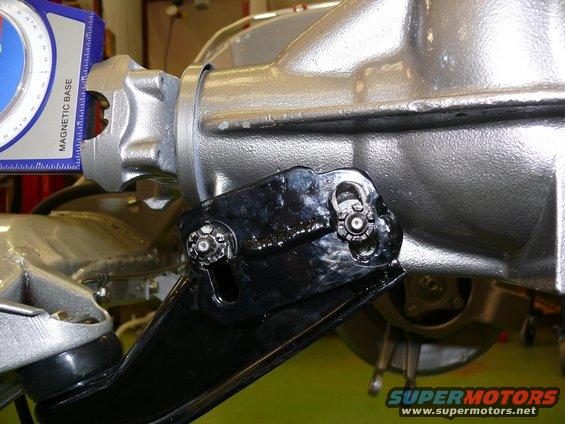
The person in the other post who ripped the differential snubber through the cross member mounting point had a horribly rust pitted thin frame.
See how they cut a slot for the rear mounting bolt? I just have a different bolt hole position and a thin aluminum bushing to get the up angle on the pinion. Just simple welding and drilling.
Last edited by gkull; Jan 29, 2019 at 11:38 AM.
Safety Car
Joined: May 2004
Posts: 4,350
Likes: 1,578
From: los altos hills california
Thread Starter
Burning Brakes
Joined: Apr 2008
Posts: 825
Likes: 40
From: Glasgow, Scotland
When you install solid motor mounts the motor at idle causes the nose body to slightly rock back and forth. Under power it TQ's the body over. When you solid mount everything in the rear like I did. When I had an automatic tranny the rear would squat when you put the car in gear with your foot on the brake. Under power the rear really squatted like when you take off on as the last yellow comes on during drag racing. To counter act all these bending forces I had a roll cage installed , went to 650 Pound QA-1 coil overs, and rear springs of over 500 pounds.
The person in the other post who ripped the differential snubber through the cross member mounting point had a horribly rust pitted thin frame.
See how they cut a slot for the rear mounting bolt? I just have a different bolt hole position and a thin aluminum bushing to get the up angle on the pinion. Just simple welding and drilling.
The person in the other post who ripped the differential snubber through the cross member mounting point had a horribly rust pitted thin frame.
See how they cut a slot for the rear mounting bolt? I just have a different bolt hole position and a thin aluminum bushing to get the up angle on the pinion. Just simple welding and drilling.
yeah got the rollcage, full one rear and front, got the 650 Pound QA-1 coil overs, and rear spring of over 500 pound, all ticked
what is the actually benefit to soild mounts in the rear? just to stop all that twisting movement on diff, therefore leading to something breaking i take it?
Thread Starter
Burning Brakes
Joined: Apr 2008
Posts: 825
Likes: 40
From: Glasgow, Scotland
Given the motor you have up front, I would say that is more than interesting. That "movement energy" is really torque, lots of it in your case, that eventually gets applied to a weld somewhere. And it is all the same amount once what ever bushings are in place get compressed. All the rubber does is take out the rate at which the torque is applied.
Drifting
Joined: Aug 2015
Posts: 1,939
Likes: 477
From: NSW, Australia
C3 of Year Finalist (track prepared) 2019
Transfers that twisting motion more directly/effectively to the tyre. Should more or less eliminate any tramp - tramp theoretically should not be an issue with IRS cars, but often is due to compliant diff mounts. Also, as most of the rear suspension is mounted off the diff, reduces the amount that the suspension mounts are moving around, hopefully improving handling and stability. And it should help a small amount to stiffen the chassis, by making the crossmember and diff stressed parts of the chassis. Generally I think the main reason for soft mounts is to reduce NVH (noise, vibration, harshness), but I think our rubber mounted body's (later c3s like you and I have) tend to isolate us from that anyway. While that means the comfort impact is fairly negligible, it may still tend to put more stress on parts and tend to rattle fasteners etc loose if they're not ideal (in condition/torque/locking etc) - and puts some of the stresses that may have been absorbed (if not in magnitude, in harshness/suddenness) by the rubber directly into the chassis/diff housing/crossmember. I already have a solidly mounted engine and have no regrets about doing that.
Thread Starter
Burning Brakes
Joined: Apr 2008
Posts: 825
Likes: 40
From: Glasgow, Scotland
Still trying to decide what to do here, biggest issue iam having, is measuing the correct diff angle, i was thinking about maybe measuring off theSmart Struts, seems like a uniform bracket, can some confirm if the angle at the yoke is the same as the smart struts bracket?? or could i measure from the front of diff, where the front diff seal is , i can get a flat metal bar in there??

Instructor


Joined: Mar 2011
Posts: 165
Likes: 31
From: space coast florida
I used the same location. If you have an Android phone, you can install an angle finder app that works too. I don't use it to measure raw angle, but rather to compare angle of the diff and the transmission.
Thread Starter
Burning Brakes
Joined: Apr 2008
Posts: 825
Likes: 40
From: Glasgow, Scotland
ive still got propshaft on and its right pain to take it off, ive measured at the front of diff, on the front seal or yoke seal and off my smart strut brace and get the same reading - using a angle finder on my phone and using the tremec app aswell, ive decided to bolt the diff carrier hard to the vette chassis
ive got 1.7 degree downward angle on engine/gearbox and propshaft is going up by 0.8 of a degree and diff is saying its going up by 0.7 degree - the tremec app says thats me at a 1.5 degree working angle, which is all green in there app, good to go - anyone else bolted there diff carrier hard to chassis, what angle were you getting on diff?
ive got 1.7 degree downward angle on engine/gearbox and propshaft is going up by 0.8 of a degree and diff is saying its going up by 0.7 degree - the tremec app says thats me at a 1.5 degree working angle, which is all green in there app, good to go - anyone else bolted there diff carrier hard to chassis, what angle were you getting on diff?