







Rear Bearing spacers

Thread Starter
Cruising

Joined: Nov 2018
Posts: 12
Likes: 0
 Rear Bearing spacers
I am rebuilding my whole rear suspension. I did a complete rebuild in 1998 using vette brakes street and salom suspension as part of the complete rebuild. The kit included Energy Suspension Bushings, This year every bushing disetegrated, Nobody knows why. So I have the trailing arm out and decided to redo the rear bearings and new axle shafts. I got the shim pack and bearings from ecklers. I have a problem: The three largest shims, used one at a time, result in no play. I triesd using the two smalles shims together and too much play. why would the larger shims result in too tight fit. I would think the largest shim would result in too much play and then I try smaller shims to get in the .002 to.006 range. Any suggestions. Im using the ecklers setup tool
Last edited by Marion Cole; Feb 6, 2019 at 03:00 AM. Reason: claify
Tech Contributor


Joined: Aug 1999
Posts: 15,175
Likes: 3,990
From: Connecticut, USA
The shim packs sold will rarely get you dialed in where they should be but should get you into the stock specs- if that is your goal. I never set rear bearings to an endplay spec but rather to -0- lateral play. This requires using a surface grinder grind the spacer and shim parallel and to size. Now the way I see bearings being checked on YouTube is down right scary but people do these various ways. When all said and done, the axle should be snug and smooth, not tight and not free wheeling. The will be no end play felt in the finished product. If you grab a wheel stud and move it in/out you have too much play- although it may still be within "spec"
Tech Contributor
Joined: Aug 1999
Posts: 15,175
Likes: 3,990
From: Connecticut, USA
Setting up rear bearings isn't hard but you have something wrong going on. A larger shim will move the bearing apart and open the end play in them. I would check over to make sure the races are seated, you can clean and reseat the bearings without the spacers in place initially but you should be able to make adjustments with the shims.

Race Director


Joined: Apr 2009
Posts: 19,294
Likes: 2,754
From: Charlotte NC
Setting up rear bearings isn't hard but you have something wrong going on. A larger shim will move the bearing apart and open the end play in them. I would check over to make sure the races are seated, you can clean and reseat the bearings without the spacers in place initially but you should be able to make adjustments with the shims.

Marion Cole....My question to you is ....are you using a set-up tool to check the lateral end play when you are setting up the bearings ??? Or are you using the spindle....or something else.
DUB

Pro

Joined: Mar 2014
Posts: 529
Likes: 113
From: Texas
Maybe the two small shims are thicker when combined than the one large shim. Set it up with a small and big shim. Take a measurement. Then measure each shim and combine one or more shims to reduce the measurement. So if you end up with .010, find a shim that is .010 smaller or reduce the large shim by .010 as GTR1999 said.
Corvette Stories
The Best of Corvette for Corvette Enthusiasts

Top 10 Most Expensive Corvettes Ever Sold on Bring A Trailer
Brett Foote
10 Things Every Corvette Owner Needs (2026 Edition)
Michael S. Palmer
8 Most "Only Corvette Owners Understand" Quirks and Problems
Pouria Savadkouei
10 Reasons the C6 Z06 is Still A Performance Benchmark After 20 Years
Joe Kucinski
How Much Horsepower Every Corvette Engine "LOST" in 1972
Joe Kucinski
Top 10 DOs and DON'Ts for Protecting Your Convertible Top!
Michael S. Palmer
Top 10 Most Explosive Corvettes Ever Made: Power-to-Weight Ratio Ranked!
Joe Kucinski
150 hp to 1,250 hp: Every Corvette Generation Compared by the Specs That Matter
Joe Kucinski
8 Coolest Corvette Pace Cars (and Replicas) of All Time
Verdad Gallardo
Tech Contributor
Joined: Aug 1999
Posts: 15,175
Likes: 3,990
From: Connecticut, USA
Maybe this will help you.
First off good for you that you are taking on this job. If you have the tools and measuring devices, preferably with access to a surface grinder you can do these with some guidance. What I have seen on YouTube is completely out there - as in wrong! I like YouTube but when I see some of the methods people use I really wonder how their cars run.
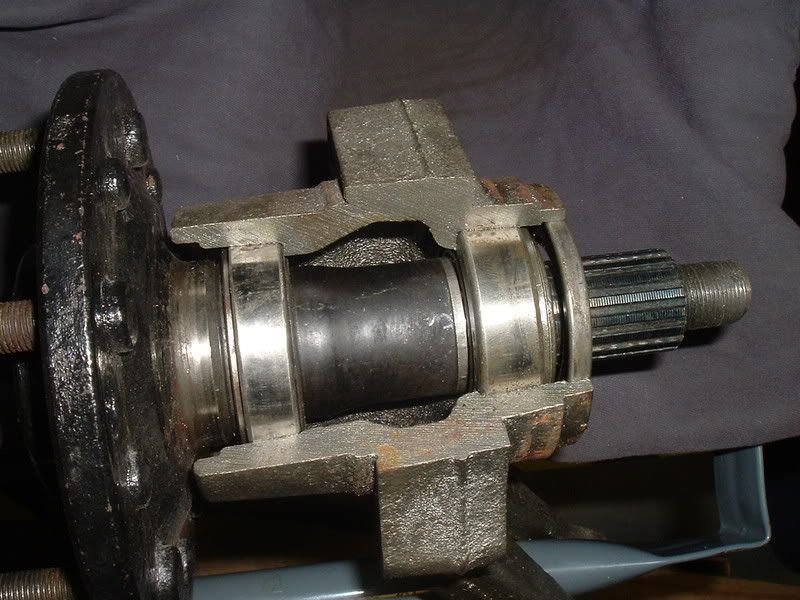
This is a cut away of a rear bearing support. I use it for my tech seminars at Carlilse and my home shop open house days. Which if anyone wants to attend can contact me.
There were two support types used, this is a 63 I cut up, you can see the well around the spacers, around 71 or so the well was removed and it's a straight bore. You can see the races seated, the bell spacer, shim, and the other bearing. Assuming you have all that correct then if it's too tight it has to be a shim thickness issue. If on the other hand the end play is consistently the same regardless of how thin the shim is, and I know this is the opposite of what you say you have, then the bell spacer is hanging up on the axle shaft journal edge and you need a new spacer. If you are using new spacers they are counterbored unlike the originals and you should not have this problem. Remove both the bell spacer and shim, assemble the bearings and snug them up. check the endplay, you should be able to dial it in from loose to tight. If so then the issue is in the spacer/shim combo, if not then you have to see what is going on- that would be very odd indeed. You have to have the support secure. I machined up a fixture to hold my support firm so I am always referencing the same way. If you are rigging up indicators and holding the support directly in a vise or worse still on the car, then you're fighting yourself.
Note- I used the term fixture above and hate that term when used by a corvette rebuilder. It usually is something a rebuilder claims as their own special invention to scare off those attempting to do the work on their own. As in " I made my fixture so I am the only one who can do this, send me your cash" again personal opinion on using that term which is often used incorrectly here. You can make a "fixture" out of hardwood that is flat and you bore a hole for the support to fit into and 4 holes to bolt it on. Pretty simple and I am not asking for any money!
Take your time, look it over and I bet you will find the issue. It can't be many things.
First off good for you that you are taking on this job. If you have the tools and measuring devices, preferably with access to a surface grinder you can do these with some guidance. What I have seen on YouTube is completely out there - as in wrong! I like YouTube but when I see some of the methods people use I really wonder how their cars run.
This is a cut away of a rear bearing support. I use it for my tech seminars at Carlilse and my home shop open house days. Which if anyone wants to attend can contact me.
There were two support types used, this is a 63 I cut up, you can see the well around the spacers, around 71 or so the well was removed and it's a straight bore. You can see the races seated, the bell spacer, shim, and the other bearing. Assuming you have all that correct then if it's too tight it has to be a shim thickness issue. If on the other hand the end play is consistently the same regardless of how thin the shim is, and I know this is the opposite of what you say you have, then the bell spacer is hanging up on the axle shaft journal edge and you need a new spacer. If you are using new spacers they are counterbored unlike the originals and you should not have this problem. Remove both the bell spacer and shim, assemble the bearings and snug them up. check the endplay, you should be able to dial it in from loose to tight. If so then the issue is in the spacer/shim combo, if not then you have to see what is going on- that would be very odd indeed. You have to have the support secure. I machined up a fixture to hold my support firm so I am always referencing the same way. If you are rigging up indicators and holding the support directly in a vise or worse still on the car, then you're fighting yourself.
Note- I used the term fixture above and hate that term when used by a corvette rebuilder. It usually is something a rebuilder claims as their own special invention to scare off those attempting to do the work on their own. As in " I made my fixture so I am the only one who can do this, send me your cash" again personal opinion on using that term which is often used incorrectly here. You can make a "fixture" out of hardwood that is flat and you bore a hole for the support to fit into and 4 holes to bolt it on. Pretty simple and I am not asking for any money!
Take your time, look it over and I bet you will find the issue. It can't be many things.

Drifting

Joined: Jul 2012
Posts: 1,255
Likes: 297
From: Slovenia, EU
2017 C3 of Year Finalist
I'm in process of doing the same thing. Changing the rear bearings. Since I'm from Europe I don't have access to any shops doing this and I don't have the specific tools tto do this. Can this be done without the special tools?
And thanks for the picture! Helps a lot to understand how the berings are assembled.
And thanks for the picture! Helps a lot to understand how the berings are assembled.
Last edited by Primoz; Feb 7, 2019 at 07:57 AM.
Pro
Joined: Mar 2014
Posts: 529
Likes: 113
From: Texas
The last one I did I used Bearing Spacer & Shim kit, and bearing and seal kit from Vansteel. If you can figure out what shim you need they carry a good assortment of them.
https://www.vansteel.com/index.cfm?f...t&subgroup=203
https://www.vansteel.com/index.cfm?f...t&subgroup=203
Drifting
Joined: Jul 2012
Posts: 1,255
Likes: 297
From: Slovenia, EU
2017 C3 of Year Finalist
The last one I did I used Bearing Spacer & Shim kit, and bearing and seal kit from Vansteel. If you can figure out what shim you need they carry a good assortment of them.
https://www.vansteel.com/index.cfm?f...t&subgroup=203
https://www.vansteel.com/index.cfm?f...t&subgroup=203
https://www.vansteel.com/index.cfm?f...up=203&ID=1554
and this:
https://www.vansteel.com/index.cfm?f...up=203&ID=1542
Tech Contributor
Joined: Aug 1999
Posts: 15,175
Likes: 3,990
From: Connecticut, USA
Nothing against Dan's or anyone else's kit they will certainly work but they are not going to get you dialed in to what I call a true blueprinted setup unless you can fit them. They will get you into the 001-008 range all day long. You need to be able to shim within 001", I grind them to within 0005" for what I do. All comes down to what you want.
Race Director
Joined: Apr 2009
Posts: 19,294
Likes: 2,754
From: Charlotte NC
'Primoz'
It is wise to also get this tool. It makes setting up the bearing much easier.
https://www.corvettecentral.com/63-82-rear-wheel-bearing-set-up-tool-582418
This tool is used to PULL the spindle through your set-up bearings and you may want it. Some use a hydraulic press. But I use this type of tool when I do them
https://www.corvettecentral.com/63-82-rear-spindle-installation-tool-582413
This tool is threaded onto the END of your spindle to protect the threads and you can beat it out . Some use a press to do this....some have made their own tool....so it is up to you.
https://willcoxcorvette.com/corvette...out-tool-63-82
DUB
It is wise to also get this tool. It makes setting up the bearing much easier.
https://www.corvettecentral.com/63-82-rear-wheel-bearing-set-up-tool-582418
This tool is used to PULL the spindle through your set-up bearings and you may want it. Some use a hydraulic press. But I use this type of tool when I do them
https://www.corvettecentral.com/63-82-rear-spindle-installation-tool-582413
This tool is threaded onto the END of your spindle to protect the threads and you can beat it out . Some use a press to do this....some have made their own tool....so it is up to you.
https://willcoxcorvette.com/corvette...out-tool-63-82
DUB
Race Director
Joined: Apr 2009
Posts: 19,294
Likes: 2,754
From: Charlotte NC
Nothing against Dan's or anyone else's kit they will certainly work but they are not going to get you dialed in to what I call a true blueprinted setup unless you can fit them. They will get you into the 001-008 range all day long. You need to be able to shim within 001", I grind them to within 0005" for what I do. All comes down to what you want.
SO It all comes down to what you want to do.
DUB
Pro
Joined: Mar 2014
Posts: 529
Likes: 113
From: Texas
Primoz, That is what I used but as GTR1999 said it will get you close (unless you get very lucky). If I remember right (need to check the build book to be sure) I got within .003 on one and .0016 on the other. I still reduced the shims to get to .000. I liked the Vansteel spacer better than the OEM spacer. The kits just made it easier for me.
Race Director
Joined: Apr 2009
Posts: 19,294
Likes: 2,754
From: Charlotte NC
Do you have a factory service manual for your car? Do you have a dial indicator??? Do you have a torque wrench that goes to 100 lbs/ft ??? Do you have the tools to remove and install the bearing races correctly without damaging them or the bearing support housing????
It is outlined in the book. BUT dialing it in to a specific spec as mentioned here is NOT outlined.
Are you removing the trailing arms from the car or doing it when the trailing arms are still in the car???
The process of setting up the bearings DRY is fairly straight forward.
DUB
It is outlined in the book. BUT dialing it in to a specific spec as mentioned here is NOT outlined.
Are you removing the trailing arms from the car or doing it when the trailing arms are still in the car???
The process of setting up the bearings DRY is fairly straight forward.
DUB
Drifting
Joined: Jul 2012
Posts: 1,255
Likes: 297
From: Slovenia, EU
2017 C3 of Year Finalist
Yes I have factory service manual and dial indicator. Torque wrench? Check! I don't have the tools to remove the bearing races or any other specific tools. I will be removing the trailing arms from the car.
Race Director
Joined: Apr 2009
Posts: 19,294
Likes: 2,754
From: Charlotte NC
Glad that you have the service manual.. So read up on it in the manual due to it saves a bunch of typing. If you have any questions ..ask them. But as you will see when you read it...GM outlined on how to set up the bearing and how to check the lateral run out. And THAT is what you are checking with the set up tool and dial indicator BEFORE you pull your spindle through the bearing assembly.
DUB
DUB