



leak down test ?

Thread Starter
Racer


Joined: May 2017
Posts: 272
Likes: 7
From: Mindenmines Missouri
 leak down test ?
I`m in the process of trying to do a leak down test and not having a lot of luck. 350 with long tube headers. Had to remove the headers to get a couple plugs out and be able to hook up the tester. Now I learn the motor should be @ normal temp before testing. My question is will it harm the motor if I run it like it is or would it be better if I put the stock manifold back on first, no down pipes just the manifold or can that harm it also ?

Team Owner


Joined: Apr 1999
Posts: 21,953
Likes: 1,445
From: Reno Nevada
2024 C3 of the Year Finalist- Modified
You don't need to get the motor up to any temperature
You do want to test every cylinder at TDC and have a good supply of airflow to maintain the 100 psi input
You do want to test every cylinder at TDC and have a good supply of airflow to maintain the 100 psi input

Race Director


Joined: Sep 1999
Posts: 11,360
Likes: 382
From: Plano TX
I agree with gkull. Never heard of any requirement to have it at temp.
On mine before the rebuild I saw much different results depending on how far down the piston was. At TDC the results were decent, but halfway down the leakdown was massive as my cylinder walls had more wear there.
On mine before the rebuild I saw much different results depending on how far down the piston was. At TDC the results were decent, but halfway down the leakdown was massive as my cylinder walls had more wear there.

Dr. Detroit

Joined: Mar 2012
Posts: 10,095
Likes: 4,025
From: New Braunfels Texas
I own this one:
It works great. Use a socket on a breaker bar to hold the engine at TDC as it may move with 100psi of air on it.
Great tool and a must for any repair guys box. I use it actually more for the vintage bikes I work on, Rhino's, Dirt bikes etc........
Last summer I hooked one up to a 180 Johnson V6 outboard after my buddy went to three marina "mechanics"......it found the problem immediately as loose carbs and reed block. Awesome troubleshooting tool.
Jebby
It works great. Use a socket on a breaker bar to hold the engine at TDC as it may move with 100psi of air on it.
Great tool and a must for any repair guys box. I use it actually more for the vintage bikes I work on, Rhino's, Dirt bikes etc........
Last summer I hooked one up to a 180 Johnson V6 outboard after my buddy went to three marina "mechanics"......it found the problem immediately as loose carbs and reed block. Awesome troubleshooting tool.
Jebby
Thread Starter
Racer
Joined: May 2017
Posts: 272
Likes: 7
From: Mindenmines Missouri
I own this one: https://www.amazon.com/OTC-5609-Cyli...SIN=B0030EVL60
It works great. Use a socket on a breaker bar to hold the engine at TDC as it may move with 100psi of air on it.
Great tool and a must for any repair guys box. I use it actually more for the vintage bikes I work on, Rhino's, Dirt bikes etc........
Last summer I hooked one up to a 180 Johnson V6 outboard after my buddy went to three marina "mechanics"......it found the problem immediately as loose carbs and reed block. Awesome troubleshooting tool.
Jebby
It works great. Use a socket on a breaker bar to hold the engine at TDC as it may move with 100psi of air on it.
Great tool and a must for any repair guys box. I use it actually more for the vintage bikes I work on, Rhino's, Dirt bikes etc........
Last summer I hooked one up to a 180 Johnson V6 outboard after my buddy went to three marina "mechanics"......it found the problem immediately as loose carbs and reed block. Awesome troubleshooting tool.
Jebby
Corvette Stories
The Best of Corvette for Corvette Enthusiasts

150 hp to 1,250 hp: Every Corvette Generation Compared by the Specs That Matter
Joe Kucinski
8 Coolest Corvette Pace Cars (and Replicas) of All Time
Verdad Gallardo
Top 10 Corvette Engines RANKED by Peak Torque (70+ Years of Muscle!)
Joe Kucinski
Corvette ZR1X Will Be Pacing the Indy 500, And Could Probably Race, Too!
Verdad Gallardo
Top 10 Corvettes Coming to Mecum Indy 2026!
Brett Foote
Top 10 C9 Corvette MUST-HAVES to Fix These C8 Generation Flaws!
Michael S. Palmer
10 Revolutionary 'Corvette Firsts' Most People Don't Know
Joe Kucinski
5 Reasons to Upgrade to an LS6-Powered Corvette; 5 Reasons to Stay LT2
Michael S. Palmer
2027 Corvette vs The World: Every C8 vs Its Closest Competitor
Joe Kucinski
Dr. Detroit
Joined: Mar 2012
Posts: 10,095
Likes: 4,025
From: New Braunfels Texas
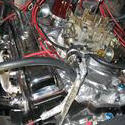
I ordered that one this morning from Summit Racing about the same price after shipping. I tested three cylinders with the first one and showed 0 leakage I felt something was wrong. I also did a compression test with a different tool and it showed 170 to 175lbs on each cylinder but I dont know if that is low or not. Its a ZZ4 or a ZZ3 dont really know the difference. It was produced between 1986 and 1994.

Jebby
Le Mans Master


Joined: Oct 2002
Posts: 7,098
Likes: 378
From: Las Vegas - Just stop perpetuating myths please.
Yes, that is problem with leakdown and compression tests as they should be done with the engine close to operating temperature but I don't know of anyone that can get their hands and hose in there with hot exhaust manifolds. That is because warm pistons and rings will seal better giving a more accurate indication. But even though cranking pressure will be lower and cylinder leakage will be higher you should still get a relative good indication of cylinder leakage and pressure.
FWIW 175psi cranking pressure would be a good number for even a high compression engine.
If you really wanted to be obsessive and compulsive about engine temperature you could rig up your household water heater to your engine's heater hose and warm the engine that way. But most of us will settle for the results while engine is cold.
Nice effort and now you know the health of your cars engine regardless of it's mileage.
FWIW 175psi cranking pressure would be a good number for even a high compression engine.
If you really wanted to be obsessive and compulsive about engine temperature you could rig up your household water heater to your engine's heater hose and warm the engine that way. But most of us will settle for the results while engine is cold.
Nice effort and now you know the health of your cars engine regardless of it's mileage.
Thread Starter
Racer
Joined: May 2017
Posts: 272
Likes: 7
From: Mindenmines Missouri
Got the new tester this morning and did the test. My results are as follows. #1, 12% #2, 5% #3, 4% #4, 4% #5, 5% #6, 6% # 7, 5% #8, 7% It looks like #1 is the worse and the air, I can hear with a stethoscope is coming from where the push rod goes through the head. So that would be the crankcase. am I right ? Compression is good, Oil pressure is at 60ish on cold start 40 after warm goes up some when driving. Very little smoke if any. but I do see a lot of blow by when running on left side. What condition would you say the engine is in. What started all this is the ticking coming from some where, I havent been able to pin point it. Then all of a sudden the engine has started vibrating, a lot. I wanted to make sure it wasnt a cylinder dying before I look at the flexplate. Which I will have to buy a transmission jack. I`ll be 72 in a couple months and getting down under is not something I look forward too. Am I going about this right ?

Le Mans Master

Joined: May 2006
Posts: 9,993
Likes: 1,136
From: League City Tx
Got the new tester this morning and did the test. My results are as follows. #1, 12% #2, 5% #3, 4% #4, 4% #5, 5% #6, 6% # 7, 5% #8, 7% It looks like #1 is the worse and the air, I can hear with a stethoscope is coming from where the push rod goes through the head. So that would be the crankcase. am I right ? Compression is good, Oil pressure is at 60ish on cold start 40 after warm goes up some when driving. Very little smoke if any. but I do see a lot of blow by when running on left side. What condition would you say the engine is in. What started all this is the ticking coming from some where, I havent been able to pin point it. Then all of a sudden the engine has started vibrating, a lot. I wanted to make sure it wasnt a cylinder dying before I look at the flexplate. Which I will have to buy a transmission jack. I`ll be 72 in a couple months and getting down under is not something I look forward too. Am I going about this right ?
If its making a noticeable ticking sound and its missing, I think I'd be pulling the lifters out for an inspection. That'll cause a tick and a miss if a lifter is going bad. Hopefully its not eating up the wheel on the lifter and the cam.
Keep investigating, you'll find it.
Definitely check the torque converter bolts for tightness. That will make a sound similar to a rod knock. But it usually doesn't vibrate, although I'm sure its possible. The torque converter bolts are an easy check, I'd do that first just to eliminate it.
Last edited by ajrothm; Aug 7, 2019 at 06:41 PM.