When you click on links to various merchants on this site and make a purchase, this can result in this site earning a commission. Affiliate programs and affiliations include, but are not limited to, the eBay Partner Network.
Is this normal for a car of this age?
There is a puddle of old oil in the depression in the intake manifiold under the throttle body linkage. Is there a gasket I need to replace or can I just clean it and be on my merry way?
Are you saying there is an engine under all that emissions crap?
Normally I would say valve covers usually leak at the bottom of the cover. And normally I would say the intake manifold bolts are "wicking" oil up their threads from lack of thread sealant and pool on the intake.
But in your case, hard to say.
Last edited by HeadsU.P.; Oct 24, 2019 at 07:45 PM.
Are you saying there is an engine under all that emissions crap?
Normally I would say valve covers usually leak at the bottom of the cover. And normally I would say the intake manifold bolts are "wicking" oil up their threads from lack of thread sealant and pool on the intake.
But in your case, hard to say.
I'm voting for oil whicking up unsealed screw threads for 30 years...
From: Arizona - If you don’t know CFI, STOP proliferating the myths around it...
It looks like it is in need of some LONG overdue maintenance, but that's just me. That doesn't look like my CF motor. Yeah, I would go through and replace the gaskets and seal all the the bolts, wouldn't hurt to replace the cover gaskets, but not the issue here. The TB will spray outside of the units, but not that bad unless something is really wrong. Time for a GI party on the CF.
From: At my Bar drinking and wrenching in Lafayette Colorado
Looks like oil vapors wicking up through the intake manifold bolt threads due to non-sealed threads. It could also be the injectors seeping a little fuel after shutdown, which will drip onto the throttle blades and wick out the throttle shafts and drip on the intake manifold, causing exactly the same appearance.
From: Arizona - If you don’t know CFI, STOP proliferating the myths around it...
Originally Posted by lars
Looks like oil vapors wicking up through the intake manifold bolt threads due to non-sealed threads. It could also be the injectors seeping a little fuel after shutdown, which will drip onto the throttle blades and wick out the throttle shafts and drip on the intake manifold, causing exactly the same appearance.
Fuel mixing with engine grime. It' from a worn throttle shaft and old base gaskets.
This would be my opinion, too...sort of. Leaking valve cover gaskets would leave a "trail" of oil, from their sealing surface, down to the manifold, that would be easy to see. It doesn't appear to be the case, based on the pictures provided. To me, the first step would be to get out some Simple Green or Purple Power, and a low pressure garden hose, and clean the engine thoroughly but GENTLY. Then closely observe both if and how the "dirt" reappears.
With respect to leaking throttle shafts, how does the gas pedal operate? Is it smooth, and not binding or maybe rough and binding? Secondly, while I'm not really familiar with the Crossfire TB set-up, how would the throttle shafts be leaking gas, when that area of the unit should be seeing vacuum from the engine?
This would be my opinion, too...sort of. Leaking valve cover gaskets would leave a "trail" of oil, from their sealing surface, down to the manifold, that would be easy to see. It doesn't appear to be the case, based on the pictures provided. To me, the first step would be to get out some Simple Green or Purple Power, and a low pressure garden hose, and clean the engine thoroughly but GENTLY. Then closely observe both if and how the "dirt" reappears.
With respect to leaking throttle shafts, how does the gas pedal operate? Is it smooth, and not binding or maybe rough and binding? Secondly, while I'm not really familiar with the Crossfire TB set-up, how would the throttle shafts be leaking gas, when that area of the unit should be seeing vacuum from the engine?
When the shafts get worn any fuel that is not pulled into the engine seeps along the shaft and out onto the intake. Worn and leaking injectors and/or injector tower gaskets soak the base gasket and shaft which leaks onto the manifold. The OP needs to get a kit and rebuild his throttle bodies. Get shaft bushing installed if needed and replace the injectors.
This would be my opinion, too...sort of. Leaking valve cover gaskets would leave a "trail" of oil, from their sealing surface, down to the manifold, that would be easy to see. It doesn't appear to be the case, based on the pictures provided. To me, the first step would be to get out some Simple Green or Purple Power, and a low pressure garden hose, and clean the engine thoroughly but GENTLY. Then closely observe both if and how the "dirt" reappears.
With respect to leaking throttle shafts, how does the gas pedal operate? Is it smooth, and not binding or maybe rough and binding? Secondly, while I'm not really familiar with the Crossfire TB set-up, how would the throttle shafts be leaking gas, when that area of the unit should be seeing vacuum from the engine?
Pedal pressure is smooth throughout range of motion (pretty sure throttle is digital from ECM signals).
I cleaned up the manifold as well as I could without removing throttle bodies. Fuel leak makes me think of a "Roman candle corvette", if the leak is super slow how dangerous is my current situation? Does it need to stay parked till I redo gaskets?
You will have to visually see if there is actually gasoline leaking or whether it is a slow process. If slow, seepage over time from the throttle shafts, you do not have a fire hazard. The seepage only occurs with the engine off.
Well, I would clean it all up. Then run it for awhile and watch and see it anything is leak and from where.
Maybe torque down the manifold bolts to see if any are under spec after all these years.
And if you spray anything on the manifold to clean it, cover the throttle bodies.
Mikey...the valve cover gaskets in those years...er-ah WEREN"T...this was the beginning of the 'silicone seal' years....over rough castings....they were good for about 5 years....that of course was 32 years ago!
It's a bit of a PIA...but any CE/82 owner can do it....replace the sh1tty silicone with the EXCELLENT rubber SBC gaskets.
1. Clean it to an inch of it's lifE
2.Remove all the **** that is in the way....5 hours!
3. Clean the heads until you can see your face! LOL
4. Clean the Rocker cover.
5. Repaint and touch up the rocker cover.
6. Install gaskets with ULTRA COPPER into the rocker cover.
7. Press them down nicely, continously, firmly, evenly and LET DRY OVERNITE... (cover the rocker galleries!)
8. Install without over tightening with #$%^ SS washers!
9. Put all the stuff back on!
Take five aspirin for your back and call me in the morning!
Take it to a quarter car wash along with a couple of cans of GUNK degreaser. After driving to the car wash, pop the hood and spray down the intake area LIBERALLY with one can of GUNK. Let it sit on the warm engine for 10-15 minutes. Put some money in the till and shoot the intake with high pressure soap spray. Don't hold the wand too close to the intake....take care around wiring and hoses so that pressure doesn't do damage. Once the gunk (and GUNK) is cleared away, look to see how clean you have it. If it needs another treatment, you will have to let it all dry up before shooting it again. But, do as you need until that area is generally clean. Rinse with hi-pres water, then SPOT FREE rinse and take it home to dry.
Now, you can take it out for a short drive and then inspect for any NEW signs of oil and/or fuel. Hopefully, at that point you will know what you are dealing with and where any leakage is initiating. Fix as needed.
Moral of this story--- You have to clean off leakage in order to find where it starts.






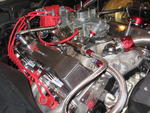
 82 Oil pool on intake manifold...