When you click on links to various merchants on this site and make a purchase, this can result in this site earning a commission. Affiliate programs and affiliations include, but are not limited to, the eBay Partner Network.
I am having problems with my 350 and could use some help. Listed below is the build, and been driving it last four summers. Late this year, it started pinging under load. I inspected the distributor and the advance mechanism on the DUI HEI distributor was completely seized up. Called Performance Distributors, and they asked me to send it back, and they set it up for my engine first time, and again now. DUI put new advance mechanism in it, and I put it back on the car. Still too much advance required to run the car and now its trailer hitching ....in fact, timing light at idle says 40-45 degrees with the advance vacuum plugged and I just cannot believe it. I have never been able to get the car to run at 10-15 degrees idle advance, but gave up and just moved the distributor till it ran okay. But, something is not right. So, I am going in now to check cam timing.....even though I am sure it is right, but could be one explanation why the timing is off. I have triple and quadruple checked my distributor timing / posiition / installation, and bottom line, and don't ask, its taking really 40 degrees at idle to run. Its not the timing light, cause the dam rotor is way off the correct position when it runs right. I try to move it towards where it should be and it quits.
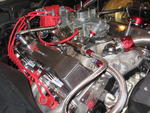
Took the intake manifold off and found ALL cylinder intake runners full of coked up oil residue, valve stems caked up, and all runners wet with oil. See pictures. I used Felpro 1256 gaskets, with no goop on the intake ports, i.e. no RTV, etc. Felpro says to install dry. But it appears maybe I am sucking oil on all cylinders, because I see no reason why there is this much oil on the intake valves and both heads and Performer RPM intake shows black oil residue. If my rings were shot, which makes no sense, would I not be burning oil? No smoking, no oil consumption. I am getting 18 inches of vacuum at idle., so I did not think I had vacuum leak, but? I have less than 16000 miles on this engine. My question:
Why does it measure 40-45 degrees advance at idle with the distributor installed correctly? Some say it is impossible. And I drove it three years without any pinging under load, till late this year, And it was very minor. NOT using oil at all and 18 inches of manifold vacuum??
- GM ZZ4 factory hydraulic roller short block - AFR 180cc Heads, 65cc Chamber 10:1 Compression (015 gasket) - GM Factory Hydraulic Roller Lifter system - Comp Cam Extreme Energy XR270 Roller Cam (218/224, .500 lift, 110 LSA) - Comp Cam Ultra Pro Magnum Steel Roller Rockers - Edelbrock Quadrajet RPM intake - Quadrajet rebuilt by Lars (with the above engine specs) - DUI Performance HEI Distributor
Last edited by Shovels and Vettes; Nov 3, 2019 at 12:25 PM.
Sounds like the balancer ring may have slipped so it’s not indicating TDC accurately any more.
that’s a lot of oil. How is the clearance on you valve guides. Take off a spring an intake valve and check it, along with the guide seals as well.
i use rtv ( ultra black permatex or similar) on the intake gaskets despite what Felpro says, they are not the ones who’ll have to take it apart and do it again if they do leak.
Rotate crank to close to before TDC. Screw in the tool until it hits the top of the piston. Rotate the crank back and forth until you find the spot where the tool hits the piston about halfway in. Mark that on the tool with paint. Make a mark on the balancer as well. Rotate engine past TDC and find the spot where the tool hits the piston as it is going down at the same tool adjustment. Make a second mark on the balancer. True TDC is in between your marks.
I don't know why FelPro thinks that should be a "dry gasket". PHEWEY! Looking at the fourth photo down, there is oil right there on the gasket.
And then there are the people that say: "I never put any sealer on my gaskets". Well, here is a classic example why you should. Either Edelbrocks Gastiniche or Permatex Black or Permatex The Right Stuff on BOTH SIDES of the gasket.
You were sucking oil vapor out of the lifter valley. Order best new gasket, best sealer money can buy, and start scraping that old crap out of there.
Last edited by HeadsU.P.; Nov 3, 2019 at 06:36 PM.
Sucking oil through the intake gaskets......check you manifold height and how it sits with the gaskets on it now.....you may need to go thicker but verify that......it could have just not been tightened down well enough or warpage on the intake. The printoseal gasket is great but requires that both surfaces be clean and not out of angle from one another...and not sitting too high or too low. You pics show the printed upper part of the gasket is good but you cannot see the back of the gasket........if clamped proper, it has to seal.
Yes....verify TDC #1 with the tool.......report your findings here.
Make SURE the vacuum advance is unplugged to check timing......leaving it connected can fudge the numbers at the light by up to 20 degrees.
As for the timing, I tried to use the exact tool shown in posts above,......and all I did was bend it. I could not feel it stop while turning engine with short ratchet on damper center bolt......then read more about it, and found out that with AFR heads, the plugs go in at such an angle that this type of piston stop does not work. Waste of $15, so I am pulling the heads anyway, and will check TDC with the Comp Cams timing kit I have.
I disconnected the vacuum line from distributor when checking timing and plugged it. No difference.....still indicates 40-50 advanced at idle.
As for the oil in the intakes, I will check the angles and china wall gap, but there it is definitely not bottoming out. I also want to point out that I have oil well up into the intake manifold,.and on the bottom of the floor under the carb....so I am not convinced its an intake gasket leak....would there be oil in in the floor and intake runners of the intake manifold with this leak?
What are the chances I would have oil leaking past the rings, pressurizing the case and the PVC system sucking oil into the carb? I cannot understand why the rings would be bypassing oil at 16000 miles. AND, I do not have any noticeable oil consumption, and no smoke out the exhaust. Which leads back to leaking intake manifold gasket.......but again....would there be oil up in the intake runners of the manifold with a leaking gasket given the flow is out of the intake and into the head?
And not sure how I am going to clean these heads.....maybe have to disassemble them to get it clean.
Last edited by Shovels and Vettes; Nov 3, 2019 at 08:13 PM.
I believe (now) you have two issues going on here. I still vote for a "bad seal on the intake gasket". And some noticeable "blow-by" pressure that your PCV is picking up and depositing the vapor / mist inside the plenum.
No need to pull the heads at this time. Just wait for more data to surface. The valve-stems can be cleaned through the ports, good enough.
I believe (now) you have two issues going on here. I still vote for a "bad seal on the intake gasket". And some noticeable "blow-by" pressure that your PCV is picking up and depositing the vapor / mist inside the plenum.
No need to pull the heads at this time. Just wait for more data to surface. The valve-stems can be cleaned through the ports, good enough.
I can do a compression test, as well as leakdown test, and see. I had 18 inch vacuum at idle, NO oil consumption, and no smoke out the exhaust......but yet, I have all this oil deposits in the runners and on the valves and oil in the floor of the intake plenum and up into the intake runners.
Rotate crank to close to before TDC. Screw in the tool until it hits the top of the piston. Rotate the crank back and forth until you find the spot where the tool hits the piston about halfway in. Mark that on the tool with paint. Make a mark on the balancer as well. Rotate engine past TDC and find the spot where the tool hits the piston as it is going down at the same tool adjustment. Make a second mark on the balancer. True TDC is in between your marks.
Ditto... Make sure your balancer ring hasn't slipped.
If that kinda tool won't work on your heads then do it old school. Take an old spark plug and a piece of rope and knock the guts out of the plug till all you have left is the metal threaded part also cutting off the electrode. Run a piece of rope through it and tie a knot in the piece of rope with about 4 inches hanging off into the combustion chamber. This should bottom your motor out on the rope. Not as accurate as the tool above but given how much we think it's moved it will confirm it. No good reason to pull heads to ensure your balancer has or has not slipped.
Last edited by kossuth; Nov 3, 2019 at 10:10 PM.
Reason: Added additional info
I can do a compression test, as well as leakdown test, and see. I had 18 inch vacuum at idle, NO oil consumption, and no smoke out the exhaust......but yet, I have all this oil deposits in the runners and on the valves and oil in the floor of the intake plenum and up into the intake runners.
There is your smoking gun. If you have oil in the intake the only possible way it's getting drawn in there is through the PCV system. Now how that's happening is another story. I'd be willing to bet it's a baffling issue in the valve cover and oil is getting pulled past the baffle.
As for the timing, I tried to use the exact tool shown in posts above,......and all I did was bend it. I could not feel it stop while turning engine with short ratchet on damper center bolt......
Don't do it that way. As I posted above: Set the crank close to TDC and turn the tool in until it stops. If needed, turn the crank a bit back and forth with the tool unscrewed until you find the crank position where the tool goes in about half way before hitting the piston. That way you don't bend the tool.
I agree with the PCV especially if you have some sort of aftermarket valve covers and you can see oil on the intake floor under the carb. You can test the PCV system by using one of those cheap glass fuel filters. Remove the PCV hose at the base of the carb and install the filter between the carb and the hose. There are 60 tablespoons of oil in a quart so if you had one tablespoon in the filter after a 10 mile drive that would indicate that you are losing a quart of oil just through the PCV system every 600 miles. Those filters unscrew for cleaning so you can use it for testing multiple times and is a surefire way to see if your valve cover baffling or the PCV valve is faulty.
Last edited by CanadaGrant; Nov 3, 2019 at 11:22 PM.
My aftermarket rocker covers are GM standard height chrome covers (Proform), with standard oil baffling. I changed the PCV valve early this year. If I am pushing oil into carb, I am hoping it is not because of rings bypassing.
In any case, I will do compression leak down check and standard compression check next and report back. I am getting ready to pull this motor and sell it anyway, I need more big block like torque so most likely building Dart SHP 406......so, motor for sale in C3 classified if interested. Selling as whole engine or might part out heads, short block, whatever. I know given the problem, I am probably hurting my sale, but whatever,.....I am an honest guy.
Lets not get all carried away here. There is still the possibility that the intakes gasket bottom edge is faulty. After all, no sealer was employed.
This would allow oil to be sucked into the plenum from the lifter valley. Very little oil consumption will be shown on the dipstick but never the less this would show up in the plenum and cake the valve-stems.
This is an easy fix as stated in post # 5. Slap some new gaskets on there and run it!
Last edited by HeadsU.P.; Nov 4, 2019 at 05:44 PM.
From: Some days your the dog and some days your the hydrant.
Royal Canadian Navy
My AFR 195's intake valves have carbon buildup. I haven't used a pcv valve in decades. Just a valve cover breather on each. I'm with those saying part, if not all, of the problem is sucking oil from the lifter valley and oil weeping up through the intake bolts.
Do you remember the part number for the PCV valve that you used? If there was oil in the intake under the carburetor then you have a crankcase vent issue. From the photos it looks like the intake gasket was sealing. You do need to pull the heads to clean them up. Pull them completely down and check the guides and seals. Also check for any warpage. Same with intake check it. If the heads are still on do a leak down test. Just to make sure the cylinders are good. Post what you find.







 Oil in Intake Runners