
Quench?

Team Owner


Joined: Apr 1999
Posts: 21,953
Likes: 1,445
From: Reno Nevada
2024 C3 of the Year Finalist- Modified

Thread Starter
Race Director


Joined: Nov 2006
Posts: 19,445
Likes: 353
From: Athens GA
St. Jude Donor '12-'13, '15- '16-'17-'18-'19, '21
Thread Starter
Race Director
Joined: Nov 2006
Posts: 19,445
Likes: 353
From: Athens GA
St. Jude Donor '12-'13, '15- '16-'17-'18-'19, '21

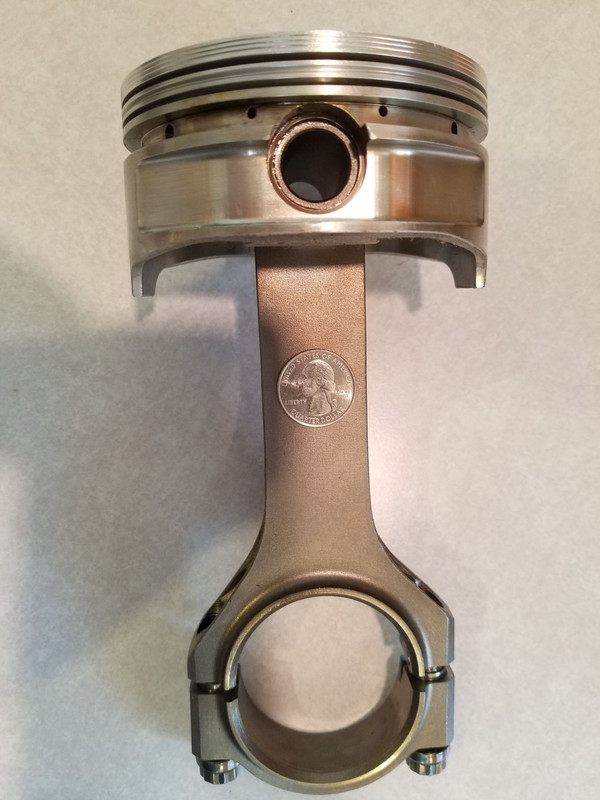
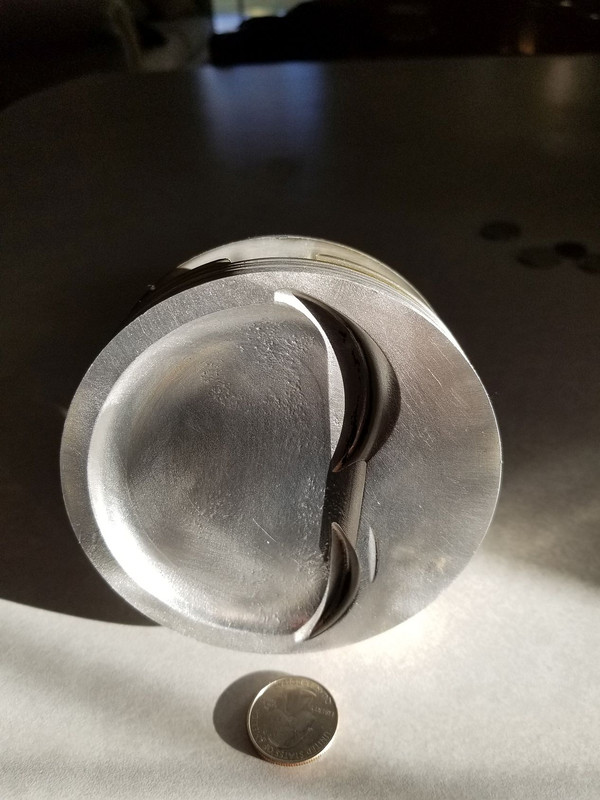
These are my Wiseco pistons and Manley H beam 6 inch rods. I need to get busy and put it together. They have a pretty good quench. They are made for up to 2.15 intake valves and .800 lift clearance. I only have 2.10 and .685 lift I so I didn't have to clay and machine them. The rods I machined for cam clearance. These rods are made for over 1000 HP. My cam is something like a .980 base circle custom billet solid roller. I don't think that arbitrarily ordering small base circle cams with a .900 diameter is very wise. Rollers like bigger diameters and the cam starts to loose strength when made small.
Team Owner
Joined: Apr 1999
Posts: 21,953
Likes: 1,445
From: Reno Nevada
2024 C3 of the Year Finalist- Modified
This is a wisco 4.155 +8 cc 6 inch rod for 3.875 stroke. I used these type on a 421 bowtie blocked drag racing motor for a friend. It was a E-85 motor with something like 13.8 C/R. 2500 lbs chevy nova II.
But anyway you have the quench area and I had to machine the domes for clearance in a Dart 227cc head chamber
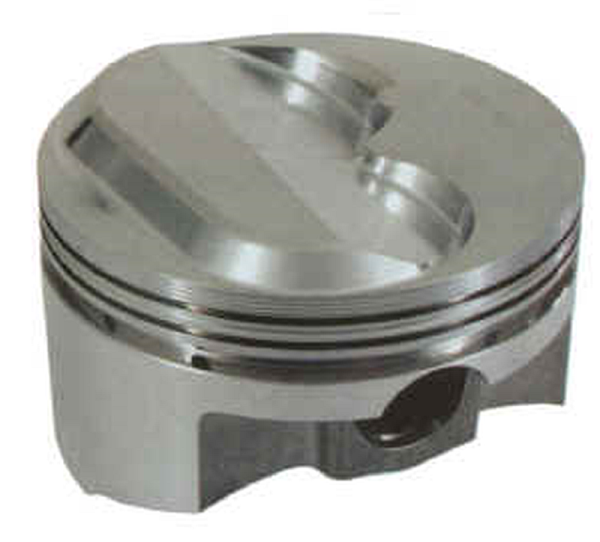
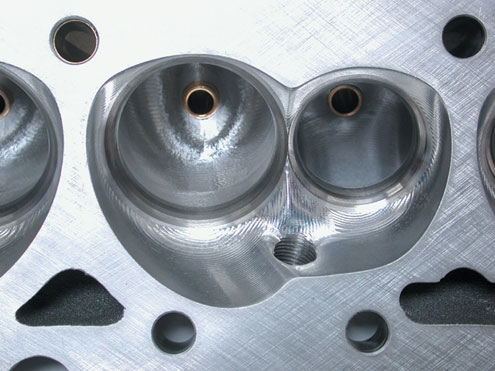
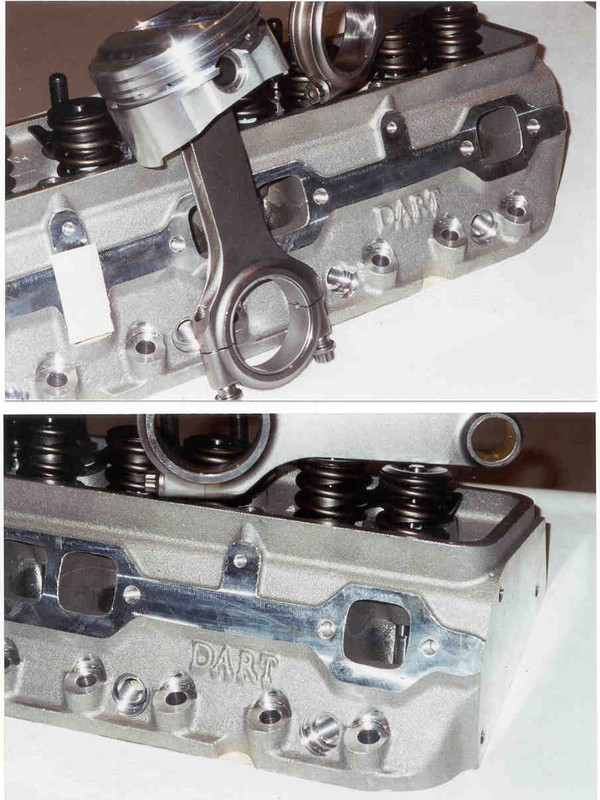
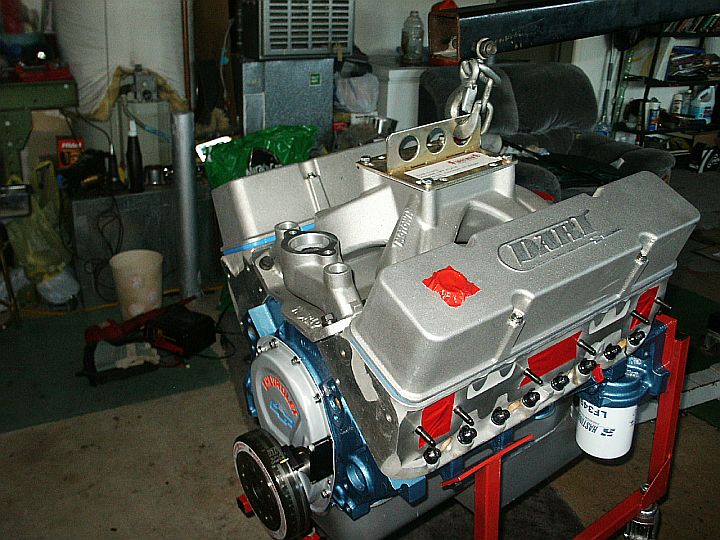
But anyway you have the quench area and I had to machine the domes for clearance in a Dart 227cc head chamber
Last edited by gkull; Nov 26, 2019 at 12:26 PM.

Melting Slicks

Joined: Jun 2016
Posts: 2,979
Likes: 332
From: Woodinville WA
David Redszus on Speedtalk has a GREAT thread discussing the main factors in determining mixture motion and turbulence and the two main variables are the quench pad area, quench distance and VELOCITY of the piston.
I think the D-Dish pistons make a ton of sense both because of the extra quench distance but also because it makes for a better, more compact 3 dimensional chamber shape (the combustion chamber in the head is 1/2 the actual combustion chamber and the piston the other half) -that means less ignition advance is required and you get TEENY, TINY improvement in torque from the faster burn.
The "ideal" quench distance / piston to head clearance / "Squish", I think is technically a variable and not a constant. The ideal quench, is as close as you can get the piston to the head without hitting it and that depends upon rotating assembly weights, rod materials, and RPM. David Vizard had so much data on this he published a "rule of thumb" of the % power increase you get for decreasing the quench.... somewhere that I can't find right now...
My understanding is that newer pistons having the quench ring around then helps to keep detonation from happening in the piston-to-wall and ring-to-piston stop space.
-It's a super fascinating subject. There's a good SpeedTalk thread recently about how many modern 4 valve engines with super straight intake tracts strictly control the intake tract to exhaust valve angle to induce super intense tumbling of air to also ensure that the mixture and temperatures in the cylinder / combustion chamber are super even and help fight off detonation, too.
Adam
Thread Starter
Race Director
Joined: Nov 2006
Posts: 19,445
Likes: 353
From: Athens GA
St. Jude Donor '12-'13, '15- '16-'17-'18-'19, '21
Those pistons I keep hearing called "D-Dish" pistons.
David Redszus on Speedtalk has a GREAT thread discussing the main factors in determining mixture motion and turbulence and the two main variables are the quench pad area, quench distance and VELOCITY of the piston.
I think the D-Dish pistons make a ton of sense both because of the extra quench distance but also because it makes for a better, more compact 3 dimensional chamber shape (the combustion chamber in the head is 1/2 the actual combustion chamber and the piston the other half) -that means less ignition advance is required and you get TEENY, TINY improvement in torque from the faster burn.
The "ideal" quench distance / piston to head clearance / "Squish", I think is technically a variable and not a constant. The ideal quench, is as close as you can get the piston to the head without hitting it and that depends upon rotating assembly weights, rod materials, and RPM. David Vizard had so much data on this he published a "rule of thumb" of the % power increase you get for decreasing the quench.... somewhere that I can't find right now...
My understanding is that newer pistons having the quench ring around then helps to keep detonation from happening in the piston-to-wall and ring-to-piston stop space.
-It's a super fascinating subject. There's a good SpeedTalk thread recently about how many modern 4 valve engines with super straight intake tracts strictly control the intake tract to exhaust valve angle to induce super intense tumbling of air to also ensure that the mixture and temperatures in the cylinder / combustion chamber are super even and help fight off detonation, too.
Adam
David Redszus on Speedtalk has a GREAT thread discussing the main factors in determining mixture motion and turbulence and the two main variables are the quench pad area, quench distance and VELOCITY of the piston.
I think the D-Dish pistons make a ton of sense both because of the extra quench distance but also because it makes for a better, more compact 3 dimensional chamber shape (the combustion chamber in the head is 1/2 the actual combustion chamber and the piston the other half) -that means less ignition advance is required and you get TEENY, TINY improvement in torque from the faster burn.
The "ideal" quench distance / piston to head clearance / "Squish", I think is technically a variable and not a constant. The ideal quench, is as close as you can get the piston to the head without hitting it and that depends upon rotating assembly weights, rod materials, and RPM. David Vizard had so much data on this he published a "rule of thumb" of the % power increase you get for decreasing the quench.... somewhere that I can't find right now...
My understanding is that newer pistons having the quench ring around then helps to keep detonation from happening in the piston-to-wall and ring-to-piston stop space.
-It's a super fascinating subject. There's a good SpeedTalk thread recently about how many modern 4 valve engines with super straight intake tracts strictly control the intake tract to exhaust valve angle to induce super intense tumbling of air to also ensure that the mixture and temperatures in the cylinder / combustion chamber are super even and help fight off detonation, too.
Adam
Thanks Adam

Great additional info.
Dennis

Le Mans Master

Joined: Apr 2011
Posts: 6,284
Likes: 1,171
From: Hermosa
No, Not necessarily.
Tightening the Quench distance is what helps prevent detonation ... but simply substituting a thinner gasket will tighten quench and raise CR.
However, one could raise CR by substituting a piston with a tall dome but with a short compression distance and ...
... the CR might skyrocket but both the Quench & detonation prevention would be minimized.
OR, one could have a poor Quench & poor detonation prevention because his piston is 0.060" below deck and ...
... his gasket is another 0.015" (Q = 0.075") ... all beneath 76cc chambers ... but then he changes heads to 58cc chambers ...
... Now his CR has jumped way up but he still has that crap 0.075" Quench and crap for detonation prevention.
Quench and detonation prevention are achieved by a short distance between Crown (not dome) of piston and bottom deck of head ... that can be independent of CR.
Higher CR alone does Not improve detonation prevention ... Higher CR alone may actually exacerbate detonation ... prevention is achieved by ...
... the violent squishing of charge ... blown-inward from chamber's circumference ... caused by piston Crown & cylinder head nearly meeting.
First, choose your components / machining to achieve a good Quench ... Then, adjust your CR with what's either above or below piston's Crown (e.g. a smaller/larger dish volume).
Tightening the Quench distance is what helps prevent detonation ... but simply substituting a thinner gasket will tighten quench and raise CR.
However, one could raise CR by substituting a piston with a tall dome but with a short compression distance and ...
... the CR might skyrocket but both the Quench & detonation prevention would be minimized.
OR, one could have a poor Quench & poor detonation prevention because his piston is 0.060" below deck and ...
... his gasket is another 0.015" (Q = 0.075") ... all beneath 76cc chambers ... but then he changes heads to 58cc chambers ...
... Now his CR has jumped way up but he still has that crap 0.075" Quench and crap for detonation prevention.
Quench and detonation prevention are achieved by a short distance between Crown (not dome) of piston and bottom deck of head ... that can be independent of CR.
Higher CR alone does Not improve detonation prevention ... Higher CR alone may actually exacerbate detonation ... prevention is achieved by ...
... the violent squishing of charge ... blown-inward from chamber's circumference ... caused by piston Crown & cylinder head nearly meeting.
First, choose your components / machining to achieve a good Quench ... Then, adjust your CR with what's either above or below piston's Crown (e.g. a smaller/larger dish volume).
Last edited by REELAV8R; Nov 27, 2019 at 10:15 PM.

Le Mans Master
Joined: Sep 2001
Posts: 7,739
Likes: 630
From: Unreconstructed, South Carolina
REELAV8R
First, I haven't made any direct comparisons and haven't read of same either ... so I can't KNOW.
Next, Constraints: seems there are relatively far fewer large chamber heads with good ports than those w/good ports and smaller (< 68cc) chambers. Choice limits are skewed.
What seems to matter most is having as much of the head's deck as closely mirrored by piston's crown as is practical.
That said, I've had great results with D-Dish pistons with smaller chambers.
On a different note: Have much experience with 355" race motors meeting regional circletrack restricted class rules which specify OE heads w/chambers no smaller than 70cc, and only 1.94/1.5 11/32" valves and NO porting, and No Angle milling, and No part of piston above block deck, and valve lift No more than .480" custom solid cam, and 2 bbl carb atop an unmolested 2101 intake. Crank no less than 50lb w/ No profiling. Rods must be steel & OE length.
Reasonable example is: OE heads x487 (76cc) heads flat milled to 70cc, and custom flattops with two tiny valve reliefs, and block zero decked, and 0.015" gasket.
With right custom grind, and very good carb, and a good oil pan w/ windage control, the better motors make about 370 fwhp on race gas.
First, I haven't made any direct comparisons and haven't read of same either ... so I can't KNOW.
Next, Constraints: seems there are relatively far fewer large chamber heads with good ports than those w/good ports and smaller (< 68cc) chambers. Choice limits are skewed.
What seems to matter most is having as much of the head's deck as closely mirrored by piston's crown as is practical.
That said, I've had great results with D-Dish pistons with smaller chambers.
On a different note: Have much experience with 355" race motors meeting regional circletrack restricted class rules which specify OE heads w/chambers no smaller than 70cc, and only 1.94/1.5 11/32" valves and NO porting, and No Angle milling, and No part of piston above block deck, and valve lift No more than .480" custom solid cam, and 2 bbl carb atop an unmolested 2101 intake. Crank no less than 50lb w/ No profiling. Rods must be steel & OE length.
Reasonable example is: OE heads x487 (76cc) heads flat milled to 70cc, and custom flattops with two tiny valve reliefs, and block zero decked, and 0.015" gasket.
With right custom grind, and very good carb, and a good oil pan w/ windage control, the better motors make about 370 fwhp on race gas.
Corvette Stories
The Best of Corvette for Corvette Enthusiasts

Top 10 Most Expensive Corvettes Ever Sold on Bring A Trailer
Brett Foote
10 Things Every Corvette Owner Needs (2026 Edition)
Michael S. Palmer
8 Most "Only Corvette Owners Understand" Quirks and Problems
Pouria Savadkouei
10 Reasons the C6 Z06 is Still A Performance Benchmark After 20 Years
Joe Kucinski
How Much Horsepower Every Corvette Engine "LOST" in 1972
Joe Kucinski
Top 10 DOs and DON'Ts for Protecting Your Convertible Top!
Michael S. Palmer
Top 10 Most Explosive Corvettes Ever Made: Power-to-Weight Ratio Ranked!
Joe Kucinski
150 hp to 1,250 hp: Every Corvette Generation Compared by the Specs That Matter
Joe Kucinski
8 Coolest Corvette Pace Cars (and Replicas) of All Time
Verdad Gallardo
Le Mans Master
Joined: Apr 2011
Posts: 6,284
Likes: 1,171
From: Hermosa
REELAV8R
First, I haven't made any direct comparisons and haven't read of same either ... so I can't KNOW.
Next, Constraints: seems there are relatively far fewer large chamber heads with good ports than those w/good ports and smaller (< 68cc) chambers. Choice limits are skewed.
What seems to matter most is having as much of the head's deck as closely mirrored by piston's crown as is practical.
That said, I've had great results with D-Dish pistons with smaller chambers.
On a different note: Have much experience with 355" race motors meeting regional circletrack restricted class rules which specify OE heads w/chambers no smaller than 70cc, and only 1.94/1.5 11/32" valves and NO porting, and No Angle milling, and No part of piston above block deck, and valve lift No more than .480" custom solid cam, and 2 bbl carb atop an unmolested 2101 intake. Crank no less than 50lb w/ No profiling. Rods must be steel & OE length.
Reasonable example is: OE heads x487 (76cc) heads flat milled to 70cc, and custom flattops with two tiny valve reliefs, and block zero decked, and 0.015" gasket.
With right custom grind, and very good carb, and a good oil pan w/ windage control, the better motors make about 370 fwhp on race gas.
First, I haven't made any direct comparisons and haven't read of same either ... so I can't KNOW.
Next, Constraints: seems there are relatively far fewer large chamber heads with good ports than those w/good ports and smaller (< 68cc) chambers. Choice limits are skewed.
What seems to matter most is having as much of the head's deck as closely mirrored by piston's crown as is practical.
That said, I've had great results with D-Dish pistons with smaller chambers.
On a different note: Have much experience with 355" race motors meeting regional circletrack restricted class rules which specify OE heads w/chambers no smaller than 70cc, and only 1.94/1.5 11/32" valves and NO porting, and No Angle milling, and No part of piston above block deck, and valve lift No more than .480" custom solid cam, and 2 bbl carb atop an unmolested 2101 intake. Crank no less than 50lb w/ No profiling. Rods must be steel & OE length.
Reasonable example is: OE heads x487 (76cc) heads flat milled to 70cc, and custom flattops with two tiny valve reliefs, and block zero decked, and 0.015" gasket.
With right custom grind, and very good carb, and a good oil pan w/ windage control, the better motors make about 370 fwhp on race gas.
Le Mans Master
Joined: Sep 2001
Posts: 7,739
Likes: 630
From: Unreconstructed, South Carolina
REELAV8R
I've never measured those. They would vary from one manufacturer to the next and across same manufacturer's line. Also varies from milling head's deck. I don't KNOW
In order to test with any certainty and then to compare, I think that requires CFD simulation program; something I don't have access to.
For CT motors, we were lucky enough from time to time to access lobe sim program to help us understand dynamics of lifter loft ... and for the distances/clearances, at TDC ...
... I measure how far below block deck a valve extends plus some for any loft ... trying for max CR with smallest eyebrow without a crash.
I've never measured those. They would vary from one manufacturer to the next and across same manufacturer's line. Also varies from milling head's deck. I don't KNOW
In order to test with any certainty and then to compare, I think that requires CFD simulation program; something I don't have access to.
For CT motors, we were lucky enough from time to time to access lobe sim program to help us understand dynamics of lifter loft ... and for the distances/clearances, at TDC ...
... I measure how far below block deck a valve extends plus some for any loft ... trying for max CR with smallest eyebrow without a crash.
Team Owner
Joined: Apr 1999
Posts: 21,953
Likes: 1,445
From: Reno Nevada
2024 C3 of the Year Finalist- Modified
Like a 76cc head vs. 64cc with a dished piston.
Le Mans Master
Joined: Sep 2001
Posts: 7,739
Likes: 630
From: Unreconstructed, South Carolina
not about Static Compression
I don't interpret REELAV8R's comment as True or Not True. Sure, a specific volume (whether from dish/chamber/both) results in a specific Static CR ... But ...
... seems (To Me) what REELAV8R is referencing are questions adjunct to cylinder Filling and its Dynamics ... all of which seems (To Me) does affect Dynamic CR.
There are myriad variables that affect filling (and emptying); e.g. valve size, angle(s), seat angle(s), stem size, backcut, tulip, port shape-size, even direct injection and more that I'm not even aware of that affect the Dynamics of filling ... And I can also envision how seat-to-piston distances could affect filling as well ... Sooo ...
that's why I referenced above a need for CFD (Computational Fluid Dynamics) software to model, study and analyze ...
and even discover those variables ... and make reliable predictions.
FWIW, the leading CFD systems cost many thousands ... just to Lease.
Just look at the Ferraris in this weekend's final F1 ... During P1, one car has the conventional single tube exiting from wastegate ... while the other ...
... has a U-tube extractor ... did some tinker simply dream that up? Uhhhh, I kinda doubt that. CFD modeling thank you very much.
What does all that have to do with street rods or amateur racing ??... I dunno, it's probably about as important as a gnat's azz in a firestorm ... 𝝅 in the sky.
Again, If I do understand REELAV8R's comment, I think it's neither True or Not ... it probably has no effect on Static CR, but could affect Dynamic CR; albeit minimally.
... seems (To Me) what REELAV8R is referencing are questions adjunct to cylinder Filling and its Dynamics ... all of which seems (To Me) does affect Dynamic CR.
There are myriad variables that affect filling (and emptying); e.g. valve size, angle(s), seat angle(s), stem size, backcut, tulip, port shape-size, even direct injection and more that I'm not even aware of that affect the Dynamics of filling ... And I can also envision how seat-to-piston distances could affect filling as well ... Sooo ...
that's why I referenced above a need for CFD (Computational Fluid Dynamics) software to model, study and analyze ...
and even discover those variables ... and make reliable predictions.
FWIW, the leading CFD systems cost many thousands ... just to Lease.
Just look at the Ferraris in this weekend's final F1 ... During P1, one car has the conventional single tube exiting from wastegate ... while the other ...
... has a U-tube extractor ... did some tinker simply dream that up? Uhhhh, I kinda doubt that. CFD modeling thank you very much.
What does all that have to do with street rods or amateur racing ??... I dunno, it's probably about as important as a gnat's azz in a firestorm ... 𝝅 in the sky.
Again, If I do understand REELAV8R's comment, I think it's neither True or Not ... it probably has no effect on Static CR, but could affect Dynamic CR; albeit minimally.
Last edited by jackson; Nov 29, 2019 at 02:06 PM.
Le Mans Master
Joined: Apr 2011
Posts: 6,284
Likes: 1,171
From: Hermosa
If The whole piston top was a dish then yes perhaps much closer to same or maybe even the reverse the dish would be shallower than the material removed from a shaved head. With the D-dish the dish area in the piston is smaller than the combustion chamber area in the head.
With greater distance to the piston from the valve seat would that not allow for greater filling and slightly more inertia to the filling during the intake stroke thereby packing the intake charge just a little more? The effect being the greatest at or near max torque RPM?
Similar, but to a lesser degree to getting the exhaust primary diameter and length right for better overlap filling.
Le Mans Master
Joined: Apr 2011
Posts: 6,284
Likes: 1,171
From: Hermosa
Again, If I do understand REELAV8R's comment, I think it's neither True or Not ... it probably has no effect on Static CR, but could affect Dynamic CR; albeit minimally.
I agree it's effect may be minimal. But while considering all the possibilities during the building process given one option that will produce less power or one that will produce more, at no additional cost, why not use the one that will make more?
edit. I guess it would cost somewhat more to get the heads milled vs just out of the box.
However, from the reading i've done I'm convinced that a more spherical combustion burn from using a dish is faster and more efficient vs a half-spherical burn that you get in a flat top configuration. A faster and more efficient burn allows you to use less ignition lead and burn more of the fuel during the very short time of combustion, both of which produce more usable power.
I know the original question referred to quench. There were several good answers to that end. I also believe that quench is of great importance. My personal experience with it (not just on my 350 but also in motobike racing) proved to me that quench (mechanical detonation prevention) can provide many benefits. Including detonation prevention. It also allows for use of a lower octane fuel.
Lower octane fuels burn faster and more violently. This produces more power since it can burn faster and thereby more completely than a higher octane fuel. High octane fuel is specifically for detonation prevention. It does not produce more power it in fact produces less. Not to be confused with oxegenated fuels that actually do produce more power.
So if an engine can run 85 octane without detonation it will produce more power over the same engine that has to run 93 octane with the same specs sans proper quench.
Proper quench also allows for less ignition lead thereby less negative work during the power stroke due to the fact that the quench effect ,as part of the whole detonation prevention package, will not allow for detonation to occur.
I cannot get my engine to detonate regardless of the ignition lead I have tried or how lean I have run it. I've tried as much as 38* lead ( and that just slowed it down) and run it so lean that the pipes nearly cooked (which also slowed it down), neither produced detonation. In the end I ended up with timing that gave me the greatest acceleration and jetting that gives the same.
I have run as low as 86 octane through mixing and still no detonation. So along with other efforts, quench just works.
Last edited by REELAV8R; Nov 29, 2019 at 04:25 PM.
Le Mans Master

Joined: Oct 2002
Posts: 7,098
Likes: 378
From: Las Vegas - Just stop perpetuating myths please.
But how do you know your not having detonation if your not able to measure it? Detonation occurs long before you can hear it from inside the car. My '94 camaro PCM senses it and pulls the timing back when trying to accelerate using 86 octane while I can't hear anything in the car. But the car bogs and surges down the on ramp.
Quench is a great if you can build it in - no doubt about that. But it has it's limits. Owners would be surprised to find out it has little or lessor effect below 9:1 compression ratio. And at high rpm like 8,000 and high c.r. like 13:1 it has a negative effect making the flow inside the cylinder too turbulent for an optimum burn.
The problem builders of street engine's are having is finding pistons with enough quench area while using large strokes. So to address the small/big head chamber vs small big piston dish you just have to look at the GM Performance catalog and see the head chambers get continually small as the head performance application increases (greater horsepower). Now racing engines use very high compression ratios and you see even domed pistons used with tight chamber heads. But the optimum piston crown is as flat as possible. You won't find pistons w/o eyebrow valve reliefs but just think about it. Could a dish or dome produce the flame front and pressure distribution any better than a flat surface?
As far as distance from the vlv seat to the piston crown I have never read of that as a consideration other than for piston to vlv (P2V) clearance. Cam designers seem more concerned with lift and the vlv skirt area made by it. I think most would be surprised at how little lift is required for the majority of flow for a given vlv size. No I can't recall all the numbers but that would be a different discussion. Anyways this should give others insight as the smaller the head chamber and the flatter the piston crown the lessor the effect of the shapes either will have on the fuel/air charge burn and it's pressure distribution.
That's how I spent my two cents on quench. Happy Holidays!
Quench is a great if you can build it in - no doubt about that. But it has it's limits. Owners would be surprised to find out it has little or lessor effect below 9:1 compression ratio. And at high rpm like 8,000 and high c.r. like 13:1 it has a negative effect making the flow inside the cylinder too turbulent for an optimum burn.
The problem builders of street engine's are having is finding pistons with enough quench area while using large strokes. So to address the small/big head chamber vs small big piston dish you just have to look at the GM Performance catalog and see the head chambers get continually small as the head performance application increases (greater horsepower). Now racing engines use very high compression ratios and you see even domed pistons used with tight chamber heads. But the optimum piston crown is as flat as possible. You won't find pistons w/o eyebrow valve reliefs but just think about it. Could a dish or dome produce the flame front and pressure distribution any better than a flat surface?
As far as distance from the vlv seat to the piston crown I have never read of that as a consideration other than for piston to vlv (P2V) clearance. Cam designers seem more concerned with lift and the vlv skirt area made by it. I think most would be surprised at how little lift is required for the majority of flow for a given vlv size. No I can't recall all the numbers but that would be a different discussion. Anyways this should give others insight as the smaller the head chamber and the flatter the piston crown the lessor the effect of the shapes either will have on the fuel/air charge burn and it's pressure distribution.
That's how I spent my two cents on quench. Happy Holidays!
Le Mans Master
Joined: Apr 2011
Posts: 6,284
Likes: 1,171
From: Hermosa
Detonation leaves behind evidence that is easy to see with a bore scope or on the spark plug, that is if you don’t hear it.
A small amount of detonation won’t hurt these engines in any case. Modern engines are a different story altogether.
That being said it’s still best to build it so that it’s likelihood is small. Best avoided rather than flirted with, at least with hyper pistons, forged pistons can handle quite a bit more.
A small amount of detonation won’t hurt these engines in any case. Modern engines are a different story altogether.
That being said it’s still best to build it so that it’s likelihood is small. Best avoided rather than flirted with, at least with hyper pistons, forged pistons can handle quite a bit more.