




Quench?

Thread Starter
Race Director


Joined: Nov 2006
Posts: 19,445
Likes: 353
From: Athens GA
St. Jude Donor '12-'13, '15- '16-'17-'18-'19, '21
 Quench?
So I understand the principle. And I understand the "ideal" figure is .040" according to most reference material. There is also articles that state .035" - .045" as a target range.
The distance is the "flat" top of the piston to the head. And that is assuming flat top pistons.
So here is the question..... and I see no clear answer out there.....
What about dished pistons in the 15 cc and up range? The configuration is almost a flat bowl.
Is the quench figure computed to the bottom of the "bowl" or just to the ridge at the top of the piston?
Common sense would say one has to take the distance to the bottom of the dish. But I am not sure...
And to add to the dilemma.... that figure (the depth of the dish) is listed nowhere on any piston specs sheet.
I imagine that if the distance to the bottom of the dish is critical, it would be possible to create a formula that would convert the volume of the dish (which is listed) in relationship to the bore of the piston to determine how deep the dish is.
And therefore that figure would have to be accounted for in determining the "actual" quench.
Basically the bottom of the dish takes over as the top of the flat top piston.
OK....so help me out.....
Thanks
Dennis
The distance is the "flat" top of the piston to the head. And that is assuming flat top pistons.
So here is the question..... and I see no clear answer out there.....
What about dished pistons in the 15 cc and up range? The configuration is almost a flat bowl.
Is the quench figure computed to the bottom of the "bowl" or just to the ridge at the top of the piston?
Common sense would say one has to take the distance to the bottom of the dish. But I am not sure...
And to add to the dilemma.... that figure (the depth of the dish) is listed nowhere on any piston specs sheet.
I imagine that if the distance to the bottom of the dish is critical, it would be possible to create a formula that would convert the volume of the dish (which is listed) in relationship to the bore of the piston to determine how deep the dish is.
And therefore that figure would have to be accounted for in determining the "actual" quench.
Basically the bottom of the dish takes over as the top of the flat top piston.
OK....so help me out.....
Thanks
Dennis
Thread Starter
Race Director
Joined: Nov 2006
Posts: 19,445
Likes: 353
From: Athens GA
St. Jude Donor '12-'13, '15- '16-'17-'18-'19, '21
Normally true....but these are one of the pistons I was considering and this is the pic they post.
Often "the pic" is not actual but a representative...I know.
But this pic sparked by thought process.
Thanks George.
Please check that PM I sent also....
https://www.cnc-motorsports.com/pts5...re-10-8-1.html
Often "the pic" is not actual but a representative...I know.
But this pic sparked by thought process.
Thanks George.
Please check that PM I sent also....
https://www.cnc-motorsports.com/pts5...re-10-8-1.html

Team Owner


Joined: Apr 1999
Posts: 21,953
Likes: 1,445
From: Reno Nevada
2024 C3 of the Year Finalist- Modified
This is one of my 427 wiseco pistons. 4.125 6 inch rod 4 inch stroke. It had a little problem one day up around 7500 rpm. The roller lifter and push rod were destroyed. so I don't know what failed first.
But all the different Wiseco pistons looked like this that I have used.
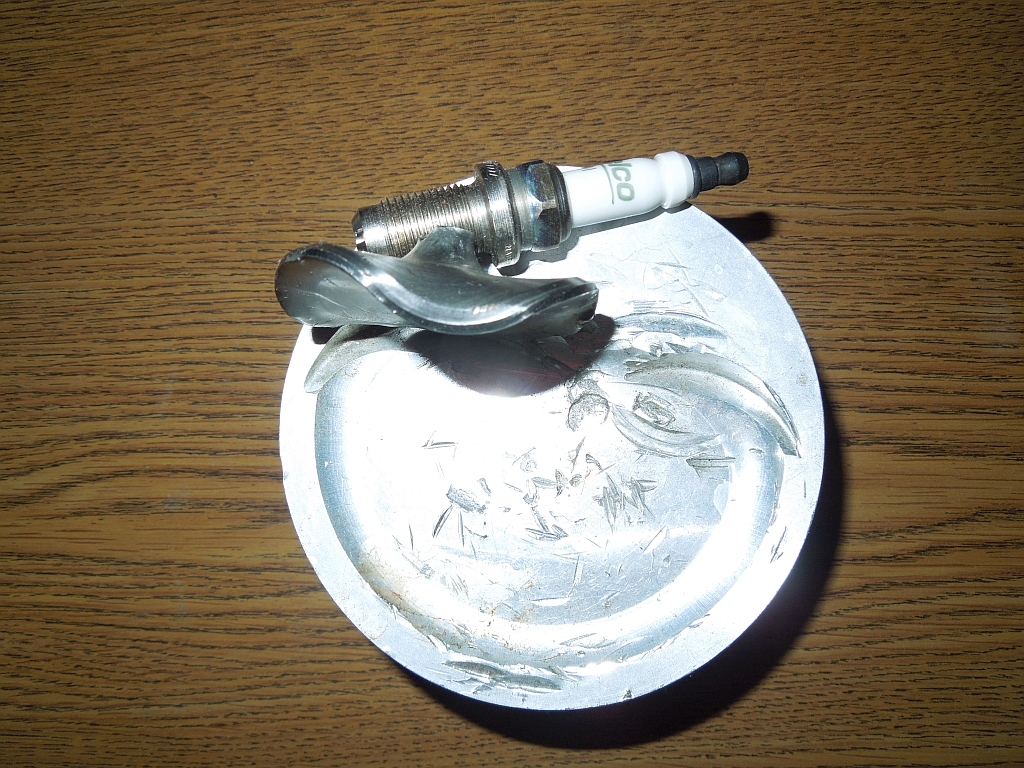
But all the different Wiseco pistons looked like this that I have used.

Racer

Joined: Jan 2008
Posts: 295
Likes: 58
From: Arvada Colorado
The quench does not matter is the piston is dished or if the piston is domed. There is a flat area of the piston that is close to the cylinder wall generally away from the valve area. This area can be level with the top of the block, slightly below or even slightly above ( but not usually ) . Measure the distance from this flat area to the top of the block with the piston at the top of its stroke. This distance PLUS the thickness of the head gasket should be 0.040". The dish of a piston or the dome of the piston determine compression. So, for example, if the piston is 0.018' down from the block surface, you can have a gasket thickness of 0.022" and so on. In the picture above, there is a flat area close to the outer edge of the piston, in this case, that is where you measure from. If you can picture a cylinder head, you see the "combustion" chamber. The "quench" area is that portion of the cylinder head covering the piston, not in the combustion chamber.
Last edited by gg521; Nov 23, 2019 at 08:25 PM.

Drifting

Joined: Aug 2015
Posts: 1,939
Likes: 477
From: NSW, Australia
C3 of Year Finalist (track prepared) 2019
If you have a circular dish then you have minimal quench, but from what I've read previously you do have turbulence from the flow into the dish that helps a little with avoiding detonation and proper burn. You still can't go tighter on the piston to head clearance (quench on a flat top piston) or you risk contact between the piston and the head.
Thread Starter
Race Director
Joined: Nov 2006
Posts: 19,445
Likes: 353
From: Athens GA
St. Jude Donor '12-'13, '15- '16-'17-'18-'19, '21
The quench does not matter is the piston is dished or if the piston is domed. There is a flat area of the piston that is close to the cylinder wall generally away from the valve area. This area can be level with the top of the block, slightly below or even slightly above ( but not usually ) . Measure the distance from this flat area to the top of the block with the piston at the top of its stroke. This distance PLUS the thickness of the head gasket should be 0.040". The dish of a piston or the dome of the piston determine compression. So, for example, if the piston is 0.018' down from the block surface, you can have a gasket thickness of 0.022" and so on. In the picture above, there is a flat area close to the outer edge of the piston, in this case, that is where you measure from. If you can picture a cylinder head, you see the "combustion" chamber. The "quench" area is that portion of the cylinder head covering the piston, not in the combustion chamber.
Otherwise I grasp everything said here and in the tech articles.
I'll just accept that there is a flat region like you all say.
Thanks again
Thread Starter
Race Director
Joined: Nov 2006
Posts: 19,445
Likes: 353
From: Athens GA
St. Jude Donor '12-'13, '15- '16-'17-'18-'19, '21
If you have a circular dish then you have minimal quench, but from what I've read previously you do have turbulence from the flow into the dish that helps a little with avoiding detonation and proper burn. You still can't go tighter on the piston to head clearance (quench on a flat top piston) or you risk contact between the piston and the head.
Corvette Stories
The Best of Corvette for Corvette Enthusiasts

Top 10 Most Expensive Corvettes Ever Sold on Bring A Trailer
Brett Foote
10 Things Every Corvette Owner Needs (2026 Edition)
Michael S. Palmer
8 Most "Only Corvette Owners Understand" Quirks and Problems
Pouria Savadkouei
10 Reasons the C6 Z06 is Still A Performance Benchmark After 20 Years
Joe Kucinski
How Much Horsepower Every Corvette Engine "LOST" in 1972
Joe Kucinski
Top 10 DOs and DON'Ts for Protecting Your Convertible Top!
Michael S. Palmer
Top 10 Most Explosive Corvettes Ever Made: Power-to-Weight Ratio Ranked!
Joe Kucinski
150 hp to 1,250 hp: Every Corvette Generation Compared by the Specs That Matter
Joe Kucinski
8 Coolest Corvette Pace Cars (and Replicas) of All Time
Verdad Gallardo
Thread Starter
Race Director
Joined: Nov 2006
Posts: 19,445
Likes: 353
From: Athens GA
St. Jude Donor '12-'13, '15- '16-'17-'18-'19, '21
This is one of my 427 wiseco pistons. 4.125 6 inch rod 4 inch stroke. It had a little problem one day up around 7500 rpm. The roller lifter and push rod were destroyed. so I don't know what failed first.
But all the different Wiseco pistons looked like this that I have used.
But all the different Wiseco pistons looked like this that I have used.
Like I just posted, I'll just go with the highest flat top area for my measurement.
Has anyone looked at the Skip White custom ordered Wiseco where he goes .015 taller?
I computed that with my crank 3.875" / 2 + 6.0" rods = 7.9375.
If I leave the deck virgin the height is 9.025
9.025 - 7.9375 = 1.0875" for compression height and zero deck with the pistons.
For 3.875 crank and 6.0 rods there are no off the shelf pistons with a CH of 1.0875.
Either 1.062 (like the Wiseco Pro Tru Street PTS547A3 with a -16 cc dish = 10.7 CR)
or 1.0 Ch, 1.15. 1.4, etc.
These Wiseco from Skip work out to 1.08 CH https://www.ebay.com/itm/SBC-CHEVY-4...3/332088108182
Ends up at .0075" in the hole and leaving the block height at 9.025.
In everyone's opinion, should I just go with the 1.08 CH pistons and a .0275 head gasket (round up to nearest available MLS gasket - .029 or .030?)
Using .035 as the quench target. The slightly thicker head gaskets listed will result in .0365 & .0375 quench....barely any difference.
Or go slightly thinner, say .025 and bump the CR up to close to my 11-1 original target?
Thanks for all input.
Dennis
Last edited by bmans vette; Nov 23, 2019 at 09:49 PM.
Le Mans Master


Joined: Oct 2002
Posts: 7,098
Likes: 378
From: Las Vegas - Just stop perpetuating myths please.
Yes, as the dish becomes larger the quench area becomes smaller to the point there is no longer enough to have any real effectiveness. Most home enthusiasts remain in denial but reality is they have no quench. Now there are some pistons with a fairly deep/large dish that retains a significant quench area but they are few and usually expensive.
Next 2 options are of course heads with larger chambers and shorter stroke. Now good quench is good to have but my self I feel it's overrated. My perspective is I target the smallest head chamber I can use with the smallest dish piston. If your locked into a small head chamber like I am then I prefer to shorten the stroke for my desired cam reducing the peak torque considerably. Example my Gen II LT1 head with 51cc chambers will only allow 3" stroke to use 7cc dish pistons making 306 or 311 cubic inches. For a 4.155" bore block you end up somewhere near 350 to 377 c.i..
You can only decide if you want massive torque or a more efficient combustion chamber with a wider power band that is much easier on the drive line.
Hope this helps more than it hurts.
Next 2 options are of course heads with larger chambers and shorter stroke. Now good quench is good to have but my self I feel it's overrated. My perspective is I target the smallest head chamber I can use with the smallest dish piston. If your locked into a small head chamber like I am then I prefer to shorten the stroke for my desired cam reducing the peak torque considerably. Example my Gen II LT1 head with 51cc chambers will only allow 3" stroke to use 7cc dish pistons making 306 or 311 cubic inches. For a 4.155" bore block you end up somewhere near 350 to 377 c.i..
You can only decide if you want massive torque or a more efficient combustion chamber with a wider power band that is much easier on the drive line.
Hope this helps more than it hurts.
Thread Starter
Race Director
Joined: Nov 2006
Posts: 19,445
Likes: 353
From: Athens GA
St. Jude Donor '12-'13, '15- '16-'17-'18-'19, '21
One additional question....the Dart Pro 230 cc heads (used) I picked up were drilled with steam holes for use on a SBC 400 block.
I will be using my new Dart SHP block (with no steam holes).
I was told that just using a head gasket without steam holes is all I need to do.
Opinions?
Suggestions?
Thanks
I will be using my new Dart SHP block (with no steam holes).
I was told that just using a head gasket without steam holes is all I need to do.
Opinions?
Suggestions?
Thanks
Thread Starter
Race Director
Joined: Nov 2006
Posts: 19,445
Likes: 353
From: Athens GA
St. Jude Donor '12-'13, '15- '16-'17-'18-'19, '21

Le Mans Master
Joined: Sep 2001
Posts: 7,739
Likes: 630
From: Unreconstructed, South Carolina
Quench is measured from that flat "ridge" around top of dish ... up to the deck of the head.
regardless how shiny the trinket ... suggest don't F with skippy.
suggest ... don't assume availability of any particular gasket thickness ... verify.
Consider ... if you go with small journal rods ... you can then have journals offset ground to increase stroke ... to help match off-the-shelf piston, rod.
regardless how shiny the trinket ... suggest don't F with skippy.
suggest ... don't assume availability of any particular gasket thickness ... verify.
Consider ... if you go with small journal rods ... you can then have journals offset ground to increase stroke ... to help match off-the-shelf piston, rod.
Thread Starter
Race Director
Joined: Nov 2006
Posts: 19,445
Likes: 353
From: Athens GA
St. Jude Donor '12-'13, '15- '16-'17-'18-'19, '21
Quench is measured from that flat "ridge" around top of dish ... up to the deck of the head.
regardless how shiny the trinket ... suggest don't F with skippy.
suggest ... don't assume availability of any particular gasket thickness ... verify.
Consider ... if you go with small journal rods ... you can then have journals offset ground to increase stroke ... to help match off-the-shelf piston, rod.
regardless how shiny the trinket ... suggest don't F with skippy.
suggest ... don't assume availability of any particular gasket thickness ... verify.
Consider ... if you go with small journal rods ... you can then have journals offset ground to increase stroke ... to help match off-the-shelf piston, rod.
Looks like .027 MLS Cometic head gaskets will give best results/numbers..

Le Mans Master
Joined: May 2008
Posts: 9,063
Likes: 2,736
2022 C3 of the Year Finalist - Modified
Deck Height
Cool pic. But sorry for the damage.
Like I just posted, I'll just go with the highest flat top area for my measurement.
Has anyone looked at the Skip White custom ordered Wiseco where he goes .015 taller?
I computed that with my crank 3.875" / 2 + 6.0" rods = 7.9375.
If I leave the deck virgin the height is 9.025
9.025 - 7.9375 = 1.0875" for compression height and zero deck with the pistons.
For 3.875 crank and 6.0 rods there are no off the shelf pistons with a CH of 1.0875.
Either 1.062 (like the Wiseco Pro Tru Street PTS547A3 with a -16 cc dish = 10.7 CR)
or 1.0 Ch, 1.15. 1.4, etc.
These Wiseco from Skip work out to 1.08 CH https://www.ebay.com/itm/SBC-CHEVY-4...3/332088108182
Ends up at .0075" in the hole and leaving the block height at 9.025.
In everyone's opinion, should I just go with the 1.08 CH pistons and a .0275 head gasket (round up to nearest available MLS gasket - .029 or .030?)
Using .035 as the quench target. The slightly thicker head gaskets listed will result in .0365 & .0375 quench....barely any difference.
Or go slightly thinner, say .025 and bump the CR up to close to my 11-1 original target?
Thanks for all input.
Dennis
Like I just posted, I'll just go with the highest flat top area for my measurement.
Has anyone looked at the Skip White custom ordered Wiseco where he goes .015 taller?
I computed that with my crank 3.875" / 2 + 6.0" rods = 7.9375.
If I leave the deck virgin the height is 9.025
9.025 - 7.9375 = 1.0875" for compression height and zero deck with the pistons.
For 3.875 crank and 6.0 rods there are no off the shelf pistons with a CH of 1.0875.
Either 1.062 (like the Wiseco Pro Tru Street PTS547A3 with a -16 cc dish = 10.7 CR)
or 1.0 Ch, 1.15. 1.4, etc.
These Wiseco from Skip work out to 1.08 CH https://www.ebay.com/itm/SBC-CHEVY-4...3/332088108182
Ends up at .0075" in the hole and leaving the block height at 9.025.
In everyone's opinion, should I just go with the 1.08 CH pistons and a .0275 head gasket (round up to nearest available MLS gasket - .029 or .030?)
Using .035 as the quench target. The slightly thicker head gaskets listed will result in .0365 & .0375 quench....barely any difference.
Or go slightly thinner, say .025 and bump the CR up to close to my 11-1 original target?
Thanks for all input.
Dennis
Team Owner
Joined: Apr 1999
Posts: 21,953
Likes: 1,445
From: Reno Nevada
2024 C3 of the Year Finalist- Modified
The wiseco pistons I use are the slightly taller type for correct quench. Blower type pistons have more meat above the first ring to protect the top ring. This winters rebuild on my 434 I went with Total seal rings just to try something different. My Wisco are custom so I have to buy them in sets of 10. It works out for problems like the one above when it destroyed one of my AFR heads
It pounded that bent up intake valve into the head through the seat and tore into the water jacket. I pulled into the pits with water coming out one exhaust pipe
It pounded that bent up intake valve into the head through the seat and tore into the water jacket. I pulled into the pits with water coming out one exhaust pipe
Racer
Joined: Jan 2008
Posts: 295
Likes: 58
From: Arvada Colorado
0.035 quench is pushing the limits of quench distance. Quench is NOT a volume thing it is a distance thing. If you push the engine over 6000, you are risking the piston to contact the head under load with this distance.
Thread Starter
Race Director
Joined: Nov 2006
Posts: 19,445
Likes: 353
From: Athens GA
St. Jude Donor '12-'13, '15- '16-'17-'18-'19, '21
Dennis, I am too working on a 406 Dart build, and my quest for a good quench and piston selection brings me to the same point you seem to be. We buy brand new Dart SHP blocks, and it seems the industry is bent on on supplying pistons that require the brand new deck to be machined down to 9.000 inches to end up with a good quench. It makes little sense to me. While Skip White gets alot of critics on this and other forums, he has provided a USA Made Wiseco piston that does NOT require machining our brand new decks down to minimum, and the bonus is that the piston compression height is better, with more meat above the top ring land. I am interested int what all the "experts" on this forum have to say about that. Maybe I am way off, but I would like some explanation.
I agree about cutting the deck to what used to be called "zero deck" - 9.00 is just not what I want to do to a new $1800 block. My last 383, I had decked to clean up the surface and match up the CR I wanted but that was a 40 yr old 3970010 GM block.
Trying to make all 3 factors, CR, DCR and quench line up at target and ideal is tough with just OTC stuff.
I saw a guy on Ebay offering overstock inventory of Carillo pistons for $599. So many styles, so he said send your needs by PM. Well I did. The price jumped up and it was 3-4 wks to make them. Did not seem very honest. More like bait and switch. And a way to just order from the manufacturer custom pistons (much higher price).
I have been following your thread also.
Good luck with your 406 project.
Dennis

Thread Starter
Race Director
Joined: Nov 2006
Posts: 19,445
Likes: 353
From: Athens GA
St. Jude Donor '12-'13, '15- '16-'17-'18-'19, '21
I just pointed out what I found in researching quench in regards to fully dished pistons which I had not used before. That is where the .035-.045 range came up.
I agree that .040 and up (slightly) is safer. GM even went .060 on low compression engines to increase the burn but that is not what we typically build here.
But thanks for pointing it out for everyone.
It is part of the general discussion.