When you click on links to various merchants on this site and make a purchase, this can result in this site earning a commission. Affiliate programs and affiliations include, but are not limited to, the eBay Partner Network.
The wiseco pistons I use are the slightly taller type for correct quench. Blower type pistons have more meat above the first ring to protect the top ring. This winters rebuild on my 434 I went with Total seal rings just to try something different. My Wisco are custom so I have to buy them in sets of 10. It works out for problems like the one above when it destroyed one of my AFR heads
It pounded that bent up intake valve into the head through the seat and tore into the water jacket. I pulled into the pits with water coming out one exhaust pipe
Good info as usual George.
Btw...the pic of the destroyed piston at 7500 rpm.......was valve float the culprit? Just wondering what seat pressure you were using and what springs.
Thanks again for your contributions here......
Dennis,
If your pistons have the round cups the quench effect is basically gone. If you decide to run those pistons you can ignore quench. The engine will just be a little more sensitive to gas quality. Keep the dynamic compression a little bit lower and you should be safe.
Wiseco, CP, Ross, Diamond ... those and others in that class ... will make piston(s) for You at the compression height You specify ...
... all within reason, of course.
Within realm of practicality, they don't create a new piston design in order to change compression distance a little.
Yes, it costs more than OTS, but it's not crazy. They satisfy such requests daily. Call 'em.
Same sort of thing goes for cranks ... if you want to tighten that 0.025" down-in-the-hole to zero ... you can get a 0.050" longer stroke ...
... I built a "388" using 30 overbore & OTS "383" pistons & rods ... but instead of a 3.750" crank ... I found an over-run 3.800" ... 388ci ...
... for that 388ci, I paid same $ for that 3.8" crank as for same 3.75" ... effectively zero-decked but at NO extra $ ... plus a few extra cubes at NO extra $.
Tighter Quench ... piston-to-bore clearance & piston-rock & expansion come into play as well.
i think that is a generic piston pic. no 2 valve wedge engine is going to have no quench area built in. google 13 cc dish piston. that pic looks like a 4 valve pent roof or hemi head.
Dennis,
If your pistons have the round cups the quench effect is basically gone. If you decide to run those pistons you can ignore quench. The engine will just be a little more sensitive to gas quality. Keep the dynamic compression a little bit lower and you should be safe.
Thanks Mark!
I'll go with the traditional style - half flat and half dish.
Just about have my pieces picked out by the numbers and recommendations.
Hope you are doing well. Bet the holidays are crazy busy for you and the biz.
Update me on that engine you were building.
Wiseco, CP, Ross, Diamond ... those and others in that class ... will make piston(s) for You at the compression height You specify ...
... all within reason, of course.
Within realm of practicality, they don't create a new piston design in order to change compression distance a little.
Yes, it costs more than OTS, but it's not crazy. They satisfy such requests daily. Call 'em.
Same sort of thing goes for cranks ... if you want to tighten that 0.025" down-in-the-hole to zero ... you can get a 0.050" longer stroke ...
... I built a "388" using 30 overbore & OTS "383" pistons & rods ... but instead of a 3.750" crank ... I found an over-run 3.800" ... 388ci ...
... for that 388ci, I paid same $ for that 3.8" crank as for same 3.75" ... effectively zero-decked but at NO extra $ ... plus a few extra cubes at NO extra $.
Tighter Quench ... piston-to-bore clearance & piston-rock & expansion come into play as well.
Excellent!
Thanks for the additional options.....now I have to rethink again......
Nice but I have a 3.875 stroke crank to make my 421.
Appreciate you looking though.
Thanks
i was pointing out a generic 13cc dish. essentially same dish size on 4 or 4.125 bore. this is from skip white's website. i think your actual piston. at least the top. pin height will be moved for stroke.
Last edited by derekderek; Nov 24, 2019 at 02:52 PM.
Dennis,
If your pistons have the round cups the quench effect is basically gone. If you decide to run those pistons you can ignore quench. The engine will just be a little more sensitive to gas quality. Keep the dynamic compression a little bit lower and you should be safe.
Quench is effective when you have a wide flat spot on both the head and the piston, it creates much turbulence enhancing combustion. You just won't get it with those pistons.
Worry way more about you compression ratio both static and dynamic.
Just run a thinner head gasket and go with it.
BTW My 454 pistons rocked a lot .011" in the bore with .005" wall clearance. That's just one of the reasons you need some quench clearance.
Good info as usual George.
Btw...the pic of the destroyed piston at 7500 rpm.......was valve float the culprit? Just wondering what seat pressure you were using and what springs.
Thanks again for your contributions here......
I was trying to think of how to word it. It had some problems from delivery date with the cam not even being able to rotate. The cam lobes were hitting the rods. So there was lots of finger pointing. But anyway it had a Comp Cams total valve train. Comp Cams had solid lifters that were heavy and of poor design. I believe that when the solid roller wheel failed it caused the valve to stay open. The link bar assembly was all bent, so the lifter was lodged in the bore. I just decided no more budget rebuilding. I never have had valve float ever since, but I also went to Crane Pro lifters and the best of everything
Dennis: I went through this same exercise when I built my 427 ci stroker Windsor small block Ford. I did all the math with the rod lengths, crank stroke (4.17"), and piston compression height. Then I had the block milled only .003 just to square it and zero the deck height. Theoretically, it should have come out 0, but guess what. .007 PROUD of the holes. Solution: use .047 composition head gaskets. So I still ended up with the .040 quench I was shooting for, but couldn't use the MLS gaskets I was planning to. I don't think the motor knows the difference, that thing still pulls like a fright train. Lesson is; you don't really know what you are going to end up with until you assemble and measure it. It's called "parts stack". As far as quench is concerned, unless you are measuring fractions of seconds at the drag stripe, you're not going to know the difference .005" makes. The main advantage of a tight quench is to reduce or eliminate detonation. I'm only running 9.5:1 static compression on pump gas and sure don't need any more on the street. As you can see, I am running dish pistons too. Gotta love a big inch small block!
Quench is effective when you have a wide flat spot on both the head and the piston, it creates much turbulence enhancing combustion. You just won't get it with those pistons.
Worry way more about you compression ratio both static and dynamic.
Just run a thinner head gasket and go with it.
BTW My 454 pistons rocked a lot .011" in the bore with .005" wall clearance. That's just one of the reasons you need some quench clearance.
Thanks for info.
If I understand your thinner gasket recommendation, that increases CR which helps prevent detonation.
Correct?
I was trying to think of how to word it. It had some problems from delivery date with the cam not even being able to rotate. The cam lobes were hitting the rods. So there was lots of finger pointing. But anyway it had a Comp Cams total valve train. Comp Cams had solid lifters that were heavy and of poor design. I believe that when the solid roller wheel failed it caused the valve to stay open. The link bar assembly was all bent, so the lifter was lodged in the bore. I just decided no more budget rebuilding. I never have had valve float ever since, but I also went to Crane Pro lifters and the best of everything
Thanks for the back story on this.
Especially about the solid lifters as my plan includes a solid roller cam.
The cam will be the last purchase once I see how the pieces go together and I figure what Intake valve closing I need for proper DCR.
After looking at your story, I see why you custom order your cams, but you will still use Comp Cams...right?
Good info my friend.
i was pointing out a generic 13cc dish. essentially same dish size on 4 or 4.125 bore. this is from skip white's website. i think your actual piston. at least the top. pin height will be moved for stroke.
Dennis: I went through this same exercise when I built my 427 ci stroker Windsor small block Ford. I did all the math with the rod lengths, crank stroke (4.17"), and piston compression height. Then I had the block milled only .003 just to square it and zero the deck height. Theoretically, it should have come out 0, but guess what. .007 PROUD of the holes. Solution: use .047 composition head gaskets. So I still ended up with the .040 quench I was shooting for, but couldn't use the MLS gaskets I was planning to. I don't think the motor knows the difference, that thing still pulls like a fright train. Lesson is; you don't really know what you are going to end up with until you assemble and measure it. It's called "parts stack". As far as quench is concerned, unless you are measuring fractions of seconds at the drag stripe, you're not going to know the difference .005" makes. The main advantage of a tight quench is to reduce or eliminate detonation. I'm only running 9.5:1 static compression on pump gas and sure don't need any more on the street. As you can see, I am running dish pistons too. Gotta love a big inch small block!
THANKS Wayne....sweet looking motor and engine bay. Double 4's.......
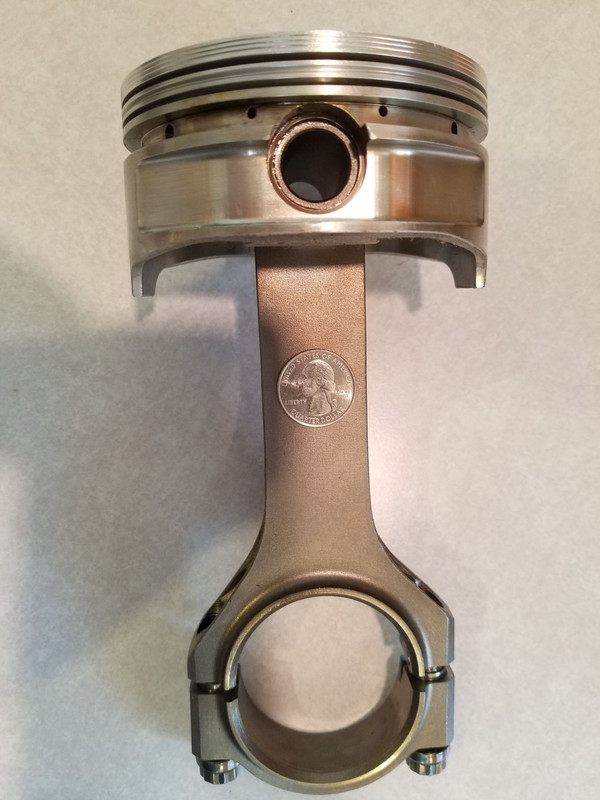
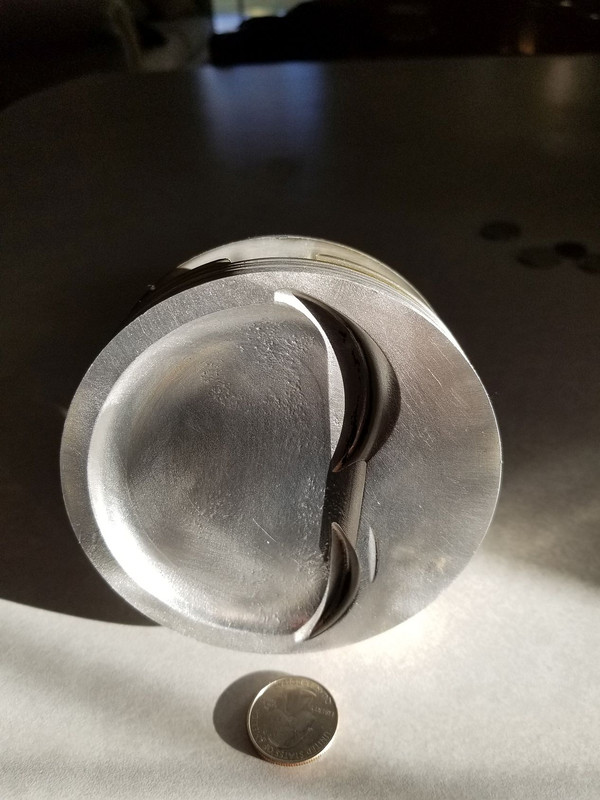
These are my Wiseco pistons and Manley H beam 6 inch rods. I need to get busy and put it together. They have a pretty good quench. They are made for up to 2.15 intake valves and .800 lift clearance. I only have 2.10 and .685 lift I so I didn't have to clay and machine them. The rods I machined for cam clearance. These rods are made for over 1000 HP. My cam is something like a .980 base circle custom billet solid roller. I don't think that arbitrarily ordering small base circle cams with a .900 diameter is very wise. Rollers like bigger diameters and the cam starts to loose strength when made small.
It's the area in red that causes great "quench" or "detonation resistance" by promoting excellent mixing (and a non-varying homogeneous mixture) in the chamber as the gases above it get violently shoved to the side at TDC. The yellow area, not so much, and that yellow area is all some low CR pistons have....
Thanks for info.
If I understand your thinner gasket recommendation, that increases CR which helps prevent detonation.
Correct?
No, Not necessarily.
Tightening the Quench distance is what helps prevent detonation ... but simply substituting a thinner gasket will tighten quench and raise CR.
However, one could raise CR by substituting a piston with a tall dome but with a short compression distance and ...
... the CR might skyrocket but both the Quench & detonation prevention would be minimized.
OR, one could have a poor Quench & poor detonation prevention because his piston is 0.060" below deck and ...
... his gasket is another 0.015" (Q = 0.075") ... all beneath 76cc chambers ... but then he changes heads to 58cc chambers ...
... Now his CR has jumped way up but he still has that crap 0.075" Quench and crap for detonation prevention.
Quench and detonation prevention are achieved by a short distance between Crown (not dome) of piston and bottom deck of head ... that can be independent of CR.
Higher CR alone does Not improve detonation prevention ... Higher CR alone may actually exacerbate detonation ... prevention is achieved by ...
... the violent squishing of charge ... blown-inward from chamber's circumference ... caused by piston Crown & cylinder head nearly meeting.
First, choose your components / machining to achieve a good Quench ... Then, adjust your CR with what's either above or below piston's Crown (e.g. a smaller/larger dish volume).
No, Not necessarily.
Tightening the Quench distance is what helps prevent detonation ... but simply substituting a thinner gasket will tighten quench and raise CR.
However, one could raise CR by substituting a piston with a tall dome but with a short compression distance and ...
... the CR might skyrocket but both the Quench & detonation prevention would be minimized.
OR, one could have a poor Quench & poor detonation prevention because his piston is 0.060" below deck and ...
... his gasket is another 0.015" (Q = 0.075") ... all beneath 76cc chambers ... but then he changes heads to 58cc chambers ...
... Now his CR has jumped way up but he still has that crap 0.075" Quench and crap for detonation prevention.
Quench and detonation prevention are achieved by a short distance between Crown (not dome) of piston and bottom deck of head ... that can be independent of CR.
Higher CR alone does Not improve detonation prevention ... Higher CR alone may actually exacerbate detonation ... prevention is achieved by ...
... the violent squishing of charge ... blown-inward from chamber's circumference ... caused by piston Crown & cylinder head nearly meeting.
First, choose your components / machining to achieve a good Quench ... Then, adjust your CR with what's either above or below piston's Crown (e.g. a smaller/larger dish volume).
GREAT EXPLANATION!
I was surprised that the dome of the piston is not considered the crown of the piston. However, a domed piston will usually create a higher CR than a flat top. I just assumed that the quench would be changed by going from flat top to dome.
If I am grasping this better, there are several variables in play to get the desired quench, CR and DCR ~ deck height, depth of piston in the cylinder, compression height of piston, head volume and piston volume (valve pockets, dish, etc), gasket bore and thickness, plus bore, stroke and rod length. Don't forget cam specs reCR.
Quite a ballet so to speak.
Getting closer to understanding what pieces I have and then need.
Along with how little machining I can have done to keep the block as solid while preserving metal for future machining (boring, shaving, etc). And achieving the goal.























 CR.
CR.