



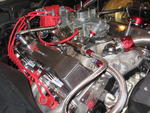


torque specs

Melting Slicks


Joined: Jun 2011
Posts: 3,116
Likes: 598

from the manual.
Intake manifold bolt (sequenced). Re-torque bolt after running engine for 10 hours.
First pass ........................................ ................... 97 in.lbs. / 11 Nm (Teflon pipe sealant)
Final pass ........................................ .................. 11 ft.lbs. / 15 Nm

Is my vette stock?? HAHA


Joined: Oct 2015
Posts: 20,212
Likes: 9,352
From: Im not allowed to tell you
2020 C3 of the Year Finalist - Modified
2020 Corvette of the Year Finalist (performance mods)
2019 C3 of Year Winner (performance mods)
2016 C3 of Year Finalist
Ive done serches on line for my heads and AFR torque specs are always coming up

Le Mans Master

Joined: Sep 2001
Posts: 7,739
Likes: 630
From: Unreconstructed, South Carolina
some aluminum heads have steel helicoil inserts or similar, (some not), different alum alloys / heat treat. Factors which can affect optimal torque ratings.
Suggest best to get torque specs for Your specific head part number direct from head manufacturer
Suggest best to get torque specs for Your specific head part number direct from head manufacturer

Le Mans Master

Joined: Nov 2016
Posts: 9,258
Likes: 950
From: Lake Tahoe, CA

Team Owner


Joined: Jan 2006
Posts: 37,637
Likes: 3,118
From: Crossville TN
If they are 3/8-16 bolts, I cannot imagine them having "inch-pound" torque requirements. Those bolts get 28-32 foot-pounds torque with iron heads. Aluminum intake will require lower torque...but not THAT low. The 1971 CCSM specifies 30 ft-lbs for intake manifolds...whether iron or aluminum. I think 25 ft-lbs would be about right for an AL intake on iron block.
Corvette Stories
The Best of Corvette for Corvette Enthusiasts

Top 10 Most Expensive Corvettes Ever Sold on Bring A Trailer
Brett Foote
10 Things Every Corvette Owner Needs (2026 Edition)
Michael S. Palmer
8 Most "Only Corvette Owners Understand" Quirks and Problems
Pouria Savadkouei
10 Reasons the C6 Z06 is Still A Performance Benchmark After 20 Years
Joe Kucinski
How Much Horsepower Every Corvette Engine "LOST" in 1972
Joe Kucinski
Top 10 DOs and DON'Ts for Protecting Your Convertible Top!
Michael S. Palmer
Top 10 Most Explosive Corvettes Ever Made: Power-to-Weight Ratio Ranked!
Joe Kucinski
150 hp to 1,250 hp: Every Corvette Generation Compared by the Specs That Matter
Joe Kucinski
8 Coolest Corvette Pace Cars (and Replicas) of All Time
Verdad Gallardo
Dr. Detroit

Joined: Mar 2012
Posts: 10,097
Likes: 4,027
From: New Braunfels Texas
I am going to stick my neck out and say that I have never torqued an intake to a head in my life.
I go around in the pattern at least three times.....each time the gasket will compress slightly and the adjacent bolt will be loose again. When you run the pattern and the adjacent bolts do not feel loose, you are close.
From there.....one can feel that the fastener is tight, it simply will not move any further without applying excessive force on it. Another issue is how are you going to torque the four center bolts on a single plane intake? No way to get a torque wrench in there.....you have to go by feel. Now when I say by feel.......that does not mean tightening the **** out of it......if you do it right, and have a good perception of how the bolt feels as you tighten it, you will know when to stop. The orginal first series Torker intake was so tight in there that I have an offset box end wrench that is ground thin on the outside edge just for this purpose.
Paper gaskets do not crush much but the Fel-Pro blue steel core laminate gaskets (like the 1204, which is the most common gasket I use, I keep a pair on the wall) will crush about .050 before compressed fully.
If you work around a lot of aluminum engine parts like I do (bike engines).......you adapt to having soft touch with fasteners.....
Neck stuck out now......carry on
Jebby
I go around in the pattern at least three times.....each time the gasket will compress slightly and the adjacent bolt will be loose again. When you run the pattern and the adjacent bolts do not feel loose, you are close.
From there.....one can feel that the fastener is tight, it simply will not move any further without applying excessive force on it. Another issue is how are you going to torque the four center bolts on a single plane intake? No way to get a torque wrench in there.....you have to go by feel. Now when I say by feel.......that does not mean tightening the **** out of it......if you do it right, and have a good perception of how the bolt feels as you tighten it, you will know when to stop. The orginal first series Torker intake was so tight in there that I have an offset box end wrench that is ground thin on the outside edge just for this purpose.
Paper gaskets do not crush much but the Fel-Pro blue steel core laminate gaskets (like the 1204, which is the most common gasket I use, I keep a pair on the wall) will crush about .050 before compressed fully.
If you work around a lot of aluminum engine parts like I do (bike engines).......you adapt to having soft touch with fasteners.....
Neck stuck out now......carry on
Jebby
Team Owner
Joined: Jan 2006
Posts: 37,637
Likes: 3,118
From: Crossville TN
The only reason to use lower torque on an aluminum intake is that the aluminum 'boss' under the [steel] bolt can only take so much compressive load before the boss gives way. The bolt would still prefer to be torqued to 30 ft-lbs, so that it gets the proper amount of stretch in it. But, that would get close to the compressive strength of of aluminum....not so good.

Le Mans Master


Joined: Oct 2010
Posts: 6,937
Likes: 848
From: melbourne florida
2023 C3 of the Year Finalist - Modified
I'm with Jebby. That's how I have always done it and never had an issue. Other things torque readings are more an issue, heads, main caps and rod.bolts yes but stretch on an intake bolt? Come on you shouldn't be near stretching a bolt.

