When you click on links to various merchants on this site and make a purchase, this can result in this site earning a commission. Affiliate programs and affiliations include, but are not limited to, the eBay Partner Network.
I have looked everywhere that I can think of (Google, mostly, but other forums as well
) to try and figure out where the p/n of this carb is and I'm stumped. I just don't see it stamped anywhere. The casting code on the back is 1705660 but that's all I have other than stamped p/n's on most of the other external parts.
The only reason I care is that I have a '68 L79 with a fuel starvation problem at WOT after about 3 seconds (typically see it in 3rd gear when I'm out for some "social distancing"). I'm trying to decide if it needs a new float, or needle and seat, or jets, or if I should just bite the bullet and get a restored original.
FWIW, the car will never be NCRS judged because somebody decked the stamp pad.
From: At my Bar drinking and wrenching in Lafayette Colorado
That's a sandblasted, commercially rebuilt, junk M4M Q-Jet bowl from a 1975+ carb. They have filled various holes with epoxy... It's not the right bowl for your car, and it's a bad bowl to try to save, but it's not likely the cause of your problem. You have a fuel supply problem not related to the carb. Throw that thing away and get a rebuildable carb. Fix your fuel supply problem first.
Q-Jet part numbers are located on the driver's side above the secondary throttle shaft. This is a 1976 Q-Jet part number 17056206:
Yeah, thanks, I knew it wasn't right but didn't realize that it was that far off. I was told that it was a "drop in replacement" by the guy that did the work on the car when I first bought it.
I'd prefer to go with a stock or nearly stock carb but geez, I really don't want to put $2500 into a "restored" unit on a car without a legible VIN stamp.
Any recommendations for a good source of a replacement that performs like the original? There's so many "direct replacement" claims that I can't begin to tell what's what.
The car has a new fuel pump too, and new tank, new sending unit/pickup. Don't know where else to look unless the line got plugged....seems unlikely.
From: At my Bar drinking and wrenching in Lafayette Colorado
You're going to have a tough time finding a genuine '68 L79 Q-Jet at any sane price. However, if you want something that looks and fits "correct", and performs well, you can use any Chevy passenger car Q-Jet from 1969 - 1974. The 1969 carbs look identical to the '68 carbs, and there are a lot of nice, original, rebuildable used ones out there for under $150. The 1970 - 74 carbs have slight visual differences from the '68, but most people can't tell the difference, and they hook up and perform like the original. The '74 carbs (and there are lots of them out there) are the most "advanced" of the 4MV divorced choke series carbs, and can be set up to run very well. Since they are also the newest of that carb series, you can find them in pretty good shape. But I've had several people find very nice '69s recently for fair prices - that would be my first choice for your application.
For info on finding and buying a used carb, drop me a note and request my "Carb Screening" tech paper.
Just beware of the fuel bowl plugs. These are the lead plugs used to seal the passageways of the fuel metering section. About 85% of these plugs leak and they are a bitch to re-seal. When these plugs leak they will cause flooding and erratic idle. I've seen people use epoxy with allen screws to repair with no luck. Eventually they leak. Some will stake the plugs too which seems to work better. Truthfully I just gave up on trying to repair these leaks. But finding a good core is essential to a successful rebuild. Once these carbs are dialed in they are very responsive.
From: At my Bar drinking and wrenching in Lafayette Colorado
It's very seldom that the 1969+ fuel bowl plugs leak. The Q-Jets gained the "leaky bowl plug" reputation on the 1966 - 1968 plug design. It's very rare that a 1969 - 1974 Q-Jet leaks, and almost unheard of on the 1975 - 1980 carbs. I might do a leaky plug repair on 1 in 100 carbs on the '69 - '74 carbs, and out of over 1,000 carbs built, I've never had to do one on the M4M 1975+ carbs. Leaky plugs can be successfully repaired.
Lars
Edit:
I just took the time to review my statistical data from the past 35 years of building over 1,000 Q-Jets. Exactly 0.9% of the carbs coming through my shop have had a leaky bowl plug requiring repair. 0% of the M4M carbs have had a leaky bowl plug, but I have done 2 forward fuel inlet plug repairs on M4M carbs. All other carbs have had no leaks with original factory plugs in the bowls.
Well, most Q-jets I rebuilt had leaky fuel well plugs and they were anywhere from '68 to '73 vintage. But I did not come anywhere near the number of carbs you have rebuilt. I don't know why I had such bad luck with these well plugs. They were mostly Buick Olds or Pontiac ones. But you could hear the engine stumble every time a drop of fuel leaked out. thought it was the fuel nozzles in the venturi but that would be too easy. Even when repaired the leak eventually came back.
One might think I'm a hack, but not the case as I have been a mechanic for over 45 years and a Mech. Engr. for 36 years.
From: At my Bar drinking and wrenching in Lafayette Colorado
Certainly not accusing you of being a hack... Being an engineer, as I am too, you know that statistical results on a small sample base can be misrepresenting of the "big picture." If you were rebuilding carbs that came in with "a problem," there's a good chance you were seeing the carbs that specifically had bowl plug leakage issues. The carbs I receive for rebuild are carbs that simply need a rebuild due to age, "hacking," or tuning problems, giving me a much more "average" statistical data base for evaluation of common problems. The bowl plug seepage issue does exist, but it's actually pretty rare in the "average" Q-Jet, with most carbs going through their lifespan with no leakage issues. GM/Rochester recognized the design fault on the secondary well plugs after 1967, and did a design change to specifically rectify the problem. The primary well plugs very seldom leak, but can be effectively repaired with some careful machine work.
I can say between 1987 or so and 2000......I must have redid over 100 Q-Jets. I never seen one with leaky well plugs either....always checked but never seen one.
Stripped fuel filter housings and wore out primary throttle shafts yes.......
No accusation taken. I must have the knack for picking junk cores from the junkyard.
Mostly rebuilt QJ's for friends and whatnot just for some car money.
Never had a secondary well plug leak these were all primary well leaks.
Now go wash your hands and be safe!
From: At my Bar drinking and wrenching in Lafayette Colorado
The hot degreaser fluids, and the vapors coming off the hot tank, keep me completely sterilized. By sipping on a good Scotch while cleaning carbs the Covid-19 does not stand a chance...
Ha.. good one! Not to change the subject but, you seem very knowledgeable when it comes to automobiles. I know this is not the right place to have this discussion so maybe I can PM you ? I have a problem concerning OBDII controls on a Dodge charger with a 5.7 Hemi. Maybe you can point me in the right direction? Been troubleshooting this thing on and off for year now. Let me know. Thanks
From: At my Bar drinking and wrenching in Lafayette Colorado
I'm an old mechanic and racer from the early '70s. I don't know what an "OBDII" is, and I don't have any intention of learning any new tricks at this point in my life. You see, my brain is completely full of pre-computer tuning info and part numbers. If I were to learn something new, something else would have to get removed from my brain. I believe if I learned anything about OBDII's that I would then forget the firing order of a Chevy. Not worth the trade or the risk...
Is it safe to assume that any chevy passenger car carb for that date range (preferably 69-74 from how I interpret what you're saying), regardless of whether it's BB or SB, would be fine for my application?




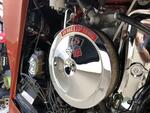




 help me ID this replacement Quadrajet.....?