When you click on links to various merchants on this site and make a purchase, this can result in this site earning a commission. Affiliate programs and affiliations include, but are not limited to, the eBay Partner Network.
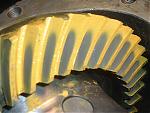
Here's the latest pattern
I think I am ready to put the new pinion bearings in! My only real question is should I leave the backlash here at .008" ? Or go back to the .006" that I had earlier?
The pattern is not quite so close to the heel this way.
Other news:
I did some other measuring with a different pinion shim just to see the effect. Gary said use the original shim for my used gear, so I went back.
Along the way I had inconsistent carrier shim issues. Tight, then loose, etc. What?!? (Steps 4-9 above that I deleted)
I finally figured out that it matters which way you insert these multi-piece "stepped" carrier shims:
After I fixed that I got readings that made sense.
The Large Flat Side needs to go against the carrier housing!
When I tried to shrink the width of this shim below .220", the step protruded and became the highest part. Once that happens the carrier race (shown) must be riding against the smaller removeable space so it can slide past the step, and be smaller than .220" Note to self. Lesson learned!
Last edited by leigh1322; Jul 9, 2021 at 04:44 PM.
Hey Leigh, I'm late coming in on this thread... But you know how I use my car. I've built two diffs (different ratios) now basically the same as you're building yours, though I don't recall whether you decided to use a solid pinion spacer - I did. Haven't had any issues with them at all. Gee you were unlucky with the carriers though!
Hey Leigh, I'm late coming in on this thread... But you know how I use my car. I've built two diffs (different ratios) now basically the same as you're building yours, though I don't recall whether you decided to use a solid pinion spacer - I did. Haven't had any issues with them at all. Gee you were unlucky with the carriers though!
Well that's good to hear! If they are holding up for you, mine should hold up for me.
I don't plan on driving mine as hard as you do, or at least not quite as often!
Thanks for the complements guys, glad to help if I can.
Lee- If you get the paste to the correct consistency and preload on the bearings the pattern will sharpen up. It's not going to make much difference between 6-8 and usually there is about 002 variance through 360*. Keep it in the 6-8 range and you should be good.
The stackable side shims are not parallel many times, you might be able to rotate them and get closer to even. I sometimes have to grind them flat first. I have always put the larger side to the housing as well and I always install the RH last. Save a couple of 004-005 shims for the final preload of the bearings.
If you are satisfied with the pattern, go to the new bearing and recheck to make sure it hasn't changed. It sometimes will once my setup bearings have been used a dozen times, then I make up new ones. If you go with a solid sleeve it has to be machine fit, the shims sold with them do not come close. If you are using a crush sleeve you get one shot at reaching 15-20 in/lb, I set them at 17-20. If you go over 20 you have to buy another sleeve and start over.
Have you kept track of your hours into this so far?
I should have noted, while the first centre I built I was lucky that the shims with the solid spacer put me right where I wanted to be, with the second centre I trimmed the spacer in my mill to get it spot on with a chosen shim. I do think I probably could have done it with careful filing or sanding, but the mill made it much simpler.
And to Gary's point, yes there was a lot of time in each diff. To be perfectly honest, far more time than I would have been willing to pay anyone else to take.
Last edited by Metalhead140; Jul 10, 2021 at 10:17 AM.
Thanks for the all the help Gary. I still have your cap screws and a few other things to do. I think I am glad I did not keep track of the hours. LOL I must have a 100 or more in it, possibly a lot more! I had to do a lot of research to teach myself how, watched a lot of videos, and read almost every thread you wrote on this topic. Saved many of them. Would not be surprised if it is more like 200 hours. Probably as much on the computer as in the garage. I will add up the tools and stuff I bought at some point.
At least I am confidant it is not a "sloppy" local rebuild, and pretty sure it is a lot stronger than OEM. I could obviously do this a lot quicker a second time, but it is one and done for me. I do really enjoy learning something new, and like metalhead said, it would really have "pained" me to pay someone to do this for me, when I "could" do it myself.
I am sure my posi parts add up to near $1k, I bought at least a couple hundred in tools, but to pay someone to do this must be thousands in labor! I save that money with my sweat equity and put it into hard parts, like my Tremec!
While I do not know the locals in your area, I have been rebuilding these for a very very long time. I have met rebuilders both locally and across the country as well as outside the usa. I doubt very much you would find a local shop that will do what you did and if they did you would spend $5000 in labor.
Yes you put in a lot of hours that a shop sure won't but you know more about these vette diff's now that your local shop does. I get calls all the time from profession gear shops on how to build these diff's beyond common text book procedures. They work in a time/money mode and that doesn't fare well with custom work. You are completing one, I have done 100's and it still takes 40 -60 hours to correctly build one. One like yours will take me about 45 hours to build. Punch in any labor number from any shop, most likely in the $80-$110 hour range, and you can see why this type of work is not offered by many and within that small group there are differences including common business ethics or lack of from some.
So carry on, your time is not the concern just the level of build.
Well said Gary!
I don't mind putting in the time. It gives me something to do, and I actually get satisfaction from it.
But I sure appreciate having you "watch over my shoulder" making sure I do this correctly.
It takes what it takes. I will do it right, rather than rush it.
I kind of did the same thing in my best friends machine shop. I actually got to do some of the head work, block line boring, and engine assembly blue-printing work.
But all under his watchful eye, because I am no expert, just willing.
I miss him terribly. Lost him to COVID last month. But he built me a hell of an engine to remember him by!
Ok today's task was to assemble it all again (I have lost count). Brand new pinion bearing was pressed on with my new bearing press tool HAH!
$6 piece of 2" x 6" pipe from Home Depot, and I made yet another bearing shell slip-fit. That way I am sure the old shell touches the new bearing in the correct spot, only on the shell/inner race. Pressed on easily.
Pressing on the new outer pinion bearing (while it is in the case) actually took a little more ingenuity with a 6" 4x4 block of wood to support the pinion, and a dead blow hammer & socket to bang it part way on, til I could get the nut started.
After all the brand new pinion bearings were installed the pattern did not appear to change. I even have the new crush sleeve in. (Hopefully I do not have to take it apart again). My Harbor Freight Earthquake torque wrench would barely crush the new sleeve.
I took it up to 14-16 in lbs with my beam torque wrench. (I did notice the new pinion bearings rotated a little more smoothly on the tq wrench than the old set-up ones.) Gary has convinced me to do this right-once, so my new 30 in lb dial tq wrench arrives tomorrow. I think Gary recommended 16-18 in-lbs. So I'll install the pinion seals next, the .005" tighter carrier shims, and the cap screws. Then we'll check the pattern again! That might be the final one, if it doesn't move.
And yes the B/L does vary. I checked it at several spots and it went from .006 to .008.
Last edited by leigh1322; Jul 11, 2021 at 06:20 PM.
You're good at 6-8, 002 is ok. 003 maybe anything over is no good. So that is covered.
Here is a trick I use maybe too late maybe not. I precrush the sleeve in a press. Trying to crush a new sleeve is a bear to do. I have a good idea where the new sleeve should be, bring it close to that and then I finish it in the housing with a new outer bearing installed. I bring in the preload to 17-20-without the seal. When I get to 17-18 I stop there. I use only CR pinion seals, I measure the new seal, measure the seal bore, measure the depth of the new outer bearing and then do the math-right up your alley, and measure the yoke to shield so that I know what the clearance is between the flange of the seal and the yoke flange- I bet NO ONE does this but I do it to everyone and once I caught one too shallow and the seal hit the yoke giving a false drag reading.
Use #271 Loctite or #272 on the pinion nut, use permashield on the splines of the yoke and pinion, stake the new nut and do the final drag test. If you do it all correct it will be dead smooth, with little to no movement in the needle of the TW. If it's choppy when done, you have to break it all down and start over or do as a lot would do and "ship it"- that's not the way to do it. Then you can do a seal test, with the diff pointing down on the stand put some gear oil in it and walk away for 24 hours. When you come back the yoke shield should not have any oil in it, if so - break it down and do it again.
So you can see the pattern here and why many places just "ship it" since time is money and some will not do what you are doing.
Appreciate all this Gary!
So I do have a question as to the final sequence.
I Installed the new pinion bearings, cap screws, and crush sleeve. (Yes the B/L did change slightly with the new pinion bearings so I fixed that back to 006-8)
I got 15-17 in-lb with the new dial TQ wrench (no carrier) and 16-19 (with carrier with 2 extra .005 shims). No pinion seal yet.
I am not sure how much drag the new seal will add.
So should I:
Install the pinion seal and seal up the pinion now?
TQ it to 17-19 in-lb like that? with new seal and no carrier? or more?
Second Q: Is there enough drag on the carrier bearings?
It only went up about an extra 1 to 2 in-lbs with the carrier in, even with the extra .005 shims on both sides.
This old post of yours I found is why I ask the question:
If I go strictly by this post I do not have enough drag on the carrier and need more side shims?
Last edited by leigh1322; Jul 12, 2021 at 07:29 PM.
When the pinion shim is known, the sleeve crushed close to final, then the seal goes in. The yoke is then finished at 17-20. The pinion is done. The case goes in and follows what I wrote in that old thread. Your case preload way too low.
Back to this. I spent the last 2 days finalizing my driveshaft and u-joint sizes. Shaft is ordered now. Decided to stay with the OEM 1330 front diff yoke.
But I checked my pinion seal / yoke / housing clearance (per Garys suggestion) I only had .030" clearance between the seal flange and the yoke! (using the .125" shim/lip gap)
I was uncomfortable with it that tight, so I did not use the normal .125" thick bar/shim to tap the seal down. I tapped it down to within .005 of the bottom of the seal bore, and used some spare carrier side shims at .080" to set up my seal depth. That gave me an .080 seal lip gap, and .080 between the seal and the yoke. Better! .080" clearance worked for me vs normal .125"
I have to find my old paper. I don't gauge that gap anymore, I just do all the measurement for the seal bore, seal in place and when I install the seal I tap it in until it bottoms and stop. The bores vary a little but on average I would say the gap between the seal and shield is about 080-100"
Yellow paste does work much better. I think I still have some white paste I got from Tom 15 years ago.
You replaced the crush sleeve with a new one correct. Loctite on the nut and staked it?
The overnight leak test was a success - NO pinion seal leak!
Sadly NO I did not add Loctite on the nut.
And I am not sure I want to move it again unless absolutely necessary!!
Let me explain for anyone reading along. Setting the rotating tension on the pinion was a big pain.
I tried to use a $23 beam in-lb TQ wrench. During my setups it was apparent that wasn't good enough.
So I bought a $180 Dial TQ wrench. That worked much better. It reads down to 1/2 in-lb vs 2 in-lb for the beam.
So even using the better wrench my first attempt at 16-19 in-lb was a bust, I shot right past it to 25! I needed to go way slower.
That meant yet another disassembly and a new crush collar. And pressing on the upper pinion bearing onto the pinion without damaging the already installed pinion seal, well that was a challenge, and took another couple hours, to get ready for crush collar #2.
So if anyone else following this wants to try to do this for themselves here is my advice: When tightening the crush collar, Sneak up on the 17 in-lb reading very slowly!
I used the press to push the upper bearing on.
At that point the crush collar was snug and needed to be crushed another 60-80 thou for the bearings to go to zero lash.
I could have done that part with the press but I did not want to go too far, AGAIN.
My Harbor Freight Earthquake impact gun will just barely move that nut while trying to crush the crush collar. It had to be way tighter than 400 ft lbs. My 28 inch manual breaker bar was a joke, I could not budge it. So impact it was.
Once the lash (looseness) was gone, I started taking TQ readings using the dial wrench.
I used Only Two "taps" or "hits" with the impact gun, then checked with the dial wrench, and it either went up 1 or 2 in-lbs.
I repeated this many times until I wound up with 17.5 in-lbs. But I did not go over this time!
This would never have worked with the beam wrench!
I swear building an engine is way easier and quicker than blue-printing a diff. My buddy charged $800 to assemble a BBC engine, (after the machine work is done). So say a full day or so.
Gary spends 40+ hrs doing this and I probably spent way more, so that's a full week or more! It's a LOT of LABOR.
It's doable, even at home, but it's VERY TIME CONSUMING. I got frustrated taking it apart like 15-20 times, so I would just walk away for a while.
If anyone thinks they are getting a "good" diff rebuild for a few hundred in parts and only $200 in labor, THINK AGAIN!
Leigh
Very good point on hours and cost. You know the deal, to get a quality build it takes time. You did one and spent 100 hours on it. I have done 100's and it still takes me 40 - 60 hr's depending on the build level. Most guys have no clue with the involvement required to this right or the tools needed. Your example of the torque wrenches is one. I can't tell you how many have told me they used just the beam and it worked- and it might have but building something more then just a bolted together job requires the correct tools, tooling, and procedures. When you see a diff advertised you can now look to see just what is being offered and know if the build is a common master kit or more involved. Most will not be able to do that and often base a decision on a catalog or website or worse on price alone.
Good job, you came a long way from your start. You're a good student and you have a diff you would not be able to get elsewhere with maybe one exception. I would still practice the break in procedure for new gears and change the oil at 500 miles once you are on the road
Everyone here should know as a newbie I could not have done this without your help.
But I never want to build one of these again! Not even for a friend. I have a whole car to finish! LOL
But I will package my "diff tool set" together and offer it at half price for the next brave soul that wants to try doing one of these on his own!
Like "paying it forward" or the crossmember tool loaner list we started.
Well just when I thought I was done, this thing is fighting me to the end.
There is just no rushing this job.
The stub axles yokes don't fit!
They are so tight I can not insert the center pin. At least not with both axles in. And there is certainly no clearance!
I can get 1 axle in at a time, and tap the center pin in, but then it is uncomfortably tight, I can just barely grip it and remove it with my fingers.
So I would assume either a 1 or 2 thou interference fit.
I believe Gary recommended .005-8 gap.
So I suppose that means I either need to grind down the axle tip or the circlip about .010"
The problem is my machinist buddy has passed on, and I do not know if his boys are up to the job.
I'll check with them today.
Center pin won't go in with both axles in.
I can jam it in with one axle in at a time, but it's very tight.
Designer Imagines A Corvette That Looks More Like a Corvette Than the Corvette
Slideshow: A Jaguar designer's personal project imagines what a modern front-engined Corvette might look like if Chevrolet revisited the golden age of the Stingray.