





Engine clunking noise

Thread Starter
Heel & Toe

Joined: Apr 2021
Posts: 22
Likes: 1
From: Fillmore CA
 Engine clunking noise
Hi folks,
I'm new member and after reading a lot the forum I decided to take on a project. I've always watched other people work on cars but never done it by myself.
I just got a 75 which has been parked for a least 6 months. It it's mostly stock, L48+4 speed, Q-Jet, HEI.
The car wasn't starting and I had to change the coil (it didn't have continuity on the secondary) and change the spark plugs which appear to be all carbon fouling.
The car now starts right but appears to be overheating (temp gauge is not working) and there is a periodic clunking noise from the engine bay.
The cooling level is OK, the radiator has been previously changed, there's a new cap and the overflow lines and tank have been disconnected. I haven't inspected in details yet the water pump and thermostat housing.
With a heat gun I can see that passenger side exhaust manifold goes above 300 after few minutes while the drivers side stays below 200.
I've uploaded a video here where you can hear the clunk and see how the engine vibrates when it happens. https://drive.google.com/file/d/1nio...ew?usp=sharing
Any ideas?
Thank you
I'm new member and after reading a lot the forum I decided to take on a project. I've always watched other people work on cars but never done it by myself.
I just got a 75 which has been parked for a least 6 months. It it's mostly stock, L48+4 speed, Q-Jet, HEI.
The car wasn't starting and I had to change the coil (it didn't have continuity on the secondary) and change the spark plugs which appear to be all carbon fouling.
The car now starts right but appears to be overheating (temp gauge is not working) and there is a periodic clunking noise from the engine bay.
The cooling level is OK, the radiator has been previously changed, there's a new cap and the overflow lines and tank have been disconnected. I haven't inspected in details yet the water pump and thermostat housing.
With a heat gun I can see that passenger side exhaust manifold goes above 300 after few minutes while the drivers side stays below 200.
I've uploaded a video here where you can hear the clunk and see how the engine vibrates when it happens. https://drive.google.com/file/d/1nio...ew?usp=sharing
Any ideas?
Thank you
Last edited by AntonioG; Apr 5, 2021 at 01:03 PM.
Thread Starter
Heel & Toe
Joined: Apr 2021
Posts: 22
Likes: 1
From: Fillmore CA
It's actually Fahrenheit but this is right after a cold start, should it gets that hot in a minute or so? I moved outside of the garage for a quick run but got right back, was afraid to do damage because it got really hot (didn't manage to capture the temp at that time). It also blew some white smoke from under the hood when I pushed the RPM to go up the driveway.
The clutch appears to work fine, the clunking still does when in gear or when the clutch pressed.
Could it be the engine mounts? Was thinking that the gyroscopic effect could make the engine move periodically if not firmly connected.
Not sure if it could have anything to do with wrong timing or miss-firing.
The clutch appears to work fine, the clunking still does when in gear or when the clutch pressed.
Could it be the engine mounts? Was thinking that the gyroscopic effect could make the engine move periodically if not firmly connected.
Not sure if it could have anything to do with wrong timing or miss-firing.
Last edited by AntonioG; Apr 5, 2021 at 01:38 PM.
1967 Pedal Car Champion

Joined: Mar 2020
Posts: 9,137
Likes: 4,247
From: US-PNW
Check to see if your car has a heat riser valve between the exhaust manifold and the exhaust pipe on the passenger side. If the valve is sticking closed, it will back up a lot of heat. It should move freely by hand - they do rust up.
Drifting


Joined: Dec 2017
Posts: 1,305
Likes: 226
From: PA
What exactly do you mean by "periodic clunking noise"? Is it rhythmic, "clunk, clunk, clunk" or random. If rhythmic, find a 3 ft or so piece of hose and listen through one end while hunting around the engine bay with the other end to see if you can pinpoint it. It it's random, you might try the same thing trying to zero in on it. But also, is there anything you're doing that triggers it.
You noted that the radiator changed and capped, the overflow lines having been disconnected. In this case if there is air in the coolant system it can't get purged. It may make some odd sounds if bubbles are pushing through the water pump or thermostat, especially if the thermostat is popping open and closed.
You noted that the radiator changed and capped, the overflow lines having been disconnected. In this case if there is air in the coolant system it can't get purged. It may make some odd sounds if bubbles are pushing through the water pump or thermostat, especially if the thermostat is popping open and closed.
Last edited by vince vette 2; Apr 5, 2021 at 03:04 PM.
Thread Starter
Heel & Toe
Joined: Apr 2021
Posts: 22
Likes: 1
From: Fillmore CA
Thanks guys, will check for the heat riser valve.
The clunk is kind of rhythmic and it's not triggered by anything I'm doing. It is though something hard/heavy since it makes the whole block shake.
The clunk is kind of rhythmic and it's not triggered by anything I'm doing. It is though something hard/heavy since it makes the whole block shake.

Team Owner


Joined: Mar 2002
Posts: 44,677
Likes: 1,830
From: Huntsville AL
That is a pretty pronounced "Clunk" like something is coming in contact with something. You need to isolate the area that is coming from and investigate more before that turns into major failure. Hard to tell from the video but looks like maybe the bellhousing area.
Thread Starter
Heel & Toe
Joined: Apr 2021
Posts: 22
Likes: 1
From: Fillmore CA
I tried again today, from a cold start the passenger side went above 400 in about 5 minutes while the drivers side stayed around 200.
There is a heater valve which I believe to have put on full open (upwards), it is connected to a vacuum actuator.
I’m not 100% sure but I suspect the clunk is coming from the bottom end
There is a heater valve which I believe to have put on full open (upwards), it is connected to a vacuum actuator.
I’m not 100% sure but I suspect the clunk is coming from the bottom end
Corvette Stories
The Best of Corvette for Corvette Enthusiasts

Top 10 Most Expensive Corvettes Ever Sold on Bring A Trailer
Brett Foote
10 Things Every Corvette Owner Needs (2026 Edition)
Michael S. Palmer
8 Most "Only Corvette Owners Understand" Quirks and Problems
Pouria Savadkouei
10 Reasons the C6 Z06 is Still A Performance Benchmark After 20 Years
Joe Kucinski
How Much Horsepower Every Corvette Engine "LOST" in 1972
Joe Kucinski
Top 10 DOs and DON'Ts for Protecting Your Convertible Top!
Michael S. Palmer
Top 10 Most Explosive Corvettes Ever Made: Power-to-Weight Ratio Ranked!
Joe Kucinski
150 hp to 1,250 hp: Every Corvette Generation Compared by the Specs That Matter
Joe Kucinski
8 Coolest Corvette Pace Cars (and Replicas) of All Time
Verdad Gallardo
Is my vette stock?? HAHA

Joined: Oct 2015
Posts: 20,212
Likes: 9,350
From: Im not allowed to tell you
2020 C3 of the Year Finalist - Modified
2020 Corvette of the Year Finalist (performance mods)
2019 C3 of Year Winner (performance mods)
2016 C3 of Year Finalist
I can see the engine shake when it happens, but it doesnt seem to be every cycle, its more like when a specific piston is firing....Do like vince said and try and isolste it by using a long pice of hose stuck in your ear like a stethoscope. put it on the intake port of each cylinder or on the valve cover and walk it slowly across fron to back on both sides of the motor..if you can determine the side its the loudest on, or hopefully the cylinder, unplug the spark plug wire on that cylinder and see if it goes away. It should run rougher but Im hoping the clunk stops. If it doesnt shut it off and pull the plug and see if the piston is hitting the plug....Does the clunk go away or get faster as th eengine speed increases?
Le Mans Master


Joined: Apr 2011
Posts: 6,284
Likes: 1,171
From: Hermosa
Take all the belts off and run it see if the clunk goes away. Not too long obviously as the water pump will not be turning.
something looks hinky with the fan , is it striking the shroud maybe?
something looks hinky with the fan , is it striking the shroud maybe?
Last edited by REELAV8R; Apr 5, 2021 at 11:18 PM.
Drifting
Joined: Dec 2017
Posts: 1,305
Likes: 226
From: PA
Never good if it's from the bottom. Another possibility is a valve got sucked in, snapped off the head, and got pounded into the head sideways by the piston. My brother had that happen on his 74 Camaro back in '77. No cell phones back then and we lived in a rural area, and this was at night. So, despite the banging he drove it the 3 miles home. When we pulled the head there was a hole melted in the piston where it had been hitting the detached valve head, and the block was cracked between that cylinder and the adjacent one on the side closer to the valve that had dropped down. You could pull the valve covers and check if any valve stems have ceased being in contact with the rockers.
Last edited by vince vette 2; Apr 6, 2021 at 12:17 PM.

Race Director


Joined: Sep 2004
Posts: 11,874
Likes: 263
From: Arlington Va Current ride 04 vert, previous vettes: 69 vert, 77 resto mod
while its running disconnect a spark plug wire and see if you can replicate it....meaning its a cylinder misfiring...may be try disconnecting two spark plugs in the firing order right next to each other.....that would cause a nice jolt.....if so you may have bad wires, or a bad distributor cap or even carbon arcing in the distributor firing a spark plug when it shouldnt be firing. i suppose you could have valve hanging open. if its making the engine jump.....its a misfire of some sort disrupting the normal cycles. my money goes to that it could even be a spark plug wire arcing over to another spark plug wire causing a cylinder to fire prematurely (seperate the wires)
Last edited by bobs77vet; Apr 6, 2021 at 09:08 PM.
Thread Starter
Heel & Toe
Joined: Apr 2021
Posts: 22
Likes: 1
From: Fillmore CA
The troubleshooting has been more difficult this weekend as the clunk is not so frequent now. It happens every few minutes. Still haven’t been able to locate the source.
I took the valve covers off and can’t see anything unusual when running.
I still need to get the wires out as it’s OEM routing and most of the wing nuts are seized.
For the over heating I believe the issue is indeed with the heat riser, looks like the EFE actuator is stuck and it doesn’t open the valve.
will continue to work today.
I took the valve covers off and can’t see anything unusual when running.
I still need to get the wires out as it’s OEM routing and most of the wing nuts are seized.
For the over heating I believe the issue is indeed with the heat riser, looks like the EFE actuator is stuck and it doesn’t open the valve.
will continue to work today.
Last edited by AntonioG; Apr 11, 2021 at 12:39 PM.

Safety Car

Joined: Jan 2006
Posts: 3,663
Likes: 361
From: Smyrna/Vinings, Georgia
From what I hear it is a specific cylinder. Best scenario is piece of carbon or foreign object stuck on a piston. Pour water through carb slowly while idling and listen if it goes away. Might bend a valve but better than bottom end.
Last edited by hope2; Apr 11, 2021 at 12:45 PM.
Race Director


Joined: Jul 2018
Posts: 10,591
Likes: 8,415
From: San Antonio, TX/Mahopac, NY
2026 Restomod of the Year Winner
2024 Corvette of the Year Finalist - Modified
2024 Corvette of the Year Finalist - Unmodified
2023 C7 of the Year Winner - Modified
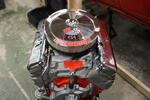
Is that smog pump connected to anything? What is your advance at idle? These will help, but isolating it to an area using the “stethoscope” approach above will also help. Your alternator fan belt looks a little loose. Remove the belt and inspect the fan and water pump pulley for looseness. If everything is tight. Start the engine without the belt and let it run for about a minute. Is the noise still there?
Old Pro Solo Guy

Joined: Dec 2017
Posts: 8,088
Likes: 4,446
From: Marlton NJ
Very odd....
I do not believe it is fast enough or frequent enough to be cylinder related (valves, piston, rod, bearings). And now it slowed down on it's own.
Hmmm.
I vote for something rusted up and sticking from sitting for 5 years, then "randomly" sticking a little. And starting to loosen up.
Use the hose, long screwdriver stethascope approach..
Then Check water pump bearing, all valves, hydraualic lifters. Or bottom end by fuel pump pushrod or bellhousing.
I do not believe it is fast enough or frequent enough to be cylinder related (valves, piston, rod, bearings). And now it slowed down on it's own.
Hmmm.
I vote for something rusted up and sticking from sitting for 5 years, then "randomly" sticking a little. And starting to loosen up.
Use the hose, long screwdriver stethascope approach..
Then Check water pump bearing, all valves, hydraualic lifters. Or bottom end by fuel pump pushrod or bellhousing.
Le Mans Master
Joined: Apr 2011
Posts: 6,284
Likes: 1,171
From: Hermosa
Very odd....
I do not believe it is fast enough or frequent enough to be cylinder related (valves, piston, rod, bearings). And now it slowed down on it's own.
Hmmm.
I vote for something rusted up and sticking from sitting for 5 years, then "randomly" sticking a little. And starting to loosen up.
Use the hose, long screwdriver stethascope approach..
Then Check water pump bearing, all valves, hydraualic lifters. Or bottom end by fuel pump pushrod or bellhousing.
I do not believe it is fast enough or frequent enough to be cylinder related (valves, piston, rod, bearings). And now it slowed down on it's own.
Hmmm.
I vote for something rusted up and sticking from sitting for 5 years, then "randomly" sticking a little. And starting to loosen up.
Use the hose, long screwdriver stethascope approach..
Then Check water pump bearing, all valves, hydraualic lifters. Or bottom end by fuel pump pushrod or bellhousing.
Thread Starter
Heel & Toe
Joined: Apr 2021
Posts: 22
Likes: 1
From: Fillmore CA
Tried with the hose and the only place so far where I can clearly hear it is when the hose is touching the bellhousing.
Will try to lift the car and open the inspection place.
Got a bit demotivated recently since I checked the status of the bird cage and it's quite bad. Rookie mistake, since the frame just had surface rust I assumed the bird cage would be OK :|
Will try to lift the car and open the inspection place.
Got a bit demotivated recently since I checked the status of the bird cage and it's quite bad. Rookie mistake, since the frame just had surface rust I assumed the bird cage would be OK :|
