When you click on links to various merchants on this site and make a purchase, this can result in this site earning a commission. Affiliate programs and affiliations include, but are not limited to, the eBay Partner Network.
Cliff, haven't seen you around here a lot having been a member since 2010. Good to see some real info being offered here
In addition to quench I would add that piston top design is critical too. A typical dish piston is going to offer no real squish. It needs to be D-dish or flat top to get that quench action. I agree that given it is kept around .040 max and .035 min, typically, you're gonna avoid the dreaded detonation issues that arise with poor quench. Nice high CR in addition opens up a lot more cam options vs something below 10:1.
Aluminum heads allows for some pretty good CR vs iron as well. Modern combustion chambers. Etc. Lots of ways to get a good burn to make fuel into power vs just exhaust.
Personally I prefer the narrow LSA for good midrange power and a pretty decent top as well. Running a 108 on a 350. Nice, more explosive type power, which I do like for the smaller dispacement.
On the HR cam and the RAIV cam dyno results looked about the same. However with the reduced seat duration, narrower LSA, I bet the HR came in a lot harder and faster. And made more vacuum.
I'm not sure who first stated on the Internet that the proverbial "brick wall" for pump gas with these engines is 9.5 to 1. That is the most inaccurate statement ever made in association with this hobby and not a day goes by it doesn't get regurgitated by someone in a thread someplace.
Compression is your friend with these things. Higher compression allows for more camshaft to be used with less negatives. Dropping compression to around 9.5 to one or limiting it to 9.5 to 1 then installing a short seat timing camshaft on a tight LSA leaves a LOT of power on the table. I've even seen several engine builds that pinged with compression that low when the cam was too small, LSA too tight and intake closing too early.
It's also rare when someone building one of these engines even knows exactly what the compression ratio is? When I'm asked to help the owner and even the engine "builder" seldom knows either.
Since I tune for a living I get to meet a lot of nice folks and get to work with a lot of engine combo's. Most 350 SBC builds for example end up with THICK head gaskets on them where the factory used a .020" steel shim. The pistons are often WAY below the deck at TDC instead of around .015-.018". So instead of the quench being .035-.038" it's typically in .050"-.090" range instead. NOTHING good comes from all of that and many of the owners of these engines believe or were told they were around 9 to 9.5 to 1 (for pump gas) when they are really a LOT lower.
If they were simply higher in compression with tighter quench I probably wouldn't be asked to help them in the first place, but in the same sentence I wouldn't be in business either if folks made good decisions with this sort of thing!........Cliff
Engine builders shoot for 9.5:1, there worried about detonation. They don’t want the customer coming back complaining about detonation.
When I built my L46, I went to three different shops, before finding one that would build it to my specs. 10:5.1 with .035 squish/quench. I though that if I experienced any detonation, I wouldn’t have any problem mixing in racing gas. I haven’t experience any detonation and I’ve tested for it by pulling a grade on a hot day. I had Henry Olsen tune the motor, Im really happy with the results. And I’m in California so 91octane.
I often wonder what's so different from big V8 to (e.g.) the Austin A series engine.
Almost all European classic cars had 9.75-+10.5-1 compresion even in the 90's.
I've never really used static compression, I try to shoot for the "ideal" dynamic compression, around 8:1.
Interesting info here too btw, love to read all this!
While I have all the knowledgeable people here,
what's your opinion on dome pistons?
According to the summit calculator I could end up at 10.8:1 with dome pistons (+4cc) and 9.74 with flattops ( 5cc for the valve reliefs I guess).
Would go for either the l79 or l82 cam.
Also, could go to 10.84 or 9.78 if I'd go for a +40 instead of a +30 overbore. Probably too little to notice.
if the 9.75:1 would make me end up with 350 hp I'd be happy already.
"Cliff, haven't seen you around here a lot having been a member since 2010. Good to see some real info being offered here"
I retired back in April so have a little more free time these days. Done with carburetor restorations Keeping the parts business going a few more years and doing some custom tuning couple of Saturdays a month, but not much else. I've been known somewhat as a "Pontiac" guy, probably because I drive and race one, but I started out with big Wedge Mopars, then went to SBC's for quite a few years before ending up with a Pontiac powered car.
In the shop I build all types of engines. To me they are 8 round pistons moving up and down in 8 round holes. Bore, stroke, compression, head flow and cam specs are about all differ between them in general parameters. They all behave in similar fashion and tuning them follows the same basic guidelines as well.
I start narrowing up LSA with larger cams otherwise the power range just runs up too high and the mid-range start to "soften up".
The WORST cam you will ever put in one of these engines is a small (short seat timing) on a tight LSA. You end up with stinky exhaust, narrow power curve and I've seen some combo's "spike" the compression so high at peak torque they ping on pump gas.
Of course small/tight LSA cams "feel" pretty stout as they yank the power down low, throw it at you quick and early, so "snappy" and hit like a small shot of nitrous. This fools the driver into thinking a lot is going on and the engine is going to make the car really quick and fast at the track. I do this for a living and drag race and have been fooled by this myself especially if comparing it to an engine with a much smoother power curve that is more "locomotive" like, just pulls really hard everyplace and no "rush" of power anyplace.
I have lots of direct examples and comparisons, dyno and at the track. As far as the HR cam hitting harder and sooner and 1.5" more vacuum so you are correct. It was however just a tad octane sensitive and I was no longer able to manage 89-90 octane at 10 to 1 compression it required 92-93 octane. Also interesting is that although it made 3 more HP it peaked at 5400rpm's where the RAIV cam peaked at 5600rpm's. So it acted like a smaller cam in several areas but made up the gap and then some with power production.
The testing did show us for sure that we can "mimic" the power of a very well chose HR cam with a longer seat timing flat cam with Rhoads lifters and high ratio rocker arms. Certainly a LOT less expensive than the HR conversion and easier on the valve springs as well. The HR took a lot more spring with more pressure to keep things happy there......
Say you bought a c3 and it pinged, what would you do to fix it? Make a list of what you would try.
.
a side note, i hear UK is cool compared to say FL where i am. Can make a big difference.
.
In the winter here on a 50F day, i have a solenoid valve and a switch- this LOCKS the vacuum advance at MAX- this way on a cold start it drives like it is warm- NO CHOKE.
Moral of the story; a cold engine on a cool day LIKES a heck of a lot of advance. this has nothing to do with your situation- or does it?
I would consider the dart heads if I'd live in the US. But 1200$ + Shipping across the ocean + 27% tax isn't isn't it for what I want to achieve.
Was going to use some standard engine tech flat top +30 pistons. Summit own brand looks like a safe bet too. iirc they needed to be 1.56 compression height. Should look on my notes.
__________________
My build thread on hotrodders : http://www.hotrodders.com/forum/dusk...c3-505921.html
1979 corvette C3
350 goodwrench crate 614 heads with 1.94" valves
Lunati 280/290
Wait a minute Dusky OP!... Questions?
If OP truly has614 heads, those may be 305ci heads and, if so, must have Very small chambers ... on the order of 58cc to 60cc. NOT large chamber (~ 76cc) heads as 71 sbc would have OE.
Therefore, all the SCR & DCR Compression calculations/predictions must be wrong; and most if not all performance parts selections must be wrong and should be reconsidered as well.
So ... Dusky ... do you have 614 305 heads (as in casting # 462614) ? ... are those 614 heads the same 614 heads you've been telling us you'll be using? Please Verify !
Also, are you CERTAIN your engine is truly a 350 ? ...Certain that it began its life with a 4.000" bore ? Please Verify !
And, once again Dusky, I cannot see most pics on your hotrodders build site because so many are "tinypic" and something seems wrong with that photo host.
Wait a minute Dusky OP!... Questions?
If OP truly has614 heads, those may be 305ci heads and, if so, must have Very small chambers ... on the order of 58cc to 60cc. NOT large chamber (~ 76cc) heads as 71 sbc would have OE.
Therefore, all the SCR & DCR Compression calculations/predictions must be wrong; and most if not all performance parts selections must be wrong and should be reconsidered as well.
So ... Dusky ... do you have 614 305 heads (as in casting # 462614) ? ... are those 614 heads the same 614 heads you've been telling us you'll be using? Please Verify !
Also, are you CERTAIN your engine is truly a 350 ? ...Certain that it began its life with a 4.000" bore ? Please Verify !
And, once again Dusky, I cannot see most pics on your hotrodders build site because so many are "tinypic" and something seems wrong with that photo host.
I should remove that info from my signature when I'm on the PC. That was my yellow 79 C3.
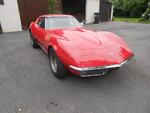
I have a 71 red C3 now, 487X heads on that one with 1.94-1.5 valves which I'm contemplating to change to 2.02-1.6 and some port work in my quest for 350 real hp's.
Dusky, You do understand that you can order cams with changes. Like you could go to the Comp Cams dyno sheets on cams and then say order a XE268 with 112 or even 114 LC ground 2 or even 4 degrees retarded compared to the original.
I have a 236/242 SR 112 lc and ground 4 degrees retarded just kinda quiet for for 11.2 C/R
People generally buying cams are wanting the race car motor sound. They are more likely concerned about people noticing the sound over actual performance enhancement. That's why they sell Thumper Cams and noisy gear driven cams
I have never understood why people would want to go to less duration than a wimpy l82 cam? Which is 222/222 114. Those are the deceived by media and sound people.
Lower numbers Lobe center angles gives a motor greater lower rpm TQ numbers. Which is good in a lower rpm red line motor, but still it will have a lower average because of the massive drop in TQ as the rpm rises past peak TQ.
You really have to look at valve events on the cam specs card. Lopey idle is caused by both valve over lap and early opening of the intake valve. So if the cam card says that intake valve starts opening at 8 degrees Before Top Dead Center it's going to have intake reversion.. so if you were to have that cam ground or install the cam 4 degrees retarded you decreases the reversion and broaden the TQ curve. Lower peak TQ numbers, but higher overall average. Kind of the same idea of running 112 114 lobe center
Engine efficiency also goes up for more fuel mileage
Excellent response, that should be a "sticky" on here someplace.
For sure "bling" sells camshafts. Who wants to idle thru a car show or cruise-in with a smooth quiet set-up? You get those "your car is slow as chit" looks from anyone who glances in your direction!
I attached a dyno chart comparison in a 463CID engine with 9.3 to 1 compression and 250cfm professionally ported heads on it. Comp chose the first cam, it idled "quirky" and didn't make nearly the power they were expecting. It pinged a bit on the dyno, enough to require rod bearing replacement. I got a call because EVERYONE right down to the guy who takes out the trash at the dyno facility was blaming the Q-jet. Instead of talking carbs we talked camshafts and they installed my suggestion instead. A couple weeks later I get a call and sent the new dyno sheet. They also noted that the engine idled better and improved throttle response as well. Even better they could now run "normal" timing in it where before it pinged pretty hard past 26 degrees total timing........
There is so much false information burned into so many people's heads by sales hype and 'cool factor' (about this cam topic) it's a wonderful breath of fresh air to read your comments Cliff,,, Thanks so much for freely sharing your experiences.
I have to be careful putting up what I know to be true about many of these things (bolt on and bolt in parts) vs what folks typically thinks is true with them.
I just gave myself a permanent vacation from the PY Pontiac Board because I was being stalked by a guy who absolutely HATED my results with many of these parts. Every single time I'd post accurate results from direct testing he'd Google to the brink of extinction to find someone, someplace who did well with the part or parts I was finding fault with.
Guys, there are a LOT of ways to skin cats, but for sure if you have never skinned a cat before maybe you should open up your mind a bit and learn from the information. If you don't like it, or it may be referencing something you've bought into and are happy with it, that's fine too.
What everyone needs to realize here is that there are no rule books for this sort of thing, and EVERYONE wants to pull up to the table to eat. So for sure there is considerable "propaganda" associated with these things. None of it has to be true or accurate, they just have to tells us that it is.......and folks buy right into it more times than not.....FWIW......
Thing is,
I want the other way round. I don't want the race car sound. I like the "mellow" idling of a stock engine.
Problem -imho- with engine related questions is that it quickly spirals down into " this or that can make you more power". If I have 350 hp I'll have enough to wipe the smirk of a lot of people's faces.
I used to have the perfect sleeper, a classic mini Cooper with +-110 hp. In a 600 kg car that was super fun to drive, but pulling away at a stoplight you'd need to Rev the proverbial t1ts off it to get it to pull away.
I didn't really find an answer yet to the last question so I'll ask again, can anyone tell me if the l79 or l82 cam would a) give me +-350 hp, b) give me that with 9.5:1 compression?
if not, I could get dome pistons which would put me at 10.6:1.
the melling 22234 is also still tempting me, but apparently it's close to the comp 268 which -probably- isn't what I'm after.
Appreciate all the input, gives me lots of things to read and "digest".
need 10.6 and decent flowing heads with headers and say, turbo mufflers.
and 350 at the engine on an engine dyno
rear wheels, maybe 230 if you are lucky.
L48 fwiw
487 heads (~76cc chamber) have a lot of meat on them and seal well even after milling to 70cc. Myself & countless others have done so for restricted asphalt CT motors.
that flattop (~6cc, 1.560" CD) summit piston I linked above + 70cc chamber + stock OE deck height + 3.245cc shim gasket = about 9.6:1 SCR compression And great 0.040" quench.
Current trend w/ OE & builders is a Very small chamber + flat/reverse-dome piston. Please note how many smaller chambers cannot mate w/ dome piston.
dome pistons are not good, but should not be confused with say, the LT-1 pistons i have in my 61 355- they are up like 1/10 inch. i recall dyno shop owner Joe Sherman saying for the street it is a waste of effort to try and get rid of 1/10" pop up - nothing wrong with their dyno results.