When you click on links to various merchants on this site and make a purchase, this can result in this site earning a commission. Affiliate programs and affiliations include, but are not limited to, the eBay Partner Network.
Is that the one you mentioned here? I thought you were referring a 396 big block. What valve train parts are you using to rev that high? And yeah, I understand the "one thing leads to another" aspect of messing with cars. :-)
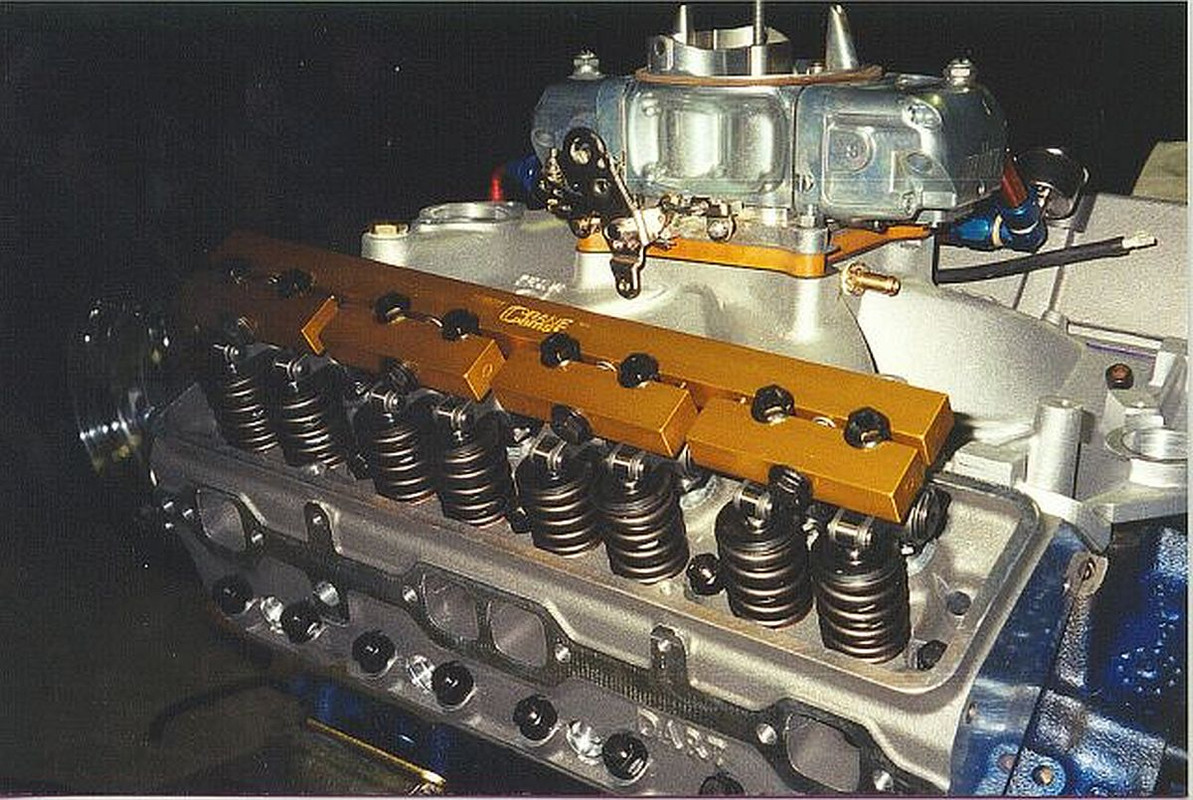
I cheeped out at some point and never did shaft rockers. The best stud girdles with ARP 7/16th studs don't move around much in a sub 8000 rpm motor. you never really have to reset the valve lash. It's more of a check.
396 small blocks are just a 30 or 40 over stock 4 bolt block.
Interesting thread. OP states he has torque Mopars and wants something different. I will not argue against a big inch small block, but recalling my youth, remember sitting out at night and hearing a high winding small block calling out and they were awesome. A tri five Chevy with gears and a 301 really sang a song! OP go for it. Use the Duntov 30-30 and enjoy that 350.
If hes not on the hwy just screwing around town and backroads Id have a 4.11, good head and something around the 250@050 108lsa single pattern or maybe 4 deg split
Will need a vac can for power brakes big deal. Still easy to drive and will scream.
Jebby, I know what you're saying about the 406. I just built a stroker motor for my son with a Mopar 318 polysphere engine (yes, you read that right) and it's night and day. But I have two other big block Mopars that I'll be restoring next. One is a 383 that I'm going to stroke and build to 500+ hp. The other will be closer to stock, but it has a 440 and they are no slouch. So those cars will be built for low to mid range monster power and torque. I want the Corvette to have a different personality, so I have some variation in my "stable".
Coming from a life-long big block Mopar guy... If you have driven even a bone stock 440 with headers, then i assure you, nothing in the small block Chevy world short ov a high-buck high-cube (427/454) big bore/stroker will impress you, torque wise.
I'm doing the exact same thing as you... a different feel. After spending decades bashing people with my 440 sledgehammer, i've come to appreciate high RPM and extremely scienced-out, optimized builds. I've become obsessed with efficiency. I am not knocking the acumen ov the guys in here... we have some serious professional knowledge in here... but as a general rule, i find most people are WAAAAY too quick to just take a sledgehammer to the problem ov making power and speed. Need more power? Throw a massive crank at it, maybe some heads with really big holes, an obscene crank, blast the compression and run it on race gas. Yeah, dont actually learn how an engine works, or god forbid, anything about volumetric efficiency... just throw money at it. Mopar guys are probably the worst for this. Thats why you see half a dozen stroked 440's running deep into the 14's at any typical local track night. I'm going the other way, and have become obsessed with DOHC V8's. At the same track you can see 4.6 mod guys (i'm not even going to start with the Coyotes...) running 11's at close to 120mph without nitrous or boost. Now... before i get the flames, yeah i know thats apples and watermelons... but it makes the point just the same. If i can make 350HP at the wheels with a 281cid stock longblock, stock head, stock cam engine... then do you really need a 400cid stroker to do the same in a Chevy? I love the NASCAR/Cup engines for this... even the older ones 'only' making 700HP and 500+tq. Chevy's ludicrous aftermarket has some wonderful options... explore it. There was a local guy here with a very simple, very well thought out 355 Chevy... making around 550HP and just a hair under 500ft/lbs, N/A. That thing ran hard all season long, not a hiccup. That was a fast car ("lazy tens"... as he put it), and he said it was no more difficult to live with than a bone stock LT1. My ex-boss had an ancient Chevy pick-up, set up for nitrous. I'm not sure ov the details, but it had a stock bore/stroke 350, with some serious iron heads, single plane, solid cam, and it ran high to mid 12's on the engine... and that thing was heavy. He drove it to work. I drove it, it felt like my 6-pack cammed 440 Charger, save the bigger stall.
I think what happens is that guys like Jebby get sick ov answering the constant 'how do i make 400HP out ov my SBC?' questions, and just hand out the easy, sure-thing recipes. Personally, i would love to see what guys like this could do in class racing, where they need to squeeze every single horse out ov a specific combo. The 4.6DOHC guys were getting absurd with this... until the Coyotes came along anyways. God damn stock (longblock) Coyotes are running mid-nines now... And those ridiculous F.A.S.T. guys... Jesus...
I build my motors to do 8000 rpm and then set the rev limiter to 7500 because you kinds feel sorry for them I use better callies crank shafts and 1200 hp Manley H beam rods because I broke a crank shaft in my first 427 SBC, but with typical 64cc compression like mine is 11.2 and it runs very well on pump gas for the past 20 years with a 236/242 roller cam 4 degrees retarded for top end power. Crower cranks are also good.
This is when I tried my Dart 227cc racing heads and big Motown single plane on my stock block 396. I ran it for a couple of years and then put my fixed 427 back in to whip up on the 700 hp turbo Porsches on the road racing tracks.
I built my 1970 LT-1 up 40 years ago and auto crossed it 100s of times for 27 years. It was fun motor. And almost stock. Realistically probably 390-400 hp. Stock heads, just pocket ported. Carefully balanced. Blueprinted. Stock pink rods, carefully magged, shot peaned, ARP rod bolts are mandatory. Stock intake & carb. Several cams in it. Ran the 30-30 grind most of the time. A little too big. 252 dur @.050 IIRC. Soft bottom end until 3500 then hang on. Probably peaked at 6600-6800 but would rev to 7400 if needed to skip a shift. Z28 off road brown springs was all. Cut down shorter poly looks and stock rocker arms. Solid lifters. Valve lash did NOT move for months after the poly loks. Aluminum flywheel really made it rev quick and was fun. Actually advanced cam and loosened lash to help bottom end TQ. 411 & 2.20 CR Muncie was just barely adequate.Switched to 2.52 WR Muncie & 3.55s. First three gears exactly the same and now I could drive it out of town. 9 to 1 first gear overall I think. Stock oil pump & pan. Zero oil problems racing for years. Even at Pocono track at 150. Pulled 1.27 Gs in turns too. Did put a larger 1/4 inch feed line to the mechanical oil gauge and could see it wiggle, but never dropped. Considered an accusump but did not need it. 20ish psi at idle, 55 hot 3500 up.
That's all you need for a really fun street motor. With today's tech a similar combo could easily make 425+ HP. What I would change if I were to build it today:
Heads. #1. The best like AFRs probably worth 40 hp alone. #2 Roller cam. Just makes more power everywhere. I like the HR cams for their more gentle on the valve train ramps and softer spring useage. But run solid roller lifters on it for no pump up worries. Run Very tight lash. Also let's you monitor roller wear. A Hybrid setup.Be very very cautious about going very far past 230 dur @ .050. Loses bottom end quickly. But you are asking for some of that. So say mid 230s. Maybe 112 LC to get a little vac back. You'll be dancing around the edge on that. Just idle it a little higher like 900. IIRC I had 12 inches.The LT-1 solid cam at 242 is 231 without the lash. The 252 30-30 cam is 239 without it's lash. So you can compare to a HR.Keep the AL flywheel. But put a TKX 5 speed in it for 10 or 12 :1 first gear!
It won't have bb TQ but it will be fast. And it will feel like it could rev forever. Linear power curve. Just keeps building......
Add 10 more duration and you maybe gain 500 rpm up top, but it will be like a PITA race motor down low. That's what some want.
Last edited by leigh1322; Sep 21, 2021 at 01:53 PM.
That's all you need for a really fun street motor. With today's tech a similar combo could easily make 425+ HP. What I would change if I were to build it today:
Heads. #1. The best like AFRs probably worth 40 hp alone. #2 Roller cam. Just makes more power everywhere. I like the HR cams for their more gentle on the valve train ramps and softer spring useage. But run solid roller lifters on it for no pump up worries. Run Very tight lash. Also let's you monitor roller wear. A Hybrid setup.Be very very cautious about going very far past 230 dur @ .050. Loses bottom end quickly. But you are asking for some of that. So say mid 230s. Maybe 112 LC to get a little vac back. You'll be dancing around the edge on that. Just idle it a little higher like 900. IIRC I had 12 inches.The LT-1 solid cam at 242 is 231 without the lash. The 252 30-30 cam is 239 without it's lash. So you can compare to a HR.Keep the AL flywheel. But put a TKX 5 speed in it for 10 or 12 :1 first gear!
It won't have bb TQ but it will be fast. And it will feel like it could rev forever. Linear power curve. Just keeps building......
Add 10 more duration and you maybe gain 500 rpm up top, but it will be like a PITA race motor down low. That's what some want.
Thanks Leigh. I don't want it to be a pain down low. I'll compromise on some top end power to get enough torque on the bottom to leave stop lights and cruise at lower rpm w/o bucking around. There is a sweet spot somewhere around there that I'm looking for. I will run manual brakes and electric headlights, so the only thing I need vacuum for is the wiper door and the advance, so I'm thinking vacuum won't really be part of the cam discussion. Might even do away with the wiper door and get a long hood. Except I already painted mine.
JMO, it's a street motor right? ... suggest don't spend all that dough & time on ~ 3.875" stroke RA in little 350 block where its skinny bore serves to shroud valves, hinder its breathing & limit its potential. YMMV. Don't care at all about a shopworn diatribe on its supposed virtues either.
425 - 450 quite doable w/ OE 3.48" ... Note: not using my suggestions as a platform for boast either.
Perhaps ponder why GM soon quit their little 396/402 bore in favor of larger 427 bore?
Wanna buck known fluid dynamic principles? Perhaps an engineer pal can model it on a CFD program.
Thanks Leigh. I don't want it to be a pain down low. I'll compromise on some top end power to get enough torque on the bottom to leave stop lights and cruise at lower rpm w/o bucking around. There is a sweet spot somewhere around there that I'm looking for. I will run manual brakes and electric headlights, so the only thing I need vacuum for is the wiper door and the advance, so I'm thinking vacuum won't really be part of the cam discussion. Might even do away with the wiper door and get a long hood. Except I already painted mine.
The duration I mentioned is the sweet spot where it still acts like a normal engine down low, but pulls hard to 6000-6500. It will have a little lope to it. That is the reason the L46 and LT1 cams are so close, and so civilized. And yet the DZ302 & 327-365/375 are a little more "rowdy" with a definate lope. It all depends on how much you like / want rowdy. But they are still very streetable, with a stick and a little gear. A new tech HR/SR cam will make more HP than those old GM cams, but the duration/overlap still determines the rpm/idle/vac. Bigger than that takes a lot of commitment / work to drive it on the street. It's not very civilized any more. But that is exactly what some prefer.
You can keep the stock L46/LT1 aluminum covers if you choose carefully. Stock length polyloks don't fit well, you need the shorter ones by Crower or trim yours down. You need the polyloks on a solid cam or the adjustment becomes too frequent and annoying. I also had to shorten the drippers in the covers and use a thick cork gasket. That was just enough.
Steel roller rockers are smaller than aluminum ones and should fit. That's a good addition. A stud girdle will not fit. But it does not sound like you need it either.
Last edited by leigh1322; Sep 22, 2021 at 09:42 AM.
From the time I was a little kid I was walking around the pits at Portland international raceway with the factory Porsche pro racers. Some of the cars like the Porsche 917 just hurt your ears or the later Mazda IMSA rotary motors. No wussy Db noise limited racing back then. So I have a different attitude on what works.
It's been my life experience that people say this or that is plenty good never tried the out of the ordinary or even built a stroker motor. If you ever saw the 441 ci small blocks roaring around circle tracks coming off the turns with the front tires in the air with 850 - 900 hp you wouldn't be thinking something stupid like the small bore to stroke ratio is impeding intake with shrouding!
When I was young I thought outside the box. 30+ years ago they had paved 1/4 and 3/8th mile circle track racing locally. Class rules were Two barrel carb, no roller cams, iron blocks and heads. Everybody ran 355 or maybe 358 ci bored out 350 chevies. The class two barrel was power limiting factory because of the low CFM. I reasoned that the motors were rpm limited because of the restricted intake. So I found a large journal 1968 327 forged crank shaft with the 3.250 short stroke. I found a good 4 bolt block and after sonic testing determined that it was good to go to .060 over bore for something like 337 ci. I found 6.250 rods with domed pistons and some of the first 200 cc iron sportsman heads on the market and I had them ported with 2.055 valves 1.60 exhaust manley tulip valves. I put lots of thought into the limited modern solid lifter cams of the day. Those old Duntov 30/30 are really poorly designed cams from the 60's when spring technology was a limitation. Crane cams made a 238/248 solid with mid .500 lift . You have to remember that I was going to compete with the established good ole boys club with their double hump headed crappy cams and bored out 350's. We showed up with an out of the box thinking car and motor. That motor could do about 1000 rpm more than any other car on the track and could pass the big boys on the straights. Every race we went to they would put up the money for a motor tear down to see how we were cheating. They hated me and my buddy enough that they would intentionally rear end us going into a turn to knock us out of the race. But it proved a point to the good ole boys who had been doing it like that for many years. Young guys with better ideas can kick your a$$.
That was my only destroked motor. later on it went into my street rod with with a dual four barrel tunnel ram and did 8000 rpm in every gear. really a fun little motor. My 79 vette became a hot rodded 355 ci drag racing machine. with the stock forged bottom end, big heads, single plane Team "G" 830 cfm carb 1 3/4 headers. Set the rev limiter at 7200 rpm to make it last. consistent low 12 second winning bracket car. It crowning achievement was running the 90 some mile state highway open road race called the "Silver State Classic" here in Nevada. With all my racing credentials of Sprint cars and paved circle track I was excepted into the max speed of 175 mph in my relatively stock looking roll caged 1979 corvette. That motor eventually expired in another event like that. It just couldn't take high rpm for like 20 minutes straight and it had severe piston failure.
So it was off to the drawing board again. 383's were starting to be the rage. So I bought engine dyno simulation soft ware and spent 100's of man hours designing cams/compression/head cfm of flow. Only to find out that cam companies only have the tooling to make their specific line up of cam choices. Until I finally got a hold of a tech from comp cams that told me about the "Cam Lobe profile book that racers use" So I looked through the lobes and settled on the endurance road racing solid roller models in the mid .600 lift and Dart 227 cc heads flowing in the 310 cfm and 243 cfm exhaust range. I didn't want to go over board in a street car with only 383 ci. So I bought a $2000 dollar crank shaft and built to do 8000 rpm and set the rev limiter to 7500 to make it last with 11.2 c/r
Well on it's maiden voyage I was very impressed with the torque compared to my previous high winding 355. Your talking nearly 30 cubic inches of more TQ. I went drag racing and instantly had a consistent 11.70 second vette. I went out an won the all vette drags in in the 11.00 to 12.49 class bracket racing.
Never build a 350 again. I made changes and a bigger cam. Then I trashed another rear end and then the tranny. Got tired of years in the hot staging lanes waiting to run and began to hate having to travel to make every NHRA division 7 points meet. It was kind of boring so I bought into a dragster and a turbo drag bike It was lots more exciting going 7.60's in the 1/4 mile and cheaper than running the poor old vette that was breaking posi units all the time.
Then I started doing more simulation time and reasoned that 396 small block was the same cost and I had all the parts. Vast improvement over the 383. Then i bought the 427 motown block and I already had the 227 Dart racing heads. Instant winner on the road racing tracks because I read the rule book about the 350 pound weight break running a small block against the up to 500 ci big blocks. My 396 has been my ready spare motor when I have to yank out the 427. My min Vette weight with driver was 3000 pounds and it was tough to get a caged 79 down that low. But cheating abounded in vintage and historic racing and I was good at it!
So nay sayers about stroker motors probably never build one or had some cheap a$$ externally balanced crate motor. I was always blessed to work at high end race shops and be around thinking people. If you are going to do a stock 4 bolt block 396 is much better than a 383. I never saw luck in 400 stock blocks. They seem to fall apart at the 700+ hp level. The bigger mains weakens the block and cooling is problematic. Aftermarket blocks are really the way to go
yup ... s'pose braggin's just part of that fun as well.
Not really bragging, because I never had the cubic dollars to really do it right. That's why I went to work at a historic race shop. If you can't beat them you join them. When you go to a road race and you see professional teams with a full line up of cars and uniformed mechanics strapping in the drivers in compared to my 4 wheel drive ford and an open trailer way back when. Or even have your slicks, cooler, floor jack, and lawn chair in the vette with the passenger seat out to go to drive to the drag races.
Somebody ask me this on a PM. About what you need to do to a stock block to put in a 3.875 stroker crank with big H Beam rods.
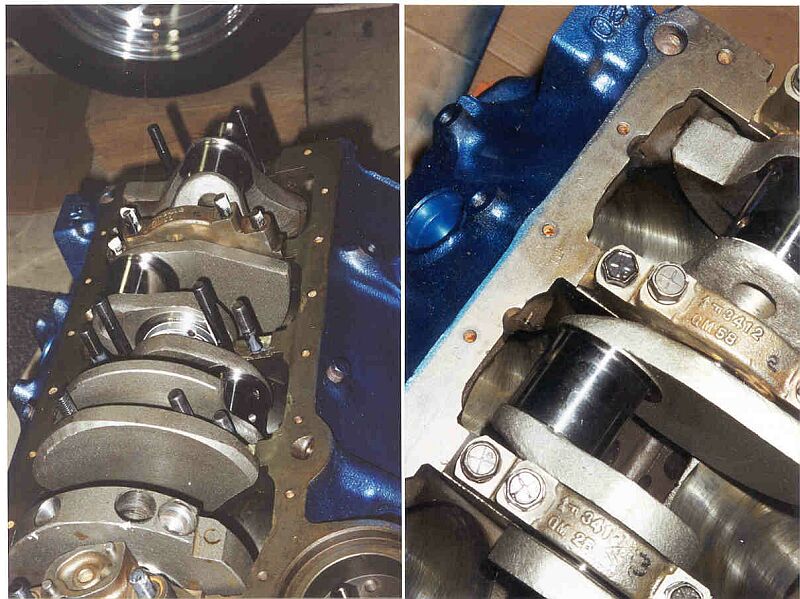
Stock blocks are narrower at the front of the pan. So you only have to grind away on the front bottom of the block for a couple of cylinders to end up with about .050 clearance to the rod bolts. These are the 397010 better 4 bolt blocks totally blue printed for head studs.......
I had an extra used 396 light weight crank shaft and the old bearings which I didn't mind if they got covered with metal debris. so I assembled it with just bolts being tight. The final motor on the left got ARP stud kit. Later on I hot tanked and polished the older crank. They are about 42 pound Callies internally balanced
Doing a 400 dart SHP block was major grinding all the way down because they are only made for 3.750 cranks. but with 4.125 standard bore you have a 415 which kicks butt on any 400 ci build
Not sure if you are going big flares or not. But there are a couple guys running 18x10s with stock fenders. Search Cargotzman:
Cargotzman, 18 x 9.5, 4.75" BSP, 270/40-18s, 10.7" of tread, front & rear
I always wondered about those tires and bs because. 275/40R18 Tires have a diameter of 26.7" I had similar diameter with 4.5 BS and they have frame rub lock to lock and i just learned to not turn all the way like in a parking lot. They do have great traction though




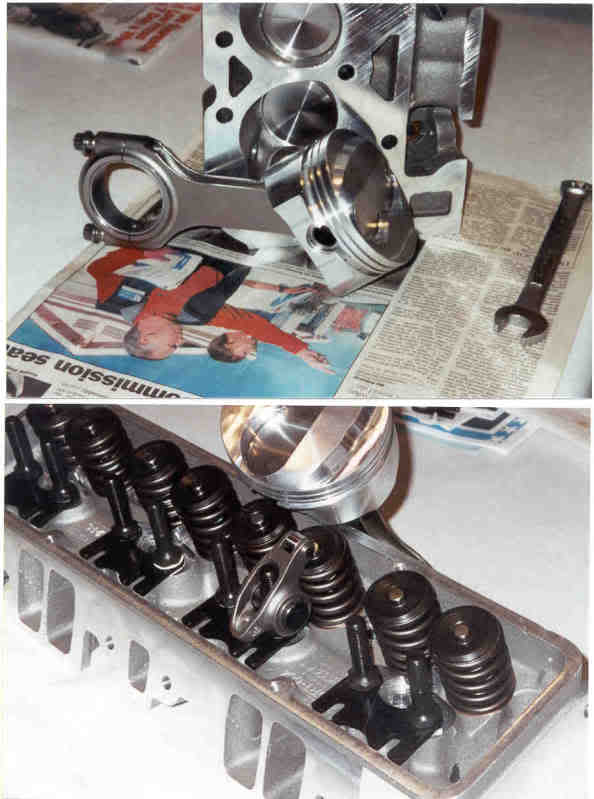
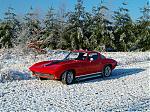



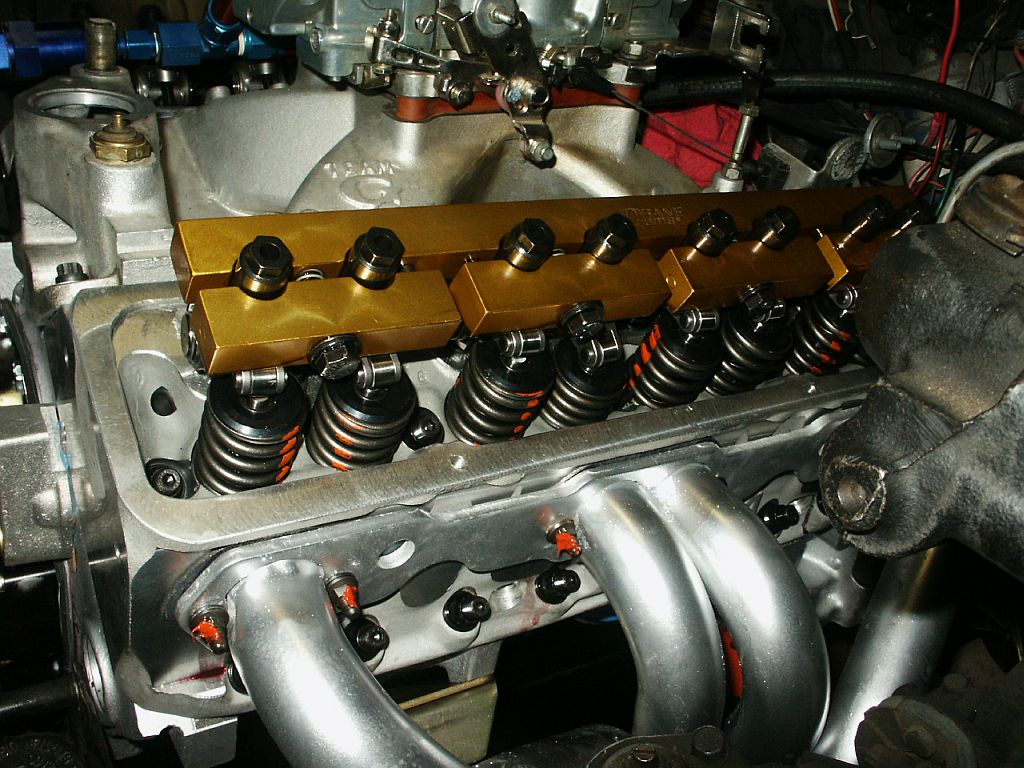
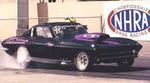


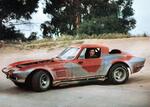


 I use better callies crank shafts and 1200 hp Manley H beam rods because I broke a crank shaft in my first 427 SBC, but with typical 64cc compression like mine is 11.2 and it runs very well on pump gas for the past 20 years with a 236/242 roller cam 4 degrees retarded for top end power. Crower cranks are also good.