When you click on links to various merchants on this site and make a purchase, this can result in this site earning a commission. Affiliate programs and affiliations include, but are not limited to, the eBay Partner Network.
There is no leakage past any compression ring, a catch can is ridiculous. There is no blow by. I believe oil is shooting out of the rocker arm and reaching the PCV, again Johnson short travel lifters move a lot of oil. You have no idea how 550 HP is utilized on 93 octane pump gas, driving down the road in high gear at a low RPM with 50 degrees of timing is a recipe for disaster and detonation at the OPs elevation. At this point the OP needs to put breathers in both valve covers with no PCV and drive the car and see if the oil consumption problem goes away, then design a PCV system.
I am going to have to side with Mark here......after seeing the oil in the "filter" that is in the PCV hose......I can tell you that the PCV is not only picking up oil, it is moving too much air........if you block the PCV and the idle vacuum goes down, then the PCV is more of an Idle Air Control unit than a crankcase evac.......I think in this application I would look at those adjustable PCV valves......you need to restrict the vacuum somehow.
The brass screen can be bought at Home Deephole.....or Lowes.....it is a Kitchen Scrub......
I also agree with Mark to a point on the vacuum advance.......50 degrees is too much.......but I do not agree with not running one........put one on that adds a soft 10 degrees, that doesn't pull abruptly when vacuum drops......you will have to investigate what cans will do this but I think the factory L-82 canister is the place to start. 44 degrees under light load is not a stretch......I run the 20/34 with a 10 degree adjustable can on my own 10.6 to 1 406......
Catch cans are completely unnecessary on a street car.......
Get the PCV under control and oil consumption will go away..........the intake is the tell.......I am not familiar with the Johnson lifters but if they move a lot of oil, this makes sense.
I am going to have to side with Mark here......after seeing the oil in the "filter" that is in the PCV hose......I can tell you that the PCV is not only picking up oil, it is moving too much air........if you block the PCV and the idle vacuum goes down, then the PCV is more of an Idle Air Control unit than a crankcase evac.......I think in this application I would look at those adjustable PCV valves......you need to restrict the vacuum somehow.
The brass screen can be bought at Home Deephole.....or Lowes.....it is a Kitchen Scrub......
I also agree with Mark to a point on the vacuum advance.......50 degrees is too much.......but I do not agree with not running one........put one on that adds a soft 10 degrees, that doesn't pull abruptly when vacuum drops......you will have to investigate what cans will do this but I think the factory L-82 canister is the place to start. 44 degrees under light load is not a stretch......I run the 20/34 with a 10 degree adjustable can on my own 10.6 to 1 406......
Catch cans are completely unnecessary on a street car.......
Get the PCV under control and oil consumption will go away..........the intake is the tell.......I am not familiar with the Johnson lifters but if they move a lot of oil, this makes sense.
Jebby
Does that oiling in the filter look like its been going past compression rings?
Does that oiling in the filter look like its been going past compression rings?
Nope....too clean.....if the compression rings had any leakage, the gases would contaminate the oil and it would look dirty....not to mention the PCV would not pick up oil as the combustion pressure would equal the vacuum or close to it.....
I have seen instances where the oil rings need a little time to be happy and scrape the walls like they should......but if that were the case, that oil would be in the chamber.....and burn away.
50* of timing would not be reached until the mechanical advance is fully advanced AND high vacuum levels, i.e. cruise driving.
At less than full advance rpm it would not be reached.. so there is no way for it to be at 1800 rpm and 50+ of timing unless the mechanical is allowed to fully advance at those rpms and you don't have your foot in it.
A leak down would just be investigating the cause of so much pcv system consumed oil. Is there a lot of blowby? I don't know. Maybe not. I'm not there.
If the reason reason for excessive oil consumption via the pcv could have been anticipated due to the oiling nature of the lifters, then I have to wonder why appropriate baffling was not employed or at least recommended from the start.
The OP wanted my thoughts on the subject and I gave them.
I have no skin in this game and no axe to grind.
Just when things are not right the way they are then changes are likely needed.
I run 10.6:1 CR 34* timing at idle (19* initial) with vacuum included. 34* total and 51* at cruise. No detonation, no trailer hitching.
Timing all in @2800. Compression test give me 200-208 psi @ 4000 ft. Running 87-88 octane pump gas no ethanol. Water temps 180*-200*. Maybe 210 on a hot day with air conditioning on those days closer to 90 octane. Rear diff 355 ratio.
all this and no detonation at any time despite the timing.
So I know it can be done.
If corvette passion wants to makes changes, and he solicits opinions. Then I figure that is what he'll get.
As far as pulling a vacuum line to get an rpm change, corvettepassion, I figure if you got a large rpm increase then your running rich from the fuel be pulled in from mains vs idle circuit.
Seems that is not an issue so more bypass air is not needed.
It also sounds like " trailer hitching" is not an appropriate term for what you're experiencing. Quite the opposite. Since you have 20* initial and your mechanical advance is not fully in then the engine is responding poorly due to perhaps a lack of timing. If in fact this is happening in the range of idle to maybe 2000 rpm (well below your full timing advance) then more timing may in fact be your solution. Since the rpms are too low to mechanically advance the timing then vacuum is the only remaining solution.
I know I'm not in agreement with Mark on this. But it is my experience on the subject. I'm not an engine builder nor a professional tuner, so take it for what its worth.
I don't have a ton of time for responding right now as I am in groundschool for a new type rating. It's kinda kicking my butt right now.. so off to study and practice flows.
Your idle screws are relatively unresponsive. Seems to me you may be pulling some fuel off the transfer slots or maybe even primary jets. It may need more idle bypass air.
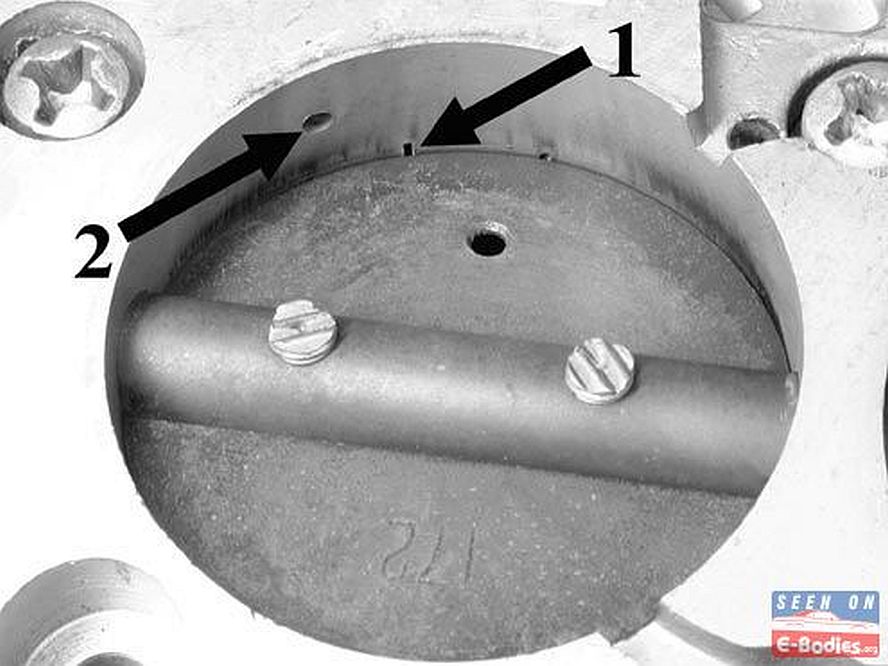
When idle screws are unresponsive. You have to drill the primary throttle blades. Here is a good article. As to a bouncy vacuum. Not a big deal. Think of the pulsing inside a manifold when you open the intake valve on 400+ ci motors. You can buy liquid filled vacuum gauges that dampen the movement. I'm very pro vacuum advance even on real race cars.
"If the reason reason for excessive oil consumption via the pcv could have been anticipated due to the oiling nature of the lifters, then I have to wonder why appropriate baffling was not employed or at least recommended from the start"
Had no reason to believe it would be a problem. Engine ran perfect on the dyno, or it wouldn't have shipped. I don't even run a PCV on my own engines, or advance.
You might have detonation and not even know it.
If an engine has had detonation for over 10,000 miles with hyper pistons and no damage is evident, either visually (borescope , or other evidence, sound, plug condition etc) is it a problem?
I would say no. It is running in it's environment in which it was designed for without detrimental damage. If I wanna tow a trailer...well that could be a problem.
It's hard to diagnose a mechanical problem that has multiple causes and or solutions without being there.
That being said, I would focus on the cause and remedy for the excessive oil consumption primarily.
Something is causing there to be alot (excessive amount) of air flowing from the valve covers, or a lot of oil aeration in the valve covers creating oil suspended in the air leaving the valve covers.
Instill believe as do others that vacuum advance is a critical item for a street driven car..
I can't be 100% sure more bypass is not needed, but that can be addressed at a later time after getting the timing sorted out.
Now we are getting some input.....thanks to all of you. And please don't let this descend into arguing and statements of who knows the most. I am not interested. In fact, the carb king on this forum has decided, via email directly to me....that he refuses to contribute.....for reasons I cannot figure out, since he has helped others with similar problems. Apparently, he doesn't like me for some reason.. This specific forum is called Corvette Tech Performance, and SHOULD be a place for people like me, who are not professional engine builders and tuners, to get help from those who are. I find it unfortunate that some choose to not contribute....for whatever reason. I suspect what happens is ego's get in the way.....but who the hell knows. Or maybe I am just too stupid for some to bother helping. I know the more people push their ego problems in my direction....the less I am interested in listening...thats my personality. So you want to go down that path.....expect me to stop listening and I will figure it out myself. And secondly....whatever is recommended has to be logical and make sense to me...otherwise, not interested. And what that means is the recommendation is more than just a one liner statement......it needs explanation and justification. This is about technical information, and more importantly SOLUTIONS....not d*** swinging. Period.
As for the oil consumption issue.....there is a problem, and the solution is not a catch can. All that is is a bandaid to the problem. I actually thought these taller valve covers would reduce the issues....the rocker arms are almost three inches below the roof of the valve cover.....as opposed to standard height valve covers which put them very close by. I almost fully enclosed the original baffle on the PCV valve side with my modification....and it STILL is pushing oil through. It has to be oil mist condensing.....because there is NO direct path for oil to hit that PCV any more. So....why the excess mist? If oil is shooting out of the rockers its just hitting the roof or side of the valve covers. I will do as Mark suggested and buy another filter....and run without the PCV......as an experiment, but I am not going to do that pernamently. I have read too much about the PCV system....and don't believe its a good idea. The downside to runniing strictly filter breathers with no PCV is well documented, especially if the car is going to be driven 5000 miles a year like I will. ON a drag strip...no big deal, especially given these engines are regularly opened up. They are not street cars.
One thing that needs remembered .......I am driving this car on the streets,.....and driving responsibly. I am NOT drag racing it,....on a strip or on the street. As many have said....I spend way more time near idle speeds, at cruise.....and in fact, I have NEVER ran this engine WOT yet, and probably never will. Its not necessary. This is a 3200 lb car......and has huge amounts of power.....I don't need WOT to go faster than any speed limit...in any gear. Its overkill. So point is....I don't need or want an engine that does well at a drag race at WOT.....I need an engine that works well from 0-60 mph....driving ALOT, on the streets of Pennsylvania. What works good on a drag racer is NOT necessarily what works good on the street, the way I drive. Keep that in mind with any suggestions.
To Gkull....thanks for the link to that tuning information....its very much in line with what I have already read, and have incorporated into my tuning thus far. To clarify your thoughts.....you believe the vacuum fluctuation at idle is normal for my cam and my engine......caused by pulses from the valve overlap / timing.....is that correct Gkull? This is what Mark Jones has said as well. I may be buying an in car vacuum gage to use while driving....and I will be sure to get a liguid filled one if I do.
To Reelav8r....I appreciate your input, and as I said, I want information, and ultimately the solution to the problem. Thus far....I have no solutions and still have problems. There are ideas to try. In the end....whatever the science of it proves....that is the solution and I don't care who is right or wrong about it.....back to the ego thing. It is my conclusion to this point that vacuum advance is needed on the street, and will solve several of the problems I have. If there is an alternative way to get the same results without a vacuum advance....someone is going to have to tell me how to do that, and so far, nobody has.
Jebby.....thanks for your input...I was hoping to hear from you.
And of course, Mark....its your engine build.....I am listening to what you are saying.
Last edited by Shovels and Vettes; May 31, 2023 at 12:37 PM.
Corvette Stories
The Best of Corvette for Corvette Enthusiasts
5 Best & 5 Most Overrated Corvette Track Packages of All Time!
Joe Kucinski
Every 2027 Corvette Engine Explained
Joe Kucinski
Designer Imagines A Corvette That Looks More Like a Corvette Than the Corvette
Verdad Gallardo
10 Ugly Corvettes That We Still Kinda Love
Joe Kucinski
Top 10 Most Expensive Corvettes Ever Sold on Bring A Trailer
Brett Foote
10 Things Every Corvette Owner Needs (2026 Edition)
Michael S. Palmer
8 Most "Only Corvette Owners Understand" Quirks and Problems
Pouria Savadkouei
10 Reasons the C6 Z06 is Still A Performance Benchmark After 20 Years
Joe Kucinski
How Much Horsepower Every Corvette Engine "LOST" in 1972
Joe Kucinski
Top 10 DOs and DON'Ts for Protecting Your Convertible Top!
Is there any way that these tall valve covers are the problem? Its doesn't make sense to me why they would....but I do have a set of standard chrome stock height valve covers, with a GM style baffle, that I could try. Maybe if the oil stream is shooting up at the roof....it has time to be picked up in the air, versus hitting a lower ceiling and then just running down????
Another idea......based on what I know about aircraft engines.....is it possible that I am simply putting TOO MUCH oil in the oil pan.....and the level is too high. In the jet engines I fly, if you service too much oil....it just pukes it out through a breather system and the level will self return to what it can take. If I am filling up the oil pan too high ....is it somehow getting aerated by the rotating parts and pushing excess mist up into the valve covers. This is a 6 quart Canton pan.....and I put 6-1/2 quarts of oil in it on day 1.....the extra half quart to fill the oil filter. That put the level at the full mark on the dipstick. First five hundred miles go by.....its at the ADD line. Added another quart....400 miles later...same thing...back to the add line. I put a quart in 200 miles ago...and its now down to halfway between add and full....so another 200 miles...if it keeps sucking....it will be back at the add line.......
Last edited by Shovels and Vettes; May 31, 2023 at 08:58 PM.
To Gkull....thanks for the link to that tuning information....its very much in line with what I have already read, and have incorporated into my tuning thus far. To clarify your thoughts.....you believe the vacuum fluctuation at idle is normal for my cam and my engine......caused by pulses from the valve overlap / timing.....is that correct Gkull? I may be buying an in car vacuum gage to use while driving....and I will be sure to get a liguid filled one if I do.
.
All of my engines have bouncy vacuum readings. I also I don't believe in PCV. It's a variable vacuum leak and when you have the most combustion gasses with open throttle blades you have very little vacuum to pull out the gasses when the motor is creating the most. I use twin breathers with spun steel wool, looks like lathe turnings to catch the oil mist before the K&N filters.
All of my engines have bouncy vacuum readings. I also I don't believe in PCV. It's a variable vacuum leak and when you have the most combustion gasses with open throttle blades you have very little vacuum to pull out the gasses when the motor is creating the most. I use twin breathers with spun steel wool, looks like lathe turnings to catch the oil mist before the K&N filters.
motors are a learning experience.
What do you say about the following issues, that have been widely written, about runing without at PCV:
- Case pressurizing to the point of pushing oil out of cranks seals, front and back?\
- Sludge buildup in the engine due to lack of properly scavenging of combustion gasses and condensation in the case
- Lack of vacuum in the case reduces pressure differental across the rings, making them a less intact seal for compression
Otherwise.....I would be way happier to take one more BS component out of the mix...and just run two breathers....but I can tell you.... that idea is outnumbered by the majority who believe PCV is necessary for long life and proper engine operation. Again.......works great on a car driven at a drag strip twice in a month, or on the street 200 miles a year.....but this is a car that will be driven 5000 miles a year, and less than 60 mph, on the streets, with a great deal of time, the majority of the time...near idle or at cruise RPM.
Is there any way that these tall valve covers are the problem? Its doesn't make sense to me why they would....but I do have a set of standard chrome stock height valve covers, with a GM style baffle, that I could try. Maybe if the oil stream is shooting up at the rook....it has time to be picked up in the air, versus hitting a lower ceiling and then just running down????
Another idea......based on what I know about aircraft engines.....is it possible that I am simply putting TOO MUCH oil in the oil pan.....and the level is too high. In the jet engines I fly, if you service too much oil....it just pukes it out through a breather system and the level will self return to what it can take. If I am filling up the oil pan too high ....is it somehow getting aerated by the rotating parts and pushing excess mist up into the valve covers. This is a 6 quart Canton pan.....and I put 6-1/2 quarts of oil in it on day 1.....the extra half quart to fill the oil filter. That put the level at the full mark on the dipstick. First five hundred miles go by.....its at the ADD line. Added another quart....400 miles later...same thing...back to the add line. I put a quart in 200 miles ago...and its now down to halfway between add and full....so another 200 miles...if it keeps sucking....it will be back at the add line.......
That thing is 6 quarts total, use the breather to ck oil consumption, what type of oil are you running?
And please don't let this descend into arguing and statements of who knows the most. I am not interested. In fact, the carb king on this forum has decided, via email directly to me....that he refuses to contribute.....for reasons I cannot figure out, since he has helped others with similar problems. Apparently, he doesn't like me for some reason.. This specific forum is called Corvette Tech Performance, and SHOULD be a place for people like me, who are not professional engine builders and tuners, to get help from those who are. I find it unfortunate that some choose to not contribute....for whatever reason. I suspect what happens is ego's get in the way.....but who the hell knows. Or maybe I am just too stupid for some to bother helping. I know the more people push their ego problems in my direction....the less I am interested in listening...thats my personality. So you want to go down that path.....expect me to stop listening and I will figure it out myself. And secondly....whatever is recommended has to be logical and make sense to me...otherwise, not interested. And what that means is the recommendation is more than just a one liner statement......it needs explanation and justification. This is about technical information, and more importantly SOLUTIONS....not d*** swinging. Period.
You know....nobody is calling anyone out and everyone is in a civil place so this precursor is 100% unnecessary.
I left this forum last year because I got sick of people attacking me for no reason.......I am getting older and don't give two ***** what some keyboard warrior thinks, and that is generally what happens when someone feels slighted....they go straight into circular reasoning and redirect without ever explaining the context of what they truly mean......they try to create echo chambers to plateau some sense of superiority....and this is the problem with forums, everyone wants to be right, not correct. All I want to do is help.....I amassed a lot of knowledge over the years from some of the best in the industry.......and it is a crime not to share, unless sharing becomes a problem.......which I believe to mister carb king, it has in the past......he, like myself, picks his battles now....and we reserve that right.
I am 99.9% sure that the person who does not want to contribute does so because they feel like I felt when I left last year for 8 months...... the less **** you step in, the better you smell. I do not believe for one second it has anything to do with you personally Passion.....
I know when I am wrong......and will be the first to retract and apologize......but I do know I am right more than I am wrong.....and when I answer now as opposed to last year and prior to, I will explain myself the best I can why I answer the way I answer.
NOW.....back to our regularly scheduled programming.....
Now think about what is happening with a tall cover.......you have mucho oil squirting out of the pushrod and it now has a chance to fly through the 3" of air you say the cover have........more oil action than a swingers party on Long Island.....and 1/3rd of the way from the front is a hole drawing vacuum........see where I am coming from now? You need a good baffle/screen setup.....one that goes damn near to the bottom of the valve spring...............I have stock LT-1 covers on my 406.......the oil bounces off the roof of the cover and the drippers, it also has a deep baffle.......if you have a pair, I say try them......but it is much easier to stick two breathers in it and run the crankcase just vented........and if the oil consumption and oil film in the intake disappear, which I think it will, then viola!
Think again on all that oil actions slinging all around getting sucked up little by little over the course of 500miles.......here to Dallas and back......that is a drive......lot of oil getting sucked up that hose.....
Now most like a PCV for its ability to keep the valve covers clean and the inside of the engine devoid of oil vapor which can get acidic if left to fog around........for those of us who build DOHC engines with plastic guides....you know exactly what I am talking about......PCV's on modern engines play a much bigger role than they did in the old days.......in fact, the crankcase is a controlled vacuum and is under a slight negative pressure most of the time.......ask anyone who has built GM Ecotec engines how crucial the PCV system is......
Do you have to have it on an old V8.....nope......but if you don't...expect oil mist on the valve covers....but for testing purposes, go for it.......
Run a test.....post results
That thing is 6 quarts total, use the breather to ck oil consumption, what type of oil are you running?
As I told you....I drained the oil you had in the engine when shipped, and put in 6-1/2 quarts of the Maxima 10W30 Break In Oil. I have purchased the normal Maxima oil you recommended and will use that once I decide to do an an oil change. I wasn't planning on an oil change till I got some use of the expensive oil I bought.
I am going to buy another breather today....and already removed the PCV valve and hose. I suspect this should required some carb adjustements now that I have removed a vacuum leak i.e. PCV calbrated vacuum leak.
You know....nobody is calling anyone out and everyone is in a civil place so this precursor is 100% unnecessary.
I left this forum last year because I got sick of people attacking me for no reason.......I am getting older and don't give two ***** what some keyboard warrior thinks, and that is generally what happens when someone feels slighted....they go straight into circular reasoning and redirect without ever explaining the context of what they truly mean......they try to create echo chambers to plateau some sense of superiority....and this is the problem with forums, everyone wants to be right, not correct. All I want to do is help.....I amassed a lot of knowledge over the years from some of the best in the industry.......and it is a crime not to share, unless sharing becomes a problem.......which I believe to mister carb king, it has in the past......he, like myself, picks his battles now....and we reserve that right.
I am 99.9% sure that the person who does not want to contribute does so because they feel like I felt when I left last year for 8 months...... the less **** you step in, the better you smell. I do not believe for one second it has anything to do with you personally Passion.....
I know when I am wrong......and will be the first to retract and apologize......but I do know I am right more than I am wrong.....and when I answer now as opposed to last year and prior to, I will explain myself the best I can why I answer the way I answer.
NOW.....back to our regularly scheduled programming.....
Now think about what is happening with a tall cover.......you have mucho oil squirting out of the pushrod and it now has a chance to fly through the 3" of air you say the cover have........more oil action than a swingers party on Long Island.....and 1/3rd of the way from the front is a hole drawing vacuum........see where I am coming from now? You need a good baffle/screen setup.....one that goes damn near to the bottom of the valve spring...............I have stock LT-1 covers on my 406.......the oil bounces off the roof of the cover and the drippers, it also has a deep baffle.......if you have a pair, I say try them......but it is much easier to stick two breathers in it and run the crankcase just vented........and if the oil consumption and oil film in the intake disappear, which I think it will, then viola!
Think again on all that oil actions slinging all around getting sucked up little by little over the course of 500miles.......here to Dallas and back......that is a drive......lot of oil getting sucked up that hose.....
Now most like a PCV for its ability to keep the valve covers clean and the inside of the engine devoid of oil vapor which can get acidic if left to fog around........for those of us who build DOHC engines with plastic guides....you know exactly what I am talking about......PCV's on modern engines play a much bigger role than they did in the old days.......in fact, the crankcase is a controlled vacuum and is under a slight negative pressure most of the time.......ask anyone who has built GM Ecotec engines how crucial the PCV system is......
Do you have to have it on an old V8.....nope......but if you don't...expect oil mist on the valve covers....but for testing purposes, go for it.......
Run a test.....post results
Jebby
Enough said about egos, etc. I understand your points. It would just be nice to have more civility....honesty, and less egos. Not sure why the carb king decided what he did on the thread......I didn't expect him to read 30 pages....I specifically suggested he look at my last few posts, explaining the current problem and get his ideas. .
Anyways,.....glad to hear you may agree with me on the tall covers....I was thinking the same thing. I can definitely try a smaller cover....its only MORE MONEY to spend. I just have to be sure they will clearn my roller rockers. Holley is reproducing those LT1 covers, but they also may be slightly taller than stock....which is back to where we started. I have a set of Proform GM standard looking covers, from when I had the first 350 in the car.....maybe I can try those but not sure they will clear the roller rockers. The baffles is that small can with metal channeling inside that runs the full height of the valve cover. I had to pinch it in slightly to clear the rockers on the 350.
But for now....I have already pulled the PCV....just need to go up the street and spend more money on a valve cover breather of some sort. They don't appear to have the same K&N I have on the right side....but I will buy what they do have, either the Mr. Gasket, or Proform, or whatever. Not sure that any particular version is critical for this experiment. And if it works....maybe I will just stop there.....problem is.....all the advertised downsides are long term failures that will take time to manifest themselves.....i.e. acidic buildups inside the engine.....when will I know? I have NO intention of rebuilding this engine again.
Last edited by Shovels and Vettes; May 31, 2023 at 02:12 PM.
A couple things i will contribute first i would not spend anymore time worrying about your vacuum gage needle moving. I have been running a vacuum gage on my engine (454 & 496) for over 20 years and the needle has always fluctuated at idle. big cams will do that it's normal. the best part about installing a vacuum gage is it can help you know if something is amiss in the engine. you learn what you get for readings at various driving conditions and speeds and then if the reading changes from what it normally is then you know something changed in the motor. as far as the valve covers go there are extra thick gaskets that will give you a little more clearance for the rockers if you decide to try a lower valve cover. I would definetly try running 2 breathers first and see what happens. based on your photo of the oil in the clear filter i believe that is at least 90% of the oil consumption problem. or if you have another set of valve covers with a better baffle you can just change the one cover that your pcv is in and run it but still put in the clear filter to make sure it still is not sucking oil.
Jeff:
My take is you are (were) running the Wagner pvc on the new engine correct? And not the old?
Are the valve covers new as well?
How about the oil pan?
With my science lab experience I am used to breaking problems down. You have several things going on at once. To solve them you need to tackle them one at a time. So I broke your issues down for you:
Focus on what has changed and that should help your trouble-shooting.
If the oli pan is new, put in the correct amount of oil it requires inside and then mark the dipstick. Yes you could be too high. If it is old, it's not the problem.
I believe the Wagner PVC valve flows a lot of air. And yes it is adjustable. So if that is new, go back to what you had before just for a test, and see. The glass "gas" filter in the PCV line is an excellent tool for seeing what is going on.
I agree that the (new) Johnson lifters, if pumping out a lot of oil, could be contributing to the oil problem, and why it was not there before. But it still has to make it to the PCV valve to suck it in. So either the baffle is not effective enough, or you need the brass wool, or liquid oil is dripping off the edge of the baffle and getting sucked in by the high airflow (see Wagner video with plexiglass cover), or the PCV airflow is just too high. All are solveable. And all of these issues are new because all the parts involved are new and different. Just keep investigating. I do not believe the engine has a serious problem, this is minor and related to the PCV inlet. If you spray liquid oil at the PCV inlet the engine will drink oil like a wino. Sound familiar? I would like to see the baffle mod you made.
I believe Mark has the engine tuning dead-on based on his experience and dyno work. Do not change any of that WOT tuning, carb or distrib. But WOT comes on the main jets at 2500 rpm, exactly where you said it started running terrific. That confirms Marks tuning.
But unknown to many people is that a carb runs on the idle circuit up thru 2500rpm, and that is where your problem is. Actually at least 2 of them. It sounds like you may have changed the "idle" screws from where Mark set them. I am guessing your idle AFR is significantly off, the symptom is two-fold, 1) the engine runs cleaner at 2500, once on the main jets and 2) the idle screws do not have the desired effect.
So the idle mixture and cruise tuning, may still need some tweaking. I have never seen an engine dyno operator yet that tunes AFR at cruise speeds, with a 20HP load. For that you will need an AFR meter, at actual cruise speed, or maybe a chassis dyno. As I mentioned to you before, I am willing to loan you my Innovate LM-1 for AFR tuning. It's $1000 worth of meter, but I trust you, and I would like to help. Besides I know where you live! LOL You might need to go richer, leaner, adjust idle feed restrictors or adjust air bleeds. But without an AFR meter it's just old fashioned guess work. Look what Rescue is going thru trying to fine tune his tri-power, and he has an AFR permanently installed. The only easy thing you can try is 1/4 richer, and then 1/4 leaner, on the idle mixture screws, and see if it runs better or worse. Wait a few weeks until I retire and I will come help!
And yes I agree with Lars, any street engine needs a vacuum advance can for load compensation. Well as long as the vacuum is higher than 6" at idle anyway. And they can not be tuned on a dyno, they must be tuned on the street, at cruise, and part throttle. Buy an adjustable one, any of the fixed ones are hit or miss. And buy an vac advance limiter. Just follow Lars directions and you will be fine. He really has nothing else to say or add on this matter that he has not already written down in his papers. So just follow them. I will bet he is waiting for you to do just that.
If you had sent the carb to Lars, for him to rebuild, he would check it on a running engine at idle and check the AFR. And at part throttle, cruise, etc. But he doesn't like to do Holleys, he focuses on Q-jets. He didn't look at your carb either, so why should he comment? Actually Holleys are kind of a PITA to adjust the idle/cruise circuit much, beyond the idle screws anyway. And all Holley models have different idle circuit calibrations. Some are good for the street, some less so, and some stink. I forgot which Holley model you had anyway?
Received two of the vacuum cans Lars recommends...one is the least advance, and the second one, is one step up. I plan to install the most mild first.
Secondly...today I got the articulating borescope and looked down through the carb butterflies into the intake tract and to the intake valves. I believe I checked three seperate tracks before my back could no longer lean over the fender. Once I figure out how, I can transfer pictures here. But here is what I found. There is definitely oil pooling in the floor of the intake manifold.... and you can see oil down the intake tracts. Each one I looked at had MASSIVE amounts of black gooey buildup on the intake valve stem, from where it exits the head to the inner face of the valve, and the inner face of the valves all had massive amounts of black wet goo all over them. So much for flow aerodynamics now.......I hope there is some way to clean these. My take.....its the 2-1/2 quarts of oil run through the PCV hose, into the intake manifold, and distributed to at least the three valves I looked at....they were essentially all the same. Two I looked at also gave me an eye on where the rocker stud hole is down into the intake track. Only one of them had oil at this location,....but could easily have been just the oil coming in from the PCV valve....rather than oil being sucked in from the top of the heads. The best way to look at all the intake valves is going to be by removing the carb.
I also went into three seperate cylinders, through the plug holes. Every piston is black on top, but only half the piston....probably the exhaust side as oil tavels from intake to exhaust.. The other side is oil free. The cylinder walls look great. There is lots of little black clumps, and debris.....which may or may not be normal.....there is a fire going on in there!! The cylinder head domes, and valves all look normal for an engine that has been run......soot, black residue...etc.
I pulled the left side valve cover off, and went into the oil valley past some pushrods. Everything there looks good......I see no evidence of intake manifold gasket leaks from the angles I could see. The cam looks good to me where I could see it. Nothing there looked incorrect.
I also took pictures through the right side breather hole.....looking across the top of all the rockers. There is HUGE amounts of space above the rockers....like I said, at least three inches or more. It would be cool if I could shoot a video across the top with the engine running.....I may try it. But IF the oil is streaming out of the rockers up into this space.....does that aerate the oil or what?
Mark called today and we talked. First step is to put another breather in the left side....totally eliminate the PCV for now.....and drive the car and see if I have any oil consumption. Based on everything learned so far....I doubt I have any oil consumption. There is clearly oil in the intake manifold and intake tracks.
The only other way oil could be getting so much oil to those valve stems is through the valve seals........?? But again....that would have to be an additional leak...because again, clearly oil coming from PCV.
Once we know the oil consumption is stopped....then the next step is to determine how to stop the oil from going through PCV into intake. The steel / brass wool idea probably would work. Also,..Mark said I could use the Mopar style breather, which has a tube that a PCV could be plumbed in between it and the carb. This would essentially do the same thing as the steel / brass wool....but just externally above the valve cover. I would also have to select the correct PCV. I wish I could just be happy without the PCV......as it solve all this nonsense. But .......if I do that....what am I sacrificing. ALot of people believe PCV is necessary for multiple reasons.
If I don't work tomorrow....I may get to run the first experiment.
Last edited by Shovels and Vettes; May 31, 2023 at 10:02 PM.
What do you say about the following issues, that have been widely written, about runing without at PCV:
- Case pressurizing to the point of pushing oil out of cranks seals, front and back?\
- Sludge buildup in the engine due to lack of properly scavenging of combustion gasses and condensation in the case
- Lack of vacuum in the case reduces pressure differental across the rings, making them a less intact seal for compression
Otherwise.....I would be way happier to take one more BS component out of the mix...and just run two breathers..
I have 174 K miles on my 79 vette without PVC other than the first few years. I've done 4500 mile round trips in 10 days. Like driving 1200 miles on some days. Just yesterday I drove 729 miles back home
It's awfully hard to pressurize TWO one inch breather tubes compared to a 1/2 inch or less PCV tube to the carb. Oh I run 195 degree Tstat to boil out stuff and generally my engine is 200 - 210 with 11.7 C/R running on pump gas
Some pictures for your viewing pleasure...the borescope shots are cellphone camera pictures of the screen....I need a SD card reader to download, and I don't have one now.
Pulled FOUR spark plugs....they all look like this one. Somewhat sooty....tip looks a little white.
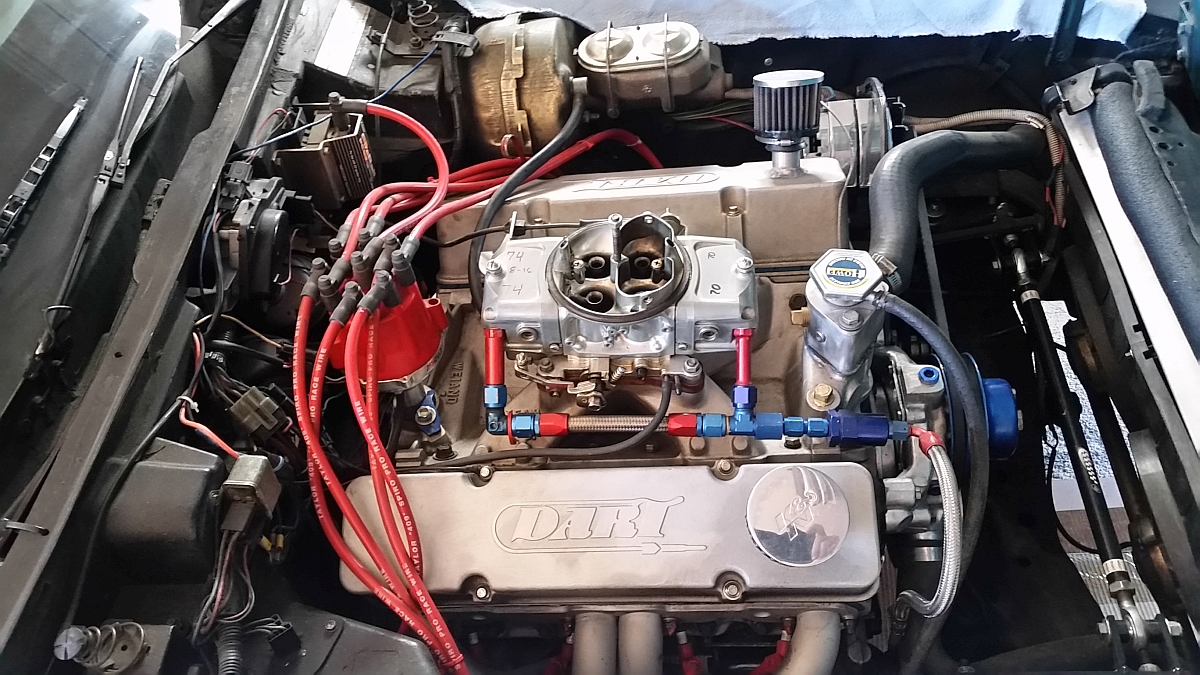
This is my modification,...boxing around the original flat baffle that is underneath. There is NO DIRECT path for oil spraying from the rockers to the inlet of the PCV valve. Air has to travel around the edges......but aerodynamics are funny......as Wagner video shows.....a small path can increase the flow?? This modification was in place when I installed the fuel filter.....so it did NOT fix the problem. It was blowing oil before and after this modification.
This is on the passenger side....showing original flat baffle under the gromment. You can see there could be direct line here, ....but on this side air is coming in.
You can see here how much space above the rockers....this is taken through the passenger side grommet looking forward.
This is looking straight down, through carb butterflies at the floor of the intake manifold.....sure looks like oil to me.
All three valves I looked at were the same is this.....gooey oily mess. This is result of 2-1/2 quarts of oil over 1200 miles of driving.
Pretty clean intake track....but if you look at the floor area....you can see trace of oil residue. That is a rocker stud in the upper area......hole must be sealed to prevent oil from coming down.
Another valve......crusty....and you can see oil track on floor.
This one has the possibility of being an intake manifold gasket leak.....but also just likely the same oil coming in and just damming up on the gasket that protudes slightly. I have some real closeups of this....and I think its just more of the same, .....hopefully not an intake manifold gasket leak.
This one obviously shows the oil tracking past the intake valve and being sucked into the exhaust. Each piston I looked at was the same.
Looking back up at the cylinder head dome.......more soot and oil. The scratches are probalby the borescope probe as I maneuvered it back at itself.
Last edited by Shovels and Vettes; Jun 1, 2023 at 05:16 AM.
Designer Imagines A Corvette That Looks More Like a Corvette Than the Corvette
Slideshow: A Jaguar designer's personal project imagines what a modern front-engined Corvette might look like if Chevrolet revisited the golden age of the Stingray.