When you click on links to various merchants on this site and make a purchase, this can result in this site earning a commission. Affiliate programs and affiliations include, but are not limited to, the eBay Partner Network.
Hello everyone; I just had my 1981 Electronic Rochester Quadrajet carb rebuilt by a coworker of mine. I drove the car home (less than one mile) and decided to put the carb on last night. I slapped the carburetor on and turned the key; and my vehicle shot up to over 7000 RPM! I immediately shut the car off, took a look at the carb and it seemed ok but when I tried to get it to start back up again I couldn't; starting fluid wouldn't even get it started. There were no leftover parts from the rebuild and he used brand new gaskets, vacuum diaphragm, and idle stop solenoid. My best guesses are that the float level is incorrect; or that he never properly dialed it in with the idle/ fuel/ air mixture screws but that's just my guess. Any help would be greatly appreciated. If it matters; I do also have the original computer hooked up as well if its something electrical by chance.
From: At my Bar drinking and wrenching in Lafayette Colorado
Float level and idle mixture has no effect on excessive idle speed. You either have a throttle jammed open or you have not hooked up your PCV and power brake lines (large open vacuum leak). Did your buddy have the dwell meter and other equipment needed to set up the ECM carb...? He obviously didn't test it, so I would seriously question his capabilities...
Float level and idle mixture has no effect on excessive idle speed. You either have a throttle jammed open or you have not hooked up your PCV and power brake lines (large open vacuum leak). Did your buddy have the dwell meter and other equipment needed to set up the ECM carb...? He obviously didn't test it, so I would seriously question his capabilities...
Lars
No he just disassembled and reassembled here at my job, no meters or anything. I was fairly certain I hooked up all the proper lines last night so it is possible I may have missed one. It ran rough before so I decided to just have him rebuild it. When I put it on last night I did not see or notice any jamming of the throttle plates, everything moved freely upon first inspection. I can post some pictures later today on how I currently have it hooked up.
Did your motor really go over 7,000 rpm?
If it did, you might as well set the carb to the side and start looking at what you all broke.
I can't picture a stock '81 motor surviving a 7,000+ rpm shot without damaging something.
Did your motor really go over 7,000 rpm?
If it did, you might as well set the carb to the side and start looking at what you all broke.
I can't picture a stock '81 motor surviving a 7,000+ rpm shot without damaging something.
I severely doubt I blew anything, however to be safe I will probably slap the old carb back on and see how it runs since it ran ok. But to be safe I will take pictures and take a closer look at the new rebuild.
here is exactly how I had it hooked up. I slapped the ‘80 back on and it’s running fine. I hooked up my ‘80 the same way as this one. (Minus the electronic connections since it’s not electric.)
From: At my Bar drinking and wrenching in Lafayette Colorado
The carb pictured above is a hacked, commercially-rebuilt carb that has a ton of problems. There are also several assembly errors visible. You got yourself a real can of worms there...
Since it started once, it should start again. I wouldn't use starting fluid. Use carb cleaner. If it doesn't start with carb cleaner, check to see if you have spark first. If not, check to see if the distributor is even turning while cranking. When using the carb cleaner, just spray one shot into each of the front carb openings. If you do have spark, pull the plugs to see if they're fouled.
here is exactly how I had it hooked up. I slapped the ‘80 back on and it’s running fine. I hooked up my ‘80 the same way as this one. (Minus the electronic connections since it’s not electric.)
Phew!
Ok, so your 7k + rev must have been a faulty tach reading. There was just a thread on here the other day about someone having wonky tach readings.
I stand behind that it would be unlikely for a stock motor to go 7K + without damage.
Anyway, for the carb issue, I recommend hitting the easy button -- by that I mean do whatever Lars tells you. It will be the quickest way to success.
Looking at those pictures shows the throttle is being held open a great distance partially from the closed choke but possibly the throttle is jammed or held open by something else. Hold the choke open, open and close the throttle while keeping the choke open. Does the throttle stop touch the idle adjustment screw?
This is the original carb that came with the car and its had its fair share of issues that's why I ended up putting the 80' version on there (as recommended by another forum user.) With as much time and a fair amount of money that's been put into this one I might as well just ditch it and sell it; and cut my losses. As of now the '80 version is working just fine again (as I found a major vacuum leak) so its the one currently being used. I was using that carb as a learning experience and its just turned out to be a mess and a nuisance.
Looking at those pictures shows the throttle is being held open a great distance partially from the closed choke but possibly the throttle is jammed or held open by something else. Hold the choke open, open and close the throttle while keeping the choke open. Does the throttle stop touch the idle adjustment screw?
I haven't checked that yet; its currently sitting in the garage while I figure out what I want to do with it.
You can see that the throttle lever is no where near the idle set screw. I would disconnect all of that linkage to see if the throttle level lands on the idle speed set screw. It just might be your linkage improperly installed.
Here is what I see...
Cap the open nipple, that is a major vacuum leak.
Remove the rod for testing from the Cruise Control Servo stud. If that is NOT adjusted correctly it can hold your throttle plate open.
The return springs should connect lower on the throttle arm (a hole with a nylon bushing) and run back to a hole in the accelerator cable support bracket.




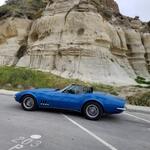

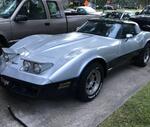


 1981 Corvette Caburetor Issue