When you click on links to various merchants on this site and make a purchase, this can result in this site earning a commission. Affiliate programs and affiliations include, but are not limited to, the eBay Partner Network.
Help finding SEALS compatible with DOT 5 BRAKE FLUID please!
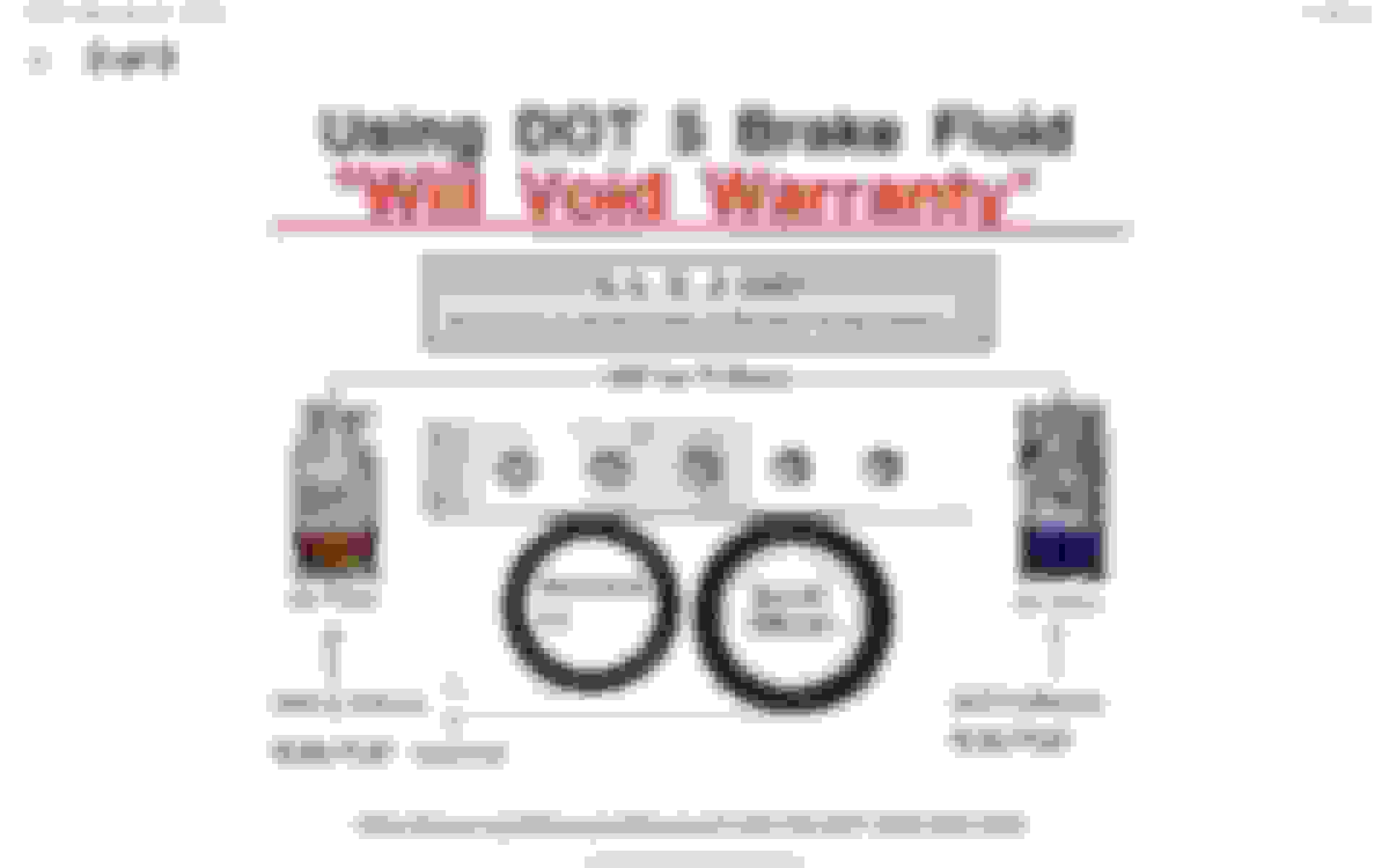
Hi all! I'm using Dot 5 silicone fluid for many years, and being aware of the endless discussions about them, I want to stay with it. I now need to change the master cylinder seal set but the part that came in was the below warning label on it. I have been trying to find a source selling brake seals that are compatible with Dot 5 but have gotten nowhere!
Can someone please help?
Thanks ahead,
Aris
I also run DOT 5 and have for many, many years.
I find it extremely interesting that in every other car, truck or motorcycle such warnings are NEVER seen.
I even ran DOT 5 in a DeLorean hydraulic clutch, no issues.
The HORRIBLE O ring convertion kit I bought for my caliper came with the same warning. The O rings looked like **** warmed over. But they say they are fine and used by everyone.
(everyone in the Corvette industry).
(Not by me).
just go to a bearing and seal shop for decent quality O rings that are impervious to all kinds of chemicals
As per the master cylinder. Get a rebuild kit from a brake and clutch shop.
Skip the Corvette vendors with there special "High temp" rubber components that can't tolerate something as none volitale as DOT 5.
Bottom line is we need to stand up to this bull. How can they sell a approved brake fluid but the seal manufacturers can't formulate a rubber that works with it.
This is total nonsense and we need to tell these people this is just NOT GOOD ENOUGH!
Lonestar is a nonstarter in this case - they have the yellow stickers on everything too.
GRL88, If you're worried about the seals in the kit you received, measure the diameters of the seals and just soak the parts in DOT 5 for a week or 3 to see if the rubber is reacting to the fluid. I tested Raybestos caliper seals last year and had no issues at all after a month or two -- even heated the fluid & seals in an oven for a bit. If you need to find other seals, the Raybestos Element3 line is made with EPDM chemistry (which is not affected by DOT 5) and is what I used.
Lonestar is a nonstarter in this case - they have the yellow stickers on everything too.
GRL88, If you're worried about the seals in the kit you received, measure the diameters of the seals and just soak the parts in DOT 5 for a week or 3 to see if the rubber is reacting to the fluid. I tested Raybestos caliper seals last year and had no issues at all after a month or two -- even heated the fluid & seals in an oven for a bit. If you need to find other seals, the Raybestos Element3 line is made with EPDM chemistry (which is not affected by DOT 5) and is what I used.
Then Raybestos will be the solution for me, I don't mind waiting for the proper EPDM's they have, Thanks! I know Raybestos from way back but nowhere can I find them online or a retailer that sells them. I found https://www.brakepartsinc.com/ however 'where to buy' I need a US zip code, my European code is no good. Can you please point me in the right direction? Thanks Ahead, Aris
.
Technically they should be compatible. It's just a bummer that companies won't change.
Brake fluid is lubricant for the rubber components in your master cylinder, wheel cylinders, calipers and hoses. Additionally, brake fluid has corrosion inhibitors that keep the bores of hydraulic cylinders from rusting and pitting.
DOT 3 brake fluid has a dry boiling point of 284 degrees, which is fine for brake systems with large brake drums and thick disc brake rotors, where brake heat can be easily dispersed. It has a viscosity of roughly 1500 at -40 F.
Dot 4 just as dot 3 is poly-glycol base. DOT 4 absorbs less moisture than the DOT 3 and has a boiling point of 311 degrees F., and it is rated at a viscosity of 1800 at -40 F.
The absorption of water promotes dispersal throughout the braking system and prevents “pooling” of the absorbed water in low-lying areas of the brake system where corrosive acids can form and make the components deteriorate at a faster however.
DOT 5 is silicone-based, it has a dry boiling point of 356 degrees. Newer brake rotors tend to be smaller and thinner, which means they disperse heat a lot less efficiently. One thing too is DOT 5 does not absorb any moisture, but it resist rust better and last longer than the other formulations.
If I were to switch to dot 5 I'd change all the rubber components in the brake system and flush all the steel lines and brake hoses.
Perhaps the seals in that kit are the problem. Maybe they are not formulated properly (cheaper to do) and aren't capable of doing the job well. Maybe the warning sticker is just to divert your attention from that vendor's own problems.
I just switched to DOT 3 or 4.......its not loss, no big deal. I am not fighting it or pushing back. The fluids have worked since the beginning of hydraulic brakes......maintain the car as suggested, use the old fluid....no big deal. Some battles worth fighting....this is not one of them.
Then Raybestos will be the solution for me, I don't mind waiting for the proper EPDM's they have, Thanks! I know Raybestos from way back but nowhere can I find them online or a retailer that sells them. I found https://www.brakepartsinc.com/ however 'where to buy' I need a US zip code, my European code is no good. Can you please point me in the right direction? Thanks Ahead, Aris
.
Nothing like recommending something that appears to be unavailable...
The power master kit, I believe, is: Part Number: MK501;
The non-power master kit, I believe, is: Part Number: MK472
You may be able to find it on eBay or the like, but I didn't do any searching. The most important thing is to find out if whatever you are considering is made from EPDM rubber. As an aside, EPDM for brake applications goes back at least 50-60 years, it's nothing new.
I found out that Summit Racing lists the Raybestos Master kit MK501, but as mentioned, it is out of stock and strangely Raybestos's own listing of it, has a picture of a single action master pump which is not our C3's case! here it is https://www.brakepartsinc.com/raybes...rt-search.html
I've sent a mail question to Raybestos asking if they carry EPDM rubbers, but I will not hear from them till after Easter.
If I get nowhere, I might just use the kit that came in with the warning, after cleaning the seals very well in alcohol. I will take my chances of swelling but I know that this might happen after many, many years. I prefer doing this than bleeding the other Dot fluids every 2-3 years and wondering how rusted the metals will become. With Dot 5, master cylinders and the wheel cylinders on older classics are shinning like mirror, better than new, no matter how many years have passed!
I have a 1968 C3 427 Convertible that I have owned for over thirty years. I tried the DOT 5 Silicone fluid in my system after a installation of all new brake caliper seals and flushing it out twice. I never had any leaks during the 1000 miles or so that I used the DOT 5 fluid. The one thing I did not personally like was the way the pedal feel changed with the DOT 5 fluid being Cold versus the pedal action after the brake fluid was Hot. To be fair about testing the new fluid change I used the same Brake Pads and rotors from before the rebuild. The idea was to see if there was any difference in the braking ability after swapping out the fluids to a Silicone brake fluid so I kept the rotors and pad locations matched to the original wheel. When I tested the brake fluids it was leaving everything else alone but the fluids. I didn't want to have new rotors or pads affecting the "feel" of the pedal while trying the DOT 5 versus the DOT 4.
The inconsistency of the pedal feel was moderately significant and you had to push harder on my (Power Brake) system when the car and brake fluid were cold. When the brake fluid was cold it took slightly more pedal pressure to get the same action with the old DOT 4. I tried to get used to it but the feeling was just too different and there was no significant improvement in Brake Action using the Silicone Fluids. With my MOTUL fluid I can still Lock up the rear wheels or even all four wheels if I desired to do so. Had the Corvettes been my daily drivers I could have become used to it but I was driving a Cadillac STS and the difference was too much between cars.
So I drained the system back out and flushed it before reverting back to MOTUL RBF DOT 4 brake fluid and now the pedal feel is consistent whether the brakes and fluid are cold or hot. With the original style brake fluid the car stops very very well. I am planning on keeping the MOTUL DOT 4 for use in both my C3 and C4. I also flush the brakes every five years (or so) to keep it clean and free of water. As long as I flush the brake system my caliper bores and master cylinder look like new and there are no leaks of brake fluid anywhere on the Corvettes.
Finding a good "efficient" way of flushing the brake fluid is probably the most important part of doing proper brake fluid maintenance. There are many ways to flush the brake fluid out of the car, I use a Phoenix Reverse Bleeding System and have the equipment to make it a breeze. This system I have does my motorcycle, boat and even my old Cessna 172 with great ease and little mess.
I have run dot5 in several Harley's, some that came with it, and a few newer ones that I switched over. Never felt any noticeable difference in lever/pedal feel hot or cold.
I have run Dot5 in my Corvette for about 30 years. And in a few other sports cars over the years. When I converted my Corvette I never noticed any change. I have never felt any difference in pedal feel hot or cold on any of my vehicles.
And, quite frankly, this is the first time I have ever heard or read such a complaint. Perhaps I am living under a rock or something.
Been working on Harley's professionally for about 50 years. We ran DOT5 standard from the early 70's until about 2005 give or take. Never once had a customer complaint that the brake feel was different when the bike heated up.
???
Check out what I found online below. The answer might well be that if heated to 248 degrees Fahrenheit (or 120 Celsius) for 70 hours they do swell, and it shows a BIG swell I admit. Now at normal engine operating temperature this will not happen to the master seals, neither will it happen in the wheel cylinder seals, unless one goes racing. However this could explain some problems I've had with the front brake cylinder of my '54 Mercury and the C3's master leaking into the booster, in both cases the Dot 5 was in there for more than 10 years and back then I never checked the quality of the rubber seals I was using.
And what about the US army that I have heard asked for the Dot 5 for the same apparent reasons we want it, no rust/pitting/leaking pistons? If they do use Dot 5, where do they get their seals from???????
So, what's the consensus here? Do we just run DOT5 anyway and tell em to get stuffed?
Or do we need to seek out special seals and Orings?
And I will repeat. On NO OTHER CAR have I seen these warnings against the brake fluid I prefer!
Therein lies a big part of my disbelief in the warnings. The link doesn't say anything about a change in chemistry or seals - as I recall, it just discusses controlled testing procedure for brake seals/fluids.
Originally Posted by 4-vettes
How often does one track there car for 70 hours???
and if the Orings in my caliper swell. Wouldn't they seal even tighter?
I don't think it's supposed to just be a swelling issue but a softening one too. I've not seen it in my cars using DOT 5 for 40 years. That's why I'm thinking if we want DOT 5 we need to use EPDM and not some newer elastomer (that's probably cheaper).
Originally Posted by 4-vettes
So, what's the consensus here? Do we just run DOT5 anyway and tell em to get stuffed?
Or do we need to seek out special seals and Orings?
And I will repeat. On NO OTHER CAR have I seen these warnings against the brake fluid I prefer!
Other than new cars with anti-lock braking systems where DOT 5 is specifically not recommended, you're right. You also don't see it on the Raybestos seal packages.








 Help finding SEALS compatible with DOT 5 BRAKE FLUID please!