When you click on links to various merchants on this site and make a purchase, this can result in this site earning a commission. Affiliate programs and affiliations include, but are not limited to, the eBay Partner Network.
On a points system, there are two feed lines to the +coil. One from the R terminal using normal wire (just for starting at full voltage), and one through the ballast resistor resistance wire.
If the resistance wire is disconnected, it will still read 12V with IGN ON, and the engine not running. It will only read 6V (or so) if the voltage divider circuit is complete.
Here's the suggestion I found on a Mustang Forum
Originally Posted by SomeMustangDiscussion
To check the resistor wire, disconnect the negative wire from the coil to the distributor, and replace it with a jumper to ground. Then check voltage at the coil positive terminal with the ignition on.
...
A reading of 5.5 volts is fine. Anything over 6.6 volts is bad.
Using Ohms Law, and two known and one guesstimate, although approximate values, you can estimate voltage at the coil.
My point is that even if you are seeing 12V (or 14.5, or whatever your alternator puts out), that might be okay. You need to test the resistance of the resistance wire another way.
Last edited by Bikespace; Jun 20, 2025 at 11:55 AM.
On a points system, there are two feed lines to the +coil. One from the R terminal using normal wire (just for starting at full voltage), and one through the ballast resistor.
If the resistor wire is disconnected, it will still read 12V with IGN ON, and the engine not running. It will only read 6V (or so) if the voltage divider circuit is complete.
Here's the suggestion I found on a Mustang Forum
My point is that even if you are seeing 12V (or 14.5, or whatever your alternator puts out), that might be okay. You need to test the ballast resistance another way.
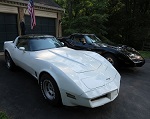
It’s my understanding that the LS 5 Vette doesn’t use a ballast resister just a resistance wire. This may just confuse people at this point, thinking they should be testing something that isn’t in their electrical system.
KC
It’s my understanding that the LS 5 Vette doesn’t use a ballast resister just a resistance wire. This may just confuse people at this point, thinking they should be testing something that isn’t in their electrical system.
KC
Oops. I was using ballast resistor and resistance wire interchangeably. I'll edit my previous post.
The high resistance wire, from the ignition switch, to the coil positive, creates an obstacle to the flow of electricity. Like a small orifice in a hose.
All the points do is ground the other end of the circuit, thru the metal housing, to engine.
When the points are open, there is no flow (amps) thru that wire, and you would measure 12-14V, 12V while on battery, 14V while the alternator/engine is on.
When the points close, they ground the coil neg, and electricity begins to flow thru the resistance wire and circuit. However due to the restriction (resistance), not much electricity can flow, So low amps flow, This means you would measure about half, or 6-7V downstream of the resistance, at the coil or points.
But this happens dozens of times a second, and you volt meter is not quick enough, so it averages the reading, and you should see around ~9V on the meter.
If you measure ~12V at the coil pos, with only this wire connected, like the OP said, someone has replaced the resistance wire with a regular wire. This is typically done for a Ignition upgrade to HEI or Petronix module, which require a full 12V source. There is no telling what someone has done over the last 50 years.
A full 12V will run a point system for a while, but then problems will develop. The double the designed voltage when the points are closed (12v vs 6V), causes double the amp flow (maybe 10A vs 5 A), and the points get too hot, and can not cool down fast enough, they overheat, metal melts, and the now oxidized surface has higher resistance and the car runs like crap.
Point systems require special coils, ~<=1 ohm IIRC. The offer low resistance internally, but are designed for 6V and low amp flow. When these coils are subjected to a full 12V supply, they flow twice as many amps, and then they quickly overheat, and burn out internally. The typical "symptom" on an over-heated coil is the car starts sputtering above 3000 rpm, just like the OPs does.
HEI and electronic modules like Pertronix, need different coils, with different/higher Ohm ratings, to slow down the electricity flow (amps) so they do not overheat.
Another issue is if you turn the key "on" and do not start the engine, and you are unlucky enough to have the points be closed at that particular moment, electricity will flow and both the coil and the points can overheat. They would never get any cooling if they are on constantly.,
For the OP:
Check for burned points. Use a fingernail file to sand them down smooth and shiney. Reset the gap to specs (matchbook cover - LOL) or dwell. Or replace them if suspect.
Check the coil for shorting out with that adjustable spark testor tool Increase the gap as large as possible, as the spark gets long, and if the engine starts to stutter well before 40K Volts, the coil is shorting out internally under high load, and needs to be replaced. Or just try a new coil back to back with the old one.
Replace the resistor wire before you put new parts in there.
The high resistance wire, from the ignition switch, to the coil positive, creates an obstacle to the flow of electricity. Like a small orifice in a hose.
All the points do is ground the other end of the circuit, thru the metal housing, to engine.
When the points are open, there is no flow (amps) thru that wire, and you would measure 12-14V, 12V while on battery, 14V while the alternator/engine is on.
When the points close, they ground the coil neg, and electricity begins to flow thru the resistance wire and circuit. However due to the restriction (resistance), not much electricity can flow, So low amps flow, This means you would measure about half, or 6-7V downstream of the resistance, at the coil or points.
But this happens dozens of times a second, and you volt meter is not quick enough, so it averages the reading, and you should see around ~9V on the meter.
If you measure ~12V at the coil pos, with only this wire connected, like the OP said, someone has replaced the resistance wire with a regular wire. This is typically done for a Ignition upgrade to HEI or Petronix module, which require a full 12V source. There is no telling what someone has done over the last 50 years.
A full 12V will run a point system for a while, but then problems will develop. The double the designed voltage when the points are closed (12v vs 6V), causes double the amp flow (maybe 10A vs 5 A), and the points get too hot, and can not cool down fast enough, they overheat, metal melts, and the now oxidized surface has higher resistance and the car runs like crap.
Point systems require special coils, ~<=1 ohm IIRC. The offer low resistance internally, but are designed for 6V and low amp flow. When these coils are subjected to a full 12V supply, they flow twice as many amps, and then they quickly overheat, and burn out internally. The typical "symptom" on an over-heated coil is the car starts sputtering above 3000 rpm, just like the OPs does.
HEI and electronic modules like Pertronix, need different coils, with different/higher Ohm ratings, to slow down the electricity flow (amps) so they do not overheat.
Another issue is if you turn the key "on" and do not start the engine, and you are unlucky enough to have the points be closed at that particular moment, electricity will flow and both the coil and the points can overheat. They would never get any cooling if they are on constantly.,
For the OP:
Check for burned points. Use a fingernail file to sand them down smooth and shiney. Reset the gap to specs (matchbook cover - LOL) or dwell. Or replace them if suspect.
Check the coil for shorting out with that adjustable spark testor tool Increase the gap as large as possible, as the spark gets long, and if the engine starts to stutter well before 40K Volts, the coil is shorting out internally under high load, and needs to be replaced. Or just try a new coil back to back with the old one.
Replace the resistor wire before you put new parts in there.
I checked the power wire as far as I could, it looks original and is marked resistance don’t cut on it.
I checked the purple at the starter with the ignition in the off position and it read 11.8 volts (should read 0).
I checked the wire (Purple) all the back to the steering column and it looked to be in very good condition with no chafing. I unhooked the neutral switch under the steering column and the purple wire measured 11.8 there also (should read 0).
The steering column was sent out to a reputable rebuilder about five years ago with very few miles driven since. Unless there is a relay in the purple wire circuit I am missing it sounds like the issue would almost have to be in the ignition switch?
KC
Would a wiring diagram help? As you stated, the purple wire should be hot on crank only (it activates the starter solenoid, sending power to the starter, and to the non-resistance wire to the coil).
Without arguing about how a voltage divider circuit works, and how it is much easier to measure the resistance wire resistance directly, or to ground the coil and measure the divided voltage, here's a video that helps explain it. The starting example is nearly exactly the same circuit as what's in a points ignition system.
Could be. The ignition wires thru the column have to get completely unpinned to restore the column. New aftermarket ignition switches are shaky reliability wise. The purple wire should only be hot in the start position. I would double check all that.
Most of them just provide power to various circuits.
But the Purple only goes to the starter start "S" solenoid. But goes thru the clutch safety switch first. Only hot when key is in Start position. When the key springs back to run mode, this switch should turn that off.
The pink goes to the fuse box, but when it pops out on the other side it is the resistance wire to the coil. Hot in run or start position.
I think red is the power in, to the switch, from the battery, via the underhood horn relay. Hot all the time.
Orange and brown supply power to things in run mode or accessory mode.
Last edited by leigh1322; Jun 20, 2025 at 11:46 PM.
Most of them just provide power to various circuits.
But the Purple only goes to the starter start "S" solenoid. But goes thru the clutch safety switch first. Only hot when key is in Start position. When the key springs back to run mode, this switch should turn that off.
The pink goes to the fuse box, but when it pops out on the other side it is the resistance wire to the coil. Hot in run or start position.
I think red is the power in, to the switch, from the battery, via the underhood horn relay. Hot all the time.
Orange and brown supply power to things in run mode or accessory mode.
Thanks to everyone for the help! I’m in a remote area so I’m on my own. The Vette only has about twenty five miles on it since light restoration and the steering column being sent out for “rebuild”. The engine ran very good on the dyno but was hit and miss in the car. It always started and idled good but had times that it didn’t accelerate. I had some test drives that the car made great power and ran flawless with great throttle response, etc.
I’m wondering if the purple wire could have pinned into the wrong slot? Are the pins different shape to not allow this?
Ill check this out and post the results. Am I the only one that gets into these bizarre mechanical issues?
KC
Last edited by grumman41; Jun 21, 2025 at 08:24 AM.
Nope.
Every single time I see a car with a non-stock aftermarket part, one single change leads to the next, which leads to the next.
It is kind of like dominos, you just hope the issues will eventually stop.
Lars calls this the 50% Hobby. Meaning only 50% of the parts available today actually work as intended.
You have to check every single thing.
You'll get there.
It is part of the charm of a classic car! LOL
1. I took my starter and solenoid to the local auto electric shop to have all functions verified. I’ve checked it previously but wanted a second look to make a solid elimination. I also recked the alternator to eliminate over voltage, it was about 13.8 at idle.
2. I ran a new wire from the (S) side of the solenoid to plus side of coil and gave the harness section to the starter an inspection and taped any suspect areas. The (S) wire now has correct voltage to the plus side of coil in the start position and none in the run. This now seems correct unless there is an intermittent issue (ggrrr!).
3. I’m now checking out my plus side coil resistance wire that runs from the fuse block. Since I’m getting battery voltage thru this I’m guessing that the resistance wire is failed? Leigh mentioned that the resistance wire is usually White with Black/Red stripes and can be checked for correct ohm by any purple wire under the dash? I hope I quoted him correct? I understand the resistance should be 2 ohms?
My resistance wire looks very original (tape intact) but is black with red and white resistance written on it. Just trying to make sure I’m right here.
Hope I got all of this correct, a few small errors can send everyone helping down a rabbit hole! Colors matter, I do think this is really narrowing down though.
KC
Last edited by grumman41; Jul 11, 2025 at 07:10 PM.
The resistance wire is there for the purpose of limiting the amount of current running thru the points and coil. If you didn't have that in the system, you would be burning points and frying coils on a regular basis. If you no longer have a points type ignition system on your engine, you don't need the resistance wire (unless the specific electronic system you have requires it to remain). Most modern electronic ignitions need a straight 12vdc power line.
I’ll check on the multi meter type, it’s just an inexpensive unit from Menards. So, there isn’t an easy way to check the resistance wire?
There is a super-easy way, barely an inconvenience. Put the resistance wire in series with the coil, to the + terminal on the coil. Apply voltage to the far end of the resistance wire. Ground the negative side of the coil (simulating "points closed").
Measure the voltage at the start (12V battery? Be sure to check!), and at the + coil. The two resistance will be a ratio of these voltages. Use the Resistive Divider equations below, or post your voltage here and we'll do the math for you.
There is a super-easy way, barely an inconvenience. Put the resistance wire in series with the coil, to the + terminal on the coil. Apply voltage to the far end of the resistance wire. Ground the negative side of the coil (simulating "points closed").
Measure the voltage at the start (12V battery? Be sure to check!), and at the + coil. The two resistance will be a ratio of these voltages. Use the Resistive Divider equations below, or post your voltage here and we'll do the math for you.
Measure the coil resistance also. And it's part number.
There are at least two types, with two different resistance levels.
One for points, one for no points.
It could have been easily replaced, over the years, with the wrong type.
There is a super-easy way, barely an inconvenience. Put the resistance wire in series with the coil, to the + terminal on the coil. Apply voltage to the far end of the resistance wire. Ground the negative side of the coil (simulating "points closed").
Measure the voltage at the start (12V battery? Be sure to check!), and at the + coil. The two resistance will be a ratio of these voltages. Use the Resistive Divider equations below, or post your voltage here and we'll do the math for you.
Bikespace, I get the jest of the test and flow but not sure what you mean by put the resistance wire in series with the coil? This is a finished car and not sure how to access the end of the resistance wire. I’m assuming it terminates somewhere around the fuse block? I’m not sure how I could apply voltage or do you just mean turn the ignition on?
KC