When you click on links to various merchants on this site and make a purchase, this can result in this site earning a commission. Affiliate programs and affiliations include, but are not limited to, the eBay Partner Network.
2020 Corvette of the Year Finalist (performance mods)
2019 C3 of Year Winner (performance mods)
2016 C3 of Year Finalist
Not with that cam....
Probably had 8:1 compression with 76cc heads...you are on the right track...you may get up to 9:1 with your set up so going with around .500 lift would be better. What is your driving goal...street light warrior, 1/4 mile track, just cruise nights?
Last edited by Rescue Rogers; Mar 11, 2024 at 08:28 PM.
If you’re not going to an actual dyno there’s a number of websites that allow you to put your engine specifications and it give you an approximation of horsepower and and what RPM you’ll achieve it.
You don’t specify your compression ratio, but since you said TH-350 I’m assuming you have an L-48. The factory 8.5:1 compression gets bumped up to around 9-9.5 with 64cc heads depending on the head gasket you use.
Assuming you have optimized the fuel and timing I would imagine that engine being in the ~350 gross horsepower range. Getting to your 385 horsepower goal you would probably need to ditch the L-48 dished pistons to raise the compression ratio.
If you still have the factory distributor weights use them instead of the ones that come with the spring kit. If you want to make the car faster without tearing into the engine again I would look at changing the rear end ratio to something like a 3.55 or 3.70
I take it you didn't like the answer I gave you yesterday so you will try again.
The answer is still no way.
Some of your listed options have absolutely nothing to do H.P estimates. The drivetrain & bottom end.
Lets take a look at past high horse Chevy engines. The Z28 302, 327, 350/350 horse, 427 & 454.
What did they all have in common? High compression. 10:1 10.5:1 11:1 12:1 and so on.
Even with the 64 chamber heads, your low compression pistons will almost nullify any new cam, carb, header additions.
If you are seeking some serious horse power and gobs of torque you have to get the compression up into upper 9s or more.
Your stock carb adds nothing. The Eddy 2101 maybe worth 10. IGN curve maybe another 15, headers add a lot.
But as stated earlier, the cam is not worth 125 over your base 170 horse engine.
Again, sorry.
To see how engine builders achieve 385 horse, go to BluePrint Engine site and click on anything around that figure. Look at the data sheet.
Have to agree. with L48 pistons your kidding yourself to think you will make that power. I'm right in there with a bit more Cam and 10.4-1 compression. So, no, I don't run dished pistons.
Sure why not ?? Comp Cams gets 350 horse with a 9.5 to 1 , World SR (stock replacement) cylinder heads with a XE262 , 2101 intake , Holley 750 , so why would the aluminum 180cc heads not add 30 horse over Comps combo with SR heads ?
Yeah yeah that's better .... And cheaper!!!! I vote nos.
If we're playing that game, a junkyard LS swap could be done for cheaper than that list of parts. Then you'll have an unknown LS engine instead of a tired L48.
If we're playing that game, a junkyard LS swap could be done for cheaper than that list of parts. Then you'll have an unknown LS engine instead of a tired L48.
I like the way a High compression engine can make power. When I rebuilt my 427 I simply rebuilt it to be a copy of an L88 engine and I have more power than I know what to do with.
There are so many ways to be able to run a High compression engine safely today even with our crappy gasoline. Look at today's "High Performance" motorcycles and their compression ratios, I saw one in the mid 13-1 range being used as a daily driver.
Higher Compression makes more power without any extra help!
A higher stall converter will make it “feel” like it has more power. Better launches and it drives more in the power band
sure does , I took out the stock 1650 rpm stall converter out of my 1980 L82 (T350C lockup torque converter transmission) to a 1984 Monte Carlo T350C torque converter rated at 2050 rpm with the 305 Monte Carlo engine which actually stalls to 2300 rpm with my 350 and the car with 3.08 gear went from a dead stop full throttle tire squall to down right smoking the tires off the rim !! Added about a 125 pounds more torque than at 1650 rpm from the original converter
If the timing is set correct and the carb is jetted properly it will make exactly that power (385hp)......put a 1.6 rocker arm on it.
If you want more compression...the Trick Flow DH175 head comes in at 60cc......
The 5736 Mahle head gasket will give oyu a little more squeeze over a Fel Pro.....
I have built Targetmaster 350's with those pistons that make more power than that.......all that quench horseshit is means about squat until you have compression that is on the edge (10.5 to 1 or more)....
If you really want that setup to work......have someone disassemble and blend the CNC marks in the bowls and entrances of those IK heads.....there is a lot of low lift flow to be had there.....
I ran the basic components through an engine simulation program on a SBC 350 block. I used advertised head flow data by Brodix as well as the advertised cam specs at 8.5 compression ratio. Also note that these results would represent the BEST case scenario without any accessories attached to the engine and assuming the engine is brand new.
As you can see, the BEST case scenario would be 350 HP @ 5500 RPM, and 371 ft-lbs @ 3500 RPM. Generally speaking, once all the accessories, other inefficiencies, are baked in there is usually a 5%-10% drop measured at the crank. I would anticipate probably around 300 HP and moderately greater than 300 ft-lbs in the real world. However, this give you an idea what the combination might do together.
This assumes the VE is at a **** 89%.......and just about anything with a modern head on it has more than 90%.......this is why I never use simulators.
Designer Imagines A Corvette That Looks More Like a Corvette Than the Corvette
Slideshow: A Jaguar designer's personal project imagines what a modern front-engined Corvette might look like if Chevrolet revisited the golden age of the Stingray.




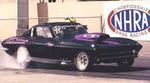


 hp guesstimation??