





Timing for a Noob.

Thread Starter
Intermediate


Joined: May 2024
Posts: 33
Likes: 6
From: Rochester, NY
 Timing for a Noob.
Hey folks, I know the subject has been done to death. I've done a lot of reading and I want to go over my understanding of the process. My brain works weird, and I want to be mostly sure I'm on the right track.
Background: The timing line on my balancer may not actually be real TDC, ie the mark is wrong on the harmonizer. I want to make sure it is, and then set my timing in a "proper way". I just moved the line to the 0 point line. I have no idea if the line on the balancer is correct. I popped open the distributor and the rotor is around the 5 mark, which to my understanding may be wrong, unless the harmonizer is set to another spot. Running a timing light on it last night at idle, it was way above the 0 line, like if it were PTDC but 30 above.
My end goal is to set TDC to the proper spot, and then set my timing from there, so the reference going forward is solid and where it should be. Here is my understanding of the process.
1.) To set TDC, put something in Plug 1's place, rotate clockwise until the piston hits the rod, in my case I bought a threaded tool for this. Mark the position on the harmonizer, then back it out counter clockwise, when it hits, mark it again. At this point TDC should be at the halfway point between the two. Mark that. Take the thing out, rotate it so meets 0 on the timing marker bolted above it.
2.) Check the position of the rotor in the distributor. Ideally this would be pointed at the 1 spot. If not, unscrew the screw below the distributor, lift it out a little ways, rotate the rotor forward, drop it back in, and keep doing that till I hit 1. I'm under the assumption I have to do it bit by bit to make sure the distributor sits correctly. I could use some clarity on here.
Secure the distributor to where you can rotate it, but not where it is so loose it can spin freely.
Put plug back in and reconnect anything.
At this point I should be at TDC and ready to adjust timing.
3.) Unplug and plug the vacuum advance port on the carb. Fire up the engine, let it warm up. First, adjust to BTDC, which for my engine according to the service manual is at 6. I imagine I'd set my Timing Light to 6, and then back the distributor Counter Clockwise till it hits 0 again, making the initial timing 6 degrees BTDC.
4.) From there, have a buddy rev the engine up to 2500-3000, while I keep an eye on the timing position. If it's stabilized, assume that the centrifugal advance is stable and things are likely OK. In the book advanced timing at 16 degrees at 2400 RPM, which would give me a total advance timing of 22. 6 BTDC + 16 Advance. So I should set the Timing Light to 22 and if at 2400 RPM it lines up with 0, theoretically, that's the proper timing. I see the number 36 thrown out a lot. I could use some clarity on that, but the manual says 16 @ 2400, 22 @4200. I imagine if it sounds "off", adjusting that further out may be warranted. (L48 Auto if that matters).
Pending a test drive and real world circumstances, I should be good. Theoretically at least.
And I know, done to death, I just don't wanna f' anything up. Have mercy.
Do I understand the process correctly?
Background: The timing line on my balancer may not actually be real TDC, ie the mark is wrong on the harmonizer. I want to make sure it is, and then set my timing in a "proper way". I just moved the line to the 0 point line. I have no idea if the line on the balancer is correct. I popped open the distributor and the rotor is around the 5 mark, which to my understanding may be wrong, unless the harmonizer is set to another spot. Running a timing light on it last night at idle, it was way above the 0 line, like if it were PTDC but 30 above.
My end goal is to set TDC to the proper spot, and then set my timing from there, so the reference going forward is solid and where it should be. Here is my understanding of the process.
1.) To set TDC, put something in Plug 1's place, rotate clockwise until the piston hits the rod, in my case I bought a threaded tool for this. Mark the position on the harmonizer, then back it out counter clockwise, when it hits, mark it again. At this point TDC should be at the halfway point between the two. Mark that. Take the thing out, rotate it so meets 0 on the timing marker bolted above it.
2.) Check the position of the rotor in the distributor. Ideally this would be pointed at the 1 spot. If not, unscrew the screw below the distributor, lift it out a little ways, rotate the rotor forward, drop it back in, and keep doing that till I hit 1. I'm under the assumption I have to do it bit by bit to make sure the distributor sits correctly. I could use some clarity on here.
Secure the distributor to where you can rotate it, but not where it is so loose it can spin freely.
Put plug back in and reconnect anything.
At this point I should be at TDC and ready to adjust timing.
3.) Unplug and plug the vacuum advance port on the carb. Fire up the engine, let it warm up. First, adjust to BTDC, which for my engine according to the service manual is at 6. I imagine I'd set my Timing Light to 6, and then back the distributor Counter Clockwise till it hits 0 again, making the initial timing 6 degrees BTDC.
4.) From there, have a buddy rev the engine up to 2500-3000, while I keep an eye on the timing position. If it's stabilized, assume that the centrifugal advance is stable and things are likely OK. In the book advanced timing at 16 degrees at 2400 RPM, which would give me a total advance timing of 22. 6 BTDC + 16 Advance. So I should set the Timing Light to 22 and if at 2400 RPM it lines up with 0, theoretically, that's the proper timing. I see the number 36 thrown out a lot. I could use some clarity on that, but the manual says 16 @ 2400, 22 @4200. I imagine if it sounds "off", adjusting that further out may be warranted. (L48 Auto if that matters).
Pending a test drive and real world circumstances, I should be good. Theoretically at least.
And I know, done to death, I just don't wanna f' anything up. Have mercy.
Do I understand the process correctly?

Melting Slicks


Joined: Apr 2021
Posts: 2,709
Likes: 2,155
From: Minnesota
It’s good that you’re checking top dead center on your harmonic balancer (not harmonizer, although that sounds nice.) If the mark you come up with doesn’t line up with the mark on the balancer I would look at replacing it sooner than later.
If your car is running in its current condition I would not remove the distributor. It spins at half of the speed of the crankshaft, meaning that if it’s pointed at the 5/6 terminals it’s halfway back to the #1 terminal.
The timing recommendations in your manual are for meeting emissions requirements, if you live in a state that doesn’t test for emissions you can throw those numbers out the window and use the 36 total. Of course with this timing spec, if you’re not already, you’ll want to run premium gas.
Most distributors in these cars have springs in the mechanical advance that don’t allow full advance until just about redline. If you don’t have lighter springs in the distributor already you won’t get your full advance at 2,800-3,000 RPM. You can get spring kits online for around $10. Get one of those and throw the weights that come in the kit in the trash. I’ve found that one medium and light spring works pretty well.
If your car is running in its current condition I would not remove the distributor. It spins at half of the speed of the crankshaft, meaning that if it’s pointed at the 5/6 terminals it’s halfway back to the #1 terminal.
The timing recommendations in your manual are for meeting emissions requirements, if you live in a state that doesn’t test for emissions you can throw those numbers out the window and use the 36 total. Of course with this timing spec, if you’re not already, you’ll want to run premium gas.
Most distributors in these cars have springs in the mechanical advance that don’t allow full advance until just about redline. If you don’t have lighter springs in the distributor already you won’t get your full advance at 2,800-3,000 RPM. You can get spring kits online for around $10. Get one of those and throw the weights that come in the kit in the trash. I’ve found that one medium and light spring works pretty well.

Burning Brakes


Joined: Dec 2017
Posts: 1,043
Likes: 414
2023 C3 of the Year Finalist - Modified
If you’re a fan of technology, check out progression distributors. Electronic distributor, with timing table created/edited from your cell phone. Very customizable, very cool.
Thread Starter
Intermediate
Joined: May 2024
Posts: 33
Likes: 6
From: Rochester, NY
It’s good that you’re checking top dead center on your harmonic balancer (not harmonizer, although that sounds nice.) If the mark you come up with doesn’t line up with the mark on the balancer I would look at replacing it sooner than later.
If your car is running in its current condition I would not remove the distributor. It spins at half of the speed of the crankshaft, meaning that if it’s pointed at the 5/6 terminals it’s halfway back to the #1 terminal.
The timing recommendations in your manual are for meeting emissions requirements, if you live in a state that doesn’t test for emissions you can throw those numbers out the window and use the 36 total. Of course with this timing spec, if you’re not already, you’ll want to run premium gas.
Most distributors in these cars have springs in the mechanical advance that don’t allow full advance until just about redline. If you don’t have lighter springs in the distributor already you won’t get your full advance at 2,800-3,000 RPM. You can get spring kits online for around $10. Get one of those and throw the weights that come in the kit in the trash. I’ve found that one medium and light spring works pretty well.
If your car is running in its current condition I would not remove the distributor. It spins at half of the speed of the crankshaft, meaning that if it’s pointed at the 5/6 terminals it’s halfway back to the #1 terminal.
The timing recommendations in your manual are for meeting emissions requirements, if you live in a state that doesn’t test for emissions you can throw those numbers out the window and use the 36 total. Of course with this timing spec, if you’re not already, you’ll want to run premium gas.
Most distributors in these cars have springs in the mechanical advance that don’t allow full advance until just about redline. If you don’t have lighter springs in the distributor already you won’t get your full advance at 2,800-3,000 RPM. You can get spring kits online for around $10. Get one of those and throw the weights that come in the kit in the trash. I’ve found that one medium and light spring works pretty well.
And yes, I disconnected the advance and plugged the port on the carb.
If things are working at least, should I not worry about it for the summer and maybe in the fall take her apart and replace stuff?
Last edited by djdresden; Jun 2, 2024 at 03:58 PM. Reason: Oops
Thread Starter
Intermediate
Joined: May 2024
Posts: 33
Likes: 6
From: Rochester, NY
Race Director


Joined: May 2006
Posts: 18,734
Likes: 2,582
Harmonizer. Musician brain.
That's what I'm wondering. Part of it is whoever worked on this car before half assed a lot of things. I found vacuum disconnected. Rotting fuel line used as vacuum lines. Half the stuff in the interior not working right. The choke not even connected. She runs, and she runs pretty good now (better than she did 2 months ago), I'm just kind of OCD about these things. If I can make it "correct" at least, I've righted a wrong someone else did. It just feels like someone threw stuff in there and didn't really take the time on it. There's a line painted on the balancer, and I know it should have a default line, I'm wondering if they just f'd up painting it on there. I probably should look closer at it and make sure. I might be worried about nothing. I'm ok with the idea of eventually replacing the balancer, and throwing in a new timing chain and gears, I feel like right now that might be over my head. This car has done a lot to build up my confidence in what I'm willing to take on, and I know I'll have to be at that point sometime.
And yes, I disconnected the advance and plugged the port on the carb.
If things are working at least, should I not worry about it for the summer and maybe in the fall take her apart and replace stuff?
That's what I'm wondering. Part of it is whoever worked on this car before half assed a lot of things. I found vacuum disconnected. Rotting fuel line used as vacuum lines. Half the stuff in the interior not working right. The choke not even connected. She runs, and she runs pretty good now (better than she did 2 months ago), I'm just kind of OCD about these things. If I can make it "correct" at least, I've righted a wrong someone else did. It just feels like someone threw stuff in there and didn't really take the time on it. There's a line painted on the balancer, and I know it should have a default line, I'm wondering if they just f'd up painting it on there. I probably should look closer at it and make sure. I might be worried about nothing. I'm ok with the idea of eventually replacing the balancer, and throwing in a new timing chain and gears, I feel like right now that might be over my head. This car has done a lot to build up my confidence in what I'm willing to take on, and I know I'll have to be at that point sometime.
And yes, I disconnected the advance and plugged the port on the carb.
If things are working at least, should I not worry about it for the summer and maybe in the fall take her apart and replace stuff?
Corvette Stories
The Best of Corvette for Corvette Enthusiasts

Top 10 Most Expensive Corvettes Ever Sold on Bring A Trailer
Brett Foote
10 Things Every Corvette Owner Needs (2026 Edition)
Michael S. Palmer
8 Most "Only Corvette Owners Understand" Quirks and Problems
Pouria Savadkouei
10 Reasons the C6 Z06 is Still A Performance Benchmark After 20 Years
Joe Kucinski
How Much Horsepower Every Corvette Engine "LOST" in 1972
Joe Kucinski
Top 10 DOs and DON'Ts for Protecting Your Convertible Top!
Michael S. Palmer
Top 10 Most Explosive Corvettes Ever Made: Power-to-Weight Ratio Ranked!
Joe Kucinski
150 hp to 1,250 hp: Every Corvette Generation Compared by the Specs That Matter
Joe Kucinski
8 Coolest Corvette Pace Cars (and Replicas) of All Time
Verdad Gallardo
Melting Slicks
Joined: Apr 2021
Posts: 2,709
Likes: 2,155
From: Minnesota
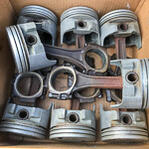
Checking your harmonic balancer should be the first step, check out this thread of one that went bad:
This is why the Forum always asks for photos and videos
This is why the Forum always asks for photos and videos
Thread Starter
Intermediate
Joined: May 2024
Posts: 33
Likes: 6
From: Rochester, NY
Checking your harmonic balancer should be the first step, check out this thread of one that went bad:
This is why the Forum always asks for photos and videos
This is why the Forum always asks for photos and videos
1967 Pedal Car Champion

Joined: Mar 2020
Posts: 9,135
Likes: 4,245
From: US-PNW
I just moved the line to the 0 point line. I have no idea if the line on the balancer is correct. I popped open the distributor and the rotor is around the 5 mark, which to my understanding may be wrong, unless the harmonizer is set to another spot. Running a timing light on it last night at idle, it was way above the 0 line, like if it were PTDC but 30 above.
1.) To set TDC, put something in Plug 1's place, rotate clockwise until the piston hits the rod, in my case I bought a threaded tool for this. Mark the position on the harmonizer, then back it out counter clockwise, when it hits, mark it again. At this point TDC should be at the halfway point between the two. Mark that. Take the thing out, rotate it so meets 0 on the timing marker bolted above it.
2.) Check the position of the rotor in the distributor. Ideally this would be pointed at the 1 spot. If not, unscrew the screw below the distributor, lift it out a little ways, rotate the rotor forward, drop it back in, and keep doing that till I hit 1. I'm under the assumption I have to do it bit by bit to make sure the distributor sits correctly. I could use some clarity on here.
2.) Check the position of the rotor in the distributor. Ideally this would be pointed at the 1 spot. If not, unscrew the screw below the distributor, lift it out a little ways, rotate the rotor forward, drop it back in, and keep doing that till I hit 1. I'm under the assumption I have to do it bit by bit to make sure the distributor sits correctly. I could use some clarity on here.
3.) Unplug and plug the vacuum advance port on the carb. Fire up the engine, let it warm up. First, adjust to BTDC, which for my engine according to the service manual is at 6. I imagine I'd set my Timing Light to 6, and then back the distributor Counter Clockwise till it hits 0 again, making the initial timing 6 degrees BTDC.
4.) From there, have a buddy rev the engine up to 2500-3000, while I keep an eye on the timing position. If it's stabilized, assume that the centrifugal advance is stable and things are likely OK. In the book advanced timing at 16 degrees at 2400 RPM, which would give me a total advance timing of 22. 6 BTDC + 16 Advance. So I should set the Timing Light to 22 and if at 2400 RPM it lines up with 0, theoretically, that's the proper timing. I see the number 36 thrown out a lot. I could use some clarity on that, but the manual says 16 @ 2400, 22 @4200. I imagine if it sounds "off", adjusting that further out may be warranted. (L48 Auto if that matters).
4.) From there, have a buddy rev the engine up to 2500-3000, while I keep an eye on the timing position. If it's stabilized, assume that the centrifugal advance is stable and things are likely OK. In the book advanced timing at 16 degrees at 2400 RPM, which would give me a total advance timing of 22. 6 BTDC + 16 Advance. So I should set the Timing Light to 22 and if at 2400 RPM it lines up with 0, theoretically, that's the proper timing. I see the number 36 thrown out a lot. I could use some clarity on that, but the manual says 16 @ 2400, 22 @4200. I imagine if it sounds "off", adjusting that further out may be warranted. (L48 Auto if that matters).
The "manual", if GM or following GM specs, is intended as a general, all climate, emissions-passing setting. It's not a performance tune that gets out of the engine all of its potential.


Race Director
Joined: May 2006
Posts: 18,734
Likes: 2,582

Burning Brakes
Joined: Dec 2017
Posts: 1,043
Likes: 414
2023 C3 of the Year Finalist - Modified
I do, and I’m a huge fan. Runs great and it’s very cool. and if you have any modifications on your motor, or are planning on it, it’s very helpful.
retards timing during starting, for easy starts. Very easy to wire in NOS timing, or just different tunes for different octane fuels.
if you have a big cam you can easily run lots of timing at idle, and easily still have perfect 36 degrees at whatever rpm you choose by just typing in numbers instead of guess and check with springs.
retards timing during starting, for easy starts. Very easy to wire in NOS timing, or just different tunes for different octane fuels.
if you have a big cam you can easily run lots of timing at idle, and easily still have perfect 36 degrees at whatever rpm you choose by just typing in numbers instead of guess and check with springs.
Thread Starter
Intermediate
Joined: May 2024
Posts: 33
Likes: 6
From: Rochester, NY
But it runs, I don’t hear any knocking. I had issues last week at 2500 RPM of it hesitating. Replaced the distributor cap, coil, rotor, and icm, and that issue has been gone since, except for one minor incident where it hesitated for a second and picked back up. I’ve probably put 200ish miles on it.
could the timing chain slip and cause all that?
Race Director
Joined: May 2006
Posts: 18,734
Likes: 2,582
I have no idea. I’m not even sure if TDC is set properly, hence wanting to see if I could set it straight and go from there. When I had the line at 0 earlier today, it was pointing at 5, but I’m not sure if the line is even correct. The two possibilities I see are that previous owner really half assed something, or now that something might be terribly wrong. So I think when stuff cones in, I want to find what TDC actually is, and then see where the rotor points.
But it runs, I don’t hear any knocking. I had issues last week at 2500 RPM of it hesitating. Replaced the distributor cap, coil, rotor, and icm, and that issue has been gone since, except for one minor incident where it hesitated for a second and picked back up. I’ve probably put 200ish miles on it.
could the timing chain slip and cause all that?
But it runs, I don’t hear any knocking. I had issues last week at 2500 RPM of it hesitating. Replaced the distributor cap, coil, rotor, and icm, and that issue has been gone since, except for one minor incident where it hesitated for a second and picked back up. I’ve probably put 200ish miles on it.
could the timing chain slip and cause all that?
Thread Starter
Intermediate
Joined: May 2024
Posts: 33
Likes: 6
From: Rochester, NY
so it was in the 5-6 range when I was messing with it earlier and lined it up. It might be ok then? I’ll test for TDC this week. I got a better timing light coming too, One with a dial. I’m done with it for today, but I appreciate you sticking with me here.
1967 Pedal Car Champion
Joined: Mar 2020
Posts: 9,135
Likes: 4,245
From: US-PNW
As MelWff said, the crankshaft turns two revolutions for every single revolution of the distributor rotor. With the engraved balancer mark at -0- on the tab, the rotor electrode will be pointing at #1 tower or the #6 tower (opposite #1 on the cap). If either of these positions are observed, then I wouldn't worry about pulling and resetting the distributor, or worrying too much about incorrect balancer, tab, etc.
A slipped timing chain doesn't have phantom effects. Once it jumps, the symptoms don't go away until the timing gears/chain is reoriented.
In your first message you said:
it was way above the 0 line, like if it were PTDC but 30 above