


Timing for a Noob.


Thread Starter
Intermediate


Joined: May 2024
Posts: 33
Likes: 6
From: Rochester, NY

Are you talking about looking down from above the distributor like a clock with the "5-6 range"? It doesn't matter where it's pointed in relation to the engine. Where is the #1 spark plug wire connected to the cap in relation to the rotor electrode when the engraved balancer mark is at the -0- mark on the timing tab. Trace #1 wire to the cap, lift the cap just slightly off the distributor and make a Sharpie mark on the distributor housing where the center of the #1 tower is located. That's where the electrode should be pointing.
As MelWff said, the crankshaft turns two revolutions for every single revolution of the distributor rotor. With the engraved balancer mark at -0- on the tab, the rotor electrode will be pointing at #1 tower or the #6 tower (opposite #1 on the cap). If either of these positions are observed, then I wouldn't worry about pulling and resetting the distributor, or worrying too much about incorrect balancer, tab, etc.
A slipped timing chain doesn't have phantom effects. Once it jumps, the symptoms don't go away until the timing gears/chain is reoriented.
In your first message you said:
What is PTDC?
As MelWff said, the crankshaft turns two revolutions for every single revolution of the distributor rotor. With the engraved balancer mark at -0- on the tab, the rotor electrode will be pointing at #1 tower or the #6 tower (opposite #1 on the cap). If either of these positions are observed, then I wouldn't worry about pulling and resetting the distributor, or worrying too much about incorrect balancer, tab, etc.
A slipped timing chain doesn't have phantom effects. Once it jumps, the symptoms don't go away until the timing gears/chain is reoriented.
In your first message you said:
What is PTDC?
The new information for me was that the rotor does two cycles, which now makes sense.
This is why I liked working on 2 cylinders. I'm getting it though, slowly.

Team Owner


Joined: Jan 2007
Posts: 53,648
Likes: 878
From: Southern Cal Ca
St. Jude Donor '22
verifying crank mark is great.
once done, disconnect vac to dist.
run engine to @2900 rpm set timing to 35deg.
let idle, check timing.
you want more than @12 less than @ 15
leave timing alone adjust carb air screws and idle
use vac gauge when doing air screws. maximizes vac level.
only thing left, dist vacuum advance check and adjust.
@lars
has papers on all this
once done, disconnect vac to dist.
run engine to @2900 rpm set timing to 35deg.
let idle, check timing.
you want more than @12 less than @ 15
leave timing alone adjust carb air screws and idle
use vac gauge when doing air screws. maximizes vac level.
only thing left, dist vacuum advance check and adjust.
@lars
has papers on all this

Old Fart Pilot


Joined: Apr 2010
Posts: 1,888
Likes: 958
From: Spokane, WA
Please make sure you use the proper terminology... The rotor does not make 2 cycles... The engine's crankshaft makes 2 revolutions for each 360* rotation of the distributor's rotor.

Race Director

Joined: Nov 2006
Posts: 13,177
Likes: 7,780
From: Sunshine Coast, Queensland, Australia
2025 C3 of the Year Finalist - Modified
2024 C3 of the Year Finalist- Modified
2022 C3 of the Year Finalist - Modified
Cruise-In VIII Veteran
I've read through all of this. Yes the OP is really green when it comes to the theory of operation of a 4 stroke engine.
So, To our newbie. Consider that a spark occurs every other time the piston is at top dead center.
So, you lined up the timing mark and the rotor was pointing away from the number 1 cylinder tower. You had the number 1 cylinder on the waste stroke. Then you turn the crank exactly 1 complete revolution. The timing mark again is lined up with the pointer. And now the rotor is pointing at the number 1 cylinder plug wire terminal.
A 4 stroke engine is called that as it has 4 strokes to every 1 power stroke.
Your 2 stroke dirt bike has a power stroke everytime the piston hits the top.
Your Chevy V8 has a power stroke every other time the piston hits the top.
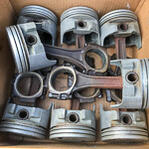
The 4 strokes are, 1, intake stroke, piston is heading downwards in the bore.the intake valve is open and the downward movement of the piston creates a vacuum sucking in your air/fuel mixture. 2. Compression stroke, the piston is now heading up the bore. Both valves are closed. The piston is now compressing the fuel mixture. 3. Power stoke. (And this is where your ignition timing comes in), at the top of the compression stroke a spark accures. Creating a explosion of the compressed fuel. Forcing the piston downward with the power of the explosion. This downward movement is called the power stroke.
4. Exhaust stroke, now the piston is heading back up again. The exhaust valve has opened and the upward movement of the piston is pushing the burnt fuel out the exhast valve. Now at the top again we start over.
so, .. Intake stroke.
Compression stroke.
. Power stroke.
Exhaust stroke.
Get it?
Suck, squish, bang, blow.
Now ignition timing is tricky. You just don't make it spark right at the very top. That's why we talk about timing advance. Imagine, inside the engine. When you light that spark. It takes a certain amount of time for the fuel mixture to completely burn. That amount of time can change with higher or lower compression in the cylinder, and even the grade of fuel. So, we want the spark to acure just before the piston gets to TDC so the fuel has time to burn and the ideal is to have the burn finish just at TDC.
So , setting ignition timing is a bit like shooting ducks. The faster the ducks are flying, the more you aim in front of them. And then of course there is windage. And what if the ducks are flying low, or way up high. We need to adjust our aim to compensate for these differences. Thus we have the added vacuum advance can that pulls in more timing under high vacuum running. Typically idle and light throttle cruise.
Go ahead and verify the timing mark is correct first.
It really is a good idea to contact Lars for his timing papers. I believe you will learn alot. The more you know. The more confident you will be working on your pride and joy.
So, To our newbie. Consider that a spark occurs every other time the piston is at top dead center.
So, you lined up the timing mark and the rotor was pointing away from the number 1 cylinder tower. You had the number 1 cylinder on the waste stroke. Then you turn the crank exactly 1 complete revolution. The timing mark again is lined up with the pointer. And now the rotor is pointing at the number 1 cylinder plug wire terminal.
A 4 stroke engine is called that as it has 4 strokes to every 1 power stroke.
Your 2 stroke dirt bike has a power stroke everytime the piston hits the top.
Your Chevy V8 has a power stroke every other time the piston hits the top.
The 4 strokes are, 1, intake stroke, piston is heading downwards in the bore.the intake valve is open and the downward movement of the piston creates a vacuum sucking in your air/fuel mixture. 2. Compression stroke, the piston is now heading up the bore. Both valves are closed. The piston is now compressing the fuel mixture. 3. Power stoke. (And this is where your ignition timing comes in), at the top of the compression stroke a spark accures. Creating a explosion of the compressed fuel. Forcing the piston downward with the power of the explosion. This downward movement is called the power stroke.
4. Exhaust stroke, now the piston is heading back up again. The exhaust valve has opened and the upward movement of the piston is pushing the burnt fuel out the exhast valve. Now at the top again we start over.
so, .. Intake stroke.
Compression stroke.
. Power stroke.
Exhaust stroke.
Get it?
Suck, squish, bang, blow.
Now ignition timing is tricky. You just don't make it spark right at the very top. That's why we talk about timing advance. Imagine, inside the engine. When you light that spark. It takes a certain amount of time for the fuel mixture to completely burn. That amount of time can change with higher or lower compression in the cylinder, and even the grade of fuel. So, we want the spark to acure just before the piston gets to TDC so the fuel has time to burn and the ideal is to have the burn finish just at TDC.
So , setting ignition timing is a bit like shooting ducks. The faster the ducks are flying, the more you aim in front of them. And then of course there is windage. And what if the ducks are flying low, or way up high. We need to adjust our aim to compensate for these differences. Thus we have the added vacuum advance can that pulls in more timing under high vacuum running. Typically idle and light throttle cruise.
Go ahead and verify the timing mark is correct first.
It really is a good idea to contact Lars for his timing papers. I believe you will learn alot. The more you know. The more confident you will be working on your pride and joy.
Old Pro Solo Guy


Joined: Dec 2017
Posts: 8,031
Likes: 4,385
From: Marlton NJ
Congrats to tackling this yourself and asking questions along the way.
You will learn a lot.
You said "it runs pretty good" so that means your timing is pretty close.
You could just check the balancer for TDC, and set it to factory specs, and be done.
Moving the distributor around in the block, a tooth at a time, is not necessary at all, if it already runs good.
But if you want to change the timing curve, and get better performance out of it, for like $18, that's also good. But will take a little time.
That is where you change the springs and settings inside the distributor, etc.
Start with the Lars Timing Papers.
The easy way to find set total advance is to pull one or both springs off the distrib, and it will reach max timing very quickly without having to rev it too much, with your face right there!
Set the max timing to 36. You may have to rev it a little until it STOPS climbing. Move the distrib a little, set it, Tighten it down, then recheck it. Done. DON'T change that again.
Then change the springs to one light and one medium, and see at what rpm you get 36 again. 2800-3500 is good.
Keep changing springs until you get the right rpm. DONE with springs.
Then check your idle timing and see what it is, and WRITE it down. Do not change it.
Report back here and we will tell you if it is acceptable or not. Anything in the 10-16* range at idle is probably good for an L48 auto.
If it is way off that, do not drive it that way. Fix it or put it back to stock.
Then add the vac can hose, Hook it up to manifold vac, (a port that gives high vac at idle).
Plug it in and read the idle timing again. If it goes up ANOTHER 10-12* , at idle, you are good to go.
If it goes up like 16-24* MORE, at idle, do not drive it that way, come back here and we will tell you how to restrict the vac advance.
You might be able to get those settings without changing any other parts except the springs. If so you are good to go.
If not, do not drive it that way. Put it back to factory springs & settings, or wait and report back here, and we can help.
That may mean you need another vac can, or a vac can restrictor, or even have to pull the distributor and modify the centrifiugal curve.
I would wait on all of that until you see what you get the first time.
You will learn a lot.
You said "it runs pretty good" so that means your timing is pretty close.
You could just check the balancer for TDC, and set it to factory specs, and be done.
Moving the distributor around in the block, a tooth at a time, is not necessary at all, if it already runs good.
But if you want to change the timing curve, and get better performance out of it, for like $18, that's also good. But will take a little time.
That is where you change the springs and settings inside the distributor, etc.
Start with the Lars Timing Papers.
The easy way to find set total advance is to pull one or both springs off the distrib, and it will reach max timing very quickly without having to rev it too much, with your face right there!
Set the max timing to 36. You may have to rev it a little until it STOPS climbing. Move the distrib a little, set it, Tighten it down, then recheck it. Done. DON'T change that again.
Then change the springs to one light and one medium, and see at what rpm you get 36 again. 2800-3500 is good.
Keep changing springs until you get the right rpm. DONE with springs.
Then check your idle timing and see what it is, and WRITE it down. Do not change it.
Report back here and we will tell you if it is acceptable or not. Anything in the 10-16* range at idle is probably good for an L48 auto.
If it is way off that, do not drive it that way. Fix it or put it back to stock.
Then add the vac can hose, Hook it up to manifold vac, (a port that gives high vac at idle).
Plug it in and read the idle timing again. If it goes up ANOTHER 10-12* , at idle, you are good to go.
If it goes up like 16-24* MORE, at idle, do not drive it that way, come back here and we will tell you how to restrict the vac advance.
You might be able to get those settings without changing any other parts except the springs. If so you are good to go.
If not, do not drive it that way. Put it back to factory springs & settings, or wait and report back here, and we can help.
That may mean you need another vac can, or a vac can restrictor, or even have to pull the distributor and modify the centrifiugal curve.
I would wait on all of that until you see what you get the first time.
Last edited by leigh1322; Jun 4, 2024 at 09:32 AM.










