When you click on links to various merchants on this site and make a purchase, this can result in this site earning a commission. Affiliate programs and affiliations include, but are not limited to, the eBay Partner Network.
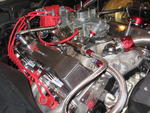
A PO installed these headers which run much closer to the fuel pump and lines than the stock rams horn headers. I believe that I experience slight symptoms of vapor lock; slight throttle bog when (and only when) engine is fully hot, and hard warm starts (cold and hot starts are immediate). I suspect that the headers may be heating the fuel too much. The factory routing of the steel line also contacts the heater hose and radiator hose, which can't help. Thats a piece of foam I wedged between the heater hose to keep it off. Thanks for any advice.
In the world of SBC, that header is a mile away from the fuel pump compared to some.
That is not an issue.
However,
I always questioned the concept of running the fuel line right up next to the cyl head. The head can't be more than 400 degrees, right?
If you are having percolation issues at the carb, the issue is likely the fuel bowl is too hot. Not the pump.
The solutions are:
An insulating spacer under the carb.
Blocking off the hot air crossover under the carb.
An Intake manifold that insulates under the carb.
<<<<<<<<< Maybe you can see my braided fuel line to the left. It's the smaller of the two.
Rerouted away from the head.
These Vettes have the small confines of a tight, hot engine bay. It always a challenge to keep the carb cool.
Vent out your vette from the top. This helps out pretty good and gives your vette a different look. There are 2 sizes, I went with the smaller one on my stock hood.
2025 c3 ('68-'73) of the Year Finalist - Unmodified
2025 C4 of the Year Finalist - Unmodified
2025 C8 Stingray of the Year Finalist - Unmodified
It is my belief that todays gasoline is formulated for closed, pressurized fuel injection engines- not old time carburetors.
I have chased heat related vapor lock/ fuel perculation issues in other vehicles and you may have to try a combination of above mentioned suggestions, especially in Texas. How hot is your engine running? If you have headers the hot air cross over under the carb may already be blocked. Some have installed a return line to the gas tank to keep fuel moving.
.
I have chased heat related vapor lock/ fuel perculation issues in other vehicles and you may have to try a combination of above mentioned suggestions, especially in Texas. How hot is your engine running? If you have headers the hot air cross over under the carb may already be blocked. Some have installed a return line to the gas tank to keep fuel moving.
Yes it gets HOT here in the Texas summer, and I think this issue is exasperated then too. DeWitts radiator and new thermostat and it never goes above 190 even on the hottest day. I was just planning on putting on new intake gaskets next weekend due to a small oil leak so I’ll be able to check if it’s blocked then. Maybe I’ll put the carb back on with a thicker insulating gasket. This is a 74 so chevy had already moved to factory installed return lines.
Coating headers decreases heat substantially. I don't have a heater or AC to reduce weight, but you can replace the carb line and run it anywhere you want. On tight engine race cars we install the thermal tubing covers on the full length of the fuel lines and electrical wires.
The big problem, as previously mentioned, is that the gas has changed dramatically in 50 years.
The old gas was designed with vapor pressure for 5 psi fuel systems and 200* temps.
The new fuel is designed for 200* temps also, but the vapor pressure of the fuel is dramatically different as it is designed with fuel injection in mind, it is designed to be kept under 40psi at 200*.
Drop the psi to 5 psi, or a slight vacuum as you have in mechanical fuel pump suction, and it boils at 200*
You may need to apply ever trick in the book to run this new fuel in a car designed for the old stuff.
Or maybe just one or two of them will be enough.
I would start with an insulator under the carb, curve the distributor, then hook up a return line, then insulate the fuel lines, coat the headers, add an electric fuel pump, etc.etc.
At some point the problem goes away.
2020 Corvette of the Year Finalist (performance mods)
2019 C3 of Year Winner (performance mods)
2016 C3 of Year Finalist
a fuel cooler will help alot. You can use a passive fluid cooler in front of the radiator or a cooler with a fan. Ambient air temp and colder fuel drastically improves power
Yeah the fuel is way different.
Here is the chart I found and marked up.
The circle in the center is the key.
Today's fuel has from 7-17psi vapor pressure when hot, at 80* C (176*F)
It must be under that much pressure, or more, to prevent it from starting to start to make a lot of vapor, not exactly boiling, but close.
This is actually not too much different than water, and if you get water up to that 176*F temp, it starts to make a lot of "fumes", and so does the gasoline. And water evaporates fairly quickly when it is that hot right? And these guys have measured fuel tank temps at up to 172*F. So they keep it under some pressure, in a sealed tank. You guys with vented tanks are going to smell gas fumes in the garage when it is warm out. Especially when you still have a tank full of winter blend, and it warms up suddenly.
But they are designing the fuel to make just the right amount of vapor, for an EFI system.
So a 30-60psi EFI system has basically no problem with it.
But dropping the pressure to atmospheric, or 6psi, causes issues. That's why being under only normal air pressure in the carb bowl is a problem, and it is even worse on the vacuum/suction side of the mechanical fuel pump. A lot more vapor is being made in the pump suction line, or evaporates quickly out the carb vent.
If you can get the Summer Blend fuel down to 50*C (122*F) that may be enough to alleviate most of your problems, but getting it below 40*C (104*F) would be even better.
I added the circles and arrows. The rest was from an oil company research paper. I needed to interpret kPA and *C to make sense of it.
Use a cheap IR temp gun and shoot your carb temp after a drive and see how hot it is!
Last edited by leigh1322; Sep 2, 2024 at 02:44 PM.




 I got my headers coated (outside and inside) 30 years ago. The radiated heat is amazingly reduced, and the pipes still look great after all this time.



 Headers close to fuel lines a problem?