When you click on links to various merchants on this site and make a purchase, this can result in this site earning a commission. Affiliate programs and affiliations include, but are not limited to, the eBay Partner Network.
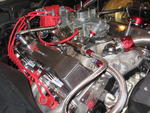
I recently installed side pipes, rebuild come of the power steering components, replaced my intake and cleaned up the engine quite a bit. I did not do any electrical work. When i tried to start the car, the starter was running slow and the battery (which is new) was heating up quickly. I replaced the starter with one from Rock Auto - an AC Delco unit and not the base model one. That one made a lot of noise when I tried it, sounding like serious metal and metal scraping. Upon a second attempt, the starter gear started spinning freewheel even with the key off. Had to disconnect the battery to get it to stop. Reconnecting the battery again triggered the gear spinning. I also tried a friends starter from his 409 and it made the same god-awful noise.
I ordered a replacement starter, but is there a spacer I am missing or something? The old one did not have spacers or washers on it and worked fine, until it died. The new one seemed to be the same size and shape as did the one from the 409...I was expecting a bolt on repair. They both were wrong somehow.
I only had one small wire on a side lug and two big wires on the main lug. I'll see if anyone else chimes in (hopefully) before I reinstall another starter, potentially with a spacer.
I think you are supposed to check clearances whenever it is replaced due to manufacturer tolerances. It sounds like your key switch may be staying engaged if it is wired correctly. The two big wires should be your fusible links, and the smaller wire engages the starter I believe. Maybe the smaller wire is touching the bigger wires causing it to engage also.
Was your battery or starter getting hot ?
But I would STILL check your Fusible links as they can burn open when there is a large short in the electrical system. One of mine was burnt when a Electric fan controller that simply shorted out (and let the smoke out) one day. They are the protection between the fuse box and a bad short. I was able to find the brand new Fusible Links at the NAPA here in Northern Virginia. You simply solder the new ones in place of the existing ones and then cover them with
The trouble with many starters is the size and then the shields and so on. My 427 has long tube headers on the 427 and the starter is not up close like the factory exhaust manifolds. I don't need any shielding on the starter as it is far away. I am using higher compression and needed help with cranking my 427 when it was hot. so I bought a Gear-Drive Starter from Summit and it fit perfectly. You need to check the teeth meshing so the starter is not to doesn't get jammed when in use. The gear-drive fit like a glove and needed no shims to work with my engine.
I am not sure what a 409 starter looks like. If it is a starter that works in a 409 Chevy engine then I have never seen one. I would have to see them side by side with a 1968 BB style starter used on C3's to be sure. Looking it up on a on-line catalog might help you determine if the 409 starters even work on the "newer" 1970's engines.
On my 1968 C3 they are located very near the starter motor. That doesn't mean you have them in the same place on your particular year Corvette. They were loose individual wires with heat shrink on them which made them easy to identify.
When I burnt one of the Fusible Links it was burnt open but the heat shrink kept it covered up. I used a multi meter to test continuity to verify that it had indeed opened up. It is also easy to follow the wires and verify that they are supplying voltage.
Guys, Took off the dust cover and checked the starter gap. It was wide open. I shimmed it over as far as I could and still have the flywheel miss the end bearing on the starter. Tried it and it threw sparks out of the end of the starter. There is also visible metal shavings indicating the gear is slipping on the flywheel. See photos. Not sure how this is supposed to work as it appears that over 50% of the flywheel teeth are not usable by the starter due to the presence of the stop bearing. Any ideas?
Update. That was the 409 starter I used in the pics, but the shavings were from the one I bought from Rockauto. I was just checking measurements to see if they were the same. Anyway, sent that back to RA and the sent another that worked well. Spacing was much better than the first one. Not sure how that works, but whatever.
I am still having issues with slow starter turning (acting like a low battery) and tonight tried it again. The new starter was struggling as before, but then started running full tilt. I turned the key off and it continued spinning full speed. Could my issue be the ignition switch? I had to cut power to get it to stop. Was turning strong when it was running on its own. Lucky the engine did not start.
The starter that was sent the second time around should have had a recommended gap specs between Bendix and flywheel.
Off-hand, I believe it was around 0.030.
Was that spacing verified?
With any flywheel cover removed, using a long screwdriver, you can force the bendix out and engage it into the flywheel teeth.
If the new starter did not come with a gap tool a heavy-duty paper clip will work. Those are around 0.030
When a bendix is denied to leave the flywheel it can keep the solenoid engaged with it. Then the solenoid just keeps on cranking until a battery cable is removed.
And I think that's what happen to you. The bendix gap is too tight.
Your slow crank issue is a 90% chance of bad battery cable connection, somewhere.
Last edited by HeadsU.P.; Nov 14, 2024 at 08:04 PM.
The whole idea of starter shims is to tweak the gap between bendix & flywheel. Some blocks are not machined perfectly.
Some starter mounts are not machined properly.
The better starters usually come with a couple shims.
The shim will either tilt the starter away from the block or towards the block, depending on where you install the shim.
If the teeth mating gap is too wide, eventually the bendix will destroy the tips of the flywheel.
If the gap is too tight, the flywheel will not allow the bendix to retreat (binding) when you let go of the IGN key.
Yes, I used the long bolts from the old starter and no shims at this time. To be clear, the starter continued to spin the engine when the key was in the off position, not just in the run position.
The gap is approx 0.04, my paperclip measured 0.04. If you think this might really be the issue, I can shim it off a little and see what happens. I can try one shim at a time. The shims I have are .018.
So added piece of data. I went ahead and added a shim just for fun and was going to try it to see what happened. As soon as i connected the power the starter started spinning. Did not throw the bendix into the flywheel, just spun in the released position. What do you think now?









 Starter and electrical