When you click on links to various merchants on this site and make a purchase, this can result in this site earning a commission. Affiliate programs and affiliations include, but are not limited to, the eBay Partner Network.
I learned a lot from this forum so I thought I would ask: I have a 79 that has been running rough. Feels like 1 or 2 cylinders are misfiring. Did the distributor and timing. #8 plug was fouled with oil. Compression 159-174 on all cylinders except for #6 at 136. A bit of blue smoke on start so I was thinking valve stem seals and #8 being the victim because of engine tilt, then maybe adjust preload on #6 and see. Removed the passenger rocker arm cover, which was a process (lucky all of you not in California, I had to remove a bunch of valves and hoses). There was a lot of crusty debris inside and indeed those were hardened-up pieces of valve stem seals and umbrella seals. Felt like little rocks as I dug them out from around the bolts, but with some shape to them (pieces of rings). I could only service both valves on #8 before my cheap screw-in spring compressor got too bent out of shape... just ordered a proform 66784... All seals (o-rings, umbrellas) were torn up on #8, I am guessing it will be the same on the other cylinders.
Now while doing this I also noticed that I have basically zero lash and no preload on all passenger valves. The pushrods did not move up and down by hand, but they were easy to spin. Before I give them 3/4 or a full turn, I wanted to ask here:
PO told me this is a rebuilt LT1. He put LT1 decals on the hood and a 330HP plate near the handbrake (I bought it in 1993, so too late now to ask him). It does not look like it to me but there are no numbers on the block. As I understand, solid lifters would have near zero lash. So I busted out the borescope and took a pic, see below. The clip at the top of the lifter would only be present on a hydraulic lifter, is that correct? I tried to push the rockers down by hand, but I could not move them at all. I think that might still be the case if they are hydraulic but full of oil?
Is it safe to give them 3/4 or 1 turn of preload even if those are solids? I don't want to end up bending anything. It is surprising that all 8 valves on that side would have no preload. Last time I had a tune-up was at a corvette shop (many years ago). First time opening the valve covers so very new to this and I don't want to mess it up.
I've held off on replying because I've never had a solid-lifter engine. Maybe my reply will to-the-top your message for those who may have missed it.
I looked at a number of solid lifters on Summit and GM originals on eBay and none appear to have the spring clip – they all have a snap-ring. If it's hydraulic, spinning the pushrods is still quite possible. Only the up/down is what you want removed to be at zero lash, then 1/2 turn additional. If it doesn't clatter, then the lifters are likely adjusted just fine, solid or hydraulic.
Out of curiosity, can you provide the block stamps on the front pad and the casting number and date from the top of the rear trans flange? This may give info as to whether this was a true LT-1 or a non-specific 350 built to LT-1 compression but hydraulic cam. Have you threaded your bore scope through a spark plug hole to see the piston top and how domed it is? (LT-1 was listed at 11:1 CR, so a dome should be pretty prominent.)
This is supposed to be an original LT-1 piston (forged TRW), listed on eBay:
Those are indeed hydraulic lifters.
Absolutely NO! It is NOT OK to crank down the adjustment on them! Under no circumstances would I ever turn them down that far even if I backed them off and reset them properly!
yes they should spin, that is normal. If you wish to reset them, back them off until you do get up and down motion in the pushrods. Then bring them up to zero shake, zero lash, then 1/2 turn down from zero lash. Then wait 5 minutes. You will find they spin again!
By the way. Solid lifters do NOT get zero lash. Something around 0.017 - 0.019 gap allows for heat expansion.
Good stem seals should be around $25 a set. Best ones should have a squeeze ring built into the unit like Viton. Not some cheap black rubber crap.
And skip the "O" rings. More junk to break off and plug your oil pickup screen.
Some people think they need to run two stem seals: Umbrella and an "O" Ring.
The valve-stem must be allowed to have "some" lubrication. Running dry wears out guides, stems and causes excess heat.
Your number 8 sparkplug fouled with oil? That is usually the cylinder that receives blowby from a PCV valve or similar setup.
And MercProf,
If you have an abundance of broken stem seals topside, you should seriously consider dropping the pan.
I bet a chilidog, fries and shake, there are more "bits" down there too. Not good.
Last edited by HeadsU.P.; Feb 9, 2025 at 10:56 AM.
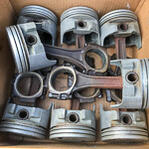
Thanks for the comments, yes it's pretty clear now that they are hydraulic. I could not see a stamp on the block (but may be under the smog pump). The pistons also look standard and not LT1, pic attached below. Now I did replace all the umbrellas. I decided to still put the o-rings on top since they were originally in my setup, albeit all hard and falling apart. I found a variety of things in there, some valves had no umbrella left at all, some intake valves had the style with two metal rings (still completely hardened, and broke to the touch), some had basic felpro rubber-only umbrellas (and those were actually still flexible for some). Anyway, my small cloud or smoke on startup is completely gone! And plug #8 (for which I had replaced the seals previously then drove some) is not oil-fouled anymore. So success on that front.
Now, I am hearing some clacking. I did as outlined by @4-vettes: completely back out (to replace the seals), then adjust to zero lash (several times, spinning the engine randomly about 10 times and each time checking all pushrods and re-tightening as needed), then once all were confirmed zero-lash, 1/2 turn down. Put all the smog stuff and valve covers on so I could do a real start and it clacks quite a bit. Clacking quiets down a bit while warming up but not completely. So maybe I need the full 1 turn recommended by the shop manual, at least on some valves (will listen with a piece of pipe or such). I may try the "adjust while running" technique but it's a bit tough to get the engine started when you first had to get the smog pump, EGR valve, hoses going to the canister, etc out of the way just to open the valve covers.
Definitely will drop the oil pan, great idea @HeadsU.P. Thanks again to all of you!
Spinning the crankshaft over and randomly grabbing a pushrod, snugging a rocker is NOT how to set valvelash.
I suggest watching a YouTube video of the specific way to do this before your valves start striking the pistons. Or burning valves because they are not closing.
Even the most basic method of valve adjustment requires you to set set a specific group of 8 valves at #1 TDC and another group at #6 TDC. What you did randomly turning over the engine is totally wrong.
Even the most basic method of valve adjustment requires you to set set a specific group of 8 valves at #1 TDC and another group at #6 TDC. What you did randomly turning over the engine is totally wrong.
I just found this procedure written in “ Corvette 1966-1982 Shop Manual”. I’ve used this procedure since the ‘70’s. It’s close enough for hydraulic lifters to start Chevy V-8 engines before the LS. The next book procedure for solid lifters is TDC 1, two cylinders, then 1/2 turn the crank and two more, etc.
On Number One Firing Position: Exhaust - 1-3-4-8. Intake - 1-2-5-7
On Number Six Firing Position: Exhaust - 2-5-6-7. Intake - 3-4-6-8
I just found this procedure written in “ Corvette 1966-1982 Shop Manual”. I’ve used this procedure since the ‘70’s. It’s close enough for hydraulic lifters to start Chevy V-8 engines before the LS. The next book procedure for solid lifters is TDC 1, two cylinders, then 1/2 turn the crank and two more, etc.
On Number One Firing Position: Exhaust - 1-3-4-8. Intake - 1-2-5-7
On Number Six Firing Position: Exhaust - 2-5-6-7. Intake - 3-4-6-8
Steve O.
Yes, that's it. Also on certain engines LT1, 30/30 on C2, there is a paper written by John Hinkley and Duke Williams indicating that at TDC the cam lifter is still on the ramp and even with the 90 degree method the valves to be adjusted are not the ones you assume. For example at #1 TDC you adjust 8E and 2I not 1E and 1I.
Thanks much, it's all good now. One of them was still loose, so I tightened it up. I was going by this method, which I wonder what you all may think about:
the random part is not which pushrod you adjust, but by which amount you spin the engine. After each spin by a random angle, you check all the pushrods and only tighten the ones that are still loose (because they previously were on top of the cam). The difficulties I was having before I tried this method were 1) getting to TDC on #1 using the starter motor (after many tries I could never get anywhere close), and then 2) with all plugs out I was able to manually crank with a wrench but only by a small amount as I would hit the fan, fan shroud, or other. So I could get to #1 firing TDC but I was not confident about being able to get exactly to #6 firing position from there.
Lots of comments on that video and all the ones I read were positive... In my day job, Monte Carlo (aka random) methods also often converge faster and more robustly than deterministic algorithms (for example, when training neural networks, finding the maximum of a function, etc), so I found this video appealing for that reason too. The translation here is that if you make one mistake with a conventional method (e.g., you are off on your #6 TDC), then half of your valves may end up mis-adjusted, while with enough random spins you should be able to avoid that (with 10 spins I initially got all but one ok, then after a few more spins I could find and fix that last one).
In any case, thank you again for all the advice, the engine is running well now and no smoke after changing all the umbrellas!
As long as the lifter you want to adjust is somewhere on the base circle of the cam (anywhere but on the profile of its lobe), you can set the pre-load.
I loved the original 1970 LT1 engines after a buddy purchased a nice 1970 convertible with the 370 hp small block. It was a "pristine" example of a LT1 Corvette. We worked on it, checked it out had some fun with that Corvette. That engine ran very nicely even if the owner was a bit timid with the throttle. I remember beating on that engine and that engine came out smiling and still making power. That engine is a "stout Small block" and it took a bit of revving but once it took off it was all business. After the owner saw what it could do he turned into a "Madman" and from then on he used the LT1 a bit more harshly and the car was happy...
The compression they used on the 1970 was 11.1, it was one of the last muscle car engines. That car my friend had, needed help with the gasoline's (lack of octane) or the timing had to be pulled back a couple degrees. That engine "rattled" (detonated) away under loads so we tried everything to clean out any carbon or hot spots. In the end it was more the timing or better than 93 octane fuel.
Setting valves with solid lifters is not a big deal for some of us who spent time setting the valves on our VW's or the Japanese motorcycle with all their cylinders. I did it for a long time on air cooled engines, give me Factory gap spec, a set of feeler gauges (the right size) and some time and I would do it. Nothing to be afraid of.
Last edited by ctmccloskey; Feb 23, 2025 at 01:31 PM.
Setting solid lifters is no big deal, once you've done it a few times.
The 9.1 compression LT-1 engines were about 6 percent down on power, the camshaft was good at higher RPM's. When the L-82 came out we put a new timing chain in them advanced 4 degrees and LT-1 INTAKE A 3310 HOLLEY AND an actual exhaust and a recurved distributor and set up like that on the street it would run better than the LT-1. On a 1/4 mile track it was anyone's bet because the LT-1 had to make it all up at the end. Mostly the better driver would win. But then I put a racer brown ssh-24 cam in mine and my old pace car was a clear winner.
I have that cam in my 79 set up like that plus a set of 64cc aluminum beads with headers and she runs just fine.
The pistons you showed are flatop 4 eyebrow pistons, that will give 10:1 CR if used with 64 cc heads. They are definately not stock for 79, those were noticeably dished. With much lower compression.
They could be forged pistons, or hypereutectic, or cast. LT-1s were forged. Cast is much more typical. If you still have your stock heads, they are likely 79cc, and your compression is likely around 9:1.
Since you have a borescope another thing you could do is shove it thru the oil plug hole, and see if you have a 4 bolt main caps or not.
Even more important if you intend to drive it or rev it hard is does it have a forged crankshaft? Steel forged cranks come with and need 8" front balancers.
And thru the oil plug hole you should be able to see the casting or forging seams on the crank throws. Narrow and jagged if it is a cast one. Wider, like 1/4" or more, and look like they were ground down with a grinder, if it is forged steel.
A decent hydraulic cam, like an L82 grind, will likely give you somewhere in the neighborhood of 12-13" of vacuum at idle.
If you have all that, you have very strong internals!
And should have a strong running SBC.
If you have the cast crank bottom end, just keep it under 6000 rpm, since you did not build it, and you should be fine.
Thanks much for the insights, very helpful in trying to figure out what that engine indeed is! Yes let me run the borescope on my next oil change. The reason I ended up buying this corvette was because it had a lot more kick than the others I had tried at the time. But it also has a very high diff ratio, so some of that comes from the diff.







 79 rough running and zero lash/preload