When you click on links to various merchants on this site and make a purchase, this can result in this site earning a commission. Affiliate programs and affiliations include, but are not limited to, the eBay Partner Network.
Posting in here a lot this week, trying to keep all my issues in separate threads. Thanks to everyone in advance for helping this noob C3 owner.
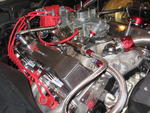
So took the car for a drive, about 45 minutes, the gauges read a steady 220 for the majority of the drive, last 10 minutes it was creeping above 220 maybe into the 230-240 range, the car has an aluminum radiator, but before I start investigating clogs, hoses water pump etc. I just wanted to know if this looked correct, I'm assuming this is a cooling overflow tank but I was just confused as the hose was connected to the top of the tank, didn't seem to practical to me or maybe I'm just unaware how this style of tank works. Once again thanks to everyone on this forum for helping me get this thing dialed in! Trying to fix the small things one at a time.
That looks to me to be a old "catch-can" from the 70's. Appears to have a drain in the bottom to remove any gunk.
What it does is collect any coolant overflow instead of letting it run on the ground.
What it does not do is, allow the radiator to recover that extra coolant (syphon) and refill during cool-down.
There is likely an air-gap it the top of the tank. That gap will keep a syphon from taking place.
Other model yrs had a hose deep into the plastic recovery tank, designed to syphon coolant back into the Rad.
Last edited by HeadsU.P.; May 18, 2025 at 04:56 PM.
If your gauge is correct. That sounds pretty warm for a gen1 SBC to run at. I would be chewing my finger nails off looking for a place to shut it down.
that catch can certainly doesn't look correct for a later C3. Sometimes it is nice to know what we are working on here.
If your gauge is correct. That sounds pretty warm for a gen1 SBC to run at. I would be chewing my finger nails off looking for a place to shut it down.
that catch can certainly doesn't look correct for a later C3. Sometimes it is nice to know what we are working on here.
Any recommendations on where I should start for fixing this potential temp issue, should I remove that silver can and put In an actual overflow tank?
That is not factory. Please let us know your cars year and what engine/transmission it came with originally. You should never drive with temps over 220. I'd be shitting bricks if my temp got that high. You need to make sure all the seals around the radiator are in place. Fan shroud is a must for these cars. Also check for the chin spoiler under the front valence. If it's missing then air has a hard time being directed up into the holes on the bottom of the valence and through the radiator.
That is not factory. Please let us know your cars year and what engine/transmission it came with originally. You should never drive with temps over 220. I'd be shitting bricks if my temp got that high. You need to make sure all the seals around the radiator are in place. Fan shroud is a must for these cars. Also check for the chin spoiler under the front valence. If it's missing then air has a hard time being directed up into the holes on the bottom of the valence and through the radiator.
so its a 79 with an L82 vin but doesnt have an L82 currently, it has a 350 in it with a TDR code code and the original 4-speed and the temps were well below 220 until I got about 15 minutes out, stopped once they hit 220, let it cool, and just rinsed and repeated stopping and driving again until I got home, the temps on the gauge hit above that 220 when i was about 2-3 minutes away from home. I got an IR thermometer yesterday to read temps and today while letting it idle for about 15 minutes the thermostat housing was about 25-30 degrees cooler than the upper radiator hose.
No electric fans and I let it idle today for about 15-20 minutes and the thermostat housing temp during at the end of those 15 minutes read 110F and the Upper radiator hose in a section near the thermostat housing read 135-140.
You need a shroud. Not only for more efficient cooling but for the sake of keeping fingers on hands.
Our Vettes are low profile. Barely have what is called a grill and the radiator is almost laying down, 45* angle.
These cars need every trick in the book to keep the small confines of the engine bay cooler.
They are bottom feeders and 90% of the cooling air must be forced up from the ground.
Air dam, clutch fan, spring in lower rad hose, foam rubber surrounding the Rad, a good W.P. and good fan belts, more IGN timing should put you under 200 degrees.
Get cheap remote temp gun at harbor freight (or generic equivalent). Then get some real readings.
I'd replace that "thing" with a regular overflow tank that is vented to atmosphere.....they're cheap and you can see the level in them.
What pressure is that cap? Take it off and see if there is a spring underneath..... are you sure it is not just a "sealing" cap? Take a picture of it.
It does have a spring under the cap and I just ordered an electric fan for the radiator and the correct overflow tank. Hopefully this can help solve the overheating issue. Thank you all!
this is a 79 L82 cooling system (with alum rad)..
as mentioned.. a few things to check.. take more pics of fan area AND under front of car spoiler if any..
you should buy yourself an assembly manual AND factory service manual.
check inside radiator as well for plugged tubes..
you should also have a front black spoiler or full optional front spoiler to direct air.
I would wait on adding electric fan until sorted. As mentioned, timing and 195f thermostat and timing was normal for these cars in 79 and ran hot..thus the back up electric fan from factory that comes on at 235f.. suggest a 180f thermostat as well.
You need a full shroud behind the radiator with properly sized and fitted fan in the opening. You also need a front air dam under the nose to direct airflow up and into the radiator. Without those two things, you will always run hot.
Another common issue with these cars is there could be a pocket of air trapped in the cooling system.
There are numerous threads and posts about how to burp the air out of the cooling system.
Most people have successfully burped the system just by elevating the front of the car while filling the radiator, running the engine and refilling with the engine running after you see the thermostat open.
The way to bleed air from a cooling system is to fire the engine up without the radiator cap on. Once the thermostat opens, you will see steady flow in the radiator. When blubbling stops, you are good to go. Shut down engine and re-install radiator cap.
P.S. If you do not have a spill can or overflow reservoir, you need to leave an air chamber in the radiator (an inch or so down) so that there is room for the water to expand when heated. Otherwise, the pressure cap and 'dump' line will burp out [excess] fluid when you shut the engine down. And, if that occurs, DO NOT add more coolant to the radiator.







 Does this look right?? Cooling system question