




Engine block codes
1967 Pedal Car Champion

Joined: Mar 2020
Posts: 9,135
Likes: 4,245
From: US-PNW

#183 & #185 are in the C3 registry = bookends!
#185 shows its block stamps (for comparison) but the pic is too poor quality for use.
I question the apparent lack of broach marks with such clear character stamps.
#185 shows its block stamps (for comparison) but the pic is too poor quality for use.
I question the apparent lack of broach marks with such clear character stamps.
Race Director


Joined: May 2006
Posts: 18,731
Likes: 2,582

Thread Starter
Navigator

Joined: Aug 2025
Posts: 9
Likes: 0
Steve

Race Director

Joined: Oct 2000
Posts: 12,680
Likes: 3,133
From: Shamong, NJ
If the casting date is either G968 or G668 the casting date would be either July (G) 9th (9) 1968 (68) or July (G) 6th (6) 1968 (68). This casting date would indicate the block is a Tonawanda block, which if so means that it cannot be a Corvette engine. All Corvette small blocks came from Flint MI and to the best of my knowledge all Flint casting dates used a single digit for the year (8 = 68, 78, 88, etc). Tonanwanda used a two digit casting date (such as 68 for 1968, 78 for 1978, etc), but Tonawanda did not supply small block engines for Corvettes. The only engines Tonawanda supplied for Corvettes were big blocks.
It's not visible in the picture posted, but another clue to a Flint verse Tonawanda small block engine is the presences of the oil hole plug above the timing cover and to the right of the stamp pad. All Flint blocks had the tapped hole and square hole plug in the front of the block, while Tonawanda blocks did not have the hole or plug. If the engine in the car does not have the hole and plug, then it is for sure a Tonawanda block that has been restamped and is not original to the Corvette in question, or any Corvette.
Below is a picture of the plug to look for.

Thread Starter
Navigator
Joined: Aug 2025
Posts: 9
Likes: 0
The plug is there. This is not a restamped motor. The V on the pad is for Flint. With closer examination of the vin, it is clear there is original orange paint n the stamp. Also it is evident that the stamp a well worn. But still deep. The pad has just been cleaned making it look fresh to the naked eye. Thanks for your time and input. More to learn.
Corvette Stories
The Best of Corvette for Corvette Enthusiasts

Top 10 Most Expensive Corvettes Ever Sold on Bring A Trailer
Brett Foote
10 Things Every Corvette Owner Needs (2026 Edition)
Michael S. Palmer
8 Most "Only Corvette Owners Understand" Quirks and Problems
Pouria Savadkouei
10 Reasons the C6 Z06 is Still A Performance Benchmark After 20 Years
Joe Kucinski
How Much Horsepower Every Corvette Engine "LOST" in 1972
Joe Kucinski
Top 10 DOs and DON'Ts for Protecting Your Convertible Top!
Michael S. Palmer
Top 10 Most Explosive Corvettes Ever Made: Power-to-Weight Ratio Ranked!
Joe Kucinski
150 hp to 1,250 hp: Every Corvette Generation Compared by the Specs That Matter
Joe Kucinski
8 Coolest Corvette Pace Cars (and Replicas) of All Time
Verdad Gallardo


Thread Starter
Navigator
Joined: Aug 2025
Posts: 9
Likes: 0
I thought the same thing when I first got the car. If you blow the image up, you will see how it is not a new stamp. There are places deep in the vin what appears to be old orange paint imbedded. I think when the engine was rebuilt, that was buffed so as to read the engine code. If you google the engine code, it will show it was a FLINT motor.
1967 Pedal Car Champion
Joined: Mar 2020
Posts: 9,135
Likes: 4,245
From: US-PNW
The plug is there. This is not a restamped motor. The V on the pad is for Flint. With closer examination of the vin, it is clear there is original orange paint n the stamp. Also it is evident that the stamp a well worn. But still deep. The pad has just been cleaned making it look fresh to the naked eye. Thanks for your time and input. More to learn.
I thought the same thing when I first got the car. If you blow the image up, you will see how it is not a new stamp. There are places deep in the vin what appears to be old orange paint imbedded. I think when the engine was rebuilt, that was buffed so as to read the engine code. If you google the engine code, it will show it was a FLINT motor.
I still question the apparent lack of broach marks. Here are pics of my '67's & '72's pads where the marks are evident. Neither of these engines had ever been rebuilt (decks cleaned in any way).


Last edited by barkingrats; Aug 28, 2025 at 11:56 PM.
Race Director
Joined: Oct 2000
Posts: 12,680
Likes: 3,133
From: Shamong, NJ
In the engine assembly plant, these pads were masked so as not to be painted. Any presence of orange on the pad or in the characters is due to a repaint after the car was originally sold.
I still question the apparent lack of broach marks. Here are pics of my '67's & '72's pads where the marks are evident. Neither of these engines had ever been rebuilt (decks cleaned in any way).
I still question the apparent lack of broach marks. Here are pics of my '67's & '72's pads where the marks are evident. Neither of these engines had ever been rebuilt (decks cleaned in any way).
 Forgetting for a moment that the pads were taped at Flint, it's obvious the engine in the pics has been repainted which negates using paint in the stampings as proof the pad could be original.
As you said, the pad has no sign of any broach marks on it. Before commenting previously I blew up the picture to look for them and there doesn't appear to be any. Even when someone uses sandpaper or something else abrasive to clean a pad, there's usually still some broach marks left close to the head, but I couldn't see any, at least not in that particular photo. Seeing it in person, or a different picture might prove otherwise.
I wasn't going to comment any further in this post since the OP seems convinced that because they found orange paint in the stamping and it has a "V" for Flint, that it is original. Because you observations agree with my previous thoughts about the pad, I thought I would at least comeback to backup or agree with your post. It could very well be original, but the pad surface and just the general appearance of the stamping itself, leaves a lot of questions.
Thread Starter
Navigator
Joined: Aug 2025
Posts: 9
Likes: 0
I don’t see any either. However, the number on the left rear of the block, is identified as a 1968. As fas as the V, that series GOOGLED states it is a Flint engine, made in July is a 327/350. I am not really concerned about original design engine, just trying for clarification. I look at the picture in a prior post and not sure I see the broach marks, unless they are the very small lines top upper left. As always I appreciate input. Thanks.
1967 Pedal Car Champion
Joined: Mar 2020
Posts: 9,135
Likes: 4,245
From: US-PNW
I don’t see any either. However, the number on the left rear of the block, is identified as a 1968. As fas as the V, that series GOOGLED states it is a Flint engine, made in July is a 327/350. I am not really concerned about original design engine, just trying for clarification. I look at the picture in a prior post and not sure I see the broach marks, unless they are the very small lines top upper left. As always I appreciate input. Thanks.
Flint's code was F from '55-'66 and in 1967 changed to V. It's one way to distinguish the time period when just briefly looking at a block.

Safety Car


Joined: Dec 1999
Posts: 3,600
Likes: 837
From: PA
I’ve looked at enough 1968 - 1972 stamp pads over the years to say with some certainty that the only way to know positively if a pad is real is to see it in person, under magnification. As good as the current generation of cameras are, they can’t compete with what your eye actually sees. While you can still rule out a pad based upon items that you can see in a photo, there is nothing that I can see that would lead me to believe that this is anything but a factory stamp. However, I’d still want to see it in person to be absolutely sure.
Couple of points…
First, as far as broach marks go, GM ran these machines on what amounted to a continuous basis. As such, the tooling used to surface these blocks experienced wear; a block cut with new tooling is going to have a much different deck surface than one cut with tooling that has already done 5,000 blocks previously (or whenever the tooling change was made). Some broach marks are deep, some are almost invisible (which is why you need the magnification). The point is that broach marks won’t always look the same over a given range of blocks.
As far as the pad finish, yes, the pad was supposed to be protected (as was the timing tab and timing mark on the balancer). However, these surfaces weren’t always masked. More often than not, someone simply wiped them clean with a rag since it was less time consuming than masking these areas off. As a result, the pad wasn’t always completely free of paint and paint was also trapped in the stamped numbers. The presence of paint isn’t always an indication that the block has been repainted.
The block casting number of 3814678 is correct for a late build 1968 Corvette small block. The casting date (as noted previously) is G 6 68 or G 9 68; either July 6 or 9, 1968. The assembly code for your engine is V0712HT, a Flint assembled (V) engine built July 12 (0712) as an L-79 327/350 (HT). The casting date and assembly date are close, but that certainly happened with small block engines in this era. Everything fits as far as date sequencing.
I looked at the cars before and after this one… Fortunately for us, all three cars have L-79 engines. For #26183, there is no pad photo, but there is a protecto plate. Playing with the photo a bit, I can make out 0712HTR (I’m assuming the R indicates a Rochester carburetor). For #26185, the pad photo isn’t a good one, but you can still make out V0712HT. The fact that all three of these engines have the same assembly date going into consecutive cars is also a good sign.
Short of actually inspecting this car in person, I’m relatively confident that all is well with your pad/engine.
Regards,
Stan Falenski
Couple of points…
First, as far as broach marks go, GM ran these machines on what amounted to a continuous basis. As such, the tooling used to surface these blocks experienced wear; a block cut with new tooling is going to have a much different deck surface than one cut with tooling that has already done 5,000 blocks previously (or whenever the tooling change was made). Some broach marks are deep, some are almost invisible (which is why you need the magnification). The point is that broach marks won’t always look the same over a given range of blocks.
As far as the pad finish, yes, the pad was supposed to be protected (as was the timing tab and timing mark on the balancer). However, these surfaces weren’t always masked. More often than not, someone simply wiped them clean with a rag since it was less time consuming than masking these areas off. As a result, the pad wasn’t always completely free of paint and paint was also trapped in the stamped numbers. The presence of paint isn’t always an indication that the block has been repainted.
The block casting number of 3814678 is correct for a late build 1968 Corvette small block. The casting date (as noted previously) is G 6 68 or G 9 68; either July 6 or 9, 1968. The assembly code for your engine is V0712HT, a Flint assembled (V) engine built July 12 (0712) as an L-79 327/350 (HT). The casting date and assembly date are close, but that certainly happened with small block engines in this era. Everything fits as far as date sequencing.
I looked at the cars before and after this one… Fortunately for us, all three cars have L-79 engines. For #26183, there is no pad photo, but there is a protecto plate. Playing with the photo a bit, I can make out 0712HTR (I’m assuming the R indicates a Rochester carburetor). For #26185, the pad photo isn’t a good one, but you can still make out V0712HT. The fact that all three of these engines have the same assembly date going into consecutive cars is also a good sign.
Short of actually inspecting this car in person, I’m relatively confident that all is well with your pad/engine.
Regards,
Stan Falenski
Thread Starter
Navigator
Joined: Aug 2025
Posts: 9
Likes: 0
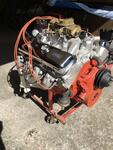
Thank you so much for your time and interpretation. I was also confident in my mind that it was all good. Al lot of people with much more experience than me, may have a variety of opinions in their own regards with their experiences. Yes, it does have the original Rochester Quadra Jet carb. The engine lbs rebuilt at some point thanks again.
Steve
Steve