



Orange Engine Paint?
Race Director


Joined: Mar 2003
Posts: 11,608
Likes: 780
From: Eustis ( Area 51 Bat Cave ) Fl

To me a real sin is a person who doesnt build their car they way they desire because they fear what someone will think or say because what they want isnt how the factory did it,
Advanced


Joined: Jul 2008
Posts: 66
Likes: 2
From: Suffield, CT
Small Block Intake color
can anyone tell me if the small block intakes were orange? I see many big blocks with silver intakes.
I'm not trying to build an NCRS car, it has far too many differences, but I like to stay in the spirit of originality.
Thanks in advance.
I'm not trying to build an NCRS car, it has far too many differences, but I like to stay in the spirit of originality.
Thanks in advance.
Last edited by Corbis; Oct 11, 2017 at 03:32 PM.

Pro

Joined: Sep 2017
Posts: 516
Likes: 72
From: Modesto California
PlastiCoat
I use PlastiCoat Chevrolet Orange because that's the brand my local auto parts store stocks. Like all the others it'll fade over time but it seems to adhere well when the surface is good and clean.

Instructor

Joined: May 2007
Posts: 221
Likes: 11
From: Methuen Ma
I've heard that story also.
Cruising
Joined: Apr 2016
Posts: 13
Likes: 0
Hi Renzo,
Probably the best source of accurate information about engine orange is found in the Engine Section of the Assembly Instruction Manual.
The reason for this is that the parts of the engine like the carburetor, starter, some pulleys, fuel pump, some brackets, etc, were added to complete the engine in St. Louis. These parts are therefore NOT engine orange.
So if you go through the engine section, and other relevant sections, you'll gain an understanding of what WAS painted in Tonawanda on big blocks like yours, and at Flint on small block engines.
Regards,
Alan
Quite a nice bb. (Please disregard the arrow)
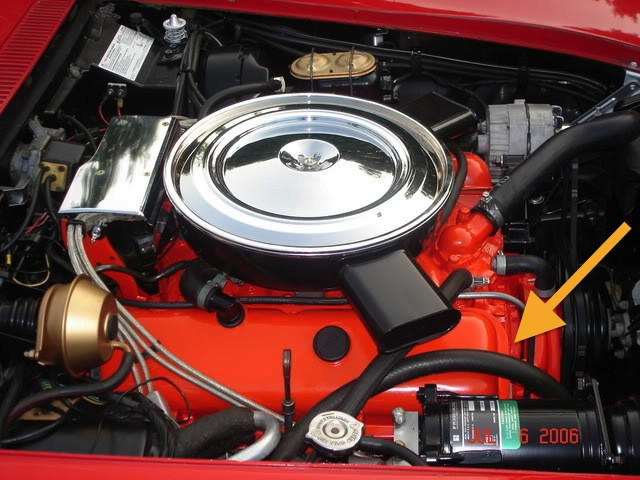
Probably the best source of accurate information about engine orange is found in the Engine Section of the Assembly Instruction Manual.
The reason for this is that the parts of the engine like the carburetor, starter, some pulleys, fuel pump, some brackets, etc, were added to complete the engine in St. Louis. These parts are therefore NOT engine orange.
So if you go through the engine section, and other relevant sections, you'll gain an understanding of what WAS painted in Tonawanda on big blocks like yours, and at Flint on small block engines.
Regards,
Alan
Quite a nice bb. (Please disregard the arrow)

Racer
Joined: Jul 2015
Posts: 396
Likes: 101
From: Lehigh Valley Pennsylvania
I used rattle can paint on my 69 back in 1985. Not sure of the brand but it did not last.
I painted my mopar with Hirsch’s and that lasted very well.
I went to redo my 69 with Hirsch’s but when I used it I didn’t like the color. It appeared to be too white.
I redid the 69 using VHT paint in rattle cans. I stripped the engine, washed it several times, and primered it with VHT primer before painting. I don’t remember if I put a satin clear on it too. The color was good, but the paint was attacked by antifreeze. I had a small leak at the heater hose in the intake from a loose clamp. The antifreeze partially filled the pocket in the intake manifold and stripped the paint off wherever it was in contact with the paint. The engine set for at least three weeks after painting but the VHT contact told me it didn’t dry long enough. They did refund my money though. About $20. Small consolation.
I also did the exhaust manifolds with VHT grey manifold paint. It is on about three years and I drove the car about 300 miles. The paint appears to be getting a brown tint.
I am redoing my 73 and am looking for show quality paint. I think I will use the paint that LARs is recommending.
I painted my mopar with Hirsch’s and that lasted very well.
I went to redo my 69 with Hirsch’s but when I used it I didn’t like the color. It appeared to be too white.
I redid the 69 using VHT paint in rattle cans. I stripped the engine, washed it several times, and primered it with VHT primer before painting. I don’t remember if I put a satin clear on it too. The color was good, but the paint was attacked by antifreeze. I had a small leak at the heater hose in the intake from a loose clamp. The antifreeze partially filled the pocket in the intake manifold and stripped the paint off wherever it was in contact with the paint. The engine set for at least three weeks after painting but the VHT contact told me it didn’t dry long enough. They did refund my money though. About $20. Small consolation.
I also did the exhaust manifolds with VHT grey manifold paint. It is on about three years and I drove the car about 300 miles. The paint appears to be getting a brown tint.
I am redoing my 73 and am looking for show quality paint. I think I will use the paint that LARs is recommending.

Tech Contributor


Joined: Aug 1999
Posts: 14,384
Likes: 6,408
From: At my Bar drinking and wrenching in Lafayette Colorado

Lars
Corvette Stories
The Best of Corvette for Corvette Enthusiasts

5 Best & 5 Worst Corvette Daily Drivers
Joe Kucinski
The Headlights of Every Corvette Generation Explained
Joe Kucinski
5 Best & 5 Most Overrated Corvette Track Packages of All Time!
Joe Kucinski
Every 2027 Corvette Engine Explained
Joe Kucinski
Designer Imagines A Corvette That Looks More Like a Corvette Than the Corvette
Verdad Gallardo
10 Ugly Corvettes That We Still Kinda Love
Joe Kucinski
Top 10 Most Expensive Corvettes Ever Sold on Bring A Trailer
Brett Foote
10 Things Every Corvette Owner Needs (2026 Edition)
Michael S. Palmer
