




Orange Engine Paint?

Thread Starter
Melting Slicks


Joined: Dec 2000
Posts: 3,407
Likes: 2
From: Carmichael CA
 Orange Engine Paint?
I'm pulling my engine this week. I want to paint it to look as original as possible. I'm thinking some rust-o-leum primer and orange colored paint. But, can it take the heat? I think I remember seeing some paint specifically for engines and other hot spots.
What have you used and how did it hold up?
Thanks
What have you used and how did it hold up?
Thanks

Racer


Joined: Oct 2000
Posts: 429
Likes: 0
From: Oak Harbor WA
Re: Orange Engine Paint? (Rockn-Roll)
I've had good luck with the 500 deg chevy orange engine enamel you can pick up at most auto parts store. However, along the exhaust crossover (just under the carb and choke) in the intake manifold, the temperatures from the heat riser's exhaust exceed 500 deg, and the paint peeled a little bit there. I touched up those two areas on the intake on either side of the carb with 1200 deg. orange paint. It's a little flatter in appearance than the chevy orange enamel, but holds on nicely under those high temps.

Senior Member since 1492


Joined: Aug 2000
Posts: 87,929
Likes: 156
From: Just because I'm paranoid doesn't mean people aren't out to get me...
St. Jude Donor '09
Re: Orange Engine Paint? (kenko74)
I used brush-on POR-15 Chevy Orange. Haven't tested it with the engine running yet but is seems very durable. I took a propane torch to it and it didn't flinch. Check out the specs at their site http://www.POR-15.com


Safety Car

Joined: Dec 1999
Posts: 4,148
Likes: 5
From: Roxbury NJ
Re: Orange Engine Paint? (1970 Stingray)
I used brush-on POR-15 Chevy Orange. Haven't tested it with the engine running yet but is seems very durable. I took a propane torch to it and it didn't flinch. Check out the specs at their site http://www.POR-15.com
Senior Member since 1492
Joined: Aug 2000
Posts: 87,929
Likes: 156
From: Just because I'm paranoid doesn't mean people aren't out to get me...
St. Jude Donor '09
Re: Orange Engine Paint? (Flareside)
You know what Joe? I painted over some 500deg spray paint. I didn't like the color or finish.
No, I didn't have any coverage problems Joe. I applied two coats just to be sure. Did you "stir" the pain and not "shake" like it states on the can? :D Nope, I didn't, I shook the can pretty good. It's pretty thick paint, much like the high gloss lead base paints of old.
No, I didn't have any coverage problems Joe. I applied two coats just to be sure. Did you "stir" the pain and not "shake" like it states on the can? :D Nope, I didn't, I shook the can pretty good. It's pretty thick paint, much like the high gloss lead base paints of old.

Race Director


Joined: Aug 1999
Posts: 11,121
Likes: 672
From: SE Pennsylvania
St. Jude Donor '03 thru '26
Oldtimer
Re: Orange Engine Paint? (Rockn-Roll)
If it were me, i'd clean the block, spray a coat of Hi-temp primer and then the dupi-color chevy hi-temp orange. I think on hot summer days when the engine is really hot the Rusto-leum will begin to cringle and crack. just my 0.02 ;)

Safety Car


Joined: Mar 2000
Posts: 3,544
Likes: 448
From: Central Pennsylvania
Re: Orange Engine Paint? (kenko74)
However, along the exhaust crossover (just under the carb and choke) in the intake manifold, the temperatures from the heat riser's exhaust exceed 500 deg, and the paint peeled a little bit there.

Instructor
Joined: May 2001
Posts: 185
Likes: 0
From: Washington, Pa. US
Re: Orange Engine Paint? (ettev)
I had the same problem with the por-15. After three coats I could see thru it. The 4th coat finally covered it. I have used por-15 and never had a problem with any of their other products, so I figured I just got a bad can of orange paint. Never did call the company , did you?
Corvette Stories
The Best of Corvette for Corvette Enthusiasts

Top 10 Most Expensive Corvettes Ever Sold on Bring A Trailer
Brett Foote
10 Things Every Corvette Owner Needs (2026 Edition)
Michael S. Palmer
8 Most "Only Corvette Owners Understand" Quirks and Problems
Pouria Savadkouei
10 Reasons the C6 Z06 is Still A Performance Benchmark After 20 Years
Joe Kucinski
How Much Horsepower Every Corvette Engine "LOST" in 1972
Joe Kucinski
Top 10 DOs and DON'Ts for Protecting Your Convertible Top!
Michael S. Palmer
Top 10 Most Explosive Corvettes Ever Made: Power-to-Weight Ratio Ranked!
Joe Kucinski
150 hp to 1,250 hp: Every Corvette Generation Compared by the Specs That Matter
Joe Kucinski
8 Coolest Corvette Pace Cars (and Replicas) of All Time
Verdad Gallardo
Safety Car

Joined: Jun 2000
Posts: 4,151
Likes: 98
From: Conroe TX
St. Jude Donor '11
Re: Orange Engine Paint? (ettev)
I am putting new heads on my 69 top flight car and have been researching the most correct engine paint on the NCRS website. I ordered my paint from QuantaProducts.com based on this search. I have not received or used the paint yet, but it is supposed to be the best match to original in color and gloss.
Pro

Joined: Sep 2002
Posts: 541
Likes: 5
From: Epping NH
Re: Orange Engine Paint? (Rockn-Roll)
I also used POR 15 on my 69 SB. Although it took 3 coats (brushed), it covered well.
I have experienced a couple of "issues" with the paint.
First, I used it to paint the harmonic balancer and although it was very dry when I started up the engine, the balancer spun off paint onto other freshly painted surfaces under and including the hood. Just spattered, but annoying never the less. Secondly, the paint actually browned/burned on the intake manifold where the exhaust gases/heat pass through the manifold. I am told that this is not unusual, so, I am living with it.
Mark
I have experienced a couple of "issues" with the paint.
First, I used it to paint the harmonic balancer and although it was very dry when I started up the engine, the balancer spun off paint onto other freshly painted surfaces under and including the hood. Just spattered, but annoying never the less. Secondly, the paint actually browned/burned on the intake manifold where the exhaust gases/heat pass through the manifold. I am told that this is not unusual, so, I am living with it.
Mark

Tech Contributor


Joined: Aug 1999
Posts: 14,380
Likes: 6,390
From: At my Bar drinking and wrenching in Lafayette Colorado
Re: Orange Engine Paint? (Rockn-Roll)
Don't use the spray can stuff like Rustoleum or VHT - the stuff is junk, and it does not hold up in the long run. It looks pretty when first sprayed, and it looks fine for the first few thousand miles. It's downhill from there.
My tech paper "Paint Formulas for Restorers" lists all the products you need, with the correct color mixing codes, to put a superb urethane finish on your engine. This stuff holds up forever, cleans up nicely, and it's the right color. If you can't find the paper, drop me an e-mail request and I'll send all the info out to you.
V8astCars@msn.com
Here is the excerpt from the paper dealing with engine paint:
On to the engine. I see guys with nice ‘Vettes using paint out of a cheap spray can that they bought at the local parts store. People with nice ‘Vettes who use spray can paint on their engines should be charged with Vette-abuse, and sentenced to restore Honda Civics for life. If you want your engine to look perfect, to be the perfect, correct color, and to have a durable, lasting finish and shine, you want to shoot it with Delstar catalyzed urethane enamel. Here is the factory-correct color code and the whole mixing formula:
PPG Delstar Chevy Engine Orange, DAR #60524 H
Mixing Formula (1 qt, cummulative):
DMR 400 4.0 units
DMR 405 160.0 units
DMR 464 660 units
DXR 495 680 units
DMR 499 1250 units
Mix the paint 8:6:1 Delstar/DTR601 Reducer/DXR80 Catalyst and shoot it with a paint gun. If you have a new engine back from the machine shop and it’s bare metal, prime the entire engine, block, heads, etc. with PPG DP40LF Epoxy Primer mixed 2:1 with DP402LF Catalyst. You won’t believe how good it will look.
[Modified by lars, 12:09 PM 1/19/2004]
[Modified by lars, 12:09 PM 1/19/2004]
[Modified by lars, 12:11 PM 1/19/2004]
My tech paper "Paint Formulas for Restorers" lists all the products you need, with the correct color mixing codes, to put a superb urethane finish on your engine. This stuff holds up forever, cleans up nicely, and it's the right color. If you can't find the paper, drop me an e-mail request and I'll send all the info out to you.
V8astCars@msn.com
Here is the excerpt from the paper dealing with engine paint:
On to the engine. I see guys with nice ‘Vettes using paint out of a cheap spray can that they bought at the local parts store. People with nice ‘Vettes who use spray can paint on their engines should be charged with Vette-abuse, and sentenced to restore Honda Civics for life. If you want your engine to look perfect, to be the perfect, correct color, and to have a durable, lasting finish and shine, you want to shoot it with Delstar catalyzed urethane enamel. Here is the factory-correct color code and the whole mixing formula:
PPG Delstar Chevy Engine Orange, DAR #60524 H
Mixing Formula (1 qt, cummulative):
DMR 400 4.0 units
DMR 405 160.0 units
DMR 464 660 units
DXR 495 680 units
DMR 499 1250 units
Mix the paint 8:6:1 Delstar/DTR601 Reducer/DXR80 Catalyst and shoot it with a paint gun. If you have a new engine back from the machine shop and it’s bare metal, prime the entire engine, block, heads, etc. with PPG DP40LF Epoxy Primer mixed 2:1 with DP402LF Catalyst. You won’t believe how good it will look.
[Modified by lars, 12:09 PM 1/19/2004]
[Modified by lars, 12:09 PM 1/19/2004]
[Modified by lars, 12:11 PM 1/19/2004]
Cruising
Joined: Apr 2016
Posts: 13
Likes: 0
Information request
I'd like to restore my engine 454/365 Hp for my 1971 C3 and need detailed information about the colours since I would be interested to get a factory style aspect even if this means to disassemble the engine.
Spraying everything (pulleys, pumps, etc.) with red colour is the easy way but not the one I wanted.
If you can help me in gathering information, it will be a great thing.
Best regards, Renzo
Spraying everything (pulleys, pumps, etc.) with red colour is the easy way but not the one I wanted.
If you can help me in gathering information, it will be a great thing.
Best regards, Renzo
Team Owner


Joined: Sep 2006
Posts: 31,274
Likes: 4,366
From: Westminster Maryland
Hi Renzo,
Probably the best source of accurate information about engine orange is found in the Engine Section of the Assembly Instruction Manual.
The reason for this is that the parts of the engine like the carburetor, starter, some pulleys, fuel pump, some brackets, etc, were added to complete the engine in St. Louis. These parts are therefore NOT engine orange.
So if you go through the engine section, and other relevant sections, you'll gain an understanding of what WAS painted in Tonawanda on big blocks like yours, and at Flint on small block engines.
Regards,
Alan
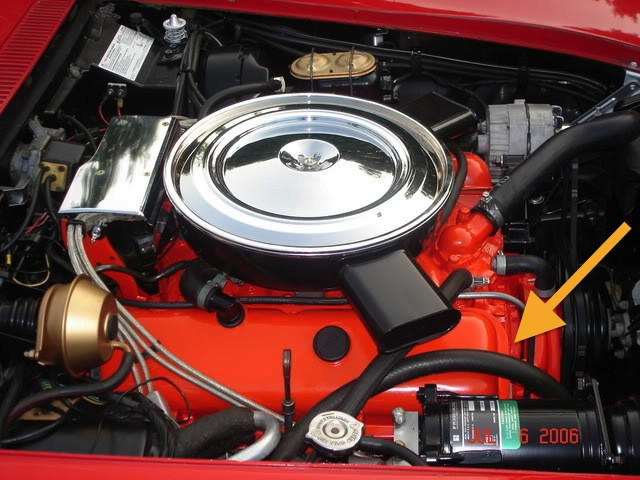
Quite a nice bb. (Please disregard the arrow)
Probably the best source of accurate information about engine orange is found in the Engine Section of the Assembly Instruction Manual.
The reason for this is that the parts of the engine like the carburetor, starter, some pulleys, fuel pump, some brackets, etc, were added to complete the engine in St. Louis. These parts are therefore NOT engine orange.
So if you go through the engine section, and other relevant sections, you'll gain an understanding of what WAS painted in Tonawanda on big blocks like yours, and at Flint on small block engines.
Regards,
Alan
Quite a nice bb. (Please disregard the arrow)
Last edited by Alan 71; Aug 23, 2017 at 06:08 PM.

Team Owner
Joined: Jan 2008
Posts: 30,894
Likes: 1,189
From: chicago
you guys are spraying on way too much paint,,i always wipe the block down with laquer thinner,let sit 1hr,then using chevy orange[yes in a spray can] I put on 2-3 coats,trying not to put it on too thick on any factory castings/stampings,but getting full coverage on the whole thing
and alan,whens the c3 color picture book coming out,at $99.95[heck even $199.95,its worth its weight in gold] per book its cheap
and alan,whens the c3 color picture book coming out,at $99.95[heck even $199.95,its worth its weight in gold] per book its cheap

Team Owner

Joined: Jan 2006
Posts: 37,637
Likes: 3,118
From: Crossville TN
Not everyone is into the NCRS 'perfection' thing or feels the need to go to the trouble and expense of buying the actual paint used at the factory 40+ years ago. For those that do, great!
If you want to use spray can paint, be aware that there are TWO colors of Chevy [orange] engine paint: for early (1955/56) 265 engines, they have a "Chevy engine Red-Orange" colored paint that has more red than the later "Chevy engine orange" paint.
Just so you know....
If you want to use spray can paint, be aware that there are TWO colors of Chevy [orange] engine paint: for early (1955/56) 265 engines, they have a "Chevy engine Red-Orange" colored paint that has more red than the later "Chevy engine orange" paint.
Just so you know....
Last edited by 7T1vette; Aug 30, 2017 at 09:48 PM.
Le Mans Master

Joined: Aug 2017
Posts: 8,336
Likes: 2,810
From: Cool Northern Michigan
Look at the experts web site on engine paint: EASTWOOD.
1. can of prep (degreaser)
2. can of hi temp primer (fills in pores)
3. Chevy orange in ceramic (brush or spray)
Very professional looking and durable. You don't have to worry about gas, oil, heat, anti-freeze, brake fluid, PS fluid, etc, destroying your paint job.
1. can of prep (degreaser)
2. can of hi temp primer (fills in pores)
3. Chevy orange in ceramic (brush or spray)
Very professional looking and durable. You don't have to worry about gas, oil, heat, anti-freeze, brake fluid, PS fluid, etc, destroying your paint job.

Racer
Joined: Jan 2008
Posts: 441
Likes: 22
From: Northeast OH
How big of a sin would it be for me to change my 1973 engine from orange to blue?
The car has a blue interior and I think it would tie everything together to make the switch.
The car has a blue interior and I think it would tie everything together to make the switch.
Last edited by Backstop; Aug 31, 2017 at 01:41 PM.
Team Owner
Joined: Sep 2006
Posts: 31,274
Likes: 4,366
From: Westminster Maryland
Hi B,
The choice is certainly yours to make.
The colors are known a Chevy Orange and Corporate Blue.
The change to blue was made so ANY ENGINE GM produced could be used in ANY CAR LINE they produced.
Regards,
Alan
The choice is certainly yours to make.
The colors are known a Chevy Orange and Corporate Blue.
The change to blue was made so ANY ENGINE GM produced could be used in ANY CAR LINE they produced.
Regards,
Alan

Team Owner


Joined: Jun 2001
Posts: 23,375
Likes: 1,067
From: Virginia USA
A little tidbit - Chevy painted the blocks orange so to locate oil leaks better. At least that is what I was told by a friends father that was a Chevy engineer back in the day. True or not I'm not sure but he did work for Chevy so who am I to dispute it.

Le Mans Master
Joined: May 2008
Posts: 9,063
Likes: 2,736
2022 C3 of the Year Finalist - Modified
No Sin
I would say paint your engine any color you want....don't worry about any of the NCRS types, they don't judge anyone's choices with Corvettes.
Last edited by Shovels and Vettes; Aug 31, 2017 at 05:49 PM.