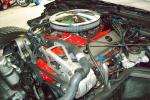
Over heating

Melting Slicks

Joined: May 2013
Posts: 2,692
Likes: 349
From: Sacramento California

Believe it or not, that sounds normal for these cars.
There's a sticky (permanent thread) at the top of the C4 general discussion page called "Corvettes, Summer, and High Coolant Temperatures." This sticky is highly recommended reading for anyone with questions about the C4 cooling systems and engine temperatures.
Welcome to the forum!
There's a sticky (permanent thread) at the top of the C4 general discussion page called "Corvettes, Summer, and High Coolant Temperatures." This sticky is highly recommended reading for anyone with questions about the C4 cooling systems and engine temperatures.
Welcome to the forum!
Last edited by DGXR; Mar 14, 2017 at 07:06 PM.

Team Owner


Joined: Feb 2003
Posts: 54,157
Likes: 9,464
From: Sitting in his Nowhere land Hanover Pa
2024 C2 of the Year Finalist - Unmodified
2015 C2 of Year Finalist
Believe it or not, that sounds normal for these cars.
There's a sticky (permanent thread) at the top of the C4 general discussion page called "Corvettes, Summer, and High Coolant Temperatures." This sticky is highly recommended reading for anyone with questions about the C4 cooling systems and engine temperatures.
Welcome to the forum!
There's a sticky (permanent thread) at the top of the C4 general discussion page called "Corvettes, Summer, and High Coolant Temperatures." This sticky is highly recommended reading for anyone with questions about the C4 cooling systems and engine temperatures.
Welcome to the forum!
have you checked the coolant level, any leaks?

Melting Slicks


Joined: May 2007
Posts: 2,075
Likes: 109
From: Longmont Co

Pro


Joined: Dec 2004
Posts: 597
Likes: 24
One possibility check the front of the radiator for a mat of grass and crud. These cars get the airflow from pretty low to the ground. On my last one, a 94, there was a large mat of crud covering about 1/3 of the radiator.
Melting Slicks
Joined: May 2013
Posts: 2,692
Likes: 349
From: Sacramento California
What the OP did not mention is, exactly how hot is it getting based on the digital gauge on the instrument cluster? And, do the radiator fans eventually come on around 228*F?
Last edited by DGXR; Mar 15, 2017 at 11:23 AM.

Drifting

Joined: Jan 2011
Posts: 1,853
Likes: 81
From: Hamilton Virginia
OK well maybe your 1994 was special. What I do know about these cooling systems is that the radiator fans are programmed to come on around 228*F. So while the car is moving a decent speed, as in "when the car is driving" mentioned by the OP, there will be airflow across the radiators and the temperature appears normal and steady, usually between 190-200*F in a healthy cooling system. But if there isn't much (or any) airflow across the radiator, such as the idling mentioned by the OP, the temperatures will climb to that setting of 228 pretty quickly, even in a healthy cooling system. When the fans turn on, the temps should drop fairly quickly as well, down to around 212. Everything I just said above has been discussed thoroughly and repeatedly on CF. Why? Because it happens all the time... because... it is normal for these cars.
What the OP did not mention is, exactly how hot is it getting based on the digital gauge on the instrument cluster? And, do the radiator fans eventually come on around 228*F?
What the OP did not mention is, exactly how hot is it getting based on the digital gauge on the instrument cluster? And, do the radiator fans eventually come on around 228*F?

Both my 92 and my 94 did the same thing. Stayed about 190-194 driving around. Then sitting in traffic or at a drive thru, the temps would go up to about 230 and the fans would kick on, then it would drop and stay around 210. Then once moving again, they would go back to 190.
Corvette Stories
The Best of Corvette for Corvette Enthusiasts

5 Best & 5 Worst Corvette Daily Drivers
Joe Kucinski
The Headlights of Every Corvette Generation Explained
Joe Kucinski
5 Best & 5 Most Overrated Corvette Track Packages of All Time!
Joe Kucinski
Every 2027 Corvette Engine Explained
Joe Kucinski
Designer Imagines A Corvette That Looks More Like a Corvette Than the Corvette
Verdad Gallardo
10 Ugly Corvettes That We Still Kinda Love
Joe Kucinski
Top 10 Most Expensive Corvettes Ever Sold on Bring A Trailer
Brett Foote
10 Things Every Corvette Owner Needs (2026 Edition)
Michael S. Palmer
8 Most "Only Corvette Owners Understand" Quirks and Problems
Pouria Savadkouei
Race Director


Joined: Oct 2005
Posts: 11,776
Likes: 182
From: Rolla Missouri
2021 C4 of the Year - Unmodified Finalist
St. Jude Donor '10 thru '25
OK well maybe your 1994 was special. What I do know about these cooling systems is that the radiator fans are programmed to come on around 228*F. So while the car is moving a decent speed, as in "when the car is driving" mentioned by the OP, there will be airflow across the radiators and the temperature appears normal and steady, usually between 190-200*F in a healthy cooling system. But if there isn't much (or any) airflow across the radiator, such as the idling mentioned by the OP, the temperatures will climb to that setting of 228 pretty quickly, even in a healthy cooling system. When the fans turn on, the temps should drop fairly quickly as well, down to around 212. Everything I just said above has been discussed thoroughly and repeatedly on CF. Why? Because it happens all the time... because... it is normal for these cars.
What the OP did not mention is, exactly how hot is it getting based on the digital gauge on the instrument cluster? And, do the radiator fans eventually come on around 228*F?
What the OP did not mention is, exactly how hot is it getting based on the digital gauge on the instrument cluster? And, do the radiator fans eventually come on around 228*F?
Exactly

Until the OP lists what temps he is seeing, nobody can tell if he has a overheating problem or not.

Team Owner


Joined: Jul 2004
Posts: 28,502
Likes: 3,302
From: Hartford WI
Until he scans it we can't even tell if the temperature he sees is right or not. My gauges before rebuild were registering 50 over what the ECM sees and the sensor was reporting correctly.

Race Director


Joined: Feb 2003
Posts: 16,475
Likes: 270
From: Kingman AZ
Cruise-In VII Veteran
Cruise-In VIII
St. Jude Donor '06-'07-'08-'09-'10-'11-'12-'13-'14-'15-'16

I got stuck on the Interstate by Gary, IN in this car on the way to Bloomington Gold. I only moved 200 yards in about 2 hours. It was late June, 90+ degrees and very muggy. I left the AC running the entire time and it did not overheat at all. This was before I cleaned the crud out too. I had done a full flush and fill on the car before the trip and it only had 60,000 on the clock. Loved that car

Team Owner

Joined: Sep 2003
Posts: 25,414
Likes: 2,745
You might consider monitoring the DIGITAL display through the function and mention those temps. IF the CTS is functioning properly I'd expect differences in "moving" and "stopped/idle" temps.
The "digital" temps display should be similar/close to likely what would be seen using a scanner and if you saw other than expected OR unusual temps there might be no reason to go to the effort.
Do you know that the coolant fans work and "as expected"? A '92 I believe that FAN1 is programmed for 226°, FAN 2 for 234°.