When you click on links to various merchants on this site and make a purchase, this can result in this site earning a commission. Affiliate programs and affiliations include, but are not limited to, the eBay Partner Network.
One must never forget that in general, all power plants in the world are more efficient at the highest feasible temperature of inlet mixtures.This includes engines. Any engine or powerplant turned up in temp to its highest feasible operating temp will have the best economy and in engines also generally the most reacted(completed) mixtures which does also help emissions.
The higher temp also has some implications with lubrication quality such as gas content of crankcase oil(high temp tends to drive out gasses such as carbon from blow-by) which helps keep the engine cleaner and alive longer.
Higher oil temp may help oil get into places and provide lube (such as roughness of cylinder wall) that cold oil has difficulty with.
Engines which are run with cold lake water (165*F inlet water) often has oil temp thermostat controller to keep 202-215*F Oil and a specifically machined cylinder bore for cold water with extra clearance for the colder jackets when using high expansion low silicone alloy pistons. In other words , one cannot simply decide what temperature to run their water. The engine assembly and spaces inside need to be approved in advance for a specific operation temperature or the owner/operator risks excessive wear and tear.
I have to disagree with you a little bit here. For the comment, "engine assembly and spaces inside need to be approved in advance for a specific operation temperature" The small block chevy, especially the earlier motors, were actually designed to operate with a lower temperature. The 1950s small block Chevies ran a 160-degree thermostat. The late 60s and early 70s small block Chevies ran a 180-degree thermostat. The design of the small block, including pistons, rings, etc., have generally not changed through the early C4s, with the exception of some flow design, stroke / bore, etc., for better (or worse) compression. Currently available parts like Hastings piston rings, still have the same part numbers they did back then, and will work for several decades of small block. Same with pistons. What I'm saying is, the Small Block chevy was in fact, actually designed for operation at 160 and 180 degrees, respectively. Of course, with the early TBI and MPFI OBD1 ECMs that we have, I'd never go below 180 degrees, or it requires a PROM burn.
Second, higher temperatures are generally responsible for carbon buildup in engines, especially if the motor is running rich. Hotter temperatures can actually result in a less-complete burn, which is the very reason why EGR was implemented (for two reasons... re-introduce the unburnt gasses to be burned again, and to cool the pistons as a result of the now excessive heat from the hotter thermostats). The ONLY reason why companies went to 195-degree thermostats is because it allows the catalytic converter to operate more efficiently... because even if there is some unburnt fuel in the exhaust, the heat required for the cat to operate properly is sustained by the increased temperature from the exhaust gasses. Hotter temperatures do not improve oil, this is actually how oils break down, and hotter under hood temperatures cause O-rings and seals to deteriorate more quickly, etc.
Originally Posted by Kingtal0n
I used to hit upullit every week. Still go once in a while with friends mostly as a tourguide tho
Towers was a decade ago for me
On weekends I tune cars in Davie still I'm messin with an R32 today in fact. Feel free to pm me if you or anyone would like tuning
Yeah, I don't live there now unfortunately. I have a house there and will move back eventually, but I left when I took a job with the government back in 2011, which last dropped me off in Tampa when I quit. But next year, I'll probably move down. I hear the new (?) replacement for the Tower Shops car show is off State Road 84, West of *** Hill on the South Side of 5-95. I went there once, and it was a bunch of old guys in jean shorts and tucked in T-shirts. Of course... that was a decade ago, and I'm probably their age now.
Do you own a shop down there, or is this something you do on the side? I remember when Jeb Bush got in, he repealed the emissions and safety inspection laws, which immediately made available like 100s of state and county facilities that had Mustang Dynamometers in them, and most of them got turned into Speed Shops.
I have to disagree with you a little bit here. For the comment, "engine assembly and spaces inside need to be approved in advance for a specific operation temperature" The small block chevy, especially the earlier motors, were actually designed to operate with a lower temperature.
Thats... what I said.... its literally exactly what I said
me: for a specific operation temperature
you designed to operate with a lower temperature
???
Nobody can argue that parts expand and the engineers need to design in advance for that expansion. Thats how ... all machines... pretty much are designed in advance. So?
The 1950s small block Chevies ran a 160-degree thermostat. The late 60s and early 70s small block Chevies ran a 180-degree thermostat.
Right and keep going. It gets warmer and warmer. 2000's run 205 to 212*F 2010's run 210 to 225*F and newest vehicles run 220 to 235*F coolant
They are getting higher and higher temp because its superior efficiency and economy... looks better on paper when the engine design is right.
Higher temps don't help as much when the engine design isn't up to the challenge (grim foreshadowing)
Second, higher temperatures are generally responsible for carbon buildup in engines, especially if the motor is running rich.
Remember the grim foreshadowing. This is only true for ancient engines with terrible starting efficiency like a small block chevy. Turning up the temp just takes that terrible efficiency and turns it into hard carbon crust. A newer engine runs higher temp because higher temp means more kinetic energy which means more reaction rate and product formation e.g. fewer carbon products and fewer deposits and better efficiency. Its my fault for being so general here so you DO have a point: Old ancient combustion chambers won't do as well as new combustion chambers at higher temperatures because they have such a overflow of unreacted product no matter what you do. But this turns into a tuning debate now because most people won't actually tune their SBC engines for minimal carbon deposits. To do this you'd need at least a wideband on an arduino or aftermarket ECU and target 15.2 to 16.5 Air Fuel Ratio for cruise and Idle, and THEN turn up the temps to more fully react products. This solves the problem of efficiency and economy and unreacted product in an ancient SBC style combustion chamber for the most part. But if you've never done it and reviewed the results you'd have no idea its even possible... not to mention there are modern heads for SBC engines now with 22* timing at wot and superior efficiency that reacts products at higher temp cleanly and so forth. Many things to do to fix this issue it isn't a general or overview its simply a problem with early engines that can be corrected.
Hotter temperatures can actually result in a less-complete burn, which is the very reason why EGR was implemented (for two reasons... re-introduce the unburnt gasses to be burned again, and to cool the pistons as a result of the now excessive heat from the hotter thermostats).
EGR when it activates at part throttle cruise does cool down the combustion chamber but remember it also brings back in combustion byproduct which was unburnt which is how the efficiency rises - they get another shot at being reacted by re-introducing them to the reaction chamber, it isn't from any cooling. Cooling any combustion process will lower gas kinetic energy which slows it down and will produce more unreacted product, it has to, a less complete burn at lower temperature is a chemistry 'standard' e.g. If we write rate coordinate reactions the temperature is the kinetic energy component on which the fraction of products forming depends. Reactions only happen when molecules collide with sufficient force and that force depends on their temperature, so more temperature = more force = more reactions. No getting around this.
The ONLY reason why companies went to 195-degree thermostats is because it allows the catalytic converter to operate more efficiently...
Converters run like 900*F to 1400*F or something insane and I personally this is just my opinion the minute you start an engine with 50*F coolant the exhaust gas is already 400*F in an instant and quickly rises in temperature beyond 500*F within a minute while the coolant is still 60*F or 80*F or whatever. I don't see any relationship between the cold coolant and the 1000*F exhaust gas and I would bet that cats warm up about the same rate no matter what thermostat is in an engine just based on heat capacity of coolant and its transfer rate to exhaust via cylinder jackets. Even if I try to argue that from 180 to 195 that space of time for 15Degree temperature difference is going to impact a 1400*F cat converter? no way. I wouldn't believe it to be significant without seeing some data.
Hotter temperatures do not improve oil, this is actually how oils break down, and hotter under hood temperatures cause O-rings and seals to deteriorate more quickly, etc.
Well both of us are being vague. Hotter temp oil like 280*F is a problem yes.
Oil at 180*F is a problem also for almost any engine.
Oil needs to be at least 205*F to 215*F In almost every engine. Its not "hotter or colder" this is just the correct range to loosen the variable chain length oil molecules(viscosity changers) and drive out water and dissolved gas. This temp works with the PCV system to help keep combustion gas out of oil and helps it flatten out those modern oil hydrocarbon chains. Thats all I meant.
Cold oil (< 186*F) is dangerous for an engine in many ways. It refuses to reach deep microscopic crevices sometimes. It flows poorly and shows a high pressure on gauge while low flow throughput to the engine top end. It is responsible for ruined engine bearings when people run an engine hard without warming up the oil first to say 195*F+ at least because of poor flow, depends on the engine though of course. The more modern the engine the smaller the orifices the more the high oil temp(200*F+) matters to the reliability of that engine.
Do you own a shop down there, or is this something you do on the side?
I'm a scientist but cant get performance out of my blood so i tinker with whatever
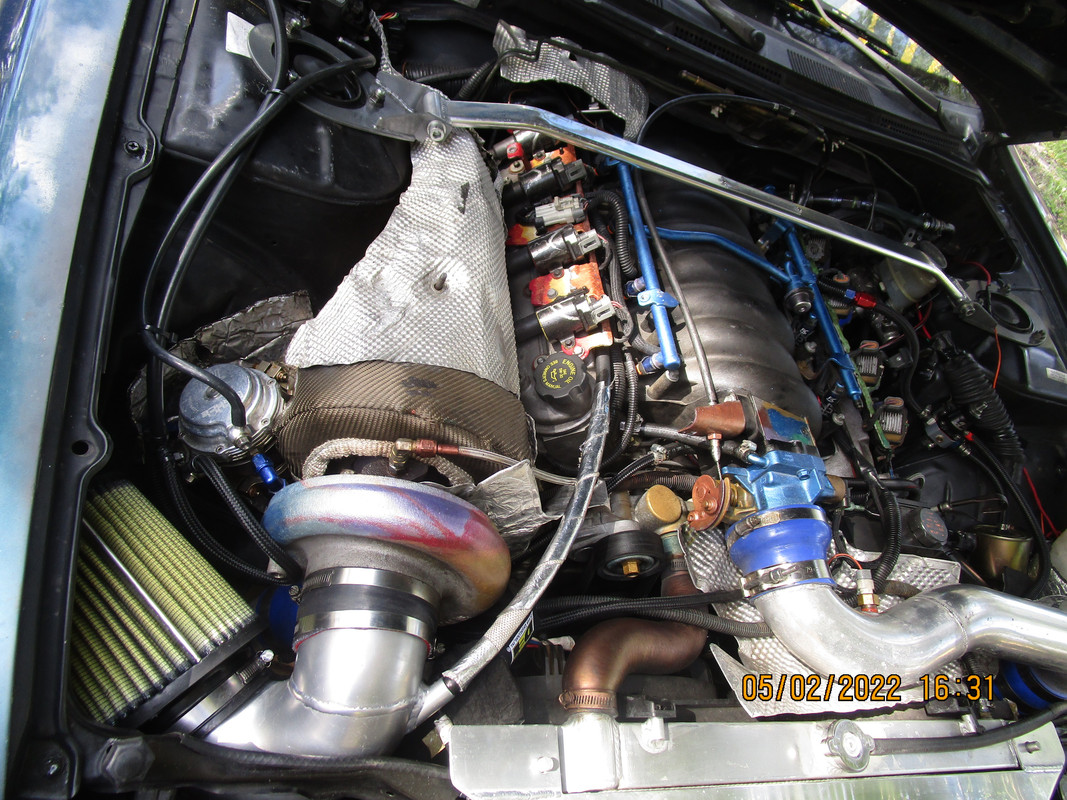
I like to recommend these to modernize your antiques a bit, get 350,000 miles its 5.3L At 600rwhp E10 93 octane daily driver
Using an original engine from 2002-2007 L33/LM7
A newer engine runs higher temp because higher temp means more kinetic energy which means more reaction rate and product formation e.g. fewer carbon products and fewer deposits and better efficiency. Its my fault for being so general here so you DO have a point: Old ancient combustion chambers won't do as well as new combustion chambers at higher temperatures because they have such a overflow of unreacted product no matter what you do. But this turns into a tuning debate now because most people won't actually tune their SBC engines for minimal carbon deposits.
... snip
I like to recommend these to modernize your antiques a bit, get 350,000 miles its 5.3L At 600rwhp E10 93 octane daily driver
Using an original engine from 2002-2007 L33/LM7
Good, we are both saying the same thing! Yes, the engine in my 84 Corvette, and essentially the small block up to but not including the LT1/4 are old-*** technology. In this Corvette, we're going to run a 180-degree thermostat because it was designed for it. Same with my Fieros, etc.
As for antiques... hah... I don't know if that was an old man crack. I'm 48, but not yet wearing the jean shorts with the tucked in polo and the white socks with tennis shoes kind of Corvette owner (yet). My wife has a new turbo Bronco, and of course we have the Solstice (which is actually 20 years old at this point, but same GM tech era as your LS motor), and I have my new Explorer. I do run a 185-degree thermostat in the Solstice, but run a stock thermostat in the other cars (designed for it, and... closed-loop doesn't happen until 192 degrees on most cars post-2003.
But yes... this is what just drives me nuts, people get SOOO worked up when you mention putting a 180-degree thermostat in an older MPFI motor... when these 80s GM motors were literally designed with the 180-degree thermostat. Gen-1 V6/60, Buick 3800, Pre-86 Small Block Chevy, etc... all originally had 180-degree thermostats. And then they scream... "but, but... the engineers!" And then I say... look at the EPA mandates. GM also made the LF9 diesel engine, and changed the crank rotation, and the Cadillac 4/6/8. All of which were awesome ideas... but they act like changing anything (or re-routing wiring locations) is blasphemy. And then you find... these people have barely changed their own spark plugs, let alone flashed a PROM or rebuilt an engine.
This Corvette is for my daughter to learn (her channel here if you haven't seen it: (1) Gen Z Garage - YouTube. It'll be the second car she's completely restored.
Can I ask why you use an Arduino to run your car ??? or did I misread that? Why not just use a MegaSquirt or MicroSquirt? Or are you trying to do more with it like getting sequential fuel injection?
After this post I asked copilot to review and it has some nit picks I agree with
1. give year, manufacturer, displacement, etc.... of engine you are discussing i.e. 1992 5.7L SBC or w/e
2. mention that leaning out an engine replaces mechanical loss benefit of EGR
3. point out that your engine does not require EGR to functional normally (not knock limited at cruise without EGR)
These are assumptions you have to specify or the general ai will consider many foreign engine designs and papers that say anything is possible with EGR since it does so many things for various types of engines
From this assumption it should reason that cooling from EGR will reduce efficiency(emissions/economy) and all it offers is fuel molecules which may be negligible
Theory and practice.
In theory the SBC is a bit more well suited to 185*F coolant which would be detrimental to something modern, simply in terms of its mechanical space makeup, not its thermodynamic efficiency which always goes up with temp.
185*F is a funny line to draw but I will get back to that - Where are you measuring that from? Going into the engine or coming out? What exactly is at 185*F? The piston probably runs around 400 to 500*F fully warmed up. The piston temperature determines piston to wall clearance along with cylinder wall temperature - 185*F for example. The bore is larger at 200*F than at 185*F. The difference from 185 to 200*F is negligible. However the difference in higher chamber wall temp from 185 to 200*F is significant and the engine at 200*F will have increase reaction rate, flame speed, product formation, pressure rise rate, everything goes up with temp.
Thermodynamics is simply hotter is better for everything in thermo. The mechanical nature of the sbc, the piston ring wear, lubrication of the top end/lobes/bearings, stuff like that might be fine at 185 or 205*F coolant it doesn't make any difference though , you can get away with it. It just doesn't favor the thermo of the engine, the mpg and or emissions lets call it efficiency of conversion.
In practice it is difficult for intermediate mechanical enthusiasts to achieve 'hot air' intake, hot cyl wall, cold valve cold piston application. The air warming from turbo is removed by intercooling which will reduce efficiency (economy/emissions down) but the engine is knock limited without the intercooler on E10 fuel so it lifts all of those constraints I placed above about what EGR is actually doing - my argument completely falls apart on my own car because I am knock limited and EGR cooling might/would benefit the reaction rate if I didn't have extra alcohol or water to inject as needed or an intercooler to remove that energy. But ONLY if we consider wide open throttle. Notice again wide open throttle completely changed the EGR argument because compression is much higher(virtual volumetric efficiency in turbo apps) making EGR Look like it does more on paper now if we had it. But in practice you can intercool and spray water to drop piston temp as needed there is no limit to water injection in that respect. EGR is just a dirty water injection system if you look at it that way, if fuel return is negligible. Looking now back at cruise, the intercooler would be a massive economy loss (friction) if the turbo doesn't push air through it at cruise (at the cost of negligible exhaust gas pressure rise, almost no cost) but this boost falls off at the throttle valve where now more pumping loss against a higher vacuum to keep the 'boost' out of the intake is needed. This is offset by leaning out the air fuel mixture which opens the throttle valve and rises intake pressure. However there is also suction from exhaust overlap period which can draw significant intake volume to a cylinder without pumping loss on the piston as well ,if the exhaust can be tuned (acoustically) and tuned (momentum'ly) and tuned (valve timing'ly) must all work together to offset pumping losses and some OEM engines do a great job at this but it is poorly replicated in aftermarket and one-off intermediate mechanics projects.
Can I ask why you use an Arduino to run your car ??? or did I misread that? Why not just use a MegaSquirt or MicroSquirt? Or are you trying to do more with it like getting sequential fuel injection?
I use factory ECU 411 2002 200lb/hr for the engine
But the engine does not have theft, trans fan controller, oil temp, light sensing, camera, wi-fi, etc... many features I'd like to add to my car with the arduino
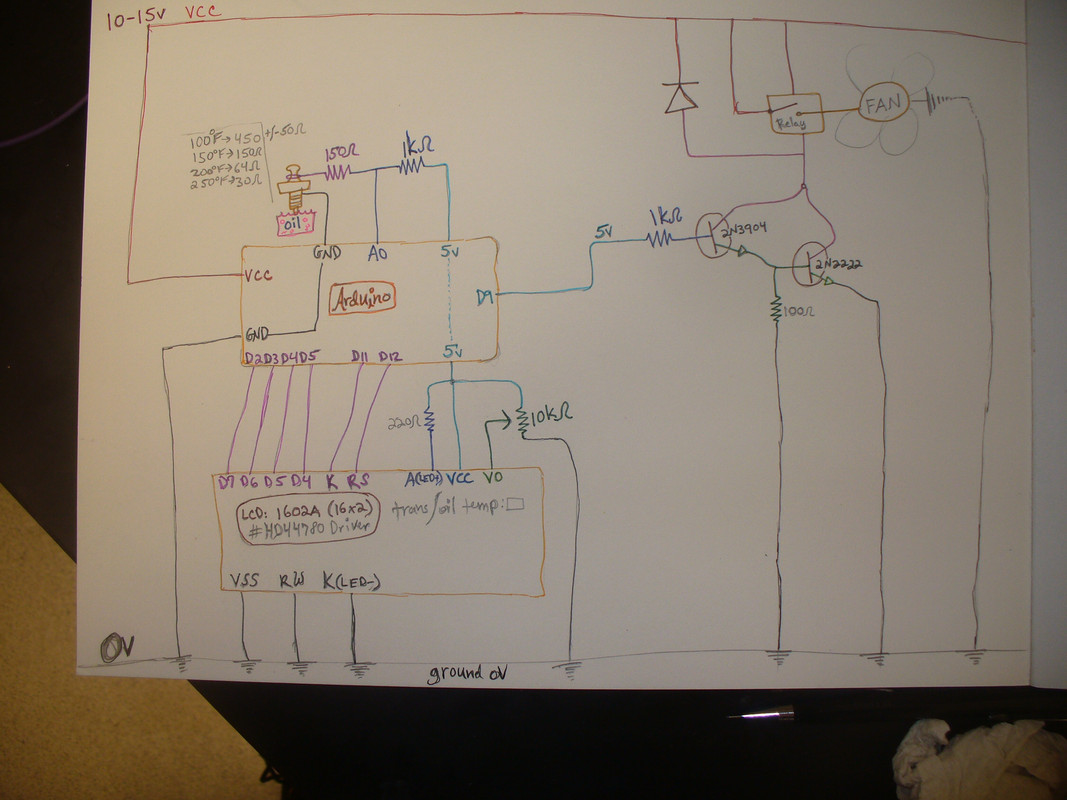
This is the basic fan controller like my first version (I still use basically this) I added a power supply and safety inductors/flybacks and some other sensors but this is the important part
Fan temp readout and relay switching without expensive components
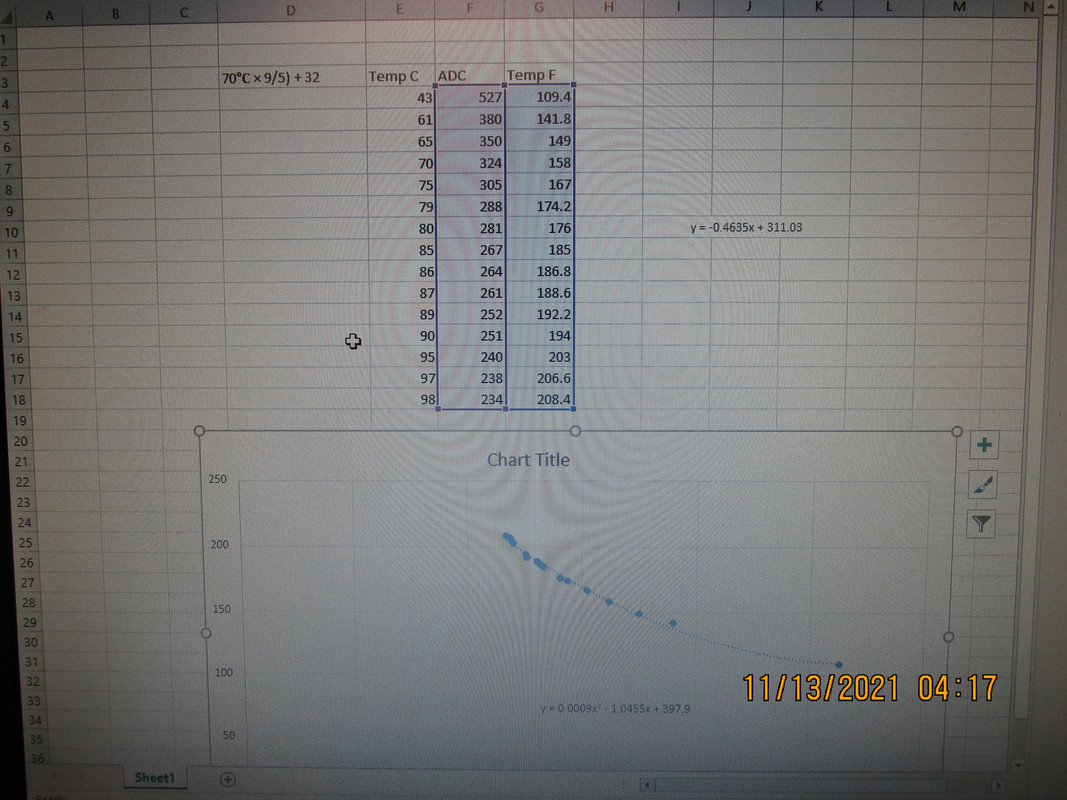
curve fit the temperature to ADC (analog to ADC from a sensor) input
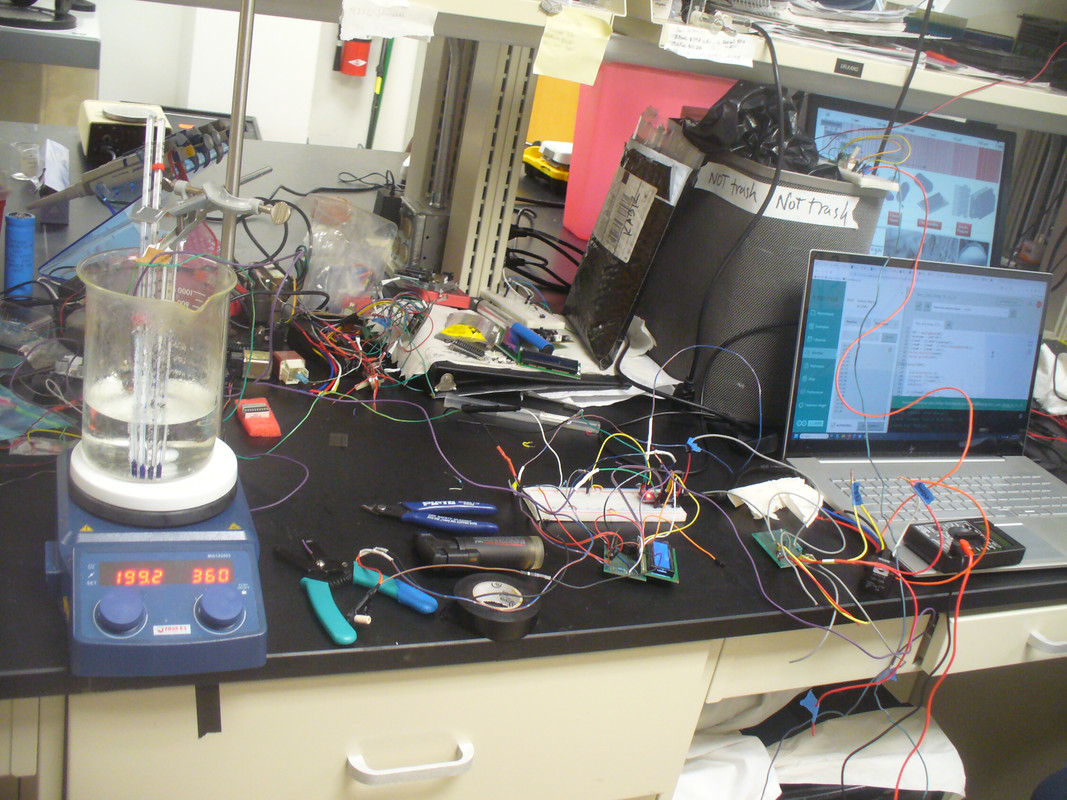
If you dont have a temp curve use a stove top to heat the sensor
I recommend 2-wire temp sensors so you have a wire for ground directly which allows mounting easily in transmission coolers and plastic or painted oil pans
Theory and practice.
In theory the SBC is a bit more well suited to 185*F coolant which would be detrimental to something modern, simply in terms of its mechanical space makeup, not its thermodynamic efficiency which always goes up with temp.
185*F is a funny line to draw but I will get back to that - Where are you measuring that from? Going into the engine or coming out? What exactly is at 185*F? The piston probably runs around 400 to 500*F fully warmed up. The piston temperature determines piston to wall clearance along with cylinder wall temperature - 185*F for example. The bore is larger at 200*F than at 185*F. The difference from 185 to 200*F is negligible. However the difference in higher chamber wall temp from 185 to 200*F is significant and the engine at 200*F will have increase reaction rate, flame speed, product formation, pressure rise rate, everything goes up with temp.
Thermodynamics is simply hotter is better for everything in thermo. The mechanical nature of the sbc, the piston ring wear, lubrication of the top end/lobes/bearings, stuff like that might be fine at 185 or 205*F coolant it doesn't make any difference though , you can get away with it. It just doesn't favor the thermo of the engine, the mpg and or emissions lets call it efficiency of conversion.
In practice it is difficult for intermediate mechanical enthusiasts to achieve 'hot air' intake, hot cyl wall, cold valve cold piston application. The air warming from turbo is removed by intercooling which will reduce efficiency (economy/emissions down) but the engine is knock limited without the intercooler on E10 fuel so it lifts all of those constraints I placed above about what EGR is actually doing - my argument completely falls apart on my own car because I am knock limited and EGR cooling might/would benefit the reaction rate if I didn't have extra alcohol or water to inject as needed or an intercooler to remove that energy. But ONLY if we consider wide open throttle. Notice again wide open throttle completely changed the EGR argument because compression is much higher(virtual volumetric efficiency in turbo apps) making EGR Look like it does more on paper now if we had it. But in practice you can intercool and spray water to drop piston temp as needed there is no limit to water injection in that respect. EGR is just a dirty water injection system if you look at it that way, if fuel return is negligible. Looking now back at cruise, the intercooler would be a massive economy loss (friction) if the turbo doesn't push air through it at cruise (at the cost of negligible exhaust gas pressure rise, almost no cost) but this boost falls off at the throttle valve where now more pumping loss against a higher vacuum to keep the 'boost' out of the intake is needed. This is offset by leaning out the air fuel mixture which opens the throttle valve and rises intake pressure. However there is also suction from exhaust overlap period which can draw significant intake volume to a cylinder without pumping loss on the piston as well ,if the exhaust can be tuned (acoustically) and tuned (momentum'ly) and tuned (valve timing'ly) must all work together to offset pumping losses and some OEM engines do a great job at this but it is poorly replicated in aftermarket and one-off intermediate mechanics projects.
I use factory ECU 411 2002 200lb/hr for the engine
But the engine does not have theft, trans fan controller, oil temp, light sensing, camera, wi-fi, etc... many features I'd like to add to my car with the arduino
This is the basic fan controller like my first version (I still use basically this) I added a power supply and safety inductors/flybacks and some other sensors but this is the important part
Fan temp readout and relay switching without expensive components
curve fit the temperature to ADC (analog to ADC from a sensor) input
If you dont have a temp curve use a stove top to heat the sensor
I recommend 2-wire temp sensors so you have a wire for ground directly which allows mounting easily in transmission coolers and plastic or painted oil pans
Oddly enough, I've had three in a row, really bad CTS sensors that I had to test in a pot of boiling water, and they were all bad *brand new*. The newer replacement 2-wire OEM DELCO and DELPHI CTS sensors are all made in China, and complete crap. I ended up having to find an original OEM one from when they were still made in Taiwan. But to answer the question, the sensors are generally good... but it's the gauge that often is now. I know you know you can test these, and they usually have a replaceable resistor that you can swap out to adjust them (for analog GM gauges). And of course, you can verify with a thermal laser tester. On my 84 (and I assume concurrent year small blocks), the gauge reads from the side of the block, while the ECM reads from the sensor on the front of the intake.
I definitely dig the set-up with all the features, but in my older years, I've really appreciated simplicity in design. In most of the car restorations, I've actually wanted to minimize design and streamline things. I prefer to keep the cars looking 100% stock, and the only improvements I make or do, typically have to look like they are OEM, or improve upon the factory design. When I was younger, I was adding scoops and all kinds of gadgets to my cars. Maybe it's my career field... but I get so tired of technology at this point that I prefer simplicity. Like a mechanical watch, to a smart watch. I got so annoyed at the original AC pressure switch no longer being available, that I used Maltego to scour the internet with that part number, and ended up having to buy some dude's parts lot / parts box with 10+ other brand new sensors... but it came with a new one! But all because I wanted to keep the original 1-wire mushroom sensor. I'm surprised you didn't use an Atari VCS to power your stuff, since you can get them for so cheap now! Haha... of course, I'm not aware of something like AppLab / IDE specifically for the Atari VCS's hardware.
As for EGR... I really do hate EGR. It's the worst... but as you know the ECM is specifically designed to expect it and adjusts the fuel maps expecting it to be there. I kind of give a "hmmm...." when people just install the EGR block-off plate without re-flashing the ECM. It's not going to destroy their engine, but the AFR is off at idle and low cruising. I believe the EGR shuts off completely at wide open throttle though, so it doesn't give that "performance" gain people think it does.
KAEL, there's a lot of discussion about temps....I bought my C4 in Arkansas, drive it around in Kansas City. Now moving to Boca Raton, FL, is there anything I should do to prevent any problems. Never lived in a differant climate.
KAEL, there's a lot of discussion about temps....I bought my C4 in Arkansas, drive it around in Kansas City. Now moving to Boca Raton, FL, is there anything I should do to prevent any problems. Never lived in a differant climate.
I know you weren't asking me... but the Corvette was built to be sold across many different regions, from Northern Canada to Key West. The only thing you typically need to do is ensure your coolant is appropriate for your region. Mostly, the concern is preventing the coolant from freezing in colder regions, as most coolant testing gauges talk about how cold it can get before the antifreeze will freeze. If everything is in good shape, you shouldn't have to do anything. I run 50/50 mix in all my cars (regardless of the thermostat) and I've never had any overheating. If you haven't changed out your coolant in a while, that would be the only thing I'd do.
You guys are way smart, so my 87 shouldn't see idle/traffic temps in the low 200's ?
is 89 octane safe to run or what is safe min octane ? (i only get gas at marathon or other top tier program approved locations)
I ran it on cruise at 72 for an hour each way friday and the temp was 170/172.
In theory around 200*F is ideal for majority of engine 1060's - 2009ish
With 212*F being the 'peak optimal' value if you know how to tune an engine
The engine compression ratio and fuel quality determine how much tuning is needed
The lower quality the fuel and higher the compression, more tuning for specifically high temp coolant needs to be done
e.g. richer air fuel ratio and reduced timing to help keep the fuel happy when it burns not to upset the piston when things got hot
The air temp plays a key role in high coolant temp situations, when air temp is cooler the engine will tolerate higher coolant temps which would normally upset the fuel but the air temp soothes the fuel behavior if its colder.
As coolant temps go up stuff changes shape and I've seen freeze plugs fly out of old and new fresh engines because of a one-off high temp traffic situation.
Modern seals don't really show up in chevrolet until 2001 so running an older engine with those pre-modern era leaky seals at higher temps and higher variations in temp is more risky for the seal situation than a newer 2001+ engine is. SBC are most susceptible to issues with their seals in general even without wandering temps.
That's an odd temperature range. What thermostat are you using? Are you using a 160-degree thermostat?
The thermostat is invisible once the water opens it. It has nothing to do with the temperature of the running engine other than to set a minimum temp for water to flow into the engine.
KAEL, there's a lot of discussion about temps....I bought my C4 in Arkansas, drive it around in Kansas City. Now moving to Boca Raton, FL, is there anything I should do to prevent any problems. Never lived in a differant climate.
In Florida no freezing, but you still need some type of anti-freeze for its buffers and chelators that help keep water quality high. No freezing so 25% to 40% anti-freeze is probably okay. The change interval has more to do with whats already inside the cooling system rather than what you are really putting in at this time. Just don't mix coolants and never use tap water only distilled. Distilled is pure water which is what is in the 50/50 bottles you buy anyways. Its clean water. It does not conduct electricity which is why you want it the most of all. Car coolant systems are not sterile though so once you pour in a drop of distilled it is no longer distilled, now it contains whatever was in there. If the container was made of stainless and absolutely sterile with not a speck of bacteria, debris, electrically charged ions, absolutely pure container of stainless then the distilled would be able to attack the stainless by taking advantage of it's unbuffered pH water becomes quite corrosive in some situations. Adding a pinch of bi-carb solves this issue the same way it would in a car coolant system if the car had a perfectly sterile flawless system. But the car's coolant system is absolutely full of microscopic debris, ions, buildup, gasket materials, rubber from hoses, metal from machining flaw, trace oil and gasoline even gets in there on the best of sealed systems after enough time.
No idea what thermostat is istalled i just got the car. What temp thermostat would have been it new.
i should be back to florida by end of june and fully moved by end of july (car and tools and fyrniture to storage soon) just did tires shocks grease oil and trans service in case it needed to be driven to florida. wont be able to do coolant and tstat and gear lube until fully moved.
I had a 1990 zf6 the guy i got it from jumped the fans to run constantly and installed a 180 tstat, once the fans were ungrounded and i installed a 195 tstat installed it ran very good. Albeit hot which per this website was correct.
The thermostat is invisible once the water opens it. It has nothing to do with the temperature of the running engine other than to set a minimum temp for water to flow into the engine.
But will a lo temp tstat keep the engine under operating temp ? is the 172 it was running hot enough if it was designed to run hotter ?
But will a lo temp tstat keep the engine under operating temp ? is the 172 it was running hot enough if it was designed to run hotter ?
I'm not sure what you are asking exactly but I will guess
The thermostat should allow water to flow into the engine at whatever temp it opens.
If water is hot then it won't do very much cooling right.
but if the water is cold then it will do more cooling than hot water.
The thermostat only controls the minimum temp of water allowed into the engine, say 165*F or 195*F or whatever.
I think you are asking is 172*F too cold. The answer is probably but it depends on the oil temps. If the oil temp is reaching 215*F or even 202*F then 172*F water is not as big of a deal. Especially if you've got a metal non-insulating intake manifold tied to an OEM style plastic insulating ductwork from the air filter. These things matter, they make a difference in the condition and temp of the air as it passes through the manifold and mixing with fuel vaporizing the fuel. If there is a fuel injector over the valve the air can be much cooler than if you have tbi or carb drawn air and fuel into a wet flow manifold which needs to be warmed up to help mix and vaporize the fuel to keep the engine smooth and distributing air and fuel evenly which helps keep the engine clean inside (carbon distribution and carbon deposits depend on variability in distribution from the smallest particulate to the largest distribution in statistical data pool)
Update.
i have been getting some knock in low rpm, WOT lugging type situation. 1 to 2 degrees knock retard.
i dropped 2 degrees in timing in that kPA and RPM range.
time will tell. The real test will be adding more 87 octane to dilute what was left of the 87 octane.
I do not recommend this method for 'tuning' an engine.
If only simply because knock threshold moves with intake, oil, and coolant temps, engine surface temps and even humidity.
Whatever you find today will change with time/temps, it cannot be dependent.
Also because knock sensors cannot be trusted to determine actual knock in modified engines.
And also because a properly tuned engine should be so far from knock threshold to begin with it never has knock.
Instead, take the vehicle to a dynojet, if vehicle weight is 2000-4000lbs roughly in that range
Remove as much timing as possible to find the minimum timing possible in any load/gear that gives adequate (within 5 to 8% of total possible) torque
A smoothing=0 graph with mild rich air fuel ratio depending on load and smooth sounding engine and great looking spark plugs (tuned on the street -> new plugs -> dynotime -> Inspect progress -> after dyno final plugs) gives a great indication of engine health and good fuel behavior.
A little common sense also goes along with it, don't expect a 11:1 engine on 87 octane to behave fuel at 110*F intake air temp
Respectfully, this is the answer a lot of people tend to give... "Engineers did *x* and that's the end-all be all."
I'm also an engineer... I have two engineering degrees, it doesn't make me any more an expert than anyone else here, other than to know that people do "x" for specific reasons, which may not be the specific reasons I'm interested in. I know that the shift to 195 degrees was intentionally done to improve emissions.
For me, longevity, under-hood temperatures, and reliability of the components, as well as a generally cooler running engine is what's important to me. The original small block chevy, incidentally, was mechanically designed with a 160-degree thermostat in mind, as this is what the early box Chevies came with. Through the late 60s and early 70s, they switched to 180-degree thermostats to improve combustion efficiency. The ONLY reason why our newer cars run an even hotter thermostat, is to ensure the exhaust is hot enough for the catalytic converter to function optimally to meet growing stringent emissions standards. As I said, I wrap the exhaust headers with header wrap, as well as the down-pipes, all the way to (but not including) the cat.
It's not like I hate the environment, but these cars get driven, MAYBE... 100 miles a year, if I'm lucky. I have a 2002 Crown Victoria LX-P74 with 40k some odd miles that sits in the garage, that I haven't even started it in 6 months. So, emissions is not really a concern. Florida also has zero emissions testing, and no safety inspections (I cut the roof off a car and we drove it around like that for 2 years till it was stolen).
"...it extends the warm up time of the engine."
How do you define the warm-up time? Are you referring to going into closed loop mode? Many older cars go into Closed loop around 147, and typically 167 degrees for MOST GM cars of the 80s and 90s, which would include the C4. With a 180-degree thermostat, it'll not affect "warming up" at all. The idea that the car will always run hot, regardless of the thermostat, is ludicrous. Most vehicles are engineered intentionally with additional cooling beyond the normal operating range to compensate for extremely harsh climates. In all my classic and hobby cars, I always put a 180-185 degree thermostat in them, and they've *always* run cooler on average about 10 degrees. I have one car that with a 180 degree thermostat, I can sit in 100+ degree heat with the car idling (A/C off) and the fan never kicks on, it just sits at a perfect 180-185 degrees. This is with all the stock cooling, but a perfecct 50/50 mix of correct anti-freeze and distilled water. To that point, a 180-185 degree thermostat also keeps the coolant flowing longer, allowing the radiator to do its thing when you're sitting in traffic, idling, etc.
I would never really recommend going to lower than 180, honesty, as anything lower and you need a reprogrammed ECM, but 195 degrees is only optimal if saving the planet or meeting CAFE and EPA regulations is your primary goal. My goal is longevity of parts... and lowered under-hood temperatures for all the rubber and other components in the engine compartment.
For my next controversial comment... I think everyone should begin collecting social security the day you're eligible. Waiting until you're older is pointless... prove me wrong!
(Haha, to be fair, I actually don't know el gouna kitesurf, I just know that this one REALLY gets people worked up too. I'm 48, so it doesn't even matter).
The way I used to do it was I purchased an old 386 laptop, and the dealer GM Tuner software which you can get offline. I then would download and modify the BIN file from the PROM, and sometimes had to use a HEX editor to modify the fuel tables and set flags, and then you could either pull the sticker off the old PROM and leave it out in the sun for a day, or use a UV light, which would effectively wipe it. I then had an RS232 serial cable attached to a prom burner, which had a ZIF socket (zero insertion force, with a little lever, like on a CPU ZIFF socket), and then I'd burn the new programming to the chip, and then re-install it in the ECM. This was for older 80s OBD-1 style ECMs... earlier than the 7730 ECM. Basically the old ones that say, the earlier Corvettes and other GM cars had.
That's a huge pain in the ***, and there are much better ways of doing it today. Being completely honest, if you have like a 1985-1989 Corvette... I would ditch the entire ECM and install something like an FAST EZ-EFI 2.0 system, along with the replacement distributor they offer. Respectfully, if you're asking, it's probably not going to be something you're going to want to just jump into. But these older ECMs are basically crap. You have to consider the fact that when they were designed, most people were using 8088s with Hercules monochrome monitors. The baud rate from the ALDL connector is like 160bps, and it's pretty much all analog. The nice thing about the 84-89 (don't know about 90/91) Corvettes is that they separate the gauge cluster engine feeds (water temp, voltage, tach, etc.) from the data that the ECM / engine reads. So, you can effectively replace the entire ECM and have it run independently (like the ECM already does) and not have to change anything in your interior with respect to your gauge cluster. The only thing shared is usually the vehicle speed sensor, which aftermarket ECMs can provide that feed to the gauge.
I really like the FAST EZ-EFI 2.0 system because it incorporates factory GM sensors and allows you to use all the existing hardware and everything else that's already on your TPI / MPFI-based system. There are even some systems you can install that will essentially upgrade the motor to SFI, which gives you better performance below 3,000 rpms and better fuel economy (individual injector fire rather than batch fire). When I worked for the NSA, there was a guy in one of my orgs who had built his own ECM and had an early AI model which didn't JUST use a revolving PID, but in fact used some predictive analysis based on driver behavior. It required a conversion to Throttle By Wire, but it worked pretty well. The thing that's good about these systems though, is that they are self-learning. A lot of people will get really worked up, like thermostats, or what age to collect social security... there are a lot of deep emotions on these things. They get upset because while these systems are self-learning, they say it's not as good as taking it to a dyno and analyzing the AFR throughout the RPM range and drive. But in reality, these newer aftermarket systems do a really good job of getting you 95% there. The older OBD1 systems cannot compensate for pretty much anything beyond a little bit of porting and minor upgrades. Anything beyond that, and it usually cannot compensate for things like cam changes or whatever... especially for MAP-based systems, and not ones that have MAFs. These aftermarket systems consistently evaluate the data, and optimize the fuel mapping.
If you JUST want to reprogram what you have... you'll want to download some software and buy a cable from Amazon. You basically plug your laptop in, record the data through your ALDL connector, and then send that to a tuner. There are a few people who do this... there's one guy I'd recommend, Sinister Performance: https://www.gmtuners.com/eprom/
He'll either send you a new PROM, or you send him your old one for reprogramming, and he'll send it back with a new flash, and you pop it back in.
On the older ECMs (not PCMs), there's a little door that's held on by two 8mm screws. You remove this panel on top of the ECM, and you carefully pop out the ECM chip, put it in an anti-static bag, and ship it. He'll send it back and then you pop it back in, in the current orientation.