


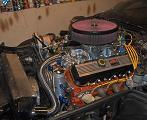

383 or 388
Thread Starter
Team Owner

Joined: Oct 2004
Posts: 35,065
Likes: 0
From: Bergen County, NJ Democrats, doing for the country what they did for Michigan

Thanks Black.
I have so much money poured into this thing... I looked at the 406, 421 options, but that's an extra $1000. My wife is going to kick my ***.
I can get a 383 built using my parts for $3K or less. Can't do that with the larger engines.
Now it's a function of $$$$.. not lack of it, but desire to pour more into the car. The results between a 383/377/406 will be negligible. If I go bigger, now I'm looking at a different cam, different heads, etc...etc...etc..... it introduces a bunch more problems.
I may even wind up staying with a 350..
I appreciate you perspective, and I don't disagree, just not the right thing at this point.
I have so much money poured into this thing... I looked at the 406, 421 options, but that's an extra $1000. My wife is going to kick my ***.
I can get a 383 built using my parts for $3K or less. Can't do that with the larger engines.
Now it's a function of $$$$.. not lack of it, but desire to pour more into the car. The results between a 383/377/406 will be negligible. If I go bigger, now I'm looking at a different cam, different heads, etc...etc...etc..... it introduces a bunch more problems.
I may even wind up staying with a 350..
I appreciate you perspective, and I don't disagree, just not the right thing at this point.
Thread Starter
Team Owner
Joined: Oct 2004
Posts: 35,065
Likes: 0
From: Bergen County, NJ Democrats, doing for the country what they did for Michigan
With my existing parts, yeah, that's what I'm thinking.
I'm looking into a 377. 400 block with a 350 crank.
I am finding out the 400 blocks are hard to come by and have some heat issues.
so I am not sure at this point. If a 377 can be done and be problem free, I may lean that way. They spin up faster than a 383 and I believe will be more fun on the street.
I'm looking into a 377. 400 block with a 350 crank.
I am finding out the 400 blocks are hard to come by and have some heat issues.
so I am not sure at this point. If a 377 can be done and be problem free, I may lean that way. They spin up faster than a 383 and I believe will be more fun on the street.

Race Director


Joined: May 2003
Posts: 10,749
Likes: 41
With my existing parts, yeah, that's what I'm thinking.
I'm looking into a 377. 400 block with a 350 crank.
I am finding out the 400 blocks are hard to come by and have some heat issues.
so I am not sure at this point. If a 377 can be done and be problem free, I may lean that way. They spin up faster than a 383 and I believe will be more fun on the street.
I'm looking into a 377. 400 block with a 350 crank.
I am finding out the 400 blocks are hard to come by and have some heat issues.
so I am not sure at this point. If a 377 can be done and be problem free, I may lean that way. They spin up faster than a 383 and I believe will be more fun on the street.
Safety Car


Joined: Apr 2005
Posts: 3,624
Likes: 431
From: Dale City VA
With my existing parts, yeah, that's what I'm thinking.
I'm looking into a 377. 400 block with a 350 crank.
I am finding out the 400 blocks are hard to come by and have some heat issues.
so I am not sure at this point. If a 377 can be done and be problem free, I may lean that way. They spin up faster than a 383 and I believe will be more fun on the street.
I'm looking into a 377. 400 block with a 350 crank.
I am finding out the 400 blocks are hard to come by and have some heat issues.
so I am not sure at this point. If a 377 can be done and be problem free, I may lean that way. They spin up faster than a 383 and I believe will be more fun on the street.
Who ever is telling you that a short stroke/big bore engine gains RPM/Accelerates or "Spins Up" faster than a long stroke/small bore engine is full of crap. THEY DO NOT. THEY CANNOT, unless someone else is capable of breaking the laws of physics.
Adding stroke increases TQ. Since it is TQ that actually acts upon the drive train, how could one engine with less TQ (less stroke) accelerate faster than one with more TQ (more stroke).
The only thing destroking a 400 gives you is a better stroke to rod ratio using factory cranks/rods/pistons. Once you start buying aftermarket parts this advantage goes (almost) out the window. These days you can buy parts that are light enough and strong enough, no matter (how bad) the stroke to rod ratio, will safely turn to the stratsophere. IHRA Pro Stock engine are a perfect example, at 815 inches, requiring a 5 1/8th stroke crank, limited to an 11.2" deck height, there isn't much room left for connecting rods, these engines have a high 1.3 to low 1.4 stroke to rod ratio and turn over 9500RPM without blowing up. Just for comparison a stock 350 Chevy is 1.63 s/r, and holy grail of high RPM engines the DZ 302 is 1.9 s/r.
When using stock or budget aftermarket parts, the better stroke to rod ratio gives you a safety net in how many RPM you can turn, given specific engine componets, over an engine that has a lower stroke to rod ratio. 377's were common at one time because people liked to turn RPM and the stock 400 with its 1.48 s/r just wouldn't do it using the heavy stock rods, cast crank and cast pistons, with the limited supply of aftermarket parts being what it was back then, the 377 was an easy way to build a bigger (than a 302/327/350) motor that would turn... With today selection of aftermarket parts there is no reason to build a smaller motor. A forged 406 will turn just as many RPM safely as a 377 and make 30-40FTlbs of TQ more. Why give up the TQ??
Think about this. How many RPM do you intend to turn a street car? How much valve train can you afford... because thats where your $$$ is going to be spent in a high RPM engine. Unless you want to spend big $$$ with T&D, PSI,PAC, Jessel, ect your only going to be capable of going 7000-75000RPM on a semi regular basis and even that is getting into replacing valve springs alot, but it is possible to do it reliably with stud mount rockers and a stud girdle, good roller lifters, and pushrods. If you are going to turn 7500RPM or less, a comparable 406/421/434 will kill a 377 any day of the week. The gap is even bigger (in the bigger engine favor) at lower RPMs. The only thing the smaller engine has is RPM. So like I said until you get to the stratsophere there is no advantage to the smaller engine and if you have enough $$$ the a bigger motor will prevail there too.
Given equall $$$ and development, there is no disadvantage to the bigger engine. If there was every body with the deep pockets would be running 300 inch engines and there would be no cubic inch limit in NHRA Pro Stock (500inches) and NASCAR (358 inches).
Will
Last edited by rklessdriver; Jun 5, 2008 at 05:02 PM.
Le Mans Master

Joined: Jun 2006
Posts: 5,642
Likes: 5
From: One day you're a Comet...the next day you're dust... Arkansas
With my existing parts, yeah, that's what I'm thinking.
I'm looking into a 377. 400 block with a 350 crank.
I am finding out the 400 blocks are hard to come by and have some heat issues.
so I am not sure at this point. If a 377 can be done and be problem free, I may lean that way. They spin up faster than a 383 and I believe will be more fun on the street.
I'm looking into a 377. 400 block with a 350 crank.
I am finding out the 400 blocks are hard to come by and have some heat issues.
so I am not sure at this point. If a 377 can be done and be problem free, I may lean that way. They spin up faster than a 383 and I believe will be more fun on the street.
Thread Starter
Team Owner
Joined: Oct 2004
Posts: 35,065
Likes: 0
From: Bergen County, NJ Democrats, doing for the country what they did for Michigan
I'm taking this all in from everyone...
My thinking is that the drivetrain would better support the 377 since there's less torque. I have no illusions that I will blow the D36 and the trans at some point, but better later than sooner.
That's all..
Corvette Stories
The Best of Corvette for Corvette Enthusiasts

Top 10 Most Expensive Corvettes Ever Sold on Bring A Trailer
Brett Foote
10 Things Every Corvette Owner Needs (2026 Edition)
Michael S. Palmer
8 Most "Only Corvette Owners Understand" Quirks and Problems
Pouria Savadkouei
10 Reasons the C6 Z06 is Still A Performance Benchmark After 20 Years
Joe Kucinski
How Much Horsepower Every Corvette Engine "LOST" in 1972
Joe Kucinski
Top 10 DOs and DON'Ts for Protecting Your Convertible Top!
Michael S. Palmer
Top 10 Most Explosive Corvettes Ever Made: Power-to-Weight Ratio Ranked!
Joe Kucinski
150 hp to 1,250 hp: Every Corvette Generation Compared by the Specs That Matter
Joe Kucinski
8 Coolest Corvette Pace Cars (and Replicas) of All Time
Verdad Gallardo
Thread Starter
Team Owner
Joined: Oct 2004
Posts: 35,065
Likes: 0
From: Bergen County, NJ Democrats, doing for the country what they did for Michigan
Who ever is telling you that a short stroke/big bore engine gains RPM/Accelerates or "Spins Up" faster than a long stroke/small bore engine is full of crap. THEY DO NOT. THEY CANNOT, unless someone else is capable of breaking the laws of physics.
Adding stroke increases TQ. Since it is TQ that actually acts upon the drive train, how could one engine with less TQ (less stroke) accelerate faster than one with more TQ (more stroke).
The only thing destroking a 400 gives you is a better stroke to rod ratio using factory cranks/rods/pistons. Once you start buying aftermarket parts this advantage goes (almost) out the window. These days you can buy parts that are light enough and strong enough, no matter (how bad) the stroke to rod ratio, will safely turn to the stratsophere. IHRA Pro Stock engine are a perfect example, at 815 inches, requiring a 5 1/8th stroke crank, limited to an 11.2" deck height, there isn't much room left for connecting rods, these engines have a high 1.3 to low 1.4 stroke to rod ratio and turn over 9500RPM without blowing up. Just for comparison a stock 350 Chevy is 1.63 s/r, and holy grail of high RPM engines the DZ 302 is 1.9 s/r.
Adding stroke increases TQ. Since it is TQ that actually acts upon the drive train, how could one engine with less TQ (less stroke) accelerate faster than one with more TQ (more stroke).
The only thing destroking a 400 gives you is a better stroke to rod ratio using factory cranks/rods/pistons. Once you start buying aftermarket parts this advantage goes (almost) out the window. These days you can buy parts that are light enough and strong enough, no matter (how bad) the stroke to rod ratio, will safely turn to the stratsophere. IHRA Pro Stock engine are a perfect example, at 815 inches, requiring a 5 1/8th stroke crank, limited to an 11.2" deck height, there isn't much room left for connecting rods, these engines have a high 1.3 to low 1.4 stroke to rod ratio and turn over 9500RPM without blowing up. Just for comparison a stock 350 Chevy is 1.63 s/r, and holy grail of high RPM engines the DZ 302 is 1.9 s/r.
When using stock or budget aftermarket parts, the better stroke to rod ratio gives you a safety net in how many RPM you can turn, given specific engine componets, over an engine that has a lower stroke to rod ratio. 377's were common at one time because people liked to turn RPM and the stock 400 with its 1.48 s/r just wouldn't do it using the heavy stock rods, cast crank and cast pistons, with the limited supply of aftermarket parts being what it was back then, the 377 was an easy way to build a bigger (than a 302/327/350) motor that would turn... With today selection of aftermarket parts there is no reason to build a smaller motor. A forged 406 will turn just as many RPM safely as a 377 and make 30-40FTlbs of TQ more. Why give up the TQ??
Think about this. How many RPM do you intend to turn a street car? How much valve train can you afford... because thats where your $$$ is going to be spent in a high RPM engine. Unless you want to spend big $$$ with T&D, PSI,PAC, Jessel, ect your only going to be capable of going 7000-75000RPM on a semi regular basis and even that is getting into replacing valve springs alot, but it is possible to do it reliably with stud mount rockers and a stud girdle, good roller lifters, and pushrods. If you are going to turn 7500RPM or less, a comparable 406/421/434 will kill a 377 any day of the week. The gap is even bigger (in the bigger engine favor) at lower RPMs. The only thing the smaller engine has is RPM. So like I said until you get to the stratsophere there is no advantage to the smaller engine and if you have enough $$$ the a bigger motor will prevail there too.
Given equall $$$ and development, there is no disadvantage to the bigger engine. If there was every body with the deep pockets would be running 300 inch engines and there would be no cubic inch limit in NHRA Pro Stock (500inches) and NASCAR (358 inches).
Will
Will
Intermediate


Joined: Mar 2007
Posts: 45
Likes: 0
From: inman sc
Why don.t you figgure out what you really want and in your finicial means and wifes budget and go from there. Every one has their own opinion of what they like or would like. You are the one who has to pay for this and drive it.
Thread Starter
Team Owner
Joined: Oct 2004
Posts: 35,065
Likes: 0
From: Bergen County, NJ Democrats, doing for the country what they did for Michigan
THat's my budget.
All this other stuff, like 409s and 421s are simply out of the question.
A 377 will fit right in that budget...however, may not be the right move.
I know my budget, I am trying to figure out what fits in that budget and narrow it down to the best choice.
Le Mans Master
Joined: Jun 2006
Posts: 5,642
Likes: 5
From: One day you're a Comet...the next day you're dust... Arkansas
IMO the 350 you built would have taken out the D36 anyway. As long as you don't go with slicks and don't race seriously you can make it last a while no matter what. The 700R4 should be OK for a while but you will need a higher stall.
Thread Starter
Team Owner
Joined: Oct 2004
Posts: 35,065
Likes: 0
From: Bergen County, NJ Democrats, doing for the country what they did for Michigan
I'm doing a stall when I do the motor. No reason not to.
Melting Slicks

Joined: Feb 2008
Posts: 3,286
Likes: 6
From: Palm Beach
Why don't you tell us what you want out of this car. I'll bet it would be nice to just be able to drive it without worrying when the next crisis will rear it's head.. With your track record, keep it simple.
ZZ4 short block. Pay someone else to assemble and install it and then just enjoy driving it. Mechanical stuff is not your forte!
Then you can spend more time on PRC!
ZZ4 short block. Pay someone else to assemble and install it and then just enjoy driving it. Mechanical stuff is not your forte!
Then you can spend more time on PRC!
Melting Slicks
Joined: Feb 2008
Posts: 3,286
Likes: 6
From: Palm Beach
Hallelujah! Finally a voice of reason!
Thread Starter
Team Owner
Joined: Oct 2004
Posts: 35,065
Likes: 0
From: Bergen County, NJ Democrats, doing for the country what they did for Michigan
Why don't you tell us what you want out of this car. I'll bet it would be nice to just be able to drive it without worrying when the next crisis will rear it's head.. With your track record, keep it simple.
ZZ4 short block. Pay someone else to assemble and install it and then just enjoy driving it. Mechanical stuff is not your forte!
Then you can spend more time on PRC!
ZZ4 short block. Pay someone else to assemble and install it and then just enjoy driving it. Mechanical stuff is not your forte!
Then you can spend more time on PRC!
After all this, I want something powerful and reliable. Someone bought up the spector of a 377. I was looking 383 as they are cheap and abundant. Then I was referred to Ohio Crank with the 388.
So I'm asking opinions based on what people have done and how they like it.

Race Director
Joined: Aug 2000
Posts: 14,130
Likes: 7
Cruise-In II Veteran
Theres so many true and tried builds of 383 engines you cant go too wrong with them.
Your 350 block,with 400 crank,bored .30 over,say a LPE matched cam,port your stock heads,w/headers,tuning,etc,it would pass emissions and be a stronger car to drive.I say the 383 goal would be impressive.

Your 350 block,with 400 crank,bored .30 over,say a LPE matched cam,port your stock heads,w/headers,tuning,etc,it would pass emissions and be a stronger car to drive.I say the 383 goal would be impressive.

Safety Car

Joined: Jan 2006
Posts: 3,566
Likes: 4
From: Mt Laurel NJ
St. Jude Donor '06-'07
This isn't the first motor I built. This isn't the first Corvette I did it in. I have NEVER had this kind of trouble before. In fact, the last one I did, a 74 C3 ran for years, trouble free until I sold it. This one has just been one big pain in the ***. That's the reason I took this on to start with. A basic carbed small block is easy to do, I never did an FI car. I did this for an education, which I got.
After all this, I want something powerful and reliable. Someone bought up the spector of a 377. I was looking 383 as they are cheap and abundant. Then I was referred to Ohio Crank with the 388.
So I'm asking opinions based on what people have done and how they like it.
After all this, I want something powerful and reliable. Someone bought up the spector of a 377. I was looking 383 as they are cheap and abundant. Then I was referred to Ohio Crank with the 388.
So I'm asking opinions based on what people have done and how they like it.
After what you have been thur, I think you need to do the built that is the most bullet proof.
Randy

Instructor
Joined: Jan 2000
Posts: 225
Likes: 0
From: Round Rock, TX
 Spinning up faster and higher RPM equals higher risk of broken parts and shorter engine life!
My 396 spins up just fine with the 3500 stall converter and 373 gears! And would spin up quicker with 4.10's!