



Question for you engineering-types...

Team Owner


Joined: Mar 2001
Posts: 54,124
Likes: 30
From: Cincinnati, Oh USA

It is true, but needs further clarification. You chose a differential ratio to maximise the average HP over ALL the stepped gears in your transmission.
Your statement, "the average horsepower in each gear will remain the same regardless of differential ratio!!!!! " is definitely not necessarily true, depending on how the ratios were chosen. If the starting and stopping engine rpm is the same in each xmsn gear, then the average HP would be the same, I doubt very much that this is true.
Your statement, "the average horsepower in each gear will remain the same regardless of differential ratio!!!!! " is definitely not necessarily true, depending on how the ratios were chosen. If the starting and stopping engine rpm is the same in each xmsn gear, then the average HP would be the same, I doubt very much that this is true.

Safety Car


Joined: Sep 2000
Posts: 3,524
Likes: 4
From: Hinckley Ohio
It is true, but needs further clarification. You chose a differential ratio to maximise the average HP over ALL the stepped gears in your transmission.
Your statement, "the average horsepower in each gear will remain the same regardless of differential ratio!!!!! " is definitely not necessarily true, depending on how the ratios were chosen. If the starting and stopping engine rpm is the same in each xmsn gear, then the average HP would be the same, I doubt very much that this is true.
Your statement, "the average horsepower in each gear will remain the same regardless of differential ratio!!!!! " is definitely not necessarily true, depending on how the ratios were chosen. If the starting and stopping engine rpm is the same in each xmsn gear, then the average HP would be the same, I doubt very much that this is true.
It is absolutely true.....but just to clarify the average horsepower in each gear would not be the same, for example first is probably not the same as in second, etc., but what ever they are it would not change if you did nothing but change the differential ratio..
The biggest gain from going to a lower differential gear ratio is our launch in first gear...after first gear differential ratio makes little difference on maximizing horsepower..


Le Mans Master


Joined: Apr 2005
Posts: 6,413
Likes: 9
From: The Old Dominion
Actually there would be power lost in the rear axle due to various frictions, windage, lubricant viscousity, etc.......
So the real question is what rear axle design, lubricant, ratio etc results in the most efficient design...
My guess would be the lower ratio numerically would tend to be the most efficient...that is a 2.59 would tend to be more efficient than a 3.73 from the standpoint of internal losses...
So the real question is what rear axle design, lubricant, ratio etc results in the most efficient design...
My guess would be the lower ratio numerically would tend to be the most efficient...that is a 2.59 would tend to be more efficient than a 3.73 from the standpoint of internal losses...
Team Owner
Joined: Mar 2001
Posts: 54,124
Likes: 30
From: Cincinnati, Oh USA
Partial Quote from LT4BUD:
after first gear differential ratio makes little difference on maximizing horsepower..
++++++++++++++++++++++++++++++++++++++++ +++++++++++++++++
Abolutely NOT true at all!!!!!!!!!!!!! If you chose too high a gear ratio for the differential, you will limit the top speed. Acceleration is zero when you become limited by the allowable engine rpm in the highest xmsn gear.
after first gear differential ratio makes little difference on maximizing horsepower..
++++++++++++++++++++++++++++++++++++++++ +++++++++++++++++
Abolutely NOT true at all!!!!!!!!!!!!! If you chose too high a gear ratio for the differential, you will limit the top speed. Acceleration is zero when you become limited by the allowable engine rpm in the highest xmsn gear.
Thread Starter
Pro

Joined: Feb 2004
Posts: 564
Likes: 0
From: Pittsburgh PA
Partial Quote from deerkill10:
Maximize RWHP ???? Do you mean RW torque. The only way to increase the RWHP would be lesson the loss between the motor and rear wheels.
++++++++++++++++++++++++++++++++++++++++ +++++++++++++++++
No the OP means RWHP. HP is the time rate of work and it is HP that causes acceleration. Almost all engines have their torque peak lower in rpm than the HP peak. If you could have a transmission whose input/output ratio was continuosly variable, for maximum acceleration you would choose the xmsn ratio curve that would allow the engine to operate at its peak HP and NOT the peak torque. At peak HP, you would provide the highest torque at the rear wheels.
For the highest acceleration in real cars that have fixed stepped ratio's in their transmissions, you choose a differential ratio that allows the engine to operate with the highest average HP (area under the HP/RPM curve) AND with the consideration that you limit the top speed of the vehicle if the differential ratio is too high.
Maximize RWHP ???? Do you mean RW torque. The only way to increase the RWHP would be lesson the loss between the motor and rear wheels.
++++++++++++++++++++++++++++++++++++++++ +++++++++++++++++
No the OP means RWHP. HP is the time rate of work and it is HP that causes acceleration. Almost all engines have their torque peak lower in rpm than the HP peak. If you could have a transmission whose input/output ratio was continuosly variable, for maximum acceleration you would choose the xmsn ratio curve that would allow the engine to operate at its peak HP and NOT the peak torque. At peak HP, you would provide the highest torque at the rear wheels.
For the highest acceleration in real cars that have fixed stepped ratio's in their transmissions, you choose a differential ratio that allows the engine to operate with the highest average HP (area under the HP/RPM curve) AND with the consideration that you limit the top speed of the vehicle if the differential ratio is too high.
But, since RWHP is also [Torque x RPM]/5252, if I go to a deeper gearset, it increases my torque, but at a lower RPM... and so the question comes around again, does it actually change my RWHP? One of the guys who works for me (a degreed E.E.) says, "no, HP is the same, regardless, and the differences in HP from flywheel to net is due to parasitic losses."
Yet, while this answer is the "ideal" answer, I still wonder...
As another poster mentioned, the transmission gearset will also come into play. However, for the purposes of this discussion, I was basically assuming that all other variables- like trans gears, stock engine, etc.- remain unchanged.
Sorry I wasn't more clear in my question. This is something that's been rattling around in my head for years, and I was simply unable to find a satisfactory answer to it, researching the question on my own... :o
Team Owner
Joined: Mar 2001
Posts: 54,124
Likes: 30
From: Cincinnati, Oh USA
I don't understand some of the posters and the EE you asked, each stating that the RWHP is the same in spite of what differential gear ratio you chose. It does indeed matter because for maximum acceleration you desire to operate the engine at the rpm that generates its maximum HP. In practical use, you want the engine to operate in a range of rpm centered about the rpm where the engine has its peak HP in each transmission gear. You want the engine to add the highest kinetic (moving) energy (acceleration) to the car in each xmsn gear. This only can only happen when the engine is delivering its highest HP.
Le Mans Master
Joined: Apr 2005
Posts: 6,413
Likes: 9
From: The Old Dominion
However, certainly choosing different rear-axle ratios will affect how quickly the car accelerates. It's just people keep talking about horsepower and whatnot.
Safety Car
Joined: Sep 2000
Posts: 3,524
Likes: 4
From: Hinckley Ohio
Partial Quote from LT4BUD:
after first gear differential ratio makes little difference on maximizing horsepower..
++++++++++++++++++++++++++++++++++++++++ +++++++++++++++++
Abolutely NOT true at all!!!!!!!!!!!!! If you chose too high a gear ratio for the differential, you will limit the top speed. Acceleration is zero when you become limited by the allowable engine rpm in the highest xmsn gear.
after first gear differential ratio makes little difference on maximizing horsepower..
++++++++++++++++++++++++++++++++++++++++ +++++++++++++++++
Abolutely NOT true at all!!!!!!!!!!!!! If you chose too high a gear ratio for the differential, you will limit the top speed. Acceleration is zero when you become limited by the allowable engine rpm in the highest xmsn gear.
 we are mixing all kinds of apples and oranges in this discussion!!!
My statement is absolutely, positively true in the context for which it was intended.....for example when I changed the rear axle in my car from 3.45 to 4.10 and if we look at 1/4mile performance, the only significant difference is going to be in first gear up to the mph I shift with the 4.10's...after that mph, the performance(horsepower under the curve) will be essentially identical.....
Regarding top speed capability...well it is not as simple as you are stating...but yes rear axle ratio will certainly be a factor..
Corvette Stories
The Best of Corvette for Corvette Enthusiasts

Top 10 Most Expensive Corvettes Ever Sold on Bring A Trailer
Brett Foote
10 Things Every Corvette Owner Needs (2026 Edition)
Michael S. Palmer
8 Most "Only Corvette Owners Understand" Quirks and Problems
Pouria Savadkouei
10 Reasons the C6 Z06 is Still A Performance Benchmark After 20 Years
Joe Kucinski
How Much Horsepower Every Corvette Engine "LOST" in 1972
Joe Kucinski
Top 10 DOs and DON'Ts for Protecting Your Convertible Top!
Michael S. Palmer
Top 10 Most Explosive Corvettes Ever Made: Power-to-Weight Ratio Ranked!
Joe Kucinski
150 hp to 1,250 hp: Every Corvette Generation Compared by the Specs That Matter
Joe Kucinski
8 Coolest Corvette Pace Cars (and Replicas) of All Time
Verdad Gallardo
Melting Slicks

Joined: Aug 2003
Posts: 3,401
Likes: 397
From: Lakeville MI
I love gear threads.
I made a bunch of plots for a similar thread in order to illustrate the effects of gearing on torque and horsepower as a function of vehicle speed.
Hopefully these still make sense and are legible.
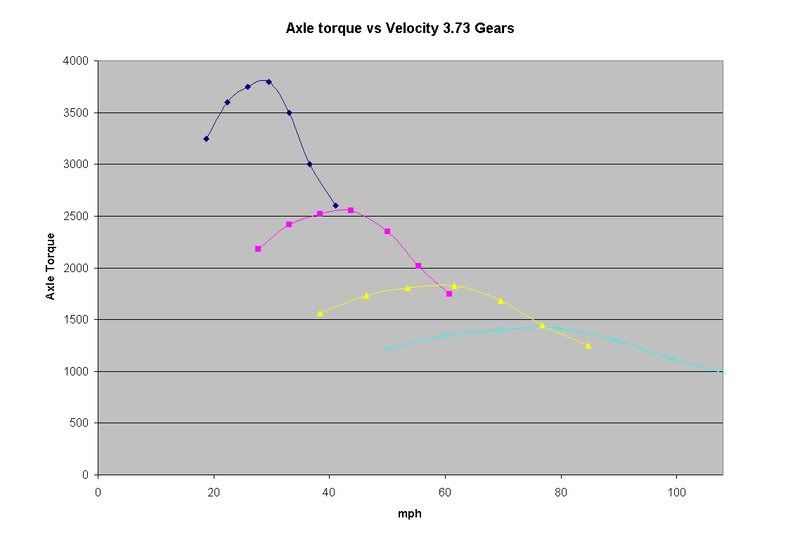
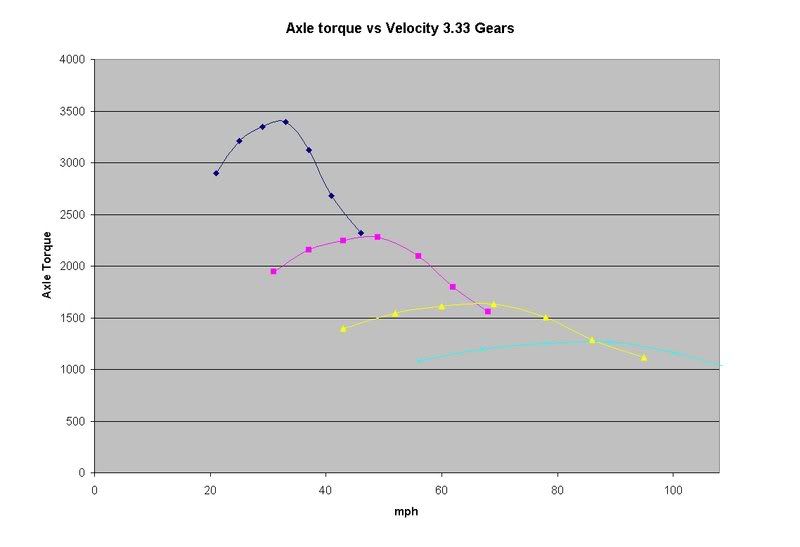
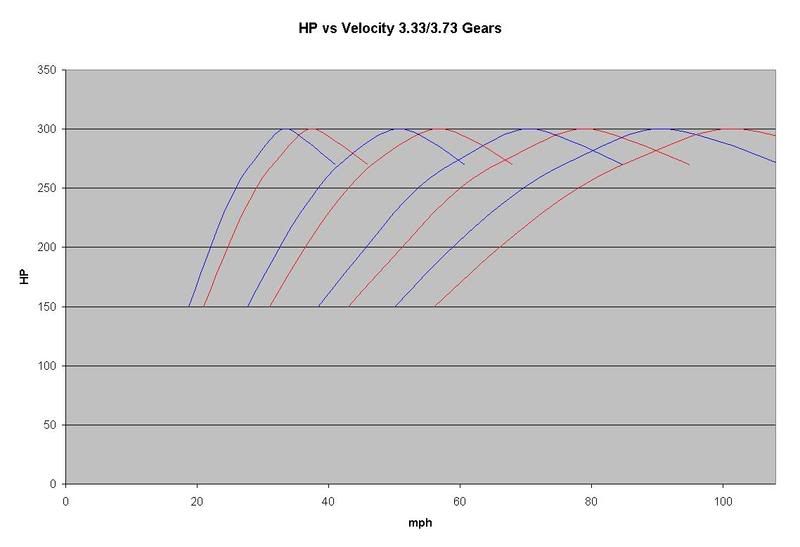
As you can see from the last plot, the higher numerical gears (in blue) offer a benefit roughly in the first half of each gear, while the lower numerical gears (in red) offer a benefit after the two lines cross. After launch, its basically a wash, except for the last few mph where the lower numerical gears are superior for the speeds shown.
As LT4BUD already correctly indicated: the primary benefit of higher numerical gearing occurs in 1st gear assuming available traction.
I made a bunch of plots for a similar thread in order to illustrate the effects of gearing on torque and horsepower as a function of vehicle speed.
Hopefully these still make sense and are legible.
As you can see from the last plot, the higher numerical gears (in blue) offer a benefit roughly in the first half of each gear, while the lower numerical gears (in red) offer a benefit after the two lines cross. After launch, its basically a wash, except for the last few mph where the lower numerical gears are superior for the speeds shown.
As LT4BUD already correctly indicated: the primary benefit of higher numerical gearing occurs in 1st gear assuming available traction.
Last edited by tequilaboy; May 10, 2009 at 12:55 AM.
Safety Car
Joined: Sep 2000
Posts: 3,524
Likes: 4
From: Hinckley Ohio
As you can see from the last plot, the higher numerical gears (in blue) offer a benefit roughly in the first half of each gear, while the lower numerical gears (in red) offer a benefit after the two lines cross. After launch, its basically a wash, except for the last few mph where the lower numerical gears are superior for the speeds shown.
As LT4BUD already correctly indicated: the primary benefit of higher numerical gearing occurs in 1st gear assuming available traction.
 Thank you...
I made these exact same plots for my car from my actual dyno tests..they looked very similiar to your illustation when I compared my original 3.45 gears to my 4.10 gears..
It is always going to be true..
BTW your plot also very clearly shows the optimum shift points to maximize power
Last edited by LT4BUD; May 10, 2009 at 07:15 AM.

Le Mans Master

Joined: Dec 2002
Posts: 5,270
Likes: 3
From: Seattle Area WA
TequilaBoy, are you using rwtq*rear gear ratio*transmission ratio for rear axle torque?
I like the second graph, HP v Velocity, I'll have to check that out.
I use the same thing to find shift points, but use rwtq*rear gear ratio*transmission gear ratio*tire diameter to find the driving force at 100% traction you are putting to the ground.
I've been wondering if using my driving force at the wheels normalized to a chosen vehicle weight will allow for quick and dirty estimations of various vehicles performance.
I've also noted that once you significantly increase the horsepower of almost any car I've analyzed (lotus, corvettes, camaros, mustangs, minis) the shift graph becomes significant because as you increase your upper RPM ability/power the torque multiplication of the previous gear becomes so substantial shifting is dictated by redline.
I like the second graph, HP v Velocity, I'll have to check that out.
I use the same thing to find shift points, but use rwtq*rear gear ratio*transmission gear ratio*tire diameter to find the driving force at 100% traction you are putting to the ground.
I've been wondering if using my driving force at the wheels normalized to a chosen vehicle weight will allow for quick and dirty estimations of various vehicles performance.
I've also noted that once you significantly increase the horsepower of almost any car I've analyzed (lotus, corvettes, camaros, mustangs, minis) the shift graph becomes significant because as you increase your upper RPM ability/power the torque multiplication of the previous gear becomes so substantial shifting is dictated by redline.

Racer

Joined: May 2005
Posts: 497
Likes: 1
From: Casa Grande Az
To the OP:
If you want max bang for the buck , ditch the 2.59's and slap in a used 3.07 diff. They are cheap and pretty easy to install.
I did exactly that a few months ago and its a world of difference.
If you want to take it to the next level, drop the tranny and get ahold of a nice high stall torque converter (retain lockup feature) and it becomes an animal off the line.
If you want max bang for the buck , ditch the 2.59's and slap in a used 3.07 diff. They are cheap and pretty easy to install.
I did exactly that a few months ago and its a world of difference.
If you want to take it to the next level, drop the tranny and get ahold of a nice high stall torque converter (retain lockup feature) and it becomes an animal off the line.
Melting Slicks
Joined: Aug 2003
Posts: 3,401
Likes: 397
From: Lakeville MI
The original torque vs rpm data came from a post by razor 89. I didn't bother to dig up the old post.
The values appear to be engine torque.
rpm torque
2500 325
3000 360
3500 375
4000 380
4500 350
5000 300
5500 260
The axle torque was obtained by multiplying torque*trans_gear_ratio*differential ratio for the 1st four gears of a ZF6 transmission.
The values appear to be engine torque.
rpm torque
2500 325
3000 360
3500 375
4000 380
4500 350
5000 300
5500 260
The axle torque was obtained by multiplying torque*trans_gear_ratio*differential ratio for the 1st four gears of a ZF6 transmission.
Last edited by tequilaboy; May 11, 2009 at 09:51 AM.
Le Mans Master
Joined: Dec 2002
Posts: 5,270
Likes: 3
From: Seattle Area WA

Drifting


Joined: Sep 2002
Posts: 1,642
Likes: 0
From: Suwanee,Ga
Which goes back to the core question: what gears, for a stock LT1/A4 combination, maximizes RWHP?
Ok. As someone else said, choose the highest RPM I'm willing to tolerate at 70MPH, and go from there... which, in my case, would be 2400-2500 RPM, at 70. Going backwards from there, this yields a 3.73 gearset.
However, I'm still curious... as to whether there is an optimum gearset that maximizes RWHP, specifically... In other words, IF I have a 3.55 gearset in my car, and yield... (for the sake of argument) 235 RWHP, will the installation of a 3.73 gearset increase or decrease that peak number?
I know, I know.... it's kind of an esoteric question, but I would have guessed that this would be a very attractive puzzle for the mechanical engineers on the forum...
Ok. As someone else said, choose the highest RPM I'm willing to tolerate at 70MPH, and go from there... which, in my case, would be 2400-2500 RPM, at 70. Going backwards from there, this yields a 3.73 gearset.
However, I'm still curious... as to whether there is an optimum gearset that maximizes RWHP, specifically... In other words, IF I have a 3.55 gearset in my car, and yield... (for the sake of argument) 235 RWHP, will the installation of a 3.73 gearset increase or decrease that peak number?
I know, I know.... it's kind of an esoteric question, but I would have guessed that this would be a very attractive puzzle for the mechanical engineers on the forum...
No.
The RWHP is what it is.
The gear is a mechanical lever that will provide less terminal velocity in favor of quicker acceleration.
TJM
Thread Starter
Pro
Joined: Feb 2004
Posts: 564
Likes: 0
From: Pittsburgh PA
I love gear threads.
As you can see from the last plot, the higher numerical gears (in blue) offer a benefit roughly in the first half of each gear, while the lower numerical gears (in red) offer a benefit after the two lines cross. After launch, its basically a wash, except for the last few mph where the lower numerical gears are superior for the speeds shown.
As LT4BUD already correctly indicated: the primary benefit of higher numerical gearing occurs in 1st gear assuming available traction.
As you can see from the last plot, the higher numerical gears (in blue) offer a benefit roughly in the first half of each gear, while the lower numerical gears (in red) offer a benefit after the two lines cross. After launch, its basically a wash, except for the last few mph where the lower numerical gears are superior for the speeds shown.
As LT4BUD already correctly indicated: the primary benefit of higher numerical gearing occurs in 1st gear assuming available traction.

A pic is worth a thousand words.... Thanks for the chart, VERY informative...
