


"Race" LT4 burning oil... Experts help!

Thread Starter
Race Director


Joined: Jul 2003
Posts: 12,742
Likes: 43
From: Color my life with the chaos of trouble.
 "Race" LT4 burning oil... Experts help!
I have a carbureted 383ci LT4 with a problem. The engine runs great, but burns oil and the spark plugs always have a good coating of oil in them when I pull them out. I have done a compression check and all 8 are almost identical. The stock PCV system is gone with a breather/catch can system in it's place. I pulled the valve covers and everything looks like the day it was new. I have a pancake type adapter on the filter that feeds an oil cooler and a 3qt Moroso sump. I can't really think of much else that could contribute to it...
Do any of you engine gurus have any ideas of what could be causing this?
Thanks in advance
Do any of you engine gurus have any ideas of what could be causing this?
Thanks in advance
Race Director


Joined: Apr 2003
Posts: 17,700
Likes: 1,667
From: moraga ca
For years I had an oiling problem with a 383 I was running. When I did the conversion, I modified a dipstick to fit a 70's style block. I ended up running with an oil level too high. The incorrect marking along with the added stroke of the crank caused the crank to throw up too much oil overpowering the oil rings. Went through a couple engines until I figured this out. Try running a half quart less oil.
Le Mans Master

Joined: Dec 2004
Posts: 5,488
Likes: 1,352
A cyliner leak down test, it deals with how well the cylinder is sealing and nothing else. The readings are not affected by carbon deposits, cam timing, or even engine cranking speed. This is what I would do next. It is not uncommon for a typical 383 to use oil though.
Thread Starter
Race Director
Joined: Jul 2003
Posts: 12,742
Likes: 43
From: Color my life with the chaos of trouble.
For years I had an oiling problem with a 383 I was running. When I did the conversion, I modified a dipstick to fit a 70's style block. I ended up running with an oil level too high. The incorrect marking along with the added stroke of the crank caused the crank to throw up too much oil overpowering the oil rings. Went through a couple engines until I figured this out. Try running a half quart less oil.
A cyliner leak down test, it deals with how well the cylinder is sealing and nothing else. The readings are not affected by carbon deposits, cam timing, or even engine cranking speed. This is what I would do next. It is not uncommon for a typical 383 to use oil though.
Melting Slicks


Joined: Dec 2008
Posts: 2,772
Likes: 64
From: Mystic CT
I wonder who started this fantasy about it making the rings seal better.. It de airates the oil and reducing foaming and oil splash by lowering the pressure in the crankcase the air bubbles in return oil and that beat by windage will separate out. A 4 psi change is dramatic for that purpose but in percentage to the pressure on top of the rings during compression or firing part of the cycle is microscopic in effect.

Le Mans Master

Joined: Feb 1999
Posts: 9,946
Likes: 39
From: South Carolina
St. Jude Donor '03 & '05
I agree,low tension rings, just went through this on my 396LT1, now I went from 500-750 a quart to about 1500 miles a quart.
Corvette Stories
The Best of Corvette for Corvette Enthusiasts

Every 2027 Corvette Engine Explained
Joe Kucinski
Designer Imagines A Corvette That Looks More Like a Corvette Than the Corvette
Verdad Gallardo
10 Ugly Corvettes That We Still Kinda Love
Joe Kucinski
Top 10 Most Expensive Corvettes Ever Sold on Bring A Trailer
Brett Foote
10 Things Every Corvette Owner Needs (2026 Edition)
Michael S. Palmer
8 Most "Only Corvette Owners Understand" Quirks and Problems
Pouria Savadkouei
10 Reasons the C6 Z06 is Still A Performance Benchmark After 20 Years
Joe Kucinski
How Much Horsepower Every Corvette Engine "LOST" in 1972
Joe Kucinski
Top 10 DOs and DON'Ts for Protecting Your Convertible Top!
Michael S. Palmer
Le Mans Master
Joined: Aug 2000
Posts: 8,838
Likes: 31
From: Australia
Got a good windage tray?

Safety Car

Joined: Sep 2001
Posts: 4,160
Likes: 554
From: Glenbeulah Wi
I wonder who started this fantasy about it making the rings seal better.. It de airates the oil and reducing foaming and oil splash by lowering the pressure in the crankcase the air bubbles in return oil and that beat by windage will separate out. A 4 psi change is dramatic for that purpose but in percentage to the pressure on top of the rings during compression or firing part of the cycle is microscopic in effect.
Le Mans Master

Joined: Oct 2004
Posts: 5,841
Likes: 19
From: CLT, North Carolina
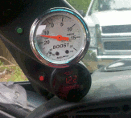
If the engine is using oil something is not right with the ring package or in how the rings fit the pistons. It is also possible you have bore distortion in the upper cylinder region due to a discrepancy between torque plate loading when the block was honed and your final cylinder head torque. Differences in head gaskets used for honing and final assembly affect cylinder bore distortion quite a bit also. Low tension Oil rings should be combined with a Napier style 2nd ring. The best low tension oil ring is the U-Flex one-piece segmented 1.5MM or 2MM oil ring from Mahle. The main purpose of a vacuum pump is to reduce crankcase pressure below atmospheric pressure which frees up some horsepower which would otherwise be consumed by pumping loss from piston movement pumping air around inside. Good competition engines require very efficient ring sealing to restrict blowby which permits running a very high crankcase vacuum. Staying with a proven standard piston/ piston ring set-up and working on the cylinder heads and manifold is by far where the most gains for the money will be found rather than investing in the latest trick deal. Someone once said tricks are for kids.
Last edited by Greg Gore; Oct 15, 2009 at 12:49 PM.
Team Owner

Joined: Mar 2001
Posts: 30,858
Likes: 293
From: Boston, Dallas, Detroit, SoCal, back to Boston MA
For years I had an oiling problem with a 383 I was running. When I did the conversion, I modified a dipstick to fit a 70's style block. I ended up running with an oil level too high. The incorrect marking along with the added stroke of the crank caused the crank to throw up too much oil overpowering the oil rings. Went through a couple engines until I figured this out. Try running a half quart less oil.

Thread Starter
Race Director
Joined: Jul 2003
Posts: 12,742
Likes: 43
From: Color my life with the chaos of trouble.
I was finally able to get in touch with the engine builder and what I got was this. They are pretty sure that it was built with no exhaust valve seals. I've done some looking around on different websites and it seems like a lot of "race" engines are built this way and it is often responsible for smoke at startup (which I have) as well as some oil consumption at high r.p.m. (which I certainly turn).
They weren't 100% sure after the amount of time since they built it so I'm planning on pulling the valve covers again and giving a look to verify that it really doesn't have them.
He was also pretty sure that it was built with low tension JE rings but wasn't 100% on that either. The combination of the 2 could add up to a decent amount of oil being burned. I don't think I mentioned before that I am generally going through about a quart every 2 hours or so of track time.
Any thoughts/comments on this one. Engine building isn't my specialty and I would love to keep learning more.
They weren't 100% sure after the amount of time since they built it so I'm planning on pulling the valve covers again and giving a look to verify that it really doesn't have them.
He was also pretty sure that it was built with low tension JE rings but wasn't 100% on that either. The combination of the 2 could add up to a decent amount of oil being burned. I don't think I mentioned before that I am generally going through about a quart every 2 hours or so of track time.
Any thoughts/comments on this one. Engine building isn't my specialty and I would love to keep learning more.
Melting Slicks
Joined: Dec 2008
Posts: 2,772
Likes: 64
From: Mystic CT
I was finally able to get in touch with the engine builder and what I got was this. They are pretty sure that it was built with no exhaust valve seals. I've done some looking around on different websites and it seems like a lot of "race" engines are built this way and it is often responsible for smoke at startup (which I have) as well as some oil consumption at high r.p.m. (which I certainly turn).
They weren't 100% sure after the amount of time since they built it so I'm planning on pulling the valve covers again and giving a look to verify that it really doesn't have them.
He was also pretty sure that it was built with low tension JE rings but wasn't 100% on that either. The combination of the 2 could add up to a decent amount of oil being burned. I don't think I mentioned before that I am generally going through about a quart every 2 hours or so of track time.
Any thoughts/comments on this one. Engine building isn't my specialty and I would love to keep learning more.
They weren't 100% sure after the amount of time since they built it so I'm planning on pulling the valve covers again and giving a look to verify that it really doesn't have them.
He was also pretty sure that it was built with low tension JE rings but wasn't 100% on that either. The combination of the 2 could add up to a decent amount of oil being burned. I don't think I mentioned before that I am generally going through about a quart every 2 hours or so of track time.
Any thoughts/comments on this one. Engine building isn't my specialty and I would love to keep learning more.
Thread Starter
Race Director
Joined: Jul 2003
Posts: 12,742
Likes: 43
From: Color my life with the chaos of trouble.
Do you really think a car that runs the 24 hours of Daytona goes through 3 gallons of oil? Measure the blowby and you will find the problem. At WOT there is no vacuum to pull oil down the guides but cylinder pressure is high so if it is rings it will get real bad there. Do all 8 plugs come up oil fouled might be a first test. Second if the engine is into mild detonation it will rattle the rings and will burn oil, is TDC marked correctly and timing set at a sensible value? What do you have for a crankcase breather system is there one in the pan as well as the covers if wet sump? Is the pan overfilled if so you are screwed. What is the oil temp if to the moon you will not be able to pour it in fast enough. The crankcase vacuum pump is at the right side of the decimal point in the end and not the fix all if everything else is right. I have run a 410 with 18 degree heads at Daytona and other tracks it makes about 770 hp in one config and 740 in the second engine for shorter tracks it does no burn oil at all and wins and has no vacuum pump either. It is all about cylinder wall prep ring package and proper scavenge of oil they are both dry sumped and a big plus. If I was a betting man though not would put my money on a poorly fitted ring package too much piston to wall clearance or poorly fininshed cylinder walls if all 8 plgs dirty if just some might bet on intake gaskets or valve seals.
I am all but certain that it is not a cylinder wall/build issue or something of that nature. The shop that built the engine is as good as they come and I find it highly unlikely that it would be something like that coming from them. The more that I research, the more I am thinking that it could be something as simple as being too full. I usually start with it right at the top of the full line with an external cooler and an accusump to boot. The stroker crank isn't helping in this regard. It does run hot ~260 degrees even with the cooler, water temps ~220 (not that it matters) although from what I can tell that isn't TOO hot. All 8 plugs look identical and compression is ~2% in all cylinders. I haven't done a leak down test yet, so that will help tell a little more...
At this point I'm hoping that it could be something as simple as the low tension rings mixed with keeping it a little too full, or possibly valve seals which I can fix with the engine where it is right now.
On a related note, I have a question with the accusump. With the 3qt accusump in the loop, how does that affect the situation if it is a quart or so low in the pan? Does it add some security in that situation?
Le Mans Master
Joined: Oct 2004
Posts: 5,841
Likes: 19
From: CLT, North Carolina
A compression test or a leakdown test are OK for looking for bent valves from not enough piston to valve clearance or something but they will not be sensitive enough to point to the cause for high oil consumption in an engine that has not had time to have excessive wear yet.
You cannot blow that much oil through the valve guides unless the shop knurled the guides and they wore excessively which always happens with knurling.
With all due respects to your shop there is a high likelyhood there is something wrong with the rings. You don't install low tension oil rings unless you are on top of your game and you know you have oil control. Otherwise why wouldn't the OEM install them? Every hand would go up for more HP and better fuel economy.
You cannot blow that much oil through the valve guides unless the shop knurled the guides and they wore excessively which always happens with knurling.
With all due respects to your shop there is a high likelyhood there is something wrong with the rings. You don't install low tension oil rings unless you are on top of your game and you know you have oil control. Otherwise why wouldn't the OEM install them? Every hand would go up for more HP and better fuel economy.
